Budget Travel Guide to the August 2026 Total Solar Eclipse in Spain

Key Highlights
- 1
- 2
- 3
+5 more in the takeaways below
On August 12, 2026, a total solar eclipse will cross Spain, and you don't need a big budget to see it. A 300-kilometer-wide shadow will race from A Coruna to Palma de Mallorca, turning day into dusk for up to 1 minute 48 seconds. Spain hasn't witnessed totality since 1905.
Organized eclipse tours charge $5,000 to $12,000 per person. Hotel prices in cities like Leon have already tripled. Here's why the $10,000 eclipse tours are such poor value: you need a train ticket, a plan, and this guide.
The August 12, 2026 total solar eclipse crosses northern Spain from the Atlantic coast to the Balearic Islands. Totality hits between 8:27 PM and 8:32 PM local time, lasting up to 1 min 48 sec depending on location. Budget strategy: fly into Madrid (roundtrip from the US ~$492), take a high-speed train to Zaragoza (from ~€9, 75 minutes) for the best clear-sky odds, or to Leon (~€19, 2 hours) for the longest totality. Book trains and accommodation now. Bring ISO 12312-2 certified eclipse glasses. Scout your viewing spot for a clear western horizon.
What You're Actually Looking At: Eclipse Basics for August 12, 2026
A total solar eclipse happens when the moon passes directly between Earth and the sun, blocking sunlight completely along a narrow strip called the path of totality. On August 12, 2026, that strip will cross northern Spain from the Atlantic coast of Galicia to the Mediterranean, sweeping over the Balearic Islands before ending at sunset. According to TimeAndDate, totality in Spain occurs between approximately 8:27 PM and 8:32 PM local time (CEST), with the sun sitting just 2 to 12 degrees above the western horizon.
This is Spain's first total solar eclipse in over 120 years and Europe's first since 1999. The maximum totality duration anywhere on the planet is 2 minutes 18 seconds, but in Spain you'll get up to 1 minute 48 seconds - depending on where you stand.
The low sun angle is both a blessing and a challenge. You'll see the corona glowing against a twilight sky, which eclipse veterans describe as one of the most dramatic viewing scenarios possible. But it means you absolutely need an unobstructed western horizon. A building, a hill, even a row of trees in the wrong spot will steal the moment from you.
The sun will be just 2-12 degrees above the western horizon during totality. Scout your viewing location in advance and check what's between you and the west. Coastal promenades, hilltops, and open fields facing west are your best options. Rooftops work too, if you can access one.
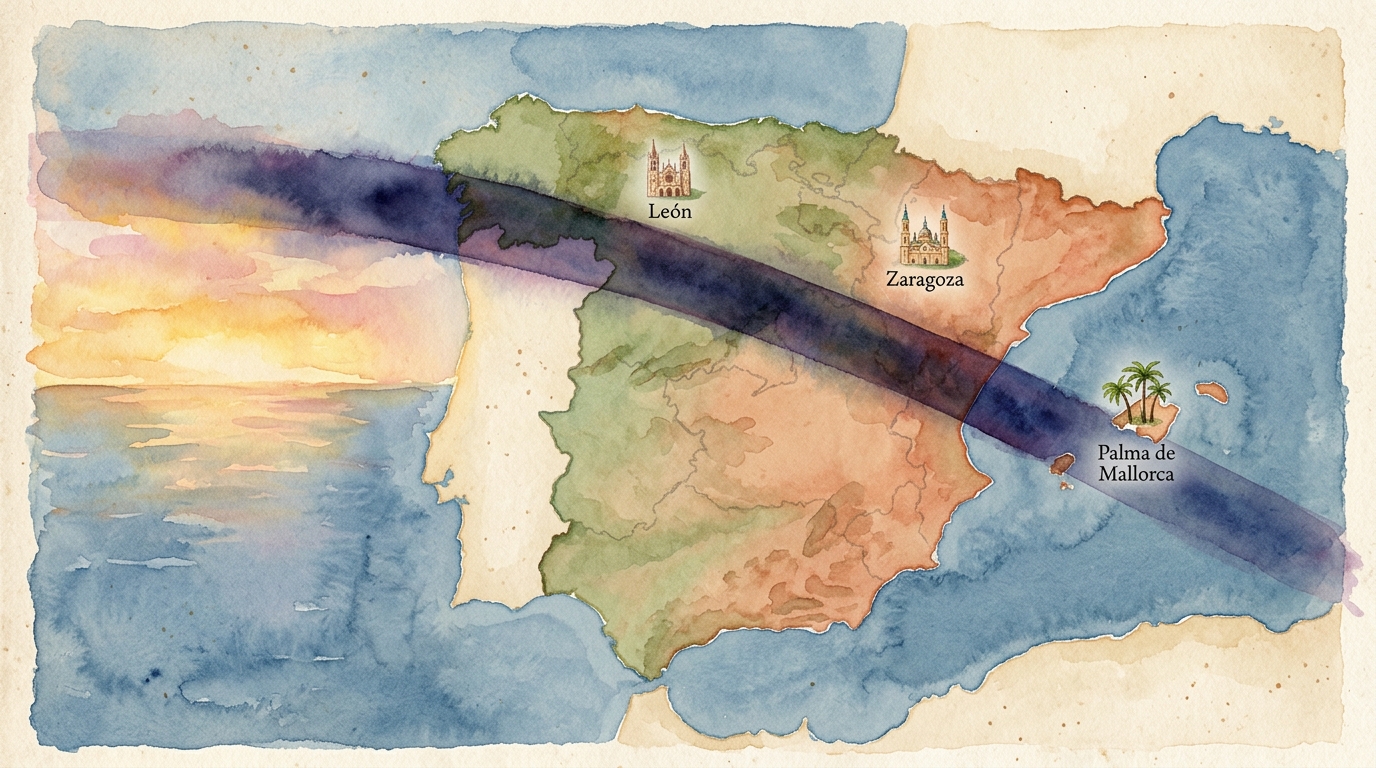
City-by-City Budget Breakdown: Where to Watch and What It Costs
Not all cities in the path of totality are equal. They differ in totality duration, weather odds, transport access, and price. Here's the honest comparison nobody else is putting together, using NationalEclipse.com totality data and Eclipsophile weather analysis.
| City | Totality | Clear Sky Odds | Train from Madrid | Budget Rating |
|---|---|---|---|---|
| Zaragoza | 1m 24s | ~70%+ Best | 75 min (AVE, from €9) | $$ |
| Leon | 1m 45s | ~70% | 2-3 hrs (from €19) | $$$ |
| Oviedo | 1m 48s | ~40% Risky | 4.5 hrs (train+bus) | $$$ |
| Burgos | 1m 45s | ~65% | 2.5 hrs (from €15) | $$ |
| Bilbao | ~30s | ~40% Risky | Direct flight/5 hrs train | $$$ |
| A Coruna | 1m 16s | ~40% Risky | 5-6 hrs (train/bus) | $$ |
| Valencia | 1m 00s | ~75% | 1.5 hrs (AVE, from €10) | $$ |
| Palma de Mallorca | 1m 36s | ~75% Great | Flight required | $$$ |
The takeaway: Zaragoza is the budget-weather sweet spot. It has the best clear-sky probability in Spain for this eclipse (Eclipsophile data shows the Ebro Valley around Zaragoza has less than 30% cloud probability), a fast and cheap high-speed rail connection from Madrid, and it won't have the astronomical hotel prices of Leon or the cloud-cover anxiety of the northern coast. The tradeoff: 1 minute 24 seconds of totality instead of 1 minute 48 seconds in Oviedo.
Bilbao is a trap for budget travelers chasing the eclipse specifically. It sits at the edge of the totality band with only 29 seconds of totality, has roughly 60% cloud risk in August, and flights are pricier than Madrid. It's a wonderful city, but not where you want to base your eclipse trip.
Valencia deserves a closer look. It gets just 1 minute of totality, which sounds short, but pair it with a roughly 75% clear-sky probability, a fast AVE connection from Madrid (around 1.5 hours, fares from €10), and Mediterranean beaches, and it becomes a strong contender for travelers who want the eclipse plus an actual vacation. The city's wide coastal promenades also solve the western-horizon problem nicely.
Burgos is the underrated pick. At 1 minute 45 seconds of totality, it's nearly as long as Leon, but with cheaper accommodation and easier access from Madrid (2.5 hours by train). The city sits on the Meseta Central plateau with roughly 70% August sunshine probability, and its Gothic cathedral makes for a memorable backdrop to an eclipse day trip. If the hotel booking situation in Leon feels hopeless, Burgos is where you pivot.

The Madrid Base Camp Strategy
Here's why the $10,000 eclipse tours are such poor value: Madrid is the cheapest major airport in Spain for transatlantic flights, it's the hub of the country's high-speed rail network, and it sits just 75 minutes by AVE from Zaragoza. Going.com reports roundtrip flights from the US to Madrid averaging $492, compared to $484 for Bilbao and $514 for Palma de Mallorca. The savings on flights are modest, but the real value is in Madrid's accommodation: far more supply, no eclipse premium, and hostel beds that won't cost you a week's salary.
The plan is simple. Fly into Madrid. Stay in Madrid. Take a day trip to the path of totality on August 12.
- Book your Madrid accommodation early Choose a hotel or hostel near Atocha or Chamartin station. Madrid isn't in totality (it gets 99.9% partial coverage), so hotel prices won't spike the way they have in Leon and Zaragoza.
- Buy your AVE train ticket the moment bookings open Trainline shows Madrid-Zaragoza fares starting from €9 on OUIGO and Avlo low-cost services. The ride takes 75 minutes. Madrid-Leon starts from around €19 and takes 2-3 hours. These prices are advance fares and will skyrocket closer to the date.
- Take the morning train out Arrive in your chosen city by noon. Explore, eat, and scout your western-horizon viewing spot while the sun is still high.
- Watch totality (around 8:28-8:31 PM) The partial phase starts about an hour before. Be settled with your eclipse glasses at least 30 minutes early.
- Catch the last train back The last Zaragoza-Madrid train departs at approximately 21:49. Totality in Zaragoza ends around 8:30 PM, giving you roughly 80 minutes to get to the station. For Leon, check late departures carefully as the last train may leave earlier.
This entire day trip costs under €50 in transport if you book early. Compare that to a Leon hotel room that accommodation sites like Leon Apartamentos are listing at €600-900+ for the night of August 12.
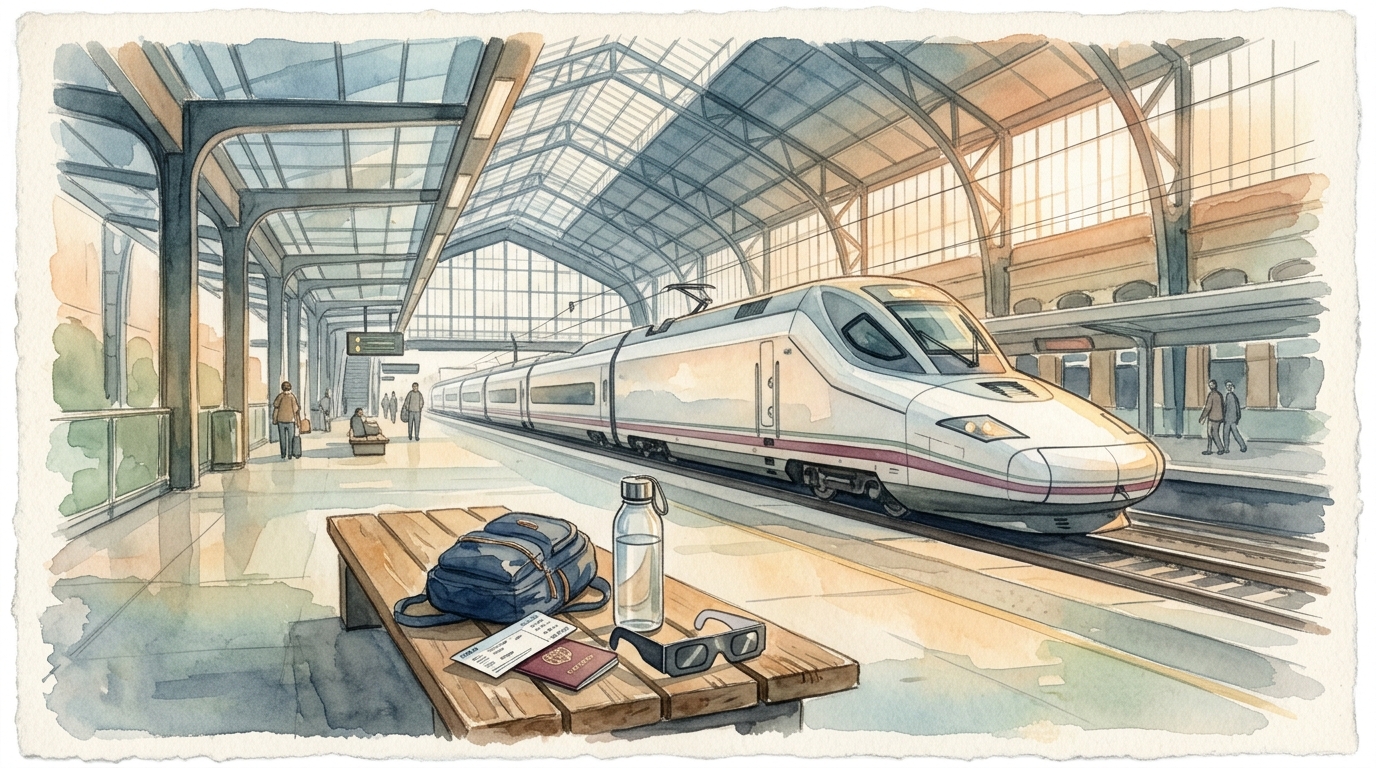
The Cloud-Hedge Mobility Plan
Eclipse veterans have a saying: you can't negotiate with clouds. The difference between an overcast sky and a clear one during totality is the difference between a life-altering experience and a slightly spooky dimming of the light. Northern Spain's Atlantic coast has roughly 60% cloud cover probability in August. If you've committed to Oviedo or A Coruna and clouds roll in, you're out of luck.
Budget travelers need a mobility plan. Veterans of the 2024 Texas eclipse reported that cloud-chasing by car paid off, with many driving 100+ kilometers on eclipse day to find a gap in the clouds. Here's one that works for Spain.
Check weather forecasts obsessively starting five days before the eclipse. The Spanish meteorological agency AEMET provides highly accurate 3-day forecasts. If your primary city looks cloudy, have a backup. The key insight: weather patterns in Spain are regional. The northern Atlantic coast (Galicia, Asturias, Cantabria, Basque Country) can be socked in while the Ebro Valley (Zaragoza, Huesca) bakes under blue skies just 200 kilometers south.
If you're already in Madrid, you have three escape routes via high-speed rail:
- Zaragoza (75 min AVE): best odds, easiest pivot
- Valencia (1.5 hrs AVE): Mediterranean coast, good weather
- Leon/Burgos (2-3 hrs): longer totality, decent Meseta weather
The cost of flexibility is having a second train ticket on standby. At €9-20 each way for advance fares, that insurance policy is cheaper than a single drink at most eclipse viewing events.
Book refundable or flexible train tickets if possible. Renfe's "Elige" fare class allows changes for a small fee. If you're using OUIGO or Avlo for the cheapest prices, buy tickets to two different cities and accept you'll eat one as a sunk cost. A €9 wasted ticket is nothing compared to missing totality.
If you're already based in northern Spain and want the flexibility to chase clear skies, renting a car gives you the most options. Roads will be congested after the eclipse ends, though. Veterans of the 2017 Oregon and 2024 Texas eclipses report multi-hour traffic jams on highways near the path of totality. If you drive, plan to stay overnight rather than fighting the post-eclipse exodus.
The transport gridlock risk in Spain is real but solvable. Trains run on fixed schedules and aren't affected by road traffic. That's another reason the Madrid base camp approach works so well: you're on rail, not road.
The key risk is that trains sell out entirely. Renfe, OUIGO, Avlo, and iryo all operate on the Madrid-Zaragoza corridor, which means 26+ daily services. But every eclipse chaser who reads a guide like this one will be targeting those same trains. The earlier you book, the better your odds of getting a seat at the cheapest fare.

Accommodation: From Campsites to the Festival Loophole
The accommodation situation is already painful. Idealista reports that rural accommodation searches along the path of totality have surged by 830% compared to last year, with some inland provinces seeing demand increase fivefold to tenfold. Airbnb's own data shows rural bookings along the eclipse path have more than tripled year-on-year. In Palencia, a room for eclipse night has climbed to as much as €1,095, more than ten times normal rates.
In Palencia, a single room for eclipse night has climbed to €1,095, more than ten times normal rates.
Here's what's still realistic on a budget:
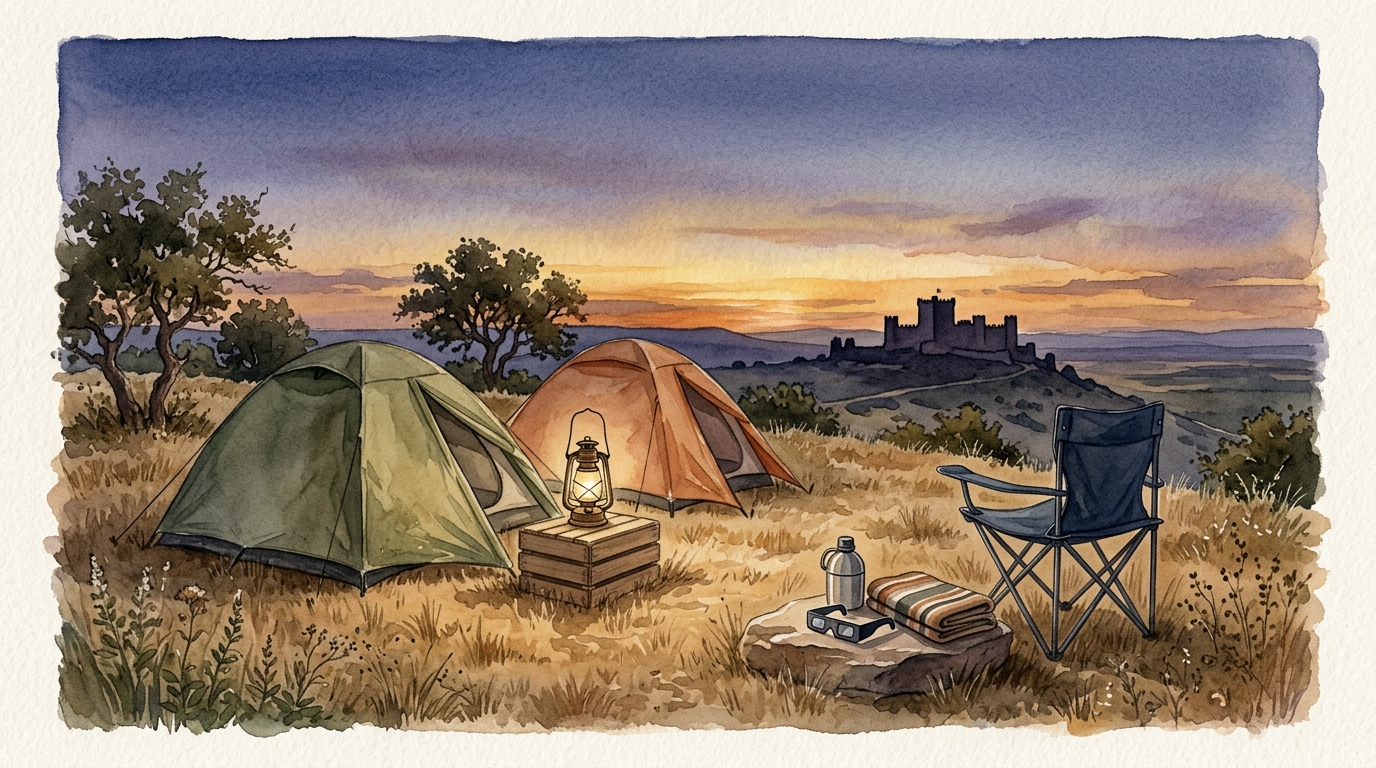
Camping. Camping Riberduero near Penafiel (Valladolid) has organized a dedicated eclipse event at the castle of Penafiel, with bungalows for 2 from €1,500 (August 10-14) and camping pitches still available. That's steep for a campsite, but it includes 4 nights and the venue. The broader JetCamp directory lists campsites across the path of totality, with many standard pitches in the €20-40/night range if you can still find availability.
The festival option. The Astral Plane Festival runs August 10-12 at La Pinilla ski resort near Segovia, roughly an hour from Madrid. Tickets start at €165 (~$192) and include camping, three stages of music, and a ski-lift ride to a mountaintop viewing platform. Kevin Saunderson headlines. For a three-day festival with accommodation included - and a mountaintop eclipse viewing platform - that's genuinely good value.
Stay outside the path. Madrid, Valladolid, and Salamanca all have normal accommodation pricing because they're outside (or at the edge of) totality. A hostel bed in Madrid runs €15-25/night year-round. Combine that with the day-trip strategy above, and your total accommodation cost for a week in Spain could be under €150.
Rural casas rurales. Spain's rural guesthouse network is extensive, and many properties along the edges of the path haven't yet caught on to eclipse pricing. Search for "casa rural" listings in smaller towns within 30 minutes of the centerline. Provinces like Soria, Navarra, and La Rioja still have options if you dig beyond the first page of results. The Idealista eclipse planning guide recommends booking outside the most obvious cities and using regional trains or a rental car for the final stretch.
You will lose roads and services in the hours before and after. Book accommodation near your viewing site or plan to sleep in your car.
Eclipse veteran on r/solareclipse, recounting the 2017 Oregon experience
If you're planning a longer trip, Spain in August offers plenty beyond the eclipse. The northern coast is gorgeous for a coolcation-style escape with temperatures far gentler than the scorching south. where to spend Christmas 2026 instead Tools like TripProf can help you build a personalized itinerary that weaves the eclipse into a broader Spain trip, so you're not just flying in for two minutes of darkness.
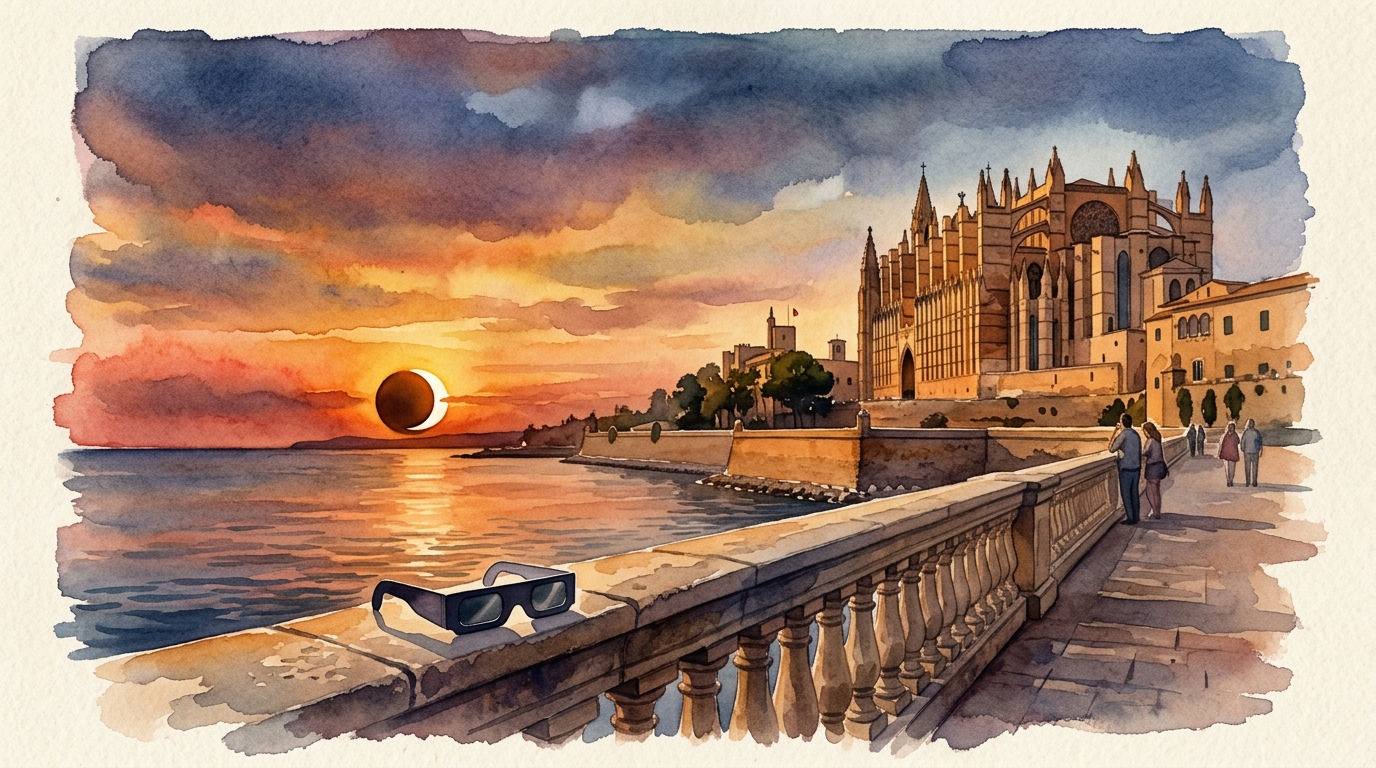
The Palma Sunset Eclipse: Budget Splurge Worth Considering
Palma de Mallorca is the wild card. TimeAndDate data shows totality hitting at 8:31 PM with the sun just 2.5 degrees above the western Mediterranean horizon. Sunset follows at roughly 8:50 PM. You'll watch the sun's corona hovering over the sea in twilight colors. Eclipse photographers call this scenario a "sunset eclipse", and it's among the rarest and most visually dramatic configurations possible.
The catch: Palma is pricier to reach. Going.com data shows average roundtrip flights from the US at $514, roughly $20 more than Madrid. August is peak season in Mallorca, so accommodation won't be cheap regardless of the eclipse. But Mallorca has a major advantage: roughly 75% chance of clear skies in August, making it one of the safest weather bets along the entire path.
Budget angle: low-cost carriers Ryanair and Vueling fly Madrid-Palma for as little as €20-40 one way if booked months ahead. A two-night Mallorca side trip after basing yourself in Madrid could cost under €200 for flights and a hostel. If you're already in Europe and can fly from a budget hub like London, Berlin, or Rome, Palma becomes much more accessible. Just watch the baggage fees on low-cost carriers: a checked bag can double the ticket price if you're not careful.
Visit Palma recommends the west-facing seafront promenade, the Bellver castle area (high ground, wide views), and the West Breakwater as prime viewing spots. All are free and public.
What to Bring and What Not to Forget
Eclipse day in Spain means August heat. Expat Explore notes daytime temperatures in northern Spain typically reach 25-32°C (77-90°F) in August, with inland areas like Zaragoza potentially hitting 35°C+. You'll be standing outside for at least an hour. Prepare accordingly.
- ISO 12312-2 certified eclipse glasses (order from Eclipsafe or Amazon well in advance)
- 2+ liters of water per person
- Sunscreen and a hat (you're standing in August sun until 8:30 PM)
- Phone battery pack (you'll be filming and navigating)
- Advance train tickets (printed or downloaded offline)
- AEMET weather app for real-time cloud tracking
- A light jacket for the temperature drop during totality
Eclipse glasses are non-negotiable for the partial phases before and after totality. During the brief totality itself, you can look at the corona with your naked eyes. The moment you see the sun's bright edge reappear (called the "diamond ring"), glasses go back on immediately. Buy your glasses now, not at the last minute. Counterfeit glasses flood the market before every major eclipse, and glasses that don't meet the ISO 12312-2 standard can cause permanent eye damage. Stick to verified vendors with traceable certification.
If you're planning a first international trip, don't let eclipse excitement make you forget the basics: check your travel documents, sort travel insurance, and get your phone connectivity sorted before you arrive. Spain is in the Schengen zone, so US citizens don't need a visa for stays under 90 days, The EU's ETIAS travel authorization has been delayed to late 2026 at earliest, with a transitional grace period after launch. It's unlikely to be mandatory by August 2026, but check the current status before you travel.
First-Timer Tip: Practice using your eclipse glasses before the day. Know which direction is west from your viewing spot. And resist the urge to spend all of totality looking through your phone camera. Your eyes will see far more detail than any phone sensor. Take a few seconds of video, then put the phone down and look up.

Sample Budget: 5-Night Eclipse Trip to Spain
Here's what a realistic budget eclipse trip looks like for one person flying from the US, using the Madrid base camp strategy and a day trip to Zaragoza. All prices sourced and verified as of early 2026.
| Expense | Budget Estimate | Source |
|---|---|---|
| Roundtrip flight (US to Madrid) | $492 (~€450) | Going.com |
| Madrid hostel (5 nights × €20) | €100 | Hostelworld avg. |
| AVE Madrid-Zaragoza roundtrip | €18-40 | Trainline |
| Eclipse glasses | €5-10 | Eclipsafe |
| Food (5 days × €30) | €150 | Budget dining estimate |
| Local transport + misc | €50 | Metro de Madrid |
| Total | ~€775 ($850) |
That's roughly $850 all-in for five nights in Spain including the eclipse, versus $5,000+ for a guided tour. Even doubling the accommodation budget for a private hotel room keeps you well under $1,200. For travelers already in Europe, drop the transatlantic flight and the total falls to around €325. If you're watching hidden airline fees, you can shave another chunk off the flight cost by flying carry-on only and packing smart.
The expanding European rail network makes this even easier if you're combining the eclipse with a broader trip. Spain's high-speed AVE, plus low-cost operators like OUIGO and Avlo, mean you can reach the path of totality from Madrid for the cost of a decent lunch. If fuel costs are on your mind, our summer 2026 budget guide covers strategies for keeping transport costs down across Europe.

Frequently Asked Questions
What time is the solar eclipse in Spain on August 12, 2026?
Totality occurs between approximately 8:27 PM and 8:32 PM local time (CEST) depending on your location. The partial phase begins about an hour earlier. A Coruna sees totality first at 8:27 PM, while Palma de Mallorca is last at around 8:31 PM. Full timing data is available at TimeAndDate.
Where is the best place to see the 2026 solar eclipse in Spain on a budget?
Zaragoza offers the best combination of clear-sky probability (less than 30% cloud cover), affordable high-speed rail access from Madrid (75 minutes, from €9), and reasonable accommodation. It has 1 minute 24 seconds of totality. For longer totality on a budget, Leon (1 min 45 sec) is reachable by train from Madrid in 2-3 hours from €19, though hotel prices there have inflated significantly.
Can I see the total solar eclipse from Madrid or Barcelona?
No. Madrid gets 99.9% partial coverage and Barcelona gets 99.8%, according to TimeAndDate. That sounds close, but the difference between 99.9% and 100% is enormous. Only total coverage produces the corona, the temperature drop, and the stars appearing. Both cities are excellent bases for day trips to the path of totality.
How long does totality last in Spain?
It varies by location. Oviedo gets the longest at 1 minute 48 seconds, followed by Leon (1 min 45 sec), Burgos (1 min 45 sec), Palma de Mallorca (1 min 36 sec), Zaragoza (1 min 24 sec), A Coruna (1 min 16 sec), and Valencia (1 min), per NationalEclipse.com.
Do I need eclipse glasses for totality?
During the total phase only, it's safe to look at the eclipsed sun with your naked eyes. For every other moment of the eclipse (the partial phases before and after totality), you need ISO 12312-2 certified eclipse glasses. Regular sunglasses are not safe. Remove your glasses only after the last sliver of sun disappears and put them back on the instant you see the "diamond ring" bright edge return.
How do I get from Madrid to the path of totality by train?
Madrid's Atocha and Chamartin stations connect to multiple totality cities. Zaragoza is 75 minutes via AVE/OUIGO/Avlo (from €9). Leon is 2-3 hours (from €19). Valencia is about 1.5 hours by AVE. Burgos is 2.5 hours. Book through Renfe or Trainline as early as possible; eclipse-day trains will sell out.
Where can I camp for the 2026 eclipse in Spain?
The Riberduero Eclipse Event near Penafiel offers camping pitches (bungalows are sold out). JetCamp lists additional campsites across the totality path. Book immediately: demand has increased fivefold to tenfold in some areas, and many sites are already full.
Key Takeaways
- August 12, 2026 brings Spain's first total solar eclipse in over 120 years. Totality crosses from A Coruna to Palma de Mallorca between 8:27-8:32 PM.
- Fly into Madrid ($492 roundtrip from the US) and day-trip by AVE train to the totality path. Zaragoza (75 min, from €9) gives you the best weather odds; Leon (2-3 hrs, from €19) gives you the longest totality.
- Hotel prices in totality cities have tripled to 10x normal. Stay in Madrid (no eclipse premium) and commute in.
- The Ebro Valley (Zaragoza) has less than 30% cloud probability. The northern Atlantic coast has ~60%. Pick accordingly, and have a backup city.
- The Astral Plane Festival near Segovia (€165) and camping at Riberduero (from ~€550 for a pitch) are the main budget alternatives to hotels.
- Buy ISO 12312-2 eclipse glasses now. Scout a viewing spot with a clear western horizon. The sun will be very low (2-12 degrees) during totality.
- A complete 5-night eclipse trip from the US can cost around $850. Tools like TripProf can help you build a personalized Spain itinerary around the eclipse, handling the planning details so you can focus on the sky.
- Book everything now. Train tickets, accommodation, and even campsites are filling up fast. The earlier you lock in prices, the less you'll pay.
Sources
- TimeAndDate: Total Solar Eclipse of August 12, 2026
- Wikipedia: Solar eclipse of August 12, 2026
- NationalEclipse.com: 2026 Total Solar Eclipse City Data
- Eclipsophile: Total Solar Eclipse 2026 August 12 Weather Analysis
- Euronews: Best Places in Spain for the 2026 Total Solar Eclipse
- Going.com: How to Book an Eclipse Trip
- Trainline: Madrid to Zaragoza Train Times and Prices
- Camping Riberduero: Riberduero Eclipse Event 2026
- Astral Plane Festival: Tickets and Event Details
- Idealista: Rural Rentals Surge for August 2026 Solar Eclipse
- Airbnb Newsroom: August's Total Solar Eclipse Shines a Spotlight on Spanish 'Pueblos'
- Idealista: Planning a Solar Eclipse Trip to Spain in 2026
- Visit Palma: Where to View the Solar Eclipse in Palma
- Expat Explore: Solar Eclipse in Spain 2026 Guide
- JetCamp: Camping Total Solar Eclipse 2026 Spain
- Renfe: Spanish National Rail Operator
- TimeAndDate: Eclipse in Spain Overview
- Leon Apartamentos: Total Solar Eclipse Leon 2026
- AEMET: Spanish Meteorological Agency
Last updated: September 19, 2026
Keep Reading
More travel tips and guides picked for you
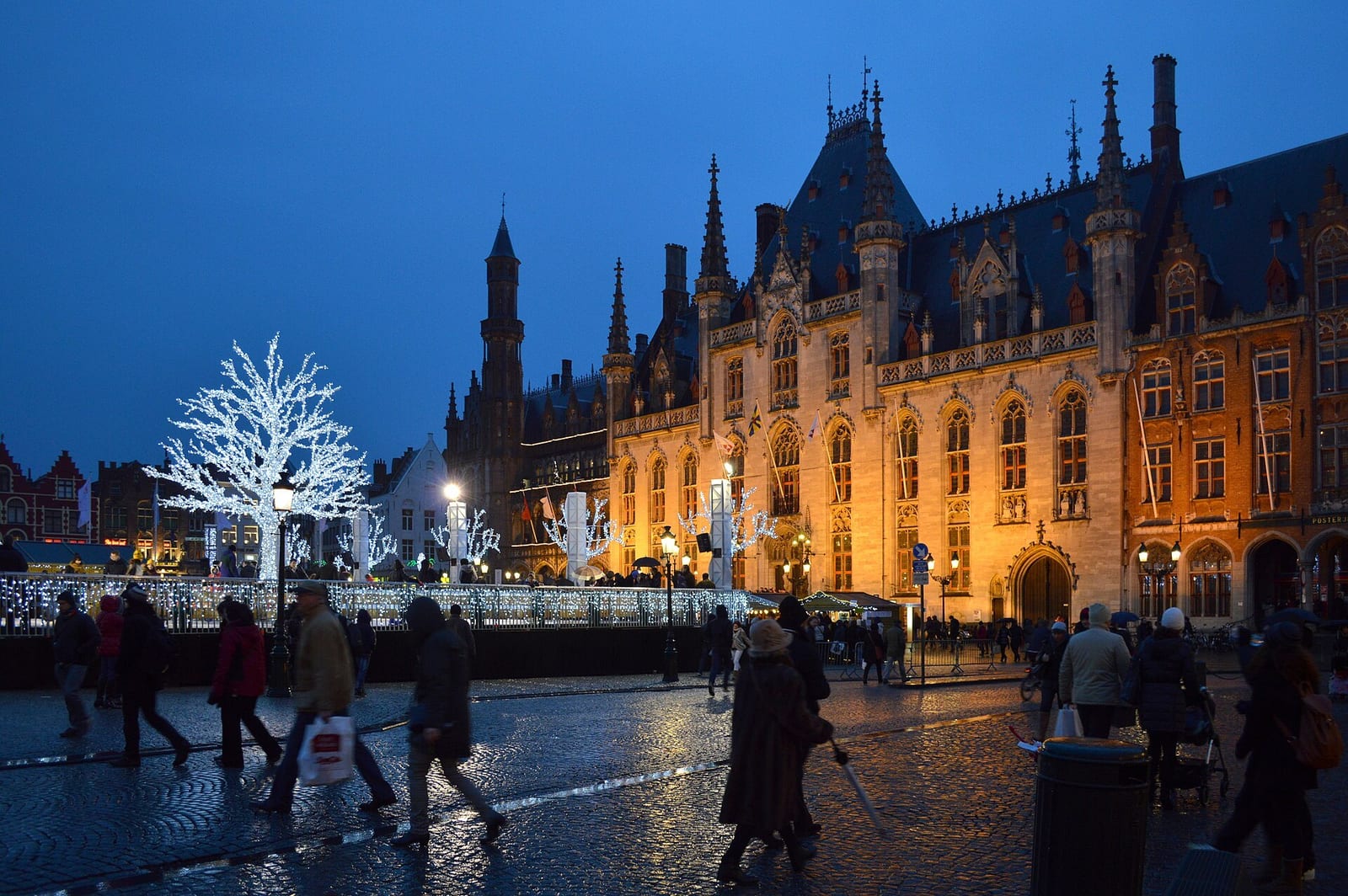
Christmas markets from London by train: what 3 nights really costs per person in 2026
Three nights at a Christmas market from London cost £426 to £704 per person. We priced Eurostar fares, central hotels and food for Lille, Brussels, Bruges and Cologne.
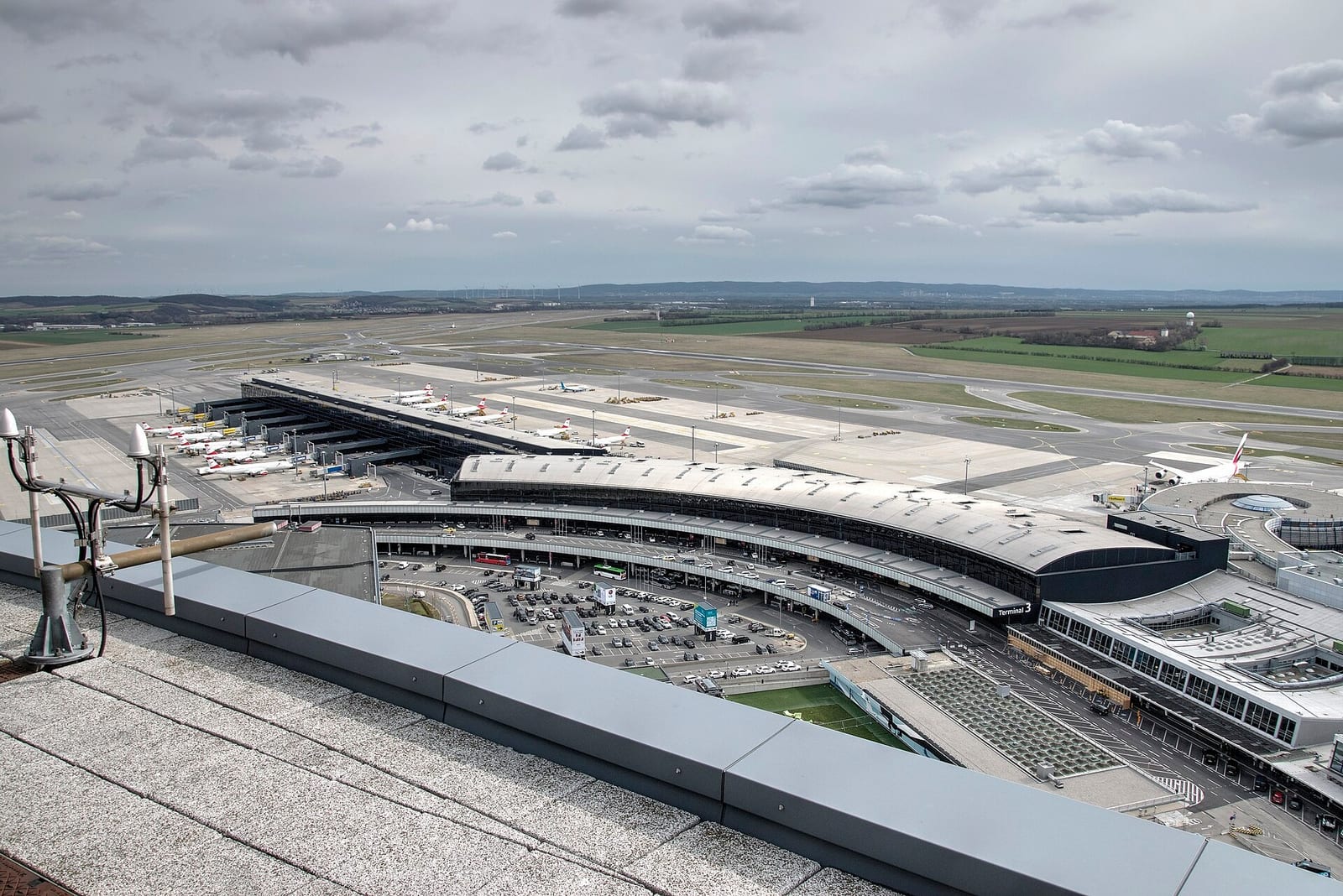
Wizz Air and Ryanair are cutting Vienna flights: what to book instead
Wizz Air has fully left Vienna and Ryanair has cut five aircraft over Austria's aviation tax. Here's exactly what changed, why it happened, and how to still book a cheap flight this winter.
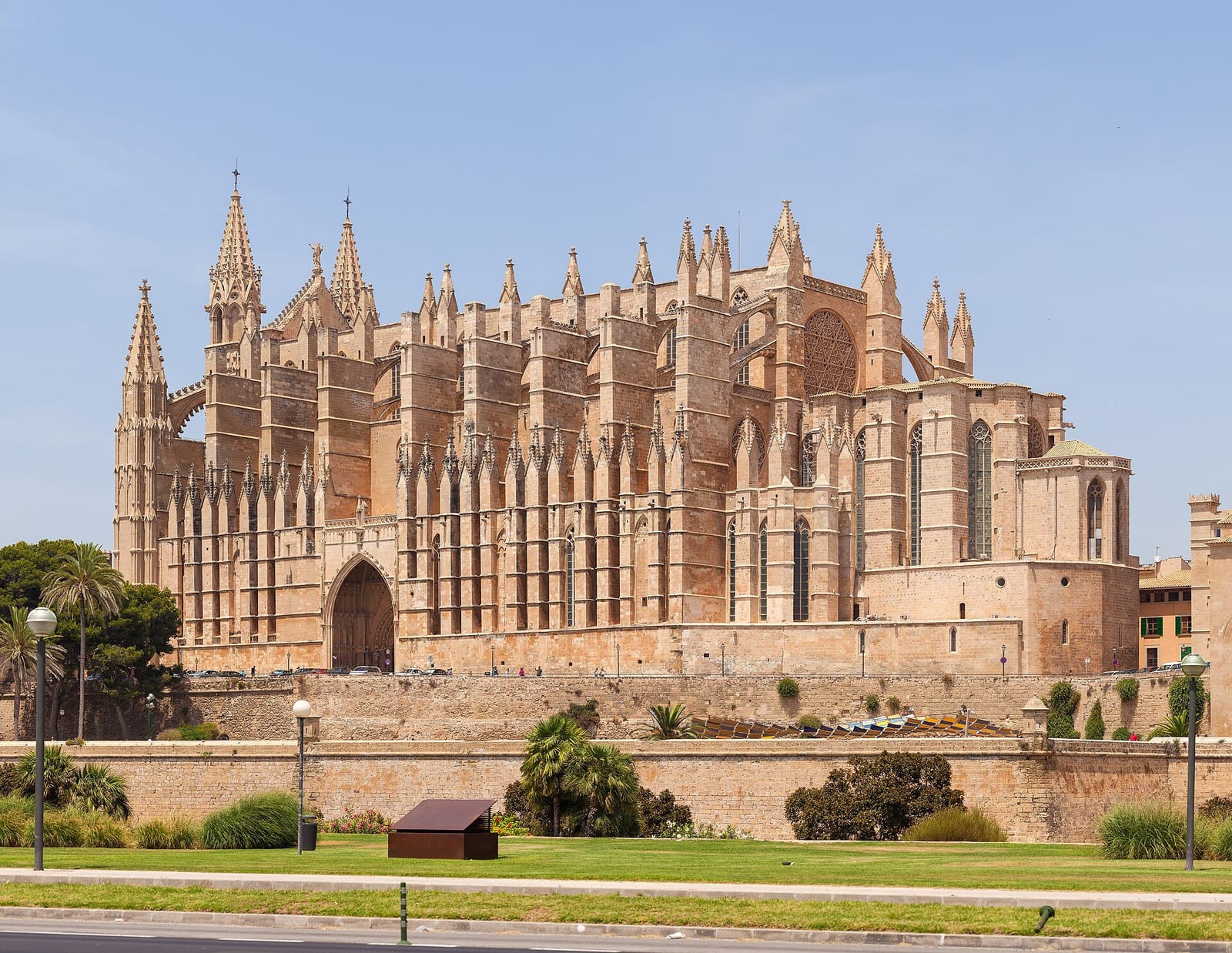
Mallorca's tourist tax hike got cancelled. Here's what a 2026 trip really costs
The Balearic tourist tax hike everyone's still warning about got cancelled in February. Here's what a week on Mallorca actually costs in 2026, flights, hotel, tax, and food, with real numbers.