Every US Airline's New Checked Bag Fees After the April 2026 Hikes (and How to Never Pay Them)
Three airlines hiked checked bag fees in the span of two weeks. Delta, United, and JetBlue all raised prices between late March and April 8, 2026, and blamed the jet fuel crisis triggered by the Iran conflict. If you're flying domestically this year, you're likely paying more to check a bag than at any point in US aviation history.
But here's the thing: you don't have to pay these fees at all. We track trip costs for a living, and we've watched travelers save hundreds by knowing a few simple tricks. Not a single dollar in bag fees, if you play it right.
Delta now charges $45 for a first checked bag (up from $35). United charges $50 ($45 prepaid). JetBlue charges $39-$49 depending on season. American is at $40 ($35 online) and expected to follow soon. Southwest charges $35 since ending free bags in May 2025. The right airline credit card eliminates these fees entirely for you and your travel companions, and carry-on optimization can save a family of four $360+ per round trip.
Why Every Airline Is Raising Bag Fees Right Now
Jet fuel is the root cause. Since the US-Israel military action against Iran began on February 28, 2026, jet fuel prices in the US have surged roughly 85% according to Argus data cited by Airlines for America. Pre-conflict, a gallon of jet fuel averaged about $2.50. By early April 2026, it hit $4.88 per gallon.
Fuel accounts for 20-30% of an airline's operating costs, so when prices nearly double, airlines bleed cash fast. Delta alone spent an estimated $400 million more on fuel in March compared to a year earlier. The Euronews reported that airfares on several international routes have jumped 30-40%, but airlines prefer to pass costs through ancillary fees when they can. Bag fees are the path of least resistance because they hit only passengers who check luggage, not everyone.
Rather than raising base ticket prices across the board, airlines are leaning on ancillary fees. US airlines collected $7.27 billion in baggage fees in 2024, and with these latest hikes, 2026 is on track to set a new record. It's a calculated move: fees are easier to adjust than fares, and passengers who don't check bags never notice the increase.
So the fuel crisis is real. But will these fees come back down when oil stabilizes? History says no. Airlines have never voluntarily lowered baggage fees once raised. The 2008 oil spike introduced checked bag fees industry-wide, and they've only gone up since. Expect these numbers to stick.
Every Major Airline's Checked Bag Fees: The Complete Comparison
Here's what every major US airline charges for checked bags as of April 2026, all in one table. These are domestic economy fares with no elite status or credit card benefits applied. Prices are per bag, per direction.
| Airline | 1st Bag | 2nd Bag | 3rd Bag | Effective Date |
|---|---|---|---|---|
| United | $50 ($45 prepaid) Highest | $60 ($55 prepaid) | $200 | April 3, 2026 |
| Delta | $45 | $55 | $200 | April 8, 2026 |
| JetBlue (off-peak) | $39 | $59 | N/A | March 30, 2026 |
| JetBlue (peak) | $49 | $69 | N/A | March 30, 2026 |
| American | $40 ($35 online) | $50 ($45 online) | $150 | Feb 18, 2026 |
| Southwest | $35 Lowest | $45 | $150 | May 28, 2025 |
| Alaska | $35 Lowest | $45 | $150 | Jan 2024 |
| Spirit | ~$45-65 | ~$65-85 | Varies | Dynamic pricing |
| Frontier | ~$53-63 (booking) / $99-117 (gate) | Varies | Varies | Dynamic pricing |
United is now the most expensive major airline for checked bags, with a $50 gate price for the first bag. Delta is close behind at $45. American hasn't announced an April hike yet, but industry analysts widely expect American to match competitors within weeks. And Spirit and Frontier use dynamic pricing, so their fees fluctuate wildly: buy at booking for the lowest rate, or pay double at the gate.
All data comes from each airline's official baggage policy pages (Delta, United, JetBlue, American, Southwest, Alaska) and reporting from The Points Guy, CNBC, and AFAR.
The Real Cost: What a Family of Four Actually Pays
A single bag fee doesn't look catastrophic. But multiply it across a family of four on a round trip, and the numbers get painful fast. Here's what one checked bag per person costs a family of four, round trip, on each airline at April 2026 prices.
| Airline | 1st Bag (one way) | Family of 4 (round trip) |
|---|---|---|
| United (gate) | $50 | $400 |
| United (prepaid) | $45 | $360 |
| Delta | $45 | $360 |
| JetBlue (peak) | $49 | $392 |
| JetBlue (off-peak) | $39 | $312 |
| American (online) | $35 | $280 |
| American (airport) | $40 | $320 |
| Southwest | $35 | $280 |
| Alaska | $35 | $280 |
That's up to $400 in bag fees alone for a family on United. And if everyone checks two bags? The United round-trip total jumps to $880. For context, that $400-$880 range could cover several nights at a hotel, a week of rental car, or meals for the entire trip.
This is why the real price of a "cheap" flight is never just the ticket. If you're comparing airlines on price alone, factor bag fees into the total before booking. A budget-conscious family flying United round trip and checking two bags per person is now looking at $880 just for luggage. That's not a rounding error in the travel budget — that's a significant portion of the trip itself.
Comparing airline ticket prices without adding baggage fees. A $250 flight on United with two checked bags actually costs $360+ per person. A $290 Southwest flight with bags included is the better deal.
Just paid $400 in bag fees for my family of four on United. That's more than one of our plane tickets cost.
r/travel user, April 2026
Airline-by-Airline Breakdown: What Changed and What Didn't
Delta Air Lines
Delta's fee increase, announced April 7, applies to tickets purchased on or after April 8, 2026. First bag: $35 to $45. Second bag: $45 to $55. Third bag: the steepest jump, from $150 to $200. This is Delta's first domestic baggage fee hike in two years. The increases apply to domestic and short-haul international routes (Canada, Caribbean, parts of Latin America) but not long-haul international flights.
Delta SkyMiles Medallion members and passengers with eligible Delta-American Express co-branded credit cards still get complimentary bags. First class passengers are also exempt. If you're booked on Delta before April 8 but flying after that date, you're locked in at the old price. The new fees only apply to tickets purchased on or after April 8.
United Airlines
Here's what stings about United: they're now the most expensive major airline for checked bags, and they added a psychological trick on top. Their increases took effect April 3 with a two-tier pricing structure. Pay at least 24 hours ahead: $45 for the first bag, $55 for the second. Wait until the airport: $50 and $60. Third bags jumped from $150 to $200. United last raised bag fees in February 2024, so this represents two years of increases compressed into one move.
Free bags remain for United Chase credit card holders, MileagePlus Premier members, active military, and premium cabin passengers. The $5 prepay discount is a relatively new addition that rewards advance planning. If you know you're checking a bag, there's zero reason to wait.
JetBlue
JetBlue used to be the traveler-friendly alternative. Not anymore. They were actually first to move, raising fees effective March 30. Their pricing is seasonal: off-peak first bag went from $35 to $39, peak first bag from $40 to $49. Second bags now cost $59 off-peak and $69 during peak travel. The peak pricing hits hardest during spring break, summer, and major holidays. If you're flying JetBlue during Thanksgiving or Christmas week, expect to pay the full $49 for that first bag.
Customers with JetBlue co-branded credit cards and TrueBlue Mosaic members keep their free bag benefit. Most transatlantic passengers also get the first bag free regardless of fare class.
American Airlines
American last updated fees on February 18, 2026 and bumped the second bag airport price by $5. Current rates: $40 for a first bag ($35 if you pay online), $50 for a second ($45 online). American hasn't announced a matching April hike, but with Delta, United, and JetBlue all moving, the industry pressure is intense. Expect American to follow within weeks. The airline's $5 online prepay discount remains one of the best ways to shave a few dollars off, and their AAdvantage Platinum credit card covers the first bag free for the cardholder plus up to four companions.
Southwest Airlines
Southwest ended its legendary "bags fly free" policy on May 28, 2025, a move that shocked loyal flyers. Current fees: $35 for the first bag, $45 for the second, $150 for a third. Southwest hasn't raised fees since the initial rollout, and they remain tied with Alaska for the lowest first-bag fee among major carriers.
Rapid Rewards A-List Preferred members and Business Select customers still get two free checked bags. A-List members get one free bag. And here's the big one: Southwest Rapid Rewards credit card holders get one free checked bag for themselves and up to eight companions on the same reservation.
Alaska Airlines
If you fly the West Coast regularly, Alaska is worth a closer look. They charge $35 for a first bag and $45 for a second, unchanged since January 2024. Following the Alaska-Hawaiian merger, both airlines now share a loyalty program (Atmos Rewards), and credit card holders get one free checked bag for themselves and up to six companions on Alaska and Hawaiian flights.
Spirit and Frontier (Ultra Low-Cost)
Budget carriers use dynamic pricing for bags, so there's no single number. Spirit typically charges $45-65 for a first checked bag at booking, with prices climbing to $65+ at the gate. Frontier ranges from $53-63 at booking to $99-117 at the gate. The golden rule with both: buy bags when you buy the ticket, never at the airport.
On Spirit and Frontier, buying a bundle (like Frontier's "The WORKS" for $99) that includes a carry-on, checked bag, and seat selection often costs less than adding each a la carte at the airport.
Seven Ways to Never Pay a Checked Bag Fee
The fees are real and they're rising. But millions of travelers fly every week without paying a cent for checked bags. Here's exactly how they do it.
1. Get the Right Airline Credit Card
This is the single most effective strategy. Most airline co-branded credit cards waive checked bag fees for the cardholder and multiple companions. The math is straightforward: a card with a $95-99 annual fee that saves you $90-180 per round trip in bag fees pays for itself after one trip.
| Airline Card | Annual Fee | Free Bags For | Savings (1 RT) |
|---|---|---|---|
| Delta SkyMiles Gold Amex | $150 | Cardholder + 8 companions | Up to $810 |
| AA AAdvantage Platinum | $99 | Cardholder + 4 companions | Up to $400 |
| United Explorer | $150 | Cardholder + 1 companion | Up to $200 |
| Southwest Rapid Rewards Plus | $99 | Cardholder + 8 companions | Up to $630 |
| Atmos Rewards Ascent Visa | $95 | Cardholder + 6 companions | Up to $490 |
Annual fees and companion benefits as of April 2026. Verify current terms on each card's website before applying.
The Delta and Southwest cards stand out for large groups because the bag fee waiver extends to 8 companions on the same reservation. We've seen families save the annual fee on their first trip alone. A family of five on Delta saves $450 per round trip with a single $150 card. That's a three-to-one return on the annual fee from just one trip.
2. Master the Carry-On
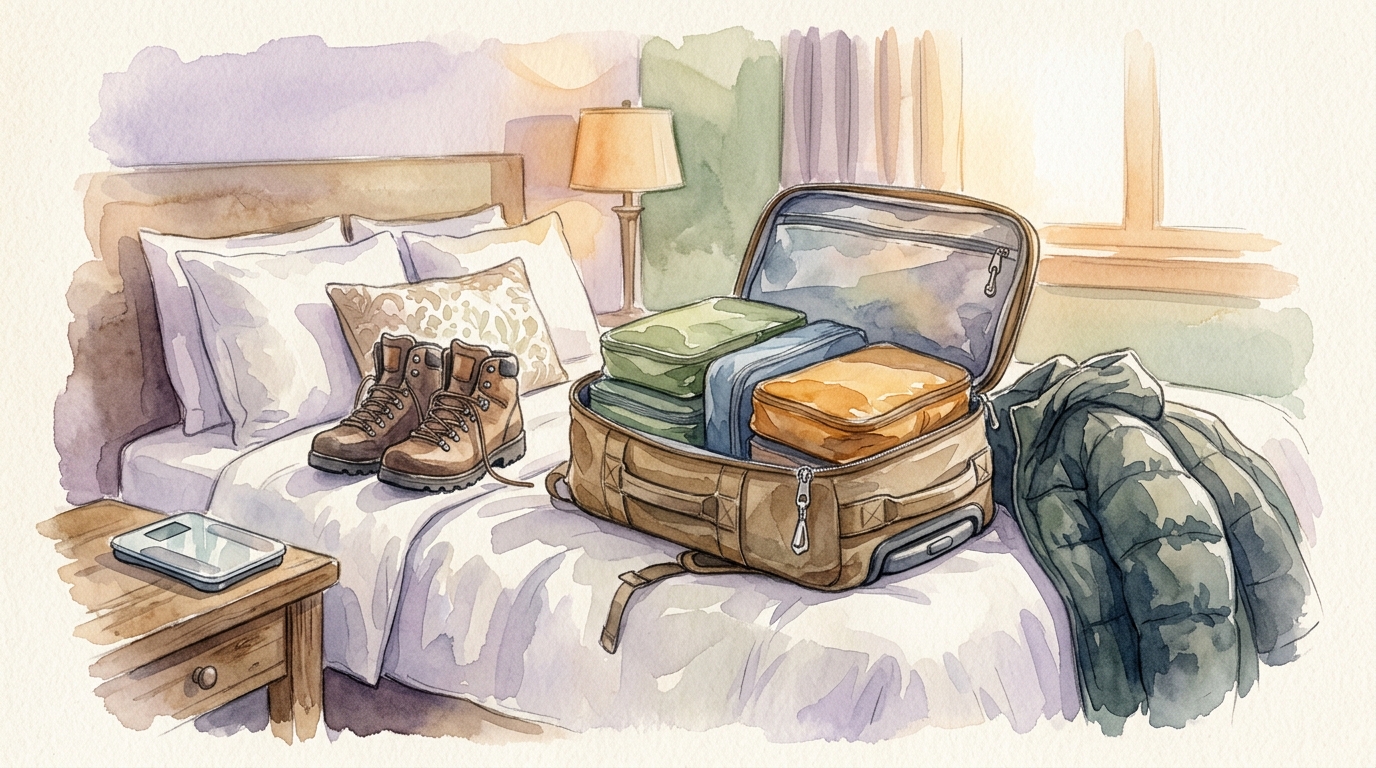
You're at the gate watching someone frantically rearranging their overstuffed suitcase, trying to avoid the $50 fee they just learned about. Meanwhile, you walked past with a 40L backpack and a smirk. A well-packed carry-on handles up to a week of travel for most people. Our guide to packing hacks that actually work covers this in detail, but the essentials: use packing cubes, roll everything, wear your bulkiest items on the plane, and ditch the "just in case" extras. A 22x14x9-inch carry-on fits under every major airline's size limit.
The Washington Post recently highlighted that carry-on optimization has become a top travel trend in 2026, with travelers actively restructuring how they pack in response to rising fees. One trick that saves real space: wear your heaviest jacket and boots onto the plane rather than packing them. A winter coat and hiking boots can take up a third of a suitcase.
3. Prepay Online (Save $5-10 Per Bag)
If you must check a bag, at least pay for it early. United offers a $5 discount when you prepay at least 24 hours before departure. American saves you $5 per bag for paying online. It's not dramatic, but for a family of four checking bags both ways, that's $40-80 saved in two minutes of clicking.
4. Earn Elite Status
Every major US airline offers complimentary checked bags to frequent flyer elites. United MileagePlus Premier members get one to three free bags depending on tier. Delta Medallion members get bags waived. American AAdvantage elites get similar treatment. If you fly 25,000+ miles a year on one airline, you're likely close to qualifying.
5. Book a Higher Fare Class
Basic Economy is the cheapest ticket, but it's also the one that gets hit hardest by add-on fees. Main Cabin and above typically include at least one checked bag on international routes. On domestic flights, bumping from Basic to Main Cabin sometimes costs less than the bag fee itself, especially when booking directly with the airline. Do the math before defaulting to Basic Economy. If the fare difference is $30 and the bag fee is $50, the upgrade is the smarter buy.
6. Qualify for Fee Waivers (Military, Elite Status)
Active military members get free checked bags on virtually every US airline — most carriers allow two to three bags at no charge, and the benefit extends to dependents on the same reservation. Even if you're not military, frequent flyer elite status unlocks similar waivers across all major airlines.
7. Ship Your Luggage Instead
For trips where you absolutely need heavy or bulky items, third-party luggage shipping services can be cheaper than airline checked bag fees, especially for overweight or oversized bags. Services like LugLess and ShipGo start around $19-25 for ground shipping on LugLess and $50-75 on ShipGo, and offer door-to-door pickup. With third-bag fees now hitting $200, shipping is worth comparing.
What's Coming Next: Will American Match? Will Fees Keep Rising?
American Airlines is the obvious domino. With Delta, United, and JetBlue all raising fees, American faces competitive pressure to follow. Their current $40 first-bag price ($35 online) is now $5-10 below Delta and $10-15 below United. Newsweek reports that analysts expect American to announce matching increases before the peak summer travel season.
Alaska Airlines, currently at $35 for a first bag, is also likely to adjust. The airline hasn't raised fees since January 2024 — the longest holdout among legacy carriers. With fuel costs affecting every carrier equally, Alaska's current pricing gap won't last forever.
But are these hikes permanent? The short answer is yes, they are. Airlines have never voluntarily reversed a baggage fee increase. The original domestic bag fee was introduced by American Airlines in 2008 during an oil price spike. When oil prices dropped months later, the fee stayed. Every subsequent increase has followed the same pattern: fuel goes up, fees go up, fuel comes down, fees stay.
This means the current fuel crisis driving summer 2026 travel costs will have lasting effects on what you pay to check a bag, long after jet fuel prices eventually stabilize.
Bureau of Transportation Statistics data shows US airlines collected a record $7.27 billion in baggage fees in 2024, up from $7.07 billion in 2023. With 2026 price hikes, that number will climb further.
How to Budget for Bags When Planning Your Trip
You found a $189 United flight to Denver. Great deal, right? Two checked bags for you and your partner at the new $50 rate: add $200. Your "cheap flight" just became a $389 flight. A Southwest ticket at $235 with free bags through the Rapid Rewards credit card perk would have saved you $154. This is the math most travelers skip.
Here's a quick framework. For any domestic round trip in 2026, add these amounts to the ticket price per person before comparing airlines:
- Carry-on only: $0 (free on all major carriers except Spirit/Frontier basic fares)
- One checked bag: $70-100 per person round trip
- Two checked bags: $180-220 per person round trip
Tools like TripProf can help you track these costs alongside flights, hotels, and activities so you see the real total before you commit. When you're comparing a $220 Southwest flight (bags included for credit card holders) against a $180 United flight plus $100 in bag fees, the math flips.
If you're traveling internationally, the calculation changes. Most international economy tickets on legacy carriers include at least one checked bag. The recent fee increases primarily target domestic and short-haul international routes, so long-haul travelers are less affected. But domestic round trips, especially those connecting to international flights, can still get tagged with bag fees on the domestic legs if booked separately.
It's also worth considering travel insurance for longer trips. Some full-coverage policies cover delayed or lost luggage, which becomes more relevant when you've paid $50-60 to check a bag and it doesn't arrive with you.
- Add bag fees to ticket price before comparing airlines
- Check if your credit card waives bag fees on your airline
- Prepay for bags online at least 24 hours ahead
- Weigh your bag at home to avoid overweight surcharges
- Consider carry-on only for trips under a week
- Compare total trip cost including all ancillary fees
Frequently Asked Questions
How much does it cost to check a bag on Delta in 2026?
Delta charges $45 for a first checked bag and $55 for a second on domestic and short-haul international routes, effective for tickets purchased on or after April 8, 2026. Third bags cost $200. Medallion members, first class passengers, and eligible Delta Amex cardholders get bags free.
Why are airlines raising baggage fees right now?
Jet fuel prices have surged roughly 85% since February 2026 due to the Iran conflict disrupting global oil supplies. Airlines are passing these costs to passengers through ancillary fees rather than raising base ticket prices.
Which airlines still offer free checked bags?
No major US airline offers universally free checked bags as of April 2026. Southwest ended its free bag policy in May 2025. However, elite status members, co-branded credit card holders, military personnel, and premium cabin passengers still get free bags on most carriers.
How can I avoid paying checked bag fees?
The most effective strategy is an airline co-branded credit card ($95-150/year) that waives fees for you and companions. Pack carry-on only when possible, prepay online for a $5 discount, or earn elite frequent flyer status for complimentary bags.
Are airline bag fee increases permanent?
Historically, yes. Airlines have never reversed a baggage fee increase. Bag fees were introduced in 2008 during an oil crisis and have only risen since, regardless of fuel price fluctuations.
Is it cheaper to prepay for checked bags online?
Always. United saves $5 per bag when you prepay at least 24 hours ahead. American saves $5 per bag online. Delta has no prepay discount. Spirit and Frontier charge $20-50+ more at the gate than at booking. Pay early, every time.
Which airline credit cards give free checked bags?
Most major airline co-branded cards offer this perk. Delta SkyMiles Gold Amex covers up to 9 travelers. American AAdvantage Platinum covers 5. Southwest Rapid Rewards Plus covers 9. Atmos Rewards Ascent Visa covers 7. United Explorer covers 2. Annual fees range from $95-150.
Key Takeaways
- United is the priciest for checked bags at $50 per first bag (or $45 prepaid), followed by Delta at $45 and JetBlue at $39-49 depending on season.
- American will likely match Delta and United's increases before summer 2026, so book now if you want current rates.
- Southwest's "bags fly free" era ended May 2025, but their $35 first-bag fee is still the lowest among major carriers alongside Alaska.
- A family of four pays $280-400 round trip in bag fees alone on domestic flights. Bags are now the largest hidden cost in air travel.
- Airline credit cards are the best defense: a $95-150 annual fee card can save $200-800+ per year in bag fees for you and your travel companions.
- Prepaying online saves $5-10 per bag on United, American, and budget carriers. It takes two minutes and the savings add up.
- Planning tools like TripProf help you compare total trip costs including bag fees, not just ticket prices, so you don't get blindsided at the airport.
- These fee increases are here to stay. Airlines have never reversed a bag fee hike. Plan accordingly.
Sources
- CNBC: Delta raises checked bag fees $10 amid jet fuel price surge
- CNBC: United Airlines hikes checked bag fee by $10 as fuel prices climb
- CNBC: JetBlue Airways raises checked bag fees as fuel prices soar
- CNBC: Southwest Airlines will start charging $35 for a checked bag
- CNBC: Jet fuel supply concerns grow as war with Iran drags on
- Bloomberg: Delta Increases Checked Bag Charges by Up to $50
- The Points Guy: Delta Air Lines hikes checked bag fees
- The Points Guy: United to raise checked bag fees by $10
- AFAR: United and JetBlue Airlines to Raise Baggage Fees
- Newsweek: Airline Baggage Fees Spike: Full List and Price Increases
- NerdWallet: Airline Credit Cards That Offer Free Checked Bags
- ConsumerAffairs: Airline passengers paid $7.27 billion to check bags in 2024
- Bureau of Transportation Statistics: Baggage Fees by Airline
- Washington Post: Top packing hacks to avoid higher checked-baggage fees
- Delta Air Lines: Baggage Policy and Fees
- United Airlines: Checked Bags
- JetBlue: Checked Bags
- American Airlines: Checked Bag Policy
- Southwest Airlines: Checked Baggage Policy
- Alaska Airlines: Checked Baggage Fees
- Southwest Media: Southwest Airlines Outlines Charges for Checked Baggage
Keep Reading
More travel tips and guides picked for you
Why Flights Are So Expensive Right Now (And What You Can Actually Do About It)
Jet fuel prices nearly doubled after the Iran conflict and Strait of Hormuz closure. Airlines are cutting flights and passing costs to you. Here's what's driving prices up, when they might come down, and six practical strategies to save hundreds on your next booking.
Revolut vs Wise vs Your Bank Card Abroad: The Real Cost of Every Swipe, Tap, and ATM Withdrawal in 2026
Your bank charges 3% on every foreign purchase. Revolut and Wise cut that to nearly zero, but each has limits and quirks. Here's exactly what a $3,000 European trip costs with each card, plus the DCC trap that hits everyone.
Budget Travel Guide to the August 2026 Total Solar Eclipse in Spain
Spain's first total eclipse in 120 years hits August 12, 2026. Skip the $10K tours: fly into Madrid, train to the path of totality for under €50, and watch the corona glow above the Spanish horizon. City-by-city cost breakdown, weather odds, and a complete $850 trip budget inside.