What Not to Do in Europe 2026: Tourist Fines, Culture Rules, and the Costs Nobody Warns You About
Key Highlights
- 1
- 2
- 3
+5 more in the takeaways below
Six friends, one week in Barcelona. Dinner runs late. Someone orders another round at 11:05 pm. The group gets loud walking back to the apartment. One person wanders off the beach in shorts and a bikini top to grab ice cream. It sounds like a perfectly normal holiday. The total in tourist fines in Europe? Potentially over €3,000.
Europe is no longer quietly tolerating tourist misbehavior. The tourist fines in Europe catching visitors off guard are rarely the obvious ones. From Venice to Edinburgh, cities are writing new laws, doubling taxes, installing cameras, and training locals to report violations. The rules that get tourists into trouble aren't obvious ones like "don't climb monuments." They're the ordinary-sounding things: wearing a swimsuit on the wrong street, driving through an old city center, sitting on famous steps, or buying sunglasses from a street vendor.
This is your 2026 rundown of the tourist fines in Europe that nobody warns you about. Exact amounts, updated April 2026, with a particular focus on what catches groups of travelers off guard.
Barcelona's tourist tax literally doubled today (April 1, 2026). Venice expanded its day-tripper fee to 60 days. Rome fines you for sitting on the Spanish Steps. Italy fines you for buying a fake bag. Driving a rental car into a historic city center can cost you hundreds in ZTL camera fines you won't know about for months. Groups are especially exposed: noise past 11pm in Barcelona, public drinking in the Balearics, and swimwear on the wrong street all carry individual fines that multiply fast.
The Overtourism Crackdown: Why 2026 Is Different
European cities have been complaining about overtourism for years. What changed in 2026 is that complaints became laws, protests became enforcement, and "please be respectful" became "€500 on the spot." The shift has a clear cause: locals organized.
In June 2025, thousands of Barcelona residents marched through tourist-packed neighborhoods chanting "Your holidays, my misery," CNN reported, with some protesters using water pistols to make their point to sunbathing visitors. Anti-tourism protests swept Spain throughout 2024 and 2025, and the political pressure worked. Barcelona welcomed an estimated 32 million visitors annually at peak levels, while Venice hosts around 30 million tourists a year against a permanent population of fewer than 50,000 residents, as Bloomberg's January 2026 report on overtourism detailed. The math is unsustainable, and governments are reacting with policy, not just press releases.
The result: a new generation of tourist regulations that use financial penalties as the enforcement mechanism. Ignorance is no longer accepted as a defense. Enforcement is no longer passive. And group travelers, who tend to be louder, more visible, and more likely to trigger multiple violations simultaneously, are carrying the highest exposure.
Barcelona: The City That Just Doubled Its Tax (and Its Fines)
Today, April 1, 2026, is the date Barcelona's new tourist tax rates took effect. This isn't a gradual phase-in. From this morning, the rates doubled across every accommodation category in the city, making Barcelona's tourist tax one of the highest in Europe.
The Euronews 2026 tourist taxes breakdown of the new rates for Barcelona specifically:
| Accommodation Type | Old Rate (per night) | New Rate from April 1, 2026 |
|---|---|---|
| Five-star hotels | €7.50 | €15 |
| Four-star hotels | €5.00 | €11.40 |
| Holiday rentals / Airbnb | €6.25 | €12.50 |
| Cruise passengers (per call) | ~€6 | ~€6 (unchanged) |
That table looks like an abstract number until you do the math. A group of six staying a week in holiday lets in Barcelona now pays €12.50 × 6 people × 7 nights = €525 in tax alone, just for accommodation. The Barcelona City Council confirmed that the Parliament of Catalonia passed the increase, with 25% of revenue earmarked for the city's housing crisis and 75% going to the Tourism Promotion Fund. The tax applies on top of accommodation costs and is not optional.
But the tourist tax is the one you actually see on your invoice. The fines below are the ones nobody budgets for.
Barcelona's Street Rules: The Ones That Actually Catch Tourists
Swimwear off the beach: Walking in a bikini, swimming trunks, or shirtless anywhere outside beach zones, promenades, and pool areas is illegal under Barcelona's civic coexistence ordinance. Euro Weekly News reports that fines can reach €300. The rule was revised in 2026 with clearer legal language after an earlier version was partially struck down by Spain's Supreme Court for vague wording. The enforcement area includes Barceloneta beach's surrounding streets, the Gothic Quarter, and commercial districts.
Noise past 11pm: Barcelona enforces strict quiet hours from 11pm to 7am under the Barcelona City Council's civic ordinance. Groups making noise on terraces, in apartments, or on streets during these hours face fines of €300 to €3,000 per Barcelona's 2025 civic ordinance, per The Olive Press. A group of six each receiving a violation notice in the same incident quickly compounds into a significant total.
Individual fines don't cap at one per group. In Barcelona and across Italy and Spain, each person in a group can receive a separate fine for the same violation: swimwear, noise, public drinking. Six friends making noise past 11pm aren't one fine. They're potentially six separate ones.
Venice: Day-Tripper Fees, Swimwear Laws, and Canal Swimming Bans
Venice runs a layered system of rules that tourists regularly stumble into. There's the well-publicized day-tripper fee, but beneath it sit older, less-reported regulations that still carry serious penalties.
The Day-Tripper Fee (Now 60 Days Per Year)
Venice's access fee returned for 2026, expanded from 54 days to 60 days between April and July, operating Friday to Sunday plus bank holidays from 8:30am to 4pm. The fee structure is simple:
- €5 if you book your entry pass 4+ days in advance via the official Venice platform
- €10 if you book fewer than 4 days ahead or haven't booked at all
- Free for hotel guests (who have accommodation reservations), residents, workers, and students
The pass is a QR code checked at entry points including the train station and bus terminals. The Timeout confirmed the 2026 dates cover April 3-30, May 1-31, June 1-28, and July 3-26, on applicable days. If you're arriving by train on a Saturday in May, budget the €5 in advance or pay €10 at the gate.
What Actually Gets Tourists Fined in Venice
Swimming in the canals: A €450 fine and a 48-hour expulsion from the city. Both. Not either/or. CNN reported in September 2025 on a couple fined €450 each after taking a swim near the Accademia bridge, with Venice local police noting that 1,136 expulsion orders had been issued that year alone for various violations. The expulsion is called a "Daspo" and it's enforced: you must leave city limits within 48 hours.
Swimwear on city streets: Walking through Venice's historic streets in swimwear or bare-chested results in fines ranging from €25 to €500 depending on severity, per Venice city regulations. Venice is emphatic: it's a UNESCO-listed historic city, not a beach resort.
Feeding pigeons or seagulls: Up to €500. Fodor's notes that the ban covers all public areas including squares and canals, because bird excrement is acidic and damages the historic mosaics and stonework across the city.
Venice has issued 1,136 orders of expulsion for incidents of degradation and uncivilized behavior this year alone. About 10 of those were for swimming in the canals.
- Venice local police, reported by CNN, September 2025
Italy Nationwide: The Fines Most Travelers Have Never Heard Of
Italy has more fine categories per square kilometer than anywhere else in Europe. Some are ancient laws. Some are newly enforced. All of them are active.
Rome
The Spanish Steps: Since 2019, sitting on Rome's Spanish Steps has been illegal. The fine starts at €250, rising to €400 if you stain or damage the stone, as CNN reported. Eating, drinking, or rolling luggage across the steps are all prohibited under the same ordinance. Police patrol the area actively. This isn't a theoretical rule. Tourists are fined regularly, and the ordinance is enforced daily during tourist season.
The Trevi Fountain: Since February 2, 2026, visiting the Trevi Fountain zone close to the basin now requires a paid entry ticket of €2 per person. Euronews covered the introduction, with CNN confirming the fee went live on schedule. Viewing from the piazza above remains free. But sitting on the fountain's edge, wading in, or causing damage carries a separate fine of €250 to €500.
The Colosseum: Carving anything into the Colosseum results in immediate arrest, fines starting at €2,000, and a city-wide Daspo ban. Artnet documented a case where a tourist was fined up to €20,000 for carving initials into the monument. Cultural heritage damage also carries a criminal charge with up to two years' imprisonment under Italian law.
ZTL Zones: The Rental Car Trap That Costs Thousands
This is the one that creates the most shock. You rent a car in Italy, use Google Maps to navigate to your hotel in the historic center of Florence, Rome, or Bologna, and drive right through a camera-enforced Limited Traffic Zone: a ZTL (Zona a Traffico Limitato). There is no gate, no guard, no immediate warning. Just a sign and a camera. Your rental car plate goes into the system.
Per the European Consumer Centre Germany, fines typically range from €80 to €175 per crossing depending on the city, rising to €200+ if unpaid promptly. Your rental company will then add an administrative processing fee of €30-€60 for passing your details to the Italian police. Cross the same zone multiple times, enter multiple ZTL areas in different cities, and the total compounds fast. Tourists have reported bills of several hundred to over a thousand euros arriving months later via their credit card company.
Before driving in any Italian city, search the city name plus "ZTL zone map." Park outside the historic center and use public transport or taxis. If your hotel is inside a ZTL, contact them directly before arrival. Hotels can often arrange temporary access permits and will send you written confirmation. Waze is the navigation app with the best crowd-sourced ZTL warnings. Google Maps does not reliably flag ZTL zones.
Sardinia: Beach Sand Is a Protected Resource
Italy's fines don't stop at traffic zones. Some reach into your luggage.
Taking sand, shells, or pebbles from Sardinia's beaches is illegal under regional protection law (enacted 2017, still in force). The fine is up to €3,000 for standard quantities, and The Local Italy confirmed that customs officers at Alghero, Cagliari, and Olbia airports conduct bag searches and have issued fines. AFAR documented cases of tourists fined $3,600 for sand and shells hidden in luggage. The pink sand of La Pelosa beach in particular is one of the most targeted sites for checks.
Fake Designer Bags: A Fine for the Buyer
Street vendors selling knockoff Gucci bags, fake Ray-Bans, and counterfeit watches are everywhere in Italian tourist areas. Under Italian anti-counterfeit law (Legislative Decree 30/2005), buying a fake item is a criminal offense, not just selling one. The fine for buying counterfeit goods is up to €7,000, with up to six months in prison for repeat or serious offenses, as Euronews confirms. The fine goes to the buyer, regardless of whether they knew the item was counterfeit.
Italy's rules are the most numerous and the most actively enforced. Spain's are the most financially aggressive for groups. Both share a common logic: the fines scale with the number of people involved.
Spain: The Balearic Islands and Beach Smoking Rules
The Balearic Islands (Ibiza, Mallorca, Menorca) have some of the strictest alcohol and public conduct rules in Spain, specifically targeting the behavior that made tourist hotspots like Magaluf and San Antonio infamous.
Public Drinking: Up to €3,000
Street drinking in tourist zones is prohibited. Euronews reported that fines for those caught with open containers on the street range from €500 to €1,500 in the first instance, rising to €3,000 in tourist hotspot zones. The overnight alcohol sales ban in shops (9:30pm to 8am) now covers Palma, Calvia (Magaluf) in Mallorca and Sant Antoni in Ibiza. Happy hours, party boats within 3 nautical miles of the coast, and late-night alcohol sales in shops are all banned in these zones, and the law runs until 2027.
Beach Smoking Bans
Beach smoking bans are already in force across Barcelona's beaches and on many beaches in the Balearics and Canary Islands. Spainvoyages confirmed that 80 beaches in Catalonia are now legally smoke-free. Fines for beach smoking in these designated smoke-free zones start at around €30 and can reach €2,000 for repeat violations.
Note: Spain's cabinet approved a broader national outdoor smoking ban covering all beaches, bar terraces, and other outdoor spaces, but Euronews reported it still requires full parliamentary approval and is not yet national law as of April 2026. Regional bans (especially in Catalonia and the Balearics) are already fully enforceable. Check local rules at your specific destination.
The New Tourist Taxes Hitting Europe in 2026
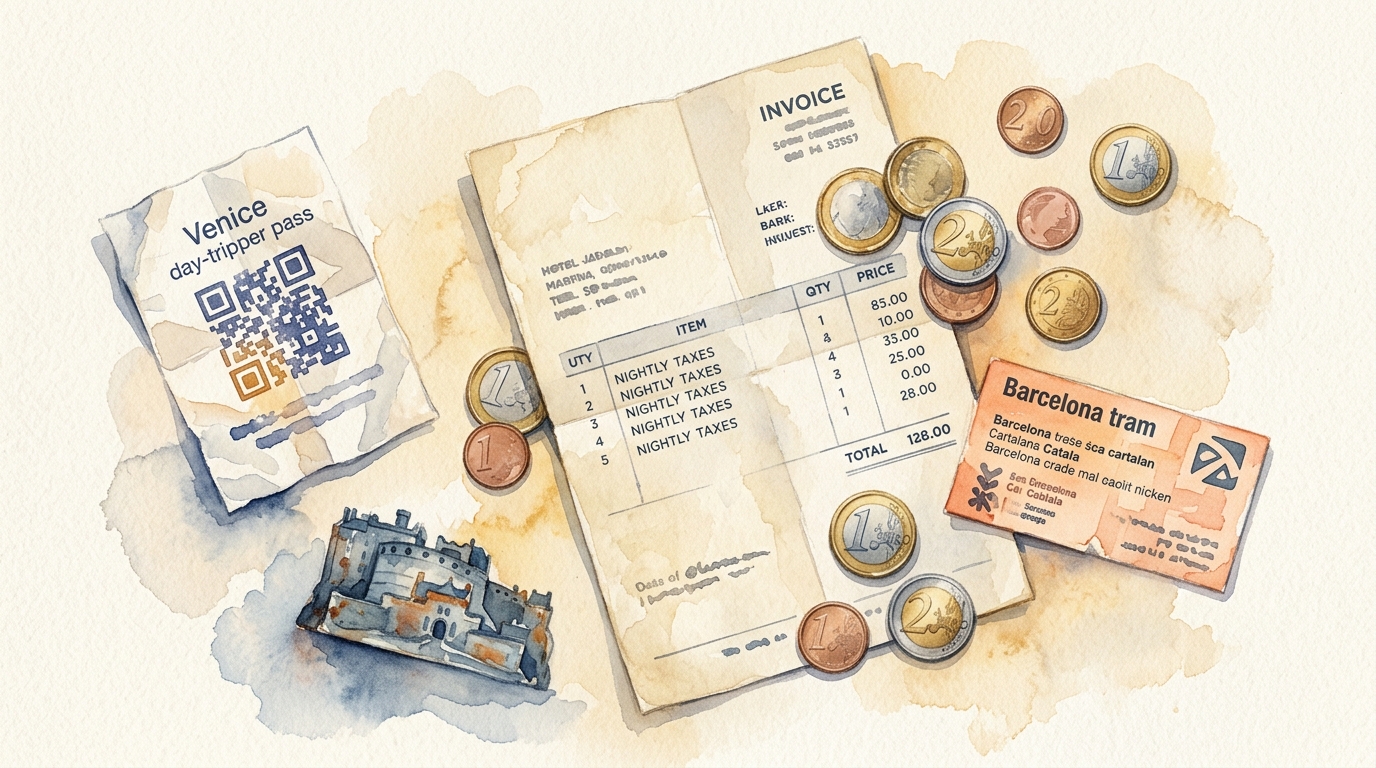
Beyond behavioral fines, 2026 has introduced or expanded tourist taxes across Europe that add real cost to trips, especially for longer stays and large groups.
- Barcelona (effective today, April 1, 2026) Holiday lets: €12.50/night. Four-star hotels: €11.40/night (€6.40 regional + €5 municipal). Five-star hotels: €15/night. Catalan law, confirmed by the Barcelona City Council. The Barcelona municipal surcharge rises an additional €1/year until 2029.
- Venice (April-July 2026, applicable days) Day-tripper fee of €5 (booked 4+ days ahead) or €10 (late booking). Applies on 60 designated days. Hotel guests, residents, workers, and students are exempt. Full date list at Euronews.
- Milan (from January 1, 2026) Tourist tax increased ahead of the Milano-Cortina 2026 Winter Olympics: €10/night for four- and five-star hotels, €9.50 for short-term rentals, €3 for hostels and camping. Applies to the first 14 nights only, per Idealista Italy.
- Edinburgh (from July 24, 2026) The UK's first-ever tourist tax: 5% of accommodation cost per night, capped at 5 nights. Applies to all accommodation types: hotels, B&Bs, holiday rentals, and campsites. Confirmed by the City of Edinburgh Council. Revenue is earmarked for public services, transport, and cultural programs. Stays after July 24, 2026 are exempt if the booking was fully paid before October 1, 2025.
For groups traveling together, these taxes are purely additive. Four people staying four nights in a Barcelona four-star hotel now pay €11.40 × 4 people × 4 nights = €182.40 in tax before a single meal. For the Edinburgh Fringe in late July or August, a group of four in a mid-range hotel paying £200/night pays £10 in tax per night, or £40 over a four-night stay. It's not catastrophic, but it's no longer negligible, and it's rarely included in online pricing when you first search.
For a broader look at hidden costs that appear after you've booked, our guide to budget airline hidden fees applies the same logic to air travel.
Rules That Apply Everywhere in Europe (and That Tourists Still Break)
Some violations aren't city-specific. They follow you from Rome to Barcelona to Split to Athens.
Church Dress Codes
Shoulders and knees must be covered to enter virtually every Catholic church, basilica, or cathedral across Italy, Spain, Greece, and Croatia. This applies to the Vatican, the Sagrada Família, the Duomo in Florence, and thousands of smaller churches that tourists enter without thinking. The rule is not a suggestion. Staff turn people away at the door, even those who hold pre-paid timed entry tickets. Some Italian sites, including major basilicas, fine visitors up to €50 for non-compliance rather than simply turning them away. Keep a scarf or light layer in your bag. The alternative is a wasted ticket and a turned-away experience.
Acropolis and Major Heritage Sites
Climbing the Acropolis walls or attempting unauthorized access beyond official paths carries a fine of up to €20,000 under Greek cultural heritage law - the same scale as the Colosseum carving fine in Italy. The principle is consistent across UNESCO-listed sites in Europe: the fine isn't the worst outcome. The ban from the city is.
Beyond Spain and Italy: Dubrovnik and Athens
Fines for tourist misconduct extend well beyond Spain and Italy. In Dubrovnik, eating or drinking outside of designated licensed areas in the Old Town carries fines starting at €50 per person, enforced by city wardens in the peak summer season. Croatia's Game of Thrones fame brought an influx that pushed officials to expand enforcement. In Athens, visitors who attempt to sit on, climb, or touch restricted parts of the Acropolis site face fines up to €20,000 and possible expulsion from the country under Greek Law 3028/2002 on cultural heritage protection.
Rental Car Rules Beyond ZTL
The ZTL camera issue is Italy-specific, but rental car problems aren't. Our rental car damage defense guide covers the documentation habits that protect you from post-return charges that can arrive weeks after you've left the country. Related: if something goes wrong despite preparation, what travel insurance actually covers in 2026 is worth knowing before you land.
Group Behavior Is Under a Different Microscope
This is the gap between solo travelers and groups. A solo traveler walking quietly in swimwear is less visible than six friends loudly heading from the beach to the nearest bar. Local residents in overtourism hotspots are increasingly empowered, and in some cases actively incentivized, to report violations. The enforcement isn't just police. It's the restaurant owner who calls in the noisy terrace at 11:30pm, the gondolier who flags canal swimmers, the airport customs officer checking bags for sand.
Groups heading to Europe should read our guide to splitting trip costs without drama. The fine conversation is even harder to have after the fact than the expense conversation is. And if you want to understand why certain European destinations are actively limiting visitor numbers, our piece on how to visit Europe without the crowds in 2026 explains the counterintuitive approach.
If you want local laws, dress codes, alcohol rules, and scam warnings for your specific destination gathered in one place, tools like TripProf generate personalized destination guides covering culture and etiquette, sensitivity tips, and alcohol and smoking rules tailored to your exact trip details.
- Check whether your specific destination has active tourist tax charges before booking - these are often not shown in initial hotel search prices
- Pack a scarf or wrap for church visits and keep one in your day bag
- Book Venice's day-tripper pass 4+ days ahead to pay €5 instead of €10
- Never drive a rental car into an Italian city center without checking the ZTL map first
- Avoid buying anything from street vendors selling branded goods in Italy
- In Barcelona: cover up immediately when leaving beach areas
- Keep noise inside after 11pm: in apartments, on terraces, and in the street
- Don't take sand, shells, or pebbles from Sardinian beaches
Frequently Asked Questions
What are you not allowed to do in Barcelona in 2026?
In Barcelona you cannot walk in swimwear or shirtless outside beach zones (fine up to €300), make noise between 11pm and 7am, smoke on designated smoke-free beaches, or drink alcohol in public spaces beyond licensed terraces. As of April 1, 2026, the tourist accommodation tax has also doubled, reaching €12.50/night for holiday lets and up to €15/night for five-star hotels.
Can you get fined for wearing a swimsuit in Venice?
Yes. Walking through Venice's historic streets in swimwear or bare-chested carries a fine of €25 to €500. Venice is a UNESCO-listed historic center, not a beach resort, and city regulations specifically prohibit beach attire in public areas away from the Lido beaches.
What is the tourist tax in Barcelona now?
From April 1, 2026, the tourist tax in Barcelona is €15/night for five-star hotels, €11.40/night for four-star hotels (€6.40 regional + €5 municipal), and €12.50/night for holiday rentals and Airbnbs. This doubled from previous rates under a new Catalan law passed in early 2026. A Barcelona municipal surcharge adds to this total and increases by €1/year until 2029.
How do you avoid ZTL fines in Italy?
Don't drive rental cars into Italian historic city centers. Park outside and use public transport or taxis. If your hotel is inside a ZTL zone, contact the hotel before arrival. They can often arrange a temporary access permit. Use Waze (not Google Maps) for real-time ZTL warnings. Fines typically range from €80 to €175 per crossing depending on the city, plus rental company admin fees of €30-€60.
Can you drink alcohol on the beach in Spain?
It depends on where you are. In Ibiza and Mallorca's designated tourist hotspots (including Magaluf and San Antonio), public street drinking is banned with fines up to €3,000. On Barcelona's beaches, alcohol is restricted but not universally banned. Alcohol sales in shops are banned overnight in Balearic hotspots from 9:30pm to 8am.
What happens if you swim in Venice canals?
Swimming in Venice's canals results in a €450 fine per person and a 48-hour expulsion (Daspo) from the city. Both penalties apply simultaneously. Venice local police actively enforce this rule, having issued over 1,136 expulsion orders in a single year for various violations including canal swimming.
Are there dress codes at European churches in 2026?
Yes, universally. Shoulders and knees must be covered for both men and women at virtually all Catholic churches, basilicas, cathedrals, and historic religious sites across Italy, Spain, Greece, Portugal, and Croatia. Staff turn visitors away at the door regardless of whether they hold pre-paid tickets. Carry a scarf or light jacket in your day bag.
How much is the Venice day trip fee?
€5 if booked 4 or more days in advance via the official Venice platform. €10 if booked fewer than 4 days ahead. Free for hotel guests with accommodation reservations, residents, students, and workers. The fee applies on 60 designated days between April and July 2026, operating 8:30am to 4pm.
What behaviors get tourists fined in Europe?
Wearing swimwear on non-beach streets (up to €300 in Barcelona, €500 in Venice), swimming in Venice canals (€450), sitting on Rome's Spanish Steps (€250+), buying fake designer goods in Italy (up to €7,000), driving rental cars into ZTL zones (€80-€175 per crossing), taking sand from Sardinia (up to €3,000), feeding pigeons in Venice (€50-€500), and public drinking in the Balearic Islands (up to €3,000).
Can a group of friends get fined for being noisy in Spain?
Yes, and each person in the group can receive an individual fine. Barcelona enforces quiet hours from 11pm to 7am with fines for noise violations of €300 to €3,000 per person. In the Balearic Islands, anti-social behavior in tourist zones carries fines up to €3,000 per person. Six friends receiving separate violations for the same incident can collectively face over €18,000 in total fines in the most serious cases.
What is the tourist tax in Milan for the 2026 Winter Olympics?
Milan increased its tourist tax ahead of the Milano-Cortina 2026 Winter Olympics: €10/night for four- and five-star hotels, €9.50/night for short-term rentals, and €3/night for hostels and camping. The tax applies to the first 14 nights of any stay and took effect from January 1, 2026. If Milan is on your list, our 4 days in Milan itinerary lays out a full group-friendly route, including which days to avoid for closures.
Key Takeaways
- Barcelona's tourist tax doubled on April 1, 2026: €12.50/night for holiday lets, up to €15/night for five-star hotels. Budget this into your accommodation cost from day one.
- Venice charges day-trippers on 60 days in 2026 (April-July, weekends and holidays). Book the €5 pass 4+ days in advance; waiting costs you €10.
- The Spanish Steps, Trevi Fountain perimeter, and Colosseum all have active fines for sitting, wading, and carving respectively. These are enforced daily, not occasionally.
- ZTL zones in Italy are the most expensive trap for rental car drivers. Never navigate into an Italian historic center without checking the ZTL map and contacting your hotel first.
- Buying counterfeit goods from Italian street vendors risks a fine of up to €7,000. The fine falls on the buyer, not just the seller.
- Group travelers multiply their fine exposure: each person can receive a separate fine for noise, swimwear, or public drinking violations in the same incident.
- Edinburgh introduces the UK's first tourist tax on July 24, 2026: 5% of accommodation cost, capped at 5 nights.
- Research local rules before you travel, not after you land. Planning tools that include destination-specific culture, etiquette, and legal information, like TripProf's destination guides, cover alcohol rules, dress codes, and sensitivity tips tailored to your specific trip.
Sources
- Barcelona City Council: Parliament of Catalonia passes tourist tax increase
- Euronews: All of 2026's new tourist taxes explained (rates and cities)
- Euro Weekly News: Catalonia doubles tourist tax to one of highest in Europe
- Euronews: Venice day-tripper fee 2026 dates and amounts
- Timeout: Venice entry fee returns April 2026
- CNN: Tourists fined and banned from Venice for swimming in canal
- Euro Weekly News: Fines for wearing beach items off the beach in Spain
- CNN: Sitting on Rome's Spanish Steps fine
- Euronews: Rome Trevi Fountain entry fee February 2026
- CNN: Trevi Fountain fee takes effect
- Artnet: Tourist fined €20,000 for carving initials on Colosseum
- European Consumer Centre Germany: Italy ZTL fines
- The Local Italy: €3,000 fine for taking sand from Sardinia
- AFAR: Tourists fined for removing sand from Sardinia
- The Olive Press: How to avoid fines under Barcelona's civic rules
- Euronews: Ibiza and Mallorca new alcohol laws
- Spainvoyages: Smoking banned on 80 beaches in Catalonia
- Euronews: Spain proposed national outdoor smoking ban
- City of Edinburgh Council: Edinburgh Visitor Levy details
- Il Sole 24 ORE: Milan doubles tourist tax for 2026 Winter Olympics
- Idealista Italy: Tourist tax rates 2026
- Bloomberg: Overtourism in Barcelona, Paris, Venice
- CNN: Europe overtourism protests
- Fodor's: Surprising things that get you fined in Italy
- Euronews: All of 2026's new tourist taxes explained
Last updated: July 16, 2026
Keep Reading
More travel tips and guides picked for you

Michelin's Great Lakes Cities, Ranked by What They Paid
Six Great Lakes cities are paying wildly different amounts for a shot at a Michelin star, and half won't say what they spent. Here's how all six rank, and why Fort Worth's zero-star result after paying proves it buys nothing.

Where to spend Diwali 2026: six real celebrations worth the trip
Diwali 2026 falls on 8 November. From Ayodhya's record-breaking lamp display to Leicester's Golden Mile and a month of Global Village in Dubai, here are six real celebrations worth planning a trip around, with dates, costs, and honest downsides.

The Best Apps to Book a Food Tour (and Where You'll Overpay)
Airbnb Experiences, EatWith, Devour Tours, GetYourGuide and Traveling Spoon, compared on real prices and honest downsides, plus the two minute check that stops you paying twice for the same tour.