The Great Tourist Food Lie: "Traditional" Dishes Locals Never Actually Eat (And What to Order Instead)
Key Highlights
- 1
- 2
- 3
+5 more in the takeaways below
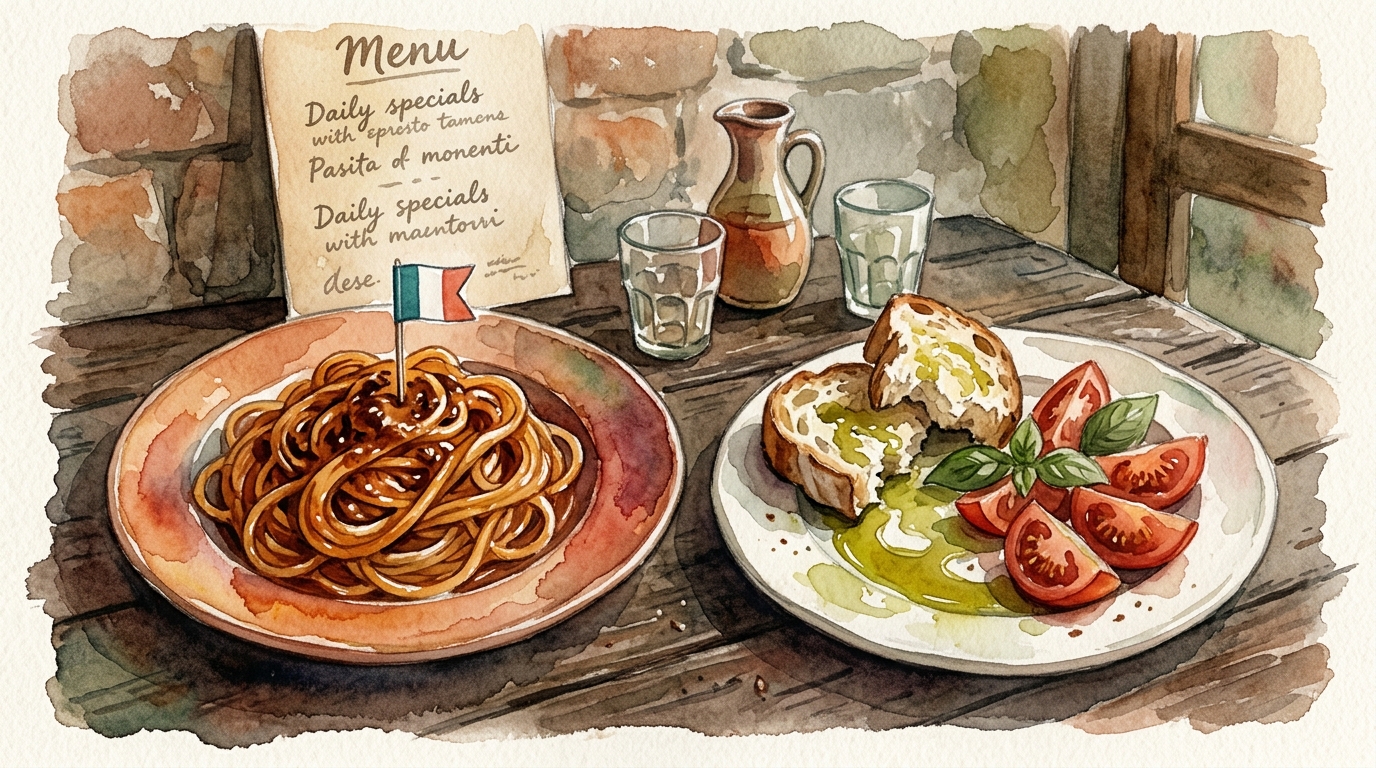
You're sitting at an outdoor terrace in Rome, the afternoon light warming your table, ordering fettuccine Alfredo because that's what you eat in Italy. The waiter nods politely, disappears into the kitchen, and you feel like you're living your best life. Here's the problem: the dish you just ordered doesn't really exist in Italian cuisine. The waiter knows it. The kitchen knows it. The only person who doesn't know it's you.
Across Europe, Asia, and the Americas, restaurants serve dishes to tourists that locals wouldn't touch. Some of these "traditional" foods were invented in a different country entirely. Others are real dishes that got twisted beyond recognition for foreign palates. A few are outright scams designed to separate you from your money while you smile for a photo.
Skyscanner's 2026 Travel Trends Report found that 73% of UK travelers now explore local supermarkets abroad as a way to experience authentic culture through everyday food. People want the real thing. They're just not always getting it.
Many "traditional" dishes served to tourists were invented elsewhere or don't exist in local cuisine at all. Fettuccine Alfredo isn't Italian. Sangria is a tourist drink in Spain. Chicago locals eat thin-crust, not deep dish. Fortune cookies are Japanese-American, not Chinese. This guide breaks down the biggest tourist food lies country by country and tells you what locals actually order instead.
The Scale of the Problem: Tourist Trap Restaurants in Numbers
Tourist food scams aren't just annoying. They're a multi-billion-euro industry that governments are finally starting to crack down on.
Greece launched over 50,000 undercover raids on tourist-area restaurants to catch scammers overcharging on food. The notorious DK Oyster bar in Mykonos charged an American tourist €836 for six portions of calamari and some beers. Tripadvisor took the rare step of adding a safety warning to the restaurant's review page.
Turkey took it further. As of February 2026, hidden charges in Turkish restaurants are banned entirely. No more surprise fees for bread, water, or sauces placed on the table. Violators face fines up to €30,000.
And in Prague, YouTube creator Janek Rubes of the Honest Guide channel was taken to court after exposing a restaurant near Prague Castle for pouring beer from plastic bottles into branded tankards while charging tourist prices. His reward for consumer advocacy? A lawsuit demanding hundreds of thousands of Czech crowns. (He was later awarded a national prize for moral integrity.)
The pattern is the same everywhere: restaurants near major tourist attractions charge more for lower quality, and often serve dishes that have nothing to do with local food culture. If you're interested in visiting Europe without the tourist crowd markup, the same logic applies to what you eat.
Italy: The Country Where Half Your Favorite "Italian" Food Doesn't Exist
Italy is ground zero for tourist food lies. The dishes most tourists order in Italy are either American inventions or mangled versions of the real thing. Here's what to skip and what to order instead.
Fettuccine Alfredo
Walk into any restaurant in Italy outside of one specific tourist spot in Rome and ask for fettuccine Alfredo. You'll get a blank stare. The dish as Americans know it, drowning in heavy cream sauce, was popularized by American tourists who visited Alfredo Di Lelio's restaurant in Rome in the 1920s, then re-created a cream-laden version back home because they couldn't replicate the original technique of emulsifying butter and Parmigiano with pasta water.
What to order instead: Cacio e pepe (pecorino and black pepper) or carbonara (guanciale, egg, pecorino). These are the actual Roman pasta dishes locals eat daily.
Spaghetti Bolognese
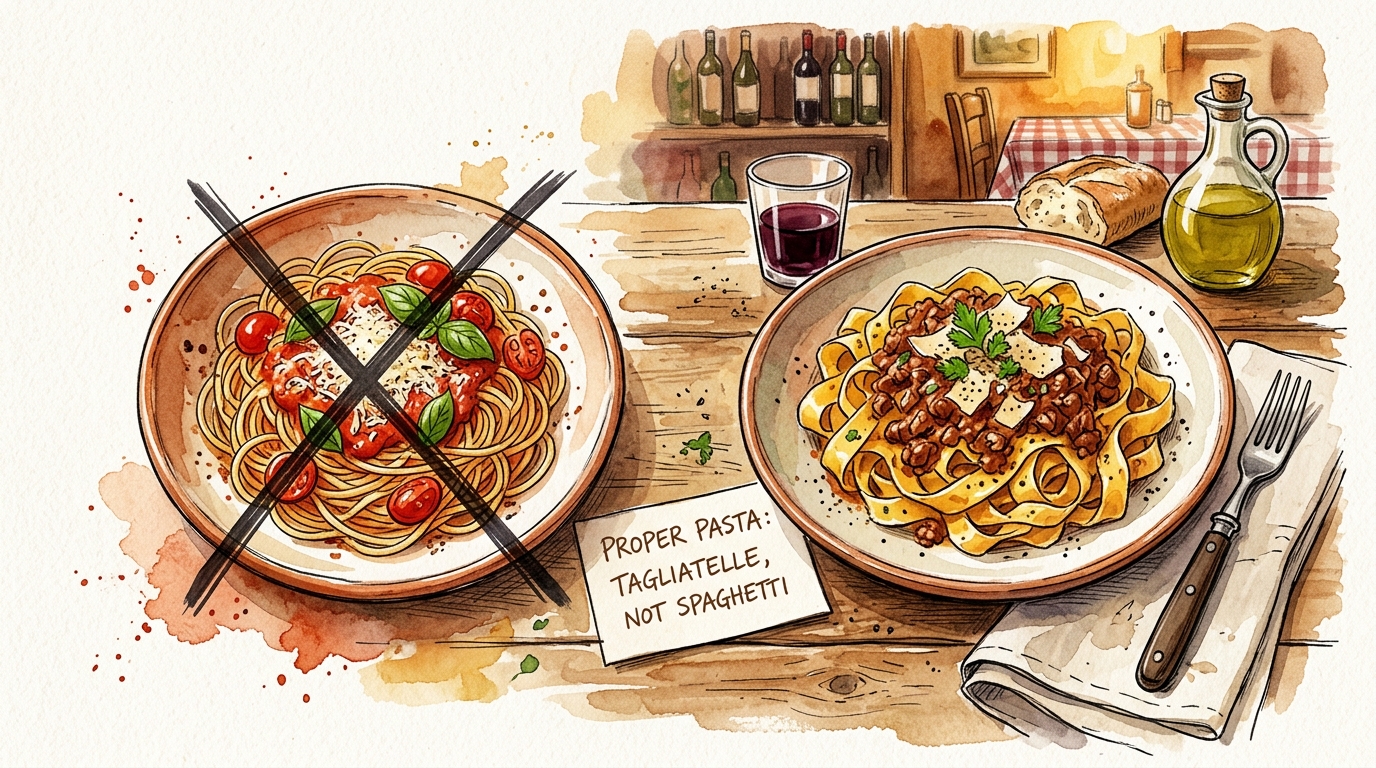
The former mayor of Bologna, Virginio Merola, declared on national radio that spaghetti Bolognese "doesn't actually exist." The real dish is tagliatelle al ragu: wide, flat ribbons of fresh egg pasta coated in a slow-cooked meat sauce of beef, pancetta, soffritto, wine, and milk. Spaghetti is round and smooth, so the sauce pools at the bottom instead of coating each strand. The Italian Academy of Cuisine registered the official recipe with the Bologna Chamber of Commerce in 1982 to stop the confusion.
What to order instead: Tagliatelle al ragu in Bologna. In other regions, ask what the local pasta specialty is. Every Italian city has one.
Spain: Sangria Is a Tourist Drink (And Locals Know It)
Ask any Spaniard what they think of sangria and you'll hear some version of the same thing: it's not a drink you order in a bar. Sangria appears at beach chiringuitos that cater to visitors, at summer parties when someone has time to slice fruit, or on restaurant menus built for out-of-towners.
The reasons are practical. A jug of sangria in a tourist zone runs past ten euros for a portion that's mostly ice. Spanish drinking culture revolves around short rounds. You have a small drink, then change bars or go home. Nobody sits around nursing a pitcher.
What locals actually drink: Tinto de verano, red wine mixed with lemon-flavored soda. It's cheaper and lower in alcohol, taking about five seconds to make. In the morning or early afternoon, order a vermut (vermouth on tap with an olive). In the evening, a cana (small draft beer) or a glass of vino joven (young wine) that often costs about the same as a bus ticket.
| Drink | Who Orders It | Typical Price | When |
|---|---|---|---|
| Sangria (pitcher) | Tourists | €10-18 | Any time (tourist hours) |
| Tinto de verano | Locals | €1.50-3 | Summer afternoons |
| Vermut | Locals | €2-4 | Sunday mornings |
| Cana (draft beer) | Locals | €1.50-2.50 | Evenings |
Prices are approximate averages for mid-sized Spanish cities (2026). Madrid and Barcelona run higher.
The savings speak for themselves. But ordering what locals drink also gets you into the rhythm of Spanish social life instead of sitting at a tourist table with a sticky pitcher.
Paella Outside Valencia
Paella originates from Valencia. Not Barcelona. Not Madrid. Not "Spain in general." If you're ordering paella near Las Ramblas in Barcelona from a restaurant with a giant photo of it on the menu outside, you're very likely getting microwave-heated rice dyed yellow with coloring agents imitating saffron, stuffed with random ingredients and (the ultimate sin) chorizo.
What to order instead: If you're in Valencia, eat paella for lunch between 1:30 and 3:30 PM, which is when locals eat it. In Barcelona, look for restaurants in neighborhoods like Poble Sec or Poblenou that specialize in rice dishes (arrocerias), not tourist-facing spots on the main drag.
Never order paella for dinner in Spain. Traditional Valencian paella is a lunch dish. Restaurants that serve paella for dinner are catering to tourist schedules, not local food culture.
Beyond Europe: "Traditional" Dishes That Were Invented Somewhere Else Entirely
The tourist food problem isn't limited to Europe. Some of the world's most famous "traditional" dishes were invented in completely different countries, sometimes for political reasons, sometimes by accident, sometimes to suit foreign tastes.
Fortune Cookies (Not Chinese)
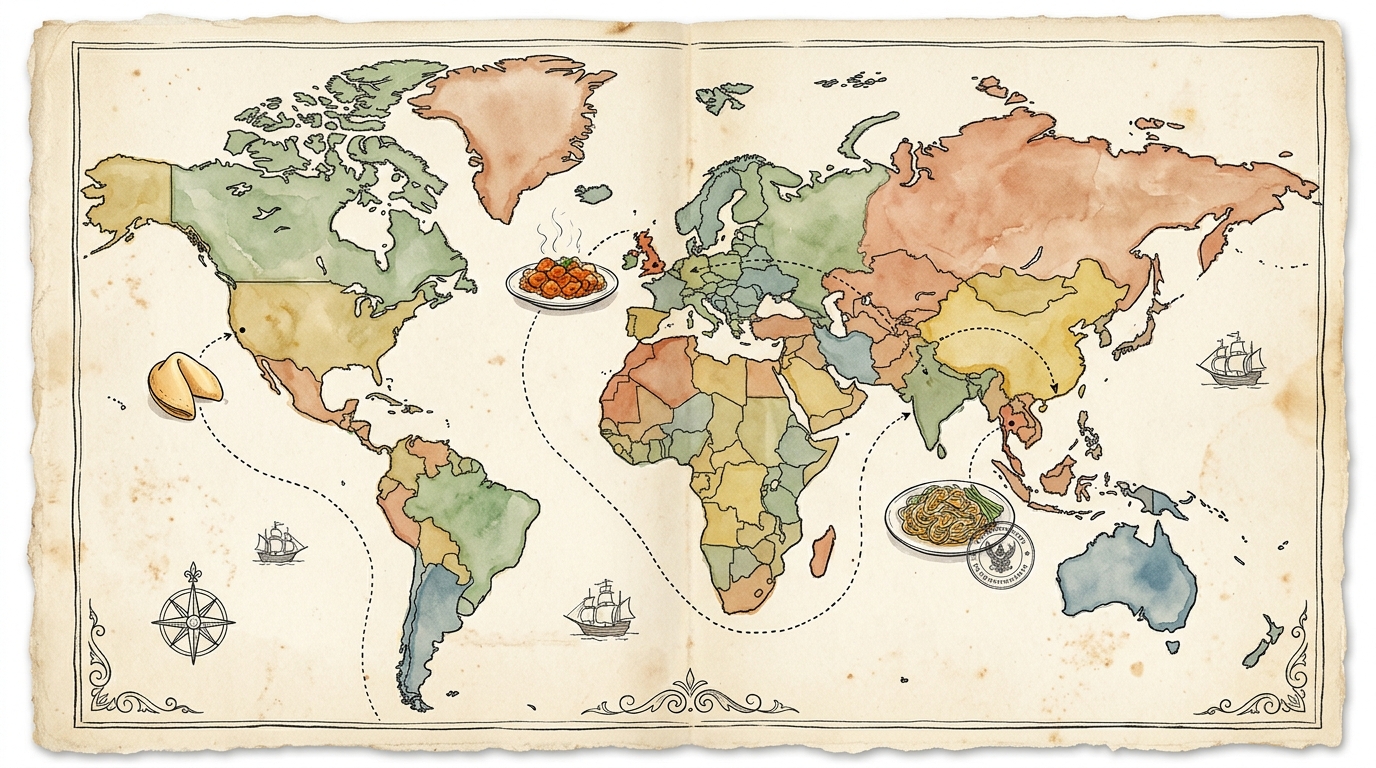
Fortune cookies are served at the end of every Chinese meal in America, Canada, and Australia. They're not Chinese. The Smithsonian's National Museum of American History traces fortune cookies to Japanese immigrants in the late 19th century, inspired by omikuji (fortune slips) sold at Japanese temples. During World War II, when Japanese Americans were forcibly placed in internment camps, Chinese-American entrepreneurs took over their bakeries, and by the war's end, the cookies were permanently associated with Chinese restaurants.
Chicken Tikka Masala (British, Not Indian)
In 2001, British Foreign Secretary Robin Cook described chicken tikka masala as "a true British national dish." The most widely accepted origin story places its invention in Glasgow in the 1960s or 1970s, where restaurateur Ali Ahmed Aslam reportedly improvised a sauce from condensed tomato soup and spices to satisfy a customer who wanted gravy with his dry chicken tikka. The chicken tikka itself is Indian. The creamy masala sauce? That's a British adaptation for British tastes.
Pad Thai (A Government Invention)
Pad Thai feels ancient. It isn't. The Smithsonian traces the dish to the late 1930s and a Thai government nation-building campaign. Prime Minister Plaek Phibunsongkhram wanted a unifying national dish, so the government distributed a standardized recipe to street vendors along with free noodle carts. The practical motivation? A wartime rice shortage meant one bowl of rice could stretch into two bowls of rice noodles. Before this campaign, fried noodles in Thailand were still strongly associated with Chinese cuisine.
Corned Beef and Cabbage (American, Not Irish)
Every St. Patrick's Day, millions of Americans eat corned beef and cabbage believing it's authentically Irish. It's not. You won't find corned beef on Dublin restaurant menus aimed at tourists. But the myth persists so strongly in the US that it's worth debunking. Traditional Irish families ate salted pork and bacon with potatoes and cabbage, the Smithsonian notes. When Irish immigrants arrived in New York, they discovered corned beef at Jewish delis and noticed its similarity to Irish bacon. Beef was cheap in America (unlike Ireland, where cattle were too valuable for dairy and farming to slaughter for meat), so the substitution stuck. It became "Irish" through Irish-American St. Patrick's Day celebrations, not through any Irish cooking tradition.
Caesar Salad (Mexican, Not Italian)
The Caesar salad was invented on July 4, 1924, in Tijuana, Mexico. NPR reports that Italian immigrant Caesar Cardini ran a restaurant in Tijuana to attract American customers during Prohibition. When a Fourth of July rush depleted his kitchen's supplies, he improvised a salad with what he had and added tableside theatrics. The salad isn't Italian (despite Cardini's heritage) and it isn't American either. It's a Mexican creation born from necessity and showmanship.
The Whale Meat Problem: When "Traditional" Food Exists Only Because Tourists Order It
Iceland presents the strangest case of tourist food lies: a dish that locals don't eat, but restaurants keep serving because tourists think it's traditional and keep ordering it.
Whale and Dolphin Conservation data shows that 84% of Icelanders never eat whale meat. Only about 1.5-2% of the Icelandic population regularly consumes it. The demand comes almost entirely from tourists who want to try something "authentically Icelandic." Surveys have shown that roughly 40% of tourists who visited Iceland in 2009 tried whale meat, though that number has since dropped following awareness campaigns.
What to order instead: Plokfiskur (mashed fish stew), hardfiskur (dried fish jerky), or lamb, the genuine backbone of Icelandic cuisine.
The Chicago Deep-Dish Lie
This one stays in the US but it's too good to skip. Every tourist in Chicago orders deep-dish pizza. Almost no one who actually lives there eats it regularly.
The Takeout reports that deep-dish comprises only about 9% of pizza deliveries in Chicago. What locals actually eat is tavern-style pizza: thin, crispy crust cut into squares you can eat with one hand while holding a beer with the other.
Coming to Chicago just to have deep dish? No. Don't do it. It's like when people visit New York just to go to Times Square and see a play.
- Steve Dolinsky, Chicago food journalist, via The Takeout
Tavern-style pizza has been around since the 1930s, rooted in neighborhood taverns where barkeeps made thin-crust pies to keep factory workers drinking. Deep-dish didn't arrive until the 1940s. Skip the hour-long wait at Giordano's and find a neighborhood tavern serving squares.
How to Spot a Tourist Trap Restaurant (Before You Sit Down)
Knowing which dishes are fake is half the battle. Here are the tells that separate tourist traps from the real thing, from Barcelona to Budapest.
- Check who's eating there. If the restaurant is full at 6 PM in Spain (where locals eat dinner at 9 or 10), it's not a local crowd. Look for restaurants where the average diner looks like they live in the neighborhood, not like they stepped off a tour bus.
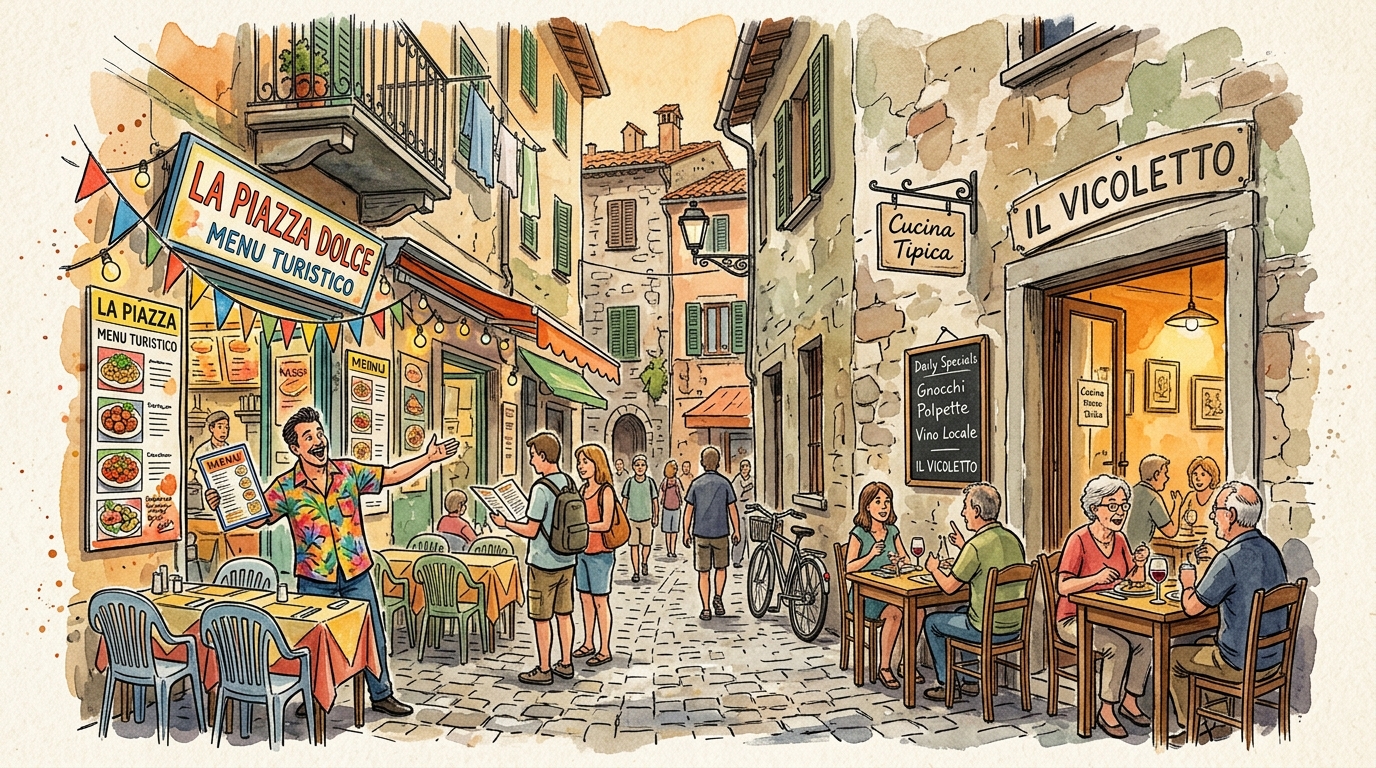
- Watch for sidewalk hawkers. A staff member standing outside actively recruiting diners is one of the clearest signs of a tourist trap. Restaurants with good food don't need to pull people in from the street.
- Examine the menu. Plastic-coated menus with photos of every dish, translated into six languages, are made for tourists. Locals don't need a picture of spaghetti to know what spaghetti looks like. A handwritten menu or a short list of daily specials is a much better sign.
- Check the location. If you're within a two-minute walk of a major monument, cathedral, or cruise ship port, prices will be inflated and quality will be compromised. Walk ten minutes in any direction and the food gets better while the prices drop.
- Look at the decor. When every wall has giant props and themed decorations that look like they came from a party supply website, the restaurant is selling an experience, not food. The best local restaurants often look unimpressive from the outside.
- Ask the right people. Hotel concierges sometimes have referral relationships with tourist restaurants. Ask bartenders, taxi drivers, or the staff at small shops instead. Or use tools like TripProf that provide personalized restaurant recommendations based on where locals actually eat.
The Hidden Fees Nobody Warns You About
Even when the food is legitimate, tourist restaurants across Europe have perfected the art of surprise charges. Here's what shows up on bills that you didn't expect.
Italy's coperto (cover charge) adds €1-3 per person for bread and the privilege of sitting down. Some regions like Lazio (where Rome is) have banned it, but it's still common elsewhere. In Lake Como, some restaurants add a €2 surcharge for a "scenic table". You're literally paying for the view.
Water is rarely free in European restaurants. Asking for tap water is technically possible but culturally unusual, and some restaurants will refuse or bring bottled water instead. A European Commission review of drinking water policy found wide variation across Europe, with the UK and France legally requiring free water while other countries have no such obligation.
These charges aren't scams in the illegal sense. They're cultural norms that tourists don't expect. The problem is when tourist-facing restaurants pile them on: bread you didn't order, water you didn't ask for, a coperto that wasn't on the menu. If you're traveling internationally for the first time, understanding these customs saves both money and frustration.
- Check if a cover charge (coperto/cubierto/couvert) is listed on the menu before ordering
- Ask whether bread and water are included or charged separately
- Verify the price of any "specials" the waiter recommends verbally. If it's not on the menu, it's often the most expensive item
- In Greece and Turkey, confirm prices for fish sold "by weight" before ordering. The per-kilo price can mean easily a €50+ plate
- Check for service charge on the bill before adding a tip on top
- Keep a photo of the menu on your phone in case the bill doesn't match
What "Eating Like a Local" Actually Looks Like
"Eat like a local" doesn't mean finding some secret restaurant. It means adopting the habits and rhythms of how people in that place actually eat.
In Spain, that means eating lunch at 2 PM and dinner at 9:30 PM. In Italy, it means ordering a primo (pasta) OR a secondo (meat/fish), not both, unless it's a special occasion. In France, it means a prix fixe lunch menu at a neighborhood bistro for roughly EUR 14-18, not a la carte dinner near the Eiffel Tower. In Japan, it means standing at a tachigui (standing-eat) counter for noodles, not sitting at a tourist sushi bar where the prices triple because there's an English menu.
The Skyscanner 2026 report found that 55% of US travelers now visit local supermarkets while abroad, not just for souvenirs but to understand how locals actually eat. Grocery stores tell you more about a food culture than any restaurant menu. What's in season? What's cheap? What do families buy for Tuesday dinner?
From our own travel notes: the best meals we've had while traveling weren't at restaurants. They were at a market in Lisbon where we pointed at things we couldn't name, at a bakery in Vienna where we watched what the person in front of us ordered, and at a convenience store in Tokyo at 2 AM where everything cost ¥200 and everything was perfect.
If you're planning a multi-city trip through Europe, each city will have completely different food rhythms. What works in Rome won't work in Copenhagen.
Frequently Asked Questions
What foods do tourists order that locals never actually eat?
The biggest offenders include fettuccine Alfredo in Italy, sangria in Spain (locals drink tinto de verano), spaghetti Bolognese in Bologna, whale meat in Iceland (84% of locals never eat it), and deep-dish pizza in Chicago.
How can you tell if a restaurant is a tourist trap?
Look for staff outside recruiting diners, plastic menus with photos translated into multiple languages, a location near major tourist sites, and a dining room full of people wearing backpacks and cameras.
What should you order instead of tourist trap dishes in Italy?
In Rome, order cacio e pepe or carbonara instead of fettuccine Alfredo. In Bologna, order tagliatelle al ragu instead of spaghetti Bolognese. Always ask what the local pasta specialty is. Every Italian region has its own.
Why do restaurants serve fake "traditional" food to tourists?
Tourists ask for it. Restaurants in tourist zones stock what sells. International visitors arrive with expectations shaped by their home country's version of that cuisine. Serving fettuccine Alfredo to Americans who expect it is easier and more profitable than explaining why it doesn't exist.
Are fortune cookies Chinese?
No. Fortune cookies originated with Japanese immigrants in the US in the late 19th century. They became associated with Chinese restaurants during World War II when Japanese Americans were interned and Chinese entrepreneurs took over their bakeries.
What are the biggest restaurant scams in Europe in 2026?
Hidden cover charges in Italy, fish sold "by weight" in Greece, beer from plastic bottles disguised as branded drafts (exposed in Prague), and scenic table surcharges. Turkey banned hidden charges (as of February 2026) with €30,000 fines.
How do locals find good restaurants in their own cities?
Word of mouth, not apps. Locals eat at places recommended by friends, family, and coworkers. They avoid restaurants near tourist sites and eat at hours that match local customs.
Key Takeaways
- Many of the world's most famous "traditional" dishes were invented in different countries. Fettuccine Alfredo is American, chicken tikka masala is British, fortune cookies are Japanese-American, and pad Thai was a 1930s government campaign.
- Tourist trap restaurants cluster near major attractions and rely on visitors who don't know local food culture. Walk ten minutes in any direction and both quality and prices improve dramatically.
- Locals eat differently than tourists: different dishes, different hours, different price points. In Spain, that means tinto de verano instead of sangria. In Chicago, thin-crust tavern pizza instead of deep dish.
- Hidden fees for bread, water, cover charges, and scenic tables are common across Europe. Turkey banned them entirely (as of February 2026) with €30,000 fines for violations.
- The best way to eat well while traveling is to adopt local habits: eat at local hours, order what the kitchen specializes in, shop at grocery stores and markets, and ask bartenders (not hotel concierges) for recommendations.
- Planning tools like TripProf build personalized dining guides for each destination with local dishes, restaurant customs, and tipping norms. You won't be guessing when you sit down at a table in an unfamiliar city.
- Greece, Turkey, and the Czech Republic are cracking down on tourist food scams, but the best defense is still your own knowledge.
- Don't eat whale meat in Iceland just because a restaurant serves it. Only 1.5-2% of Icelanders eat it regularly. Tourist demand is the primary driver of that market.
Sources
- Skyscanner 2026 Travel Trends Report: Travel behavior statistics including food tourism and local supermarket visits
- Fodor's Travel: Greece's 50,000+ undercover raids on tourist restaurants
- Turkiye Today: Turkey's February 2026 ban on hidden restaurant charges
- Radio Prague International: Prague Honest Guide court case over tourist restaurant scam exposure
- Wikipedia: Fettuccine Alfredo: History and American popularization of the dish
- CBC News: Mayor of Bologna's declaration that spaghetti Bolognese doesn't exist
- CNN: Sangria as a tourist drink in Spain vs. local alternatives
- Whale and Dolphin Conservation: Iceland whale meat consumption statistics
- The Sun: DK Oyster Mykonos €836 tourist overcharging incident
- The Takeout: Chicago deep-dish vs. tavern-style pizza local preferences
- Smithsonian National Museum of American History: Japanese-American origins of fortune cookies
- Smithsonian Magazine: Irish-American origin of corned beef and cabbage
- Smithsonian Magazine: Political origins of pad Thai in 1930s Thailand
- Wikipedia: Chicken Tikka Masala: British origin and Glasgow creation story
- NPR: Caesar salad's 1924 invention in Tijuana, Mexico
- Tasting Table: Signs of tourist trap restaurants
- European Commission: European drinking water policy and restaurant obligations
- Radio Prague International: Janek Rubes lawsuit and national prize
- Fodor's Travel: Paella origins and Valencian food culture
- Lonely Planet: Spanish food and dining customs
- CNN: Ali Ahmed Aslam and the invention of chicken tikka masala in Glasgow
- CNN: Outrageous charges targeting tourists in Italy
Last updated: July 3, 2026
Keep Reading
More travel tips and guides picked for you
Michelin's Great Lakes Cities, Ranked by What They Paid
Six Great Lakes cities are paying wildly different amounts for a shot at a Michelin star, and half won't say what they spent. Here's how all six rank, and why Fort Worth's zero-star result after paying proves it buys nothing.

Where to spend Diwali 2026: six real celebrations worth the trip
Diwali 2026 falls on 8 November. From Ayodhya's record-breaking lamp display to Leicester's Golden Mile and a month of Global Village in Dubai, here are six real celebrations worth planning a trip around, with dates, costs, and honest downsides.
The Best Apps to Book a Food Tour (and Where You'll Overpay)
Airbnb Experiences, EatWith, Devour Tours, GetYourGuide and Traveling Spoon, compared on real prices and honest downsides, plus the two minute check that stops you paying twice for the same tour.