How to Plan a Multi-City Europe Trip (2026)
Key Highlights
- 1
- 2
- 3
+4 more in the takeaways below
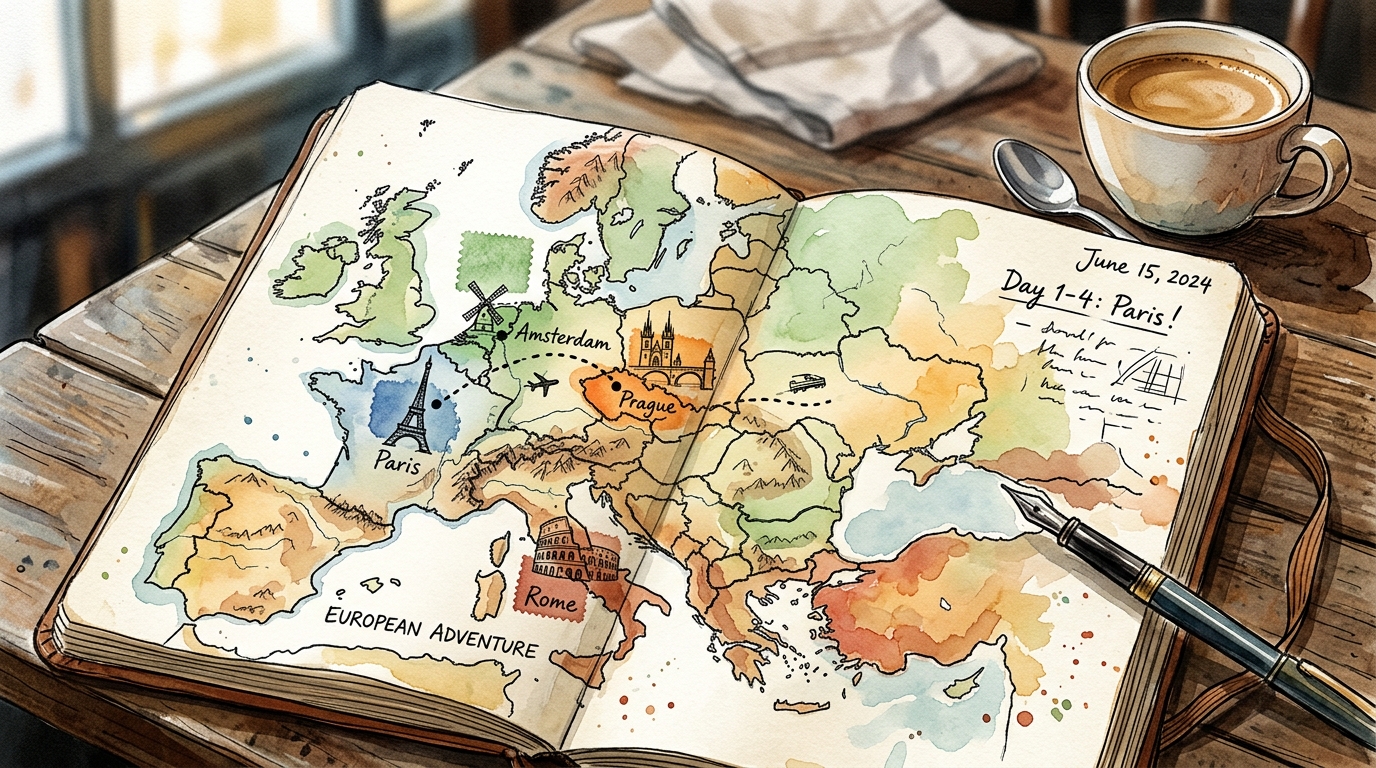
You're staring at a map of Europe with 11 pins in it. Paris, obviously. Rome, non-negotiable. Barcelona, Amsterdam, Prague, and somehow you've also pinned Cinque Terre, Dubrovnik, and "maybe Switzerland?" You have 14 days.
Something has to go.
Planning a multi-city Europe trip is absolutely doable. But most people get it wrong, spend half their vacation on trains and in airports, and come home more tired than when they left. 793 million tourists visited Europe in 2025. A lot of them made the same mistakes you're about to. Here's how to not do that.
Stick to 3-4 cities in two weeks (not 7). Build a geographic loop, not a zigzag. Use trains for legs under 6 hours, flights above. Budget €80-120/day for Western Europe, €35-70 for Eastern. And if you're going with a group, get a planning tool that handles multi-currency expenses and per-city destination guides before someone starts a spreadsheet that nobody updates.
How Many Cities Can You Actually Visit?
For a two-week trip, 3-4 cities is the sweet spot. For 10 days, cap it at 3. Go beyond that and you'll spend more time packing and unpacking than actually seeing anything.
The biggest mistake first-timers make? Treating Europe like a checklist. "We'll do Paris for 2 days, then Amsterdam for 1, then Berlin for 2, then Prague..." Suddenly half the trip is transit days. We've seen this play out dozens of times in travel forums, and the advice is always the same: slow down. The European Travel Commission reports that slow travel is rising fast, from 22% of travelers in 2025 to 26% in 2026. People are catching on.
Here's a framework that works:
| City Tier | Examples | Minimum Stay | Why |
|---|---|---|---|
| Tier 1 (Major capitals) | Paris, Rome, London, Barcelona | 3-4 full days | Dense with museums, neighborhoods, day trips. Two days isn't enough for any of them |
| Tier 2 (Mid-size gems) | Prague, Lisbon, Vienna, Amsterdam | 2-3 full days | Walkable, manageable. Two days gives you the highlights plus one deep-dive |
| Tier 3 (Small stops) | Bruges, Cinque Terre, Sintra, Hallstatt | 1-2 full days | Often a day trip from a Tier 2 base. Don't book a separate hotel |
Three rules on top of this:
The jet-lag buffer. Flying in from outside Europe? Add a full day to your first stop. You'll waste it otherwise, groggy and disoriented, eating dinner at 4pm because your body thinks it's lunch.
The transit tax. Every city switch costs you roughly half a day. Packing, checkout, travel, finding the new place, checking in. That's not a sightseeing day. Count it.
Then there's the burnout threshold. After 8-9 days of constant moving and sightseeing, most people hit a wall so hard they spend day ten in their hotel room watching Netflix in a language they don't speak. Build one slow day into the trip. No museum, no agenda, just wandering.
So a realistic 14-day trip looks like: 4 days Paris + travel day + 3 days Barcelona + travel day + 3 days Rome + 1 slow day + travel home. Three cities. Doesn't feel rushed.
Adding a "quick stop" in a fifth city because it's "on the way." Those detours eat an entire day and usually mean a mediocre 4-hour visit you'll barely remember. If you can't give a city at least 2 full days, skip it. You can always come back.
Want a fourth city? Drop one Tier 1 and replace it with a Tier 2. Prague instead of Rome, say. Same trip length, more variety, less exhaustion. If this is your first international trip, resist the urge to see everything. The people who enjoy Europe most are the ones who saw less of it, slower.
Train, Flight, or Bus? The Route-by-Route Verdict
If the train takes less than 6 hours, take the train. You skip the airport circus, travel city center to city center, and keep your luggage with you. Above 6 hours, fly. But budget for the real cost, not just the ticket price.
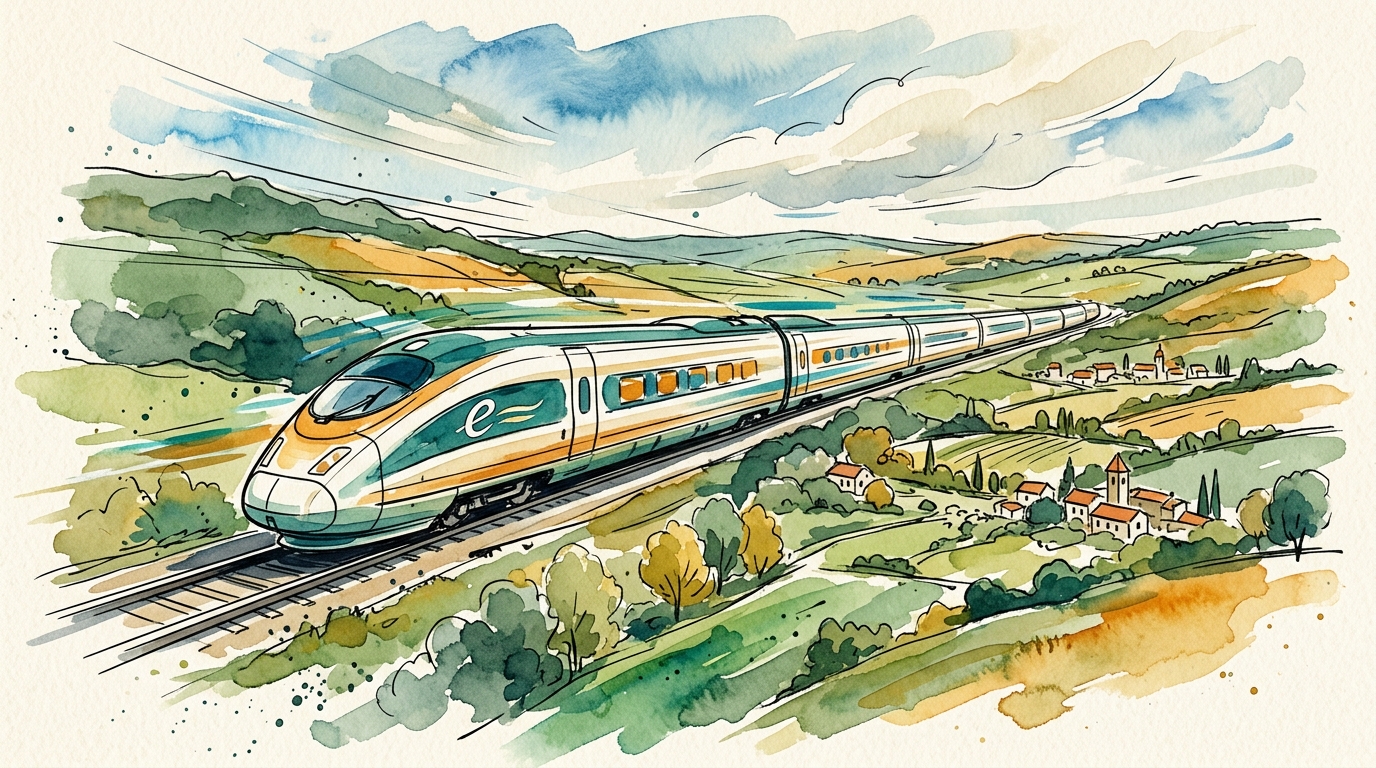
The "€19 Ryanair flight" is one of Europe's great illusions. Add a carry-on bag (€6-36 depending on route and timing), airport transit on both ends (€10-20 each way), and the 2+ hours you spend in security lines, and you've spent €60-95 and nearly 5 hours. A €35-50 train ticket covering the same distance in 3 hours, city center to city center, is the better deal almost every time.
Here's how popular routes actually compare:
| Route | Train | Flight (total) | Verdict |
|---|---|---|---|
| Paris → Amsterdam | €35-80, 3h20 (Eurostar) | €30-90 + airports, ~4.5h | Train |
| Rome → Florence | €20-50, 1h30 (Frecciarossa) | No worthwhile flight | Train |
| London → Paris | €50-180, 2h15 (Eurostar) | €40-120 + airports, ~4.5h | Train |
| Prague → Vienna | €15-25, 4h (RegioJet) | €40-90 + airports, ~4h total | Train |
| Barcelona → Paris | €59-130, 6h30 (TGV) | €30-80 + airports, ~5h | Flight (marginal) |
| Berlin → Amsterdam | €40-90, 6h (ICE) | €30-70 + airports, ~5h | Tie |
| Rome → Barcelona | No good direct train | ~€40-100, 2h + airports | Flight |
| Lisbon → Madrid | €25-45, 9h30 (train/bus) | ~€25-60, 1h + airports | Flight |
Prices checked March 2026. Fares vary by booking date and availability. Flight totals include estimated airport transit and baggage fees.
One thing to know: the former Thalys trains are now Eurostar. Same trains, same Paris-Amsterdam and Paris-Brussels routes, just one booking system. Prices drop significantly when you book 2-3 months ahead. Seat61 is the best independent resource for checking European train routes and prices.
And don't write off buses. FlixBus covers routes that trains overcharge for, especially in Eastern Europe. Prague to Budapest for €17-30, about 6 hours? The 1:45am departure gets you there by breakfast, saving you a hotel night.
Book high-speed trains (Eurostar, Frecciarossa, TGV, AVE) in advance. Prices can triple last-minute. Regional trains in Germany, Austria, and Switzerland? Buy at the station. No price difference.
Building Your Multi-City Itinerary Without Wasting Days in Transit
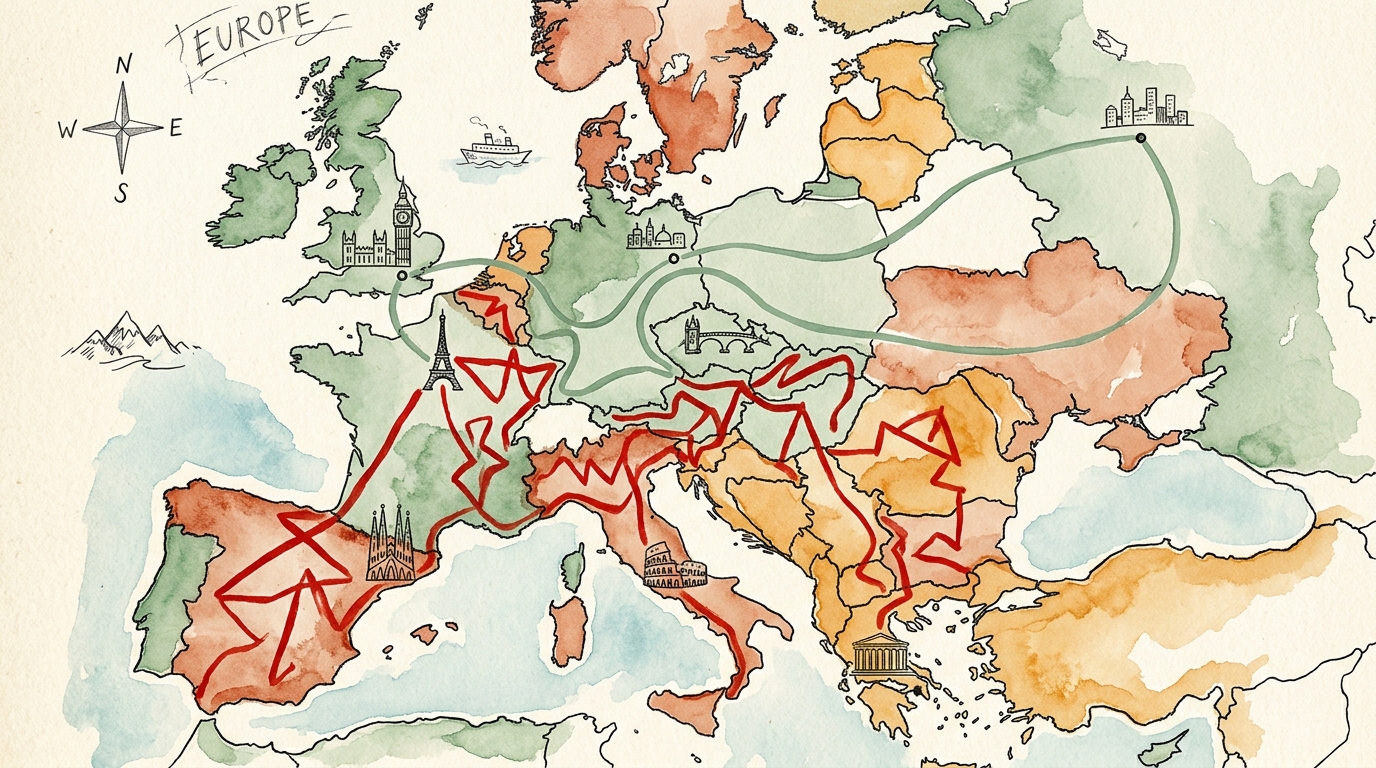
Design your route as a geographic loop or a straight line. Never a zigzag. And fly into one city, out of another. This single trick saves more time and money than any other planning decision you'll make.
Look at the difference:
- London → Barcelona → Amsterdam → Rome
- 3 flights, 15+ hours of transit
- Crisscrossing the continent
- Backtracking to your departure city
- London → Paris → Amsterdam → Berlin → Prague
- 4 train legs, each 3-6 hours
- Steady eastward movement
- Fly home from Prague (open-jaw ticket)
That open-jaw ticket (fly into one city, out of another) typically costs about the same as a round-trip and eliminates the backtrack. Search "multi-city" on Google Flights or Skyscanner instead of round-trip. It's the single biggest time-and-money saver in multi-city planning.
If you're traveling with a group, this is where everything falls apart. Four people, four wishlists, zero overlap. On our last trip, one person lobbied hard for a "quick stop" in Dresden between Berlin and Prague. We gave it 4 hours between trains. Nobody remembers it. The lesson: if you can't give a city two full days, it's not a stop, it's a blur.
Here's what actually works for groups: the organizer proposes 2-3 route options, the group votes asynchronously (not in a group chat where the loudest voice wins), and everyone commits before a single flight gets booked. Don't try to build it from scratch in a 47-message WhatsApp thread, because you'll end up three weeks later with no plan and one person who's already booked a non-refundable Airbnb in a city nobody else agreed to.
This is also where generic "top 10 things to do in Prague" lists fail you. They won't tell you that trams beat the metro for sightseeing, that the tourist tax runs €2 per night, or that half the museums close on Mondays. For a multi-city trip, you need detail that's specific to each stop: how local transport works, what a meal actually costs, which cultural norms you'll trip over if nobody warns you.
TripProf generates a personalized travel guide with 60 sections per destination covering exactly this: public transport, tipping customs, scam warnings, restaurant picks, phrase cheat sheets, and budget benchmarks, all tailored to your group size, budget, and interests. Instead of Googling "is Prague safe" at 11pm the night before you arrive, you've got it in your pocket. The itinerary builder lets you lay out each city's schedule day by day, rearrange activities across days, and share the whole plan with your travel group so everyone sees the same thing.
Budgeting Across Borders (And Currencies)
Western Europe costs €80-120 per person per day at a mid-range level. Eastern Europe runs €35-70. But the total isn't the hard part. The hard part is tracking expenses across 3+ currencies when you're splitting costs with friends who all paid for different things in different countries.
A typical mid-range day breaks down to roughly €40-60 on accommodation (shared Airbnb or 3-star hotel), €25-35 on food (café breakfast, lunch out, a cooked dinner), €10-20 on transport, and €10-15 on one paid attraction or tour.
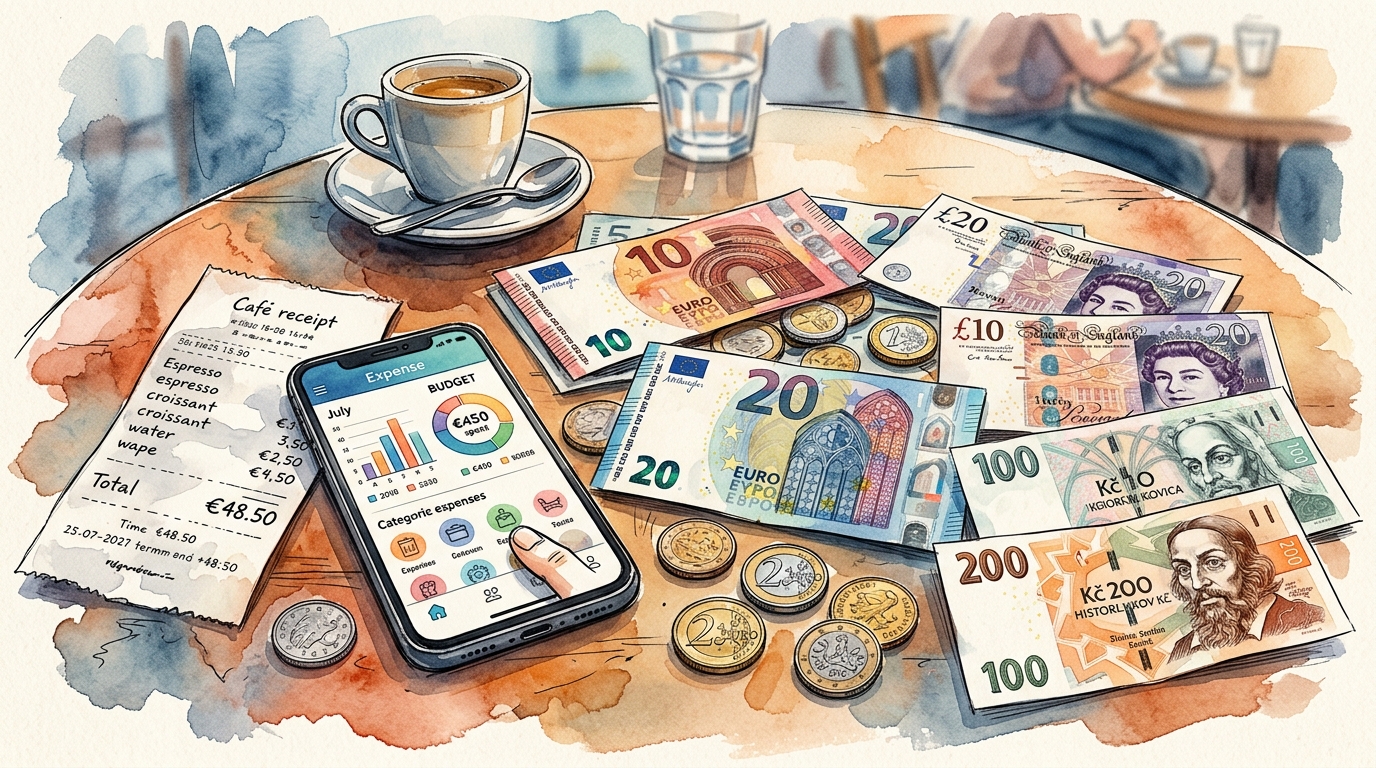
But here's where multi-city trips get properly messy, especially with a group. You start in Paris (EUR), hop to London (GBP), fly to Prague (CZK), and someone at home Venmo'd their share in USD. That's four currencies in one trip. Your spreadsheet can't handle this. Most expense apps can't either.
And it gets worse at the receipt level. You're staring at a dinner bill in Czech that reads "Celkem: 1 247 Kč" and trying to figure out what everyone owes in euros, who paid for what, and whether the beer that one friend ordered should be split or individual.
TripProf's expense tracker was built for this exact scenario. It handles multi-currency conversion automatically, scans receipts in local languages (German, French, Czech, Italian, and 40+ others), splits costs per person, and shows running totals in your home currency. So when someone asks "how much have we actually spent?" on day six of a four-country trip, you have an answer. Not a shrug and a promise to figure it out later. For a deeper look at how to split trip costs fairly, we've written a full guide.
Hidden costs nobody warns you about:
- Tourist/city taxes: €1-7 per person per night (varies by city and hotel rating)
- Interrail seat reservations: €10-35 per leg on top of the pass price
- Luggage storage: €5-12 per bag per day at train stations
- SIM cards / eSIMs: €10-25 for 10-30 days of data
- Museum pre-booking fees: €2-4 service charge per ticket (Uffizi, Louvre, Sagrada Família)
These add up to €100-200 per person over two weeks. Budget for them.
Withdraw cash from ATMs in the local currency. Never accept the terminal's "conversion offer" (Dynamic Currency Conversion). That's a 3-7% markup over the interbank rate. Your bank's own exchange rate is almost always better.
What Changed for Multi-City Europe Trips in 2026
One major change affects every non-EU traveler crossing into Europe this year: the new biometric border system. If your route also spans multiple climates, the packing side matters too.
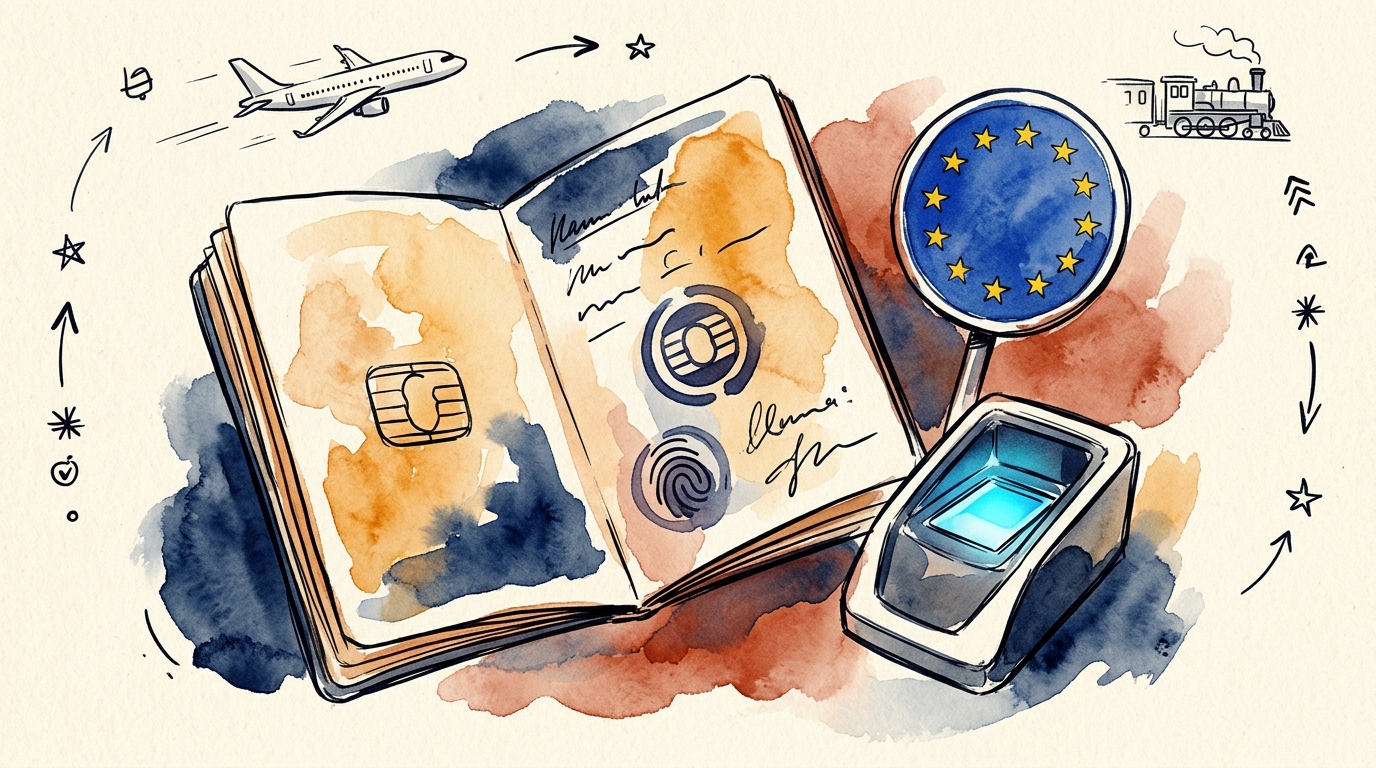
The EES biometric system. Starting April 10, 2026, all 29 Schengen countries require non-EU travelers to provide fingerprints and a facial scan at their first point of entry. This replaces the old passport-stamp system. According to the European Commission, children under 12 are exempt from fingerprinting but still need a facial scan.
What this means for multi-city travelers: your first Schengen border crossing will take longer. Plan for 30-60 extra minutes at passport control. After that initial registration, movement between Schengen countries stays the same. France to Germany? No additional checks. But if your route includes a non-Schengen stop (UK, Ireland) and you re-enter Schengen afterward, expect another scan.
There's a practical safety valve, though. EU rules allow member states to partially suspend EES checks for up to 90 days after the April rollout to manage long queues during peak travel, with a possible 60-day extension on top of that. So if you're traveling in June-August 2026, the initial chaos may have eased somewhat. The system also replaces the old 90/180-day rule tracking via passport stamps with automated digital tracking, which means no more worrying about whether the border guard counted your stamps correctly.
Keep your travel documents organized - passport, visa (if applicable), proof of accommodation, and return ticket details should all be accessible, not buried in your checked luggage.
Packing for multiple climates. A Barcelona → Swiss Alps → Amsterdam trip means dressing for 32°C, 8°C, and sideways rain in one bag. Pack a compressible mid-layer and a weatherproof shell, wear your heaviest shoes on the plane, and check our tested packing hacks for the full multi-city strategy.
Frequently Asked Questions
How many cities can I visit in Europe in 2 weeks?
Three to four, comfortably. Budget 3-4 full days in major cities (Paris, Rome, Barcelona) and 2-3 in smaller ones (Prague, Lisbon). Any more and you're sightseeing from train windows.
Is it cheaper to fly or take the train between European cities?
Under 6 hours, trains are usually faster door-to-door and comparable in price. Over 6 hours, flights win on time. But add €30-50 for airport transit and baggage to every flight price you see online.
Should I book trains in advance in Europe?
Yes for high-speed routes (Eurostar, Frecciarossa, TGV, AVE). Prices can triple last-minute. Regional trains in Germany, Austria, and Switzerland are generally buy-on-the-day.
What's the best way to handle money across multiple European countries?
Use a no-foreign-transaction-fee card (Revolut or Wise work well across Europe and the US). Withdraw from ATMs in local currency. Always decline Dynamic Currency Conversion at payment terminals.
Is Interrail/Eurail worth it for a multi-city trip?
For 4+ countries over 3+ weeks, the math often works. For shorter trips (2 weeks, 3 cities), buying individual tickets is usually cheaper once you factor in €10-35 reservation fees per train that the pass doesn't cover.
What is the EU Entry/Exit System and how will it affect my trip?
EES goes fully live April 10, 2026. Non-EU travelers provide fingerprints and a face scan at their first Schengen border entry. After that, travel within Schengen is unchanged. Allow extra time at your first crossing.
How do I split costs on a group trip across different currencies?
Use a multi-currency expense tracker, not a spreadsheet. You need automatic conversion between EUR, GBP, CZK, and whatever else your route crosses. Group planning apps that handle this save hours of post-trip reconciliation.
Key Takeaways
- Cap your trip at 3-4 cities for two weeks. Fewer cities means more time to actually enjoy them.
- Build a geographic loop and use open-jaw flights (fly into one city, out of another) to eliminate backtracking.
- Take the train for legs under 6 hours. Fly for anything longer. Don't dismiss buses for Eastern Europe.
- Budget €80-120/day for Western Europe, €35-70 for Eastern. Add €100-200 for hidden costs (tourist taxes, reservations, SIM cards).
- Europe's EES biometric system goes live April 10, 2026. Budget extra time at your first Schengen border crossing.
- Pack for your warmest destination and layer up for the rest. One mid-layer and a weatherproof shell cover most European climate swings.
- A multi-city trip across currencies, languages, and transport systems needs a single place to manage it all. TripProf handles personalized destination guides for each city, day-by-day itinerary planning, multi-currency expense tracking with receipt scanning in 40+ languages, and shared document storage for the whole group.
Last updated: July 3, 2026
Keep Reading
More travel tips and guides picked for you

Airport liquid rules in 2026: which airports actually allow more than 100ml
Some UK airports now let you carry 2 litres of liquid through security. Others, and every US airport, still cap you at 100ml. Here is exactly which is which, airport by airport, and which rule to pack for when your outbound and return airports disagree.

The best group packing list apps in 2026
PackParty nails the everyone-vs-one-person split gear needs. whobrings.com skips the app. TripProf holds the whole trip. Five tools, tested against each other.
The 2026 Hand-Luggage Trap: The EU "Free Cabin Bag" Law Did Not Pass - And the Rules Just Got Stricter
Everyone shared the headline about free cabin bags coming to the EU. The law never passed, and for summer 2026 the rules tightened instead. Exact free allowances for every airline DACH travelers fly, and how to avoid a €70 gate fee.