What the Hondius Outbreak Tells Us About Booking an Expedition Cruise in 2026

Key Highlights
- 1
- 2
- 3
+4 more in the takeaways below
The MV Hondius left Ushuaia on April 1, 2026 with about 175 passengers and crew. Six weeks later, with the ship still steaming toward Tenerife, three of them are dead, six lab-confirmed cases of Andes hantavirus have been logged on board, and 17 American passengers are being prepared for airlift to the National Quarantine Unit at the University of Nebraska.
If you have an expedition cruise booked for 2026/27, you shouldn't panic. You should ask harder questions before you wire the deposit.
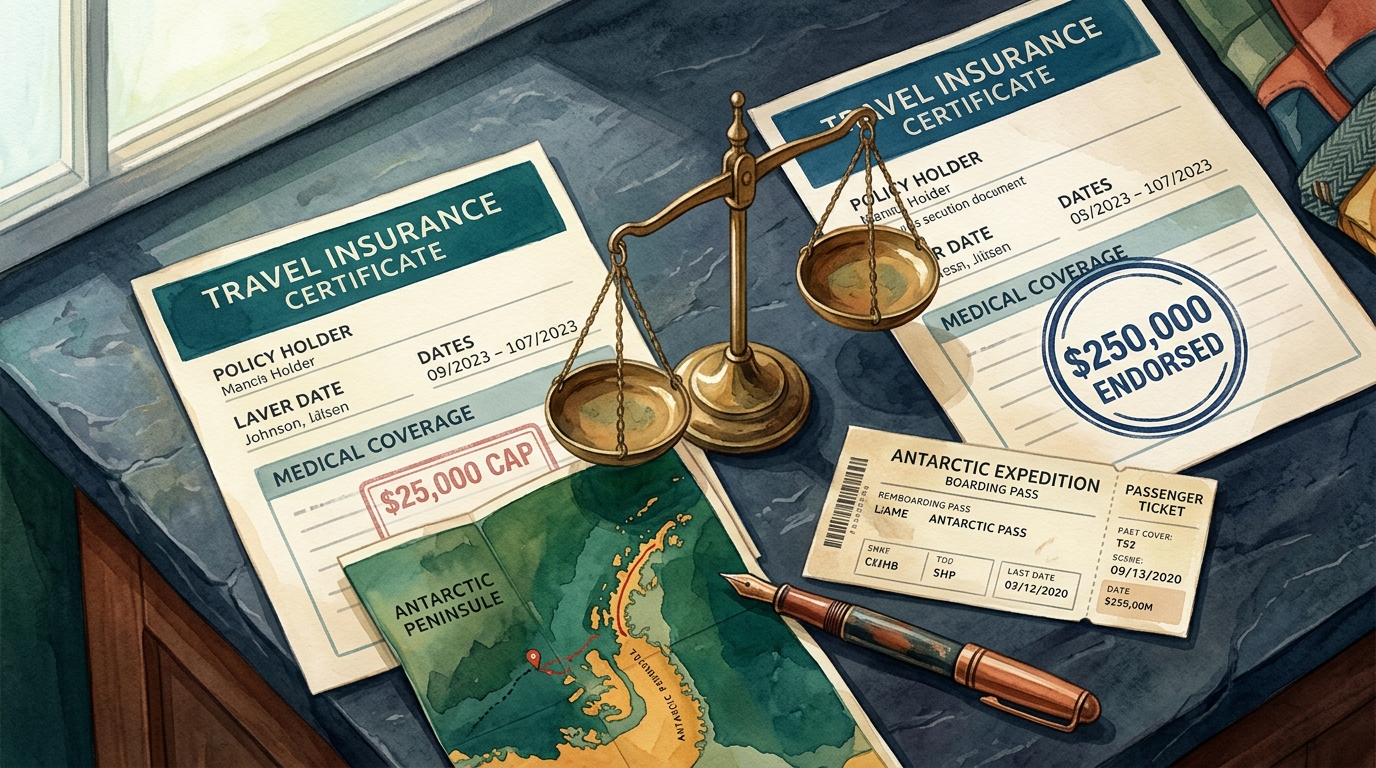
The Hondius outbreak exposed gaps that exist on most small-ship expedition cruises: medical evacuation costs that can hit $250,000+ in the polar regions, insurance policies that cap medevac at $25k, and CFAR clauses that exclude pandemics and government quarantines. Before booking, demand the operator's mandatory insurance minimums in writing, buy a primary policy with at least $250,000 medevac coverage, and confirm the operator's IAATO category and onboard medical capabilities.
What Actually Happened on the Hondius
The Hondius is the world's first Polar Class 6 expedition vessel, operated by Dutch outfitter Oceanwide Expeditions, designed for up to 170 passengers across 80 cabins (Oceanwide Expeditions). On April 1, 2026 it left Ushuaia, Argentina with about 175 passengers and crew on board, drawn from 23 nationalities (most of them Spanish, French, British, and American), bound for a long northbound itinerary that included the Antarctic Peninsula, South Georgia, Saint Helena, and a Spanish port (Wikipedia).
Ten days into the trip, on April 11, a passenger died on board. His body was offloaded at Saint Helena on April 24, where his wife was put ashore. She died in Johannesburg two days later. Tests confirmed Andes virus (ANDV), a hantavirus carried by long-tailed pygmy rice rats in southern Argentina and Chile, and the only hantavirus known to spread person-to-person through close prolonged contact (World Health Organization).
By the time the WHO published its Disease Outbreak News bulletin on May 7, the case count stood at eight suspected, six laboratory-confirmed, three deaths. The Canary Islands authorities initially refused docking. Spain's Ministry of Health eventually approved a controlled arrival to Tenerife for the morning of May 10, 2026, with passenger and crew evacuations beginning May 11 under WHO oversight (Washington Times). The 17 Americans on board are now being prepared for airlift to the National Quarantine Unit at the University of Nebraska Medical Center, where CDC teams will assess them as asymptomatic contacts (CDC).
Oceanwide Expeditions has cooperated with WHO, the CDC, and Spanish health authorities throughout the response, issuing daily press updates (Oceanwide press updates). The questions in this article are about structural gaps in expedition cruising as a category, not Oceanwide's specific handling of this case.
This was not a Carnival ship docking in Cozumel. This was a small expedition vessel a thousand miles from the nearest hospital with helipad access. The decisions a passenger makes before they wire the deposit determine what happens when something goes wrong at sea.

The Eight Questions to Ask Before You Wire the Deposit
This is the section to bookmark. Most expedition operators are competent and safety-focused, but the variation between them is wider than the brochures suggest. These eight questions, asked in writing, separate the operators who are ready for an outbreak from the ones who are hoping one never happens.
- What is your IAATO category, and is it Category A or B? The International Association of Antarctica Tour Operators classifies vessels by passenger capacity and shore-landing rules. Category A operators (under 200 passengers) can land passengers; Category B (200-500) can land in limited fashion. If the operator is not an IAATO member at all, walk away (IAATO).
- What insurance minimums do you require, and will you accept third-party policies? Get the dollar amount and the list of accepted insurers in writing before deposit. Some operators force you onto their captive policy, which often duplicates coverage you already have.
- What is the onboard medical capability: doctor, nurse, telemedicine, or none? A ship doctor on a 200-person expedition is not the same as a ship doctor on a 3,000-person mainstream cruise. Ask about ICU equipment, ventilators, and isolation cabins.
- What is the typical medevac time from the most remote point of the itinerary? Force them to give you a real number for the worst-case leg. "We have evacuation procedures" is not an answer.
- What is your refund and rebooking policy if the ship cancels for medical reasons? This was a critical gap on the Hondius, where passengers had no clear path to compensation when the operator made the cancellation call.
- Is your CFAR coverage a true any-reason policy, or does it exclude pandemics, outbreaks, and government quarantines? Many CFAR policies have exactly these exclusions. Get the policy document, not the marketing summary (NerdWallet).
- What are the ship's quarantine and isolation protocols if a contagious illness is identified onboard? Post-2020 every operator has a written plan. Ask to see it.
- Who pays if a port refuses entry and the ship has to divert? The Hondius was initially turned away by the Canary Islands. Diversion costs (fuel, port fees, extended crew payroll) are sometimes passed to passengers in the fine print.
Expedition Cruising Is Booming, and the Risks Scale With It
The whole reason this story is showing up in your feed is that a lot of people you know are about to book exactly this kind of trip. Antarctica trip interest was up 34% year-on-year through the first four months of 2026, according to Squaremouth, the travel-insurance marketplace. Expedition cruising has been the fastest-growing segment in the industry, with passenger numbers up 71% between 2019 and 2023, per CLIA's 2024 State of the Cruise Industry Report.
Cruising overall is having its biggest year ever. AAA forecasts 21.7 million Americans on ocean cruises in 2026, a record-setting fourth consecutive year of growth. And purchases of Cancel For Any Reason and Interruption For Any Reason upgrades on travel-insurance marketplace Squaremouth nearly doubled from 10% in early 2025 to 19% in early 2026. Travelers can feel that something has shifted, even if they cannot articulate exactly what.
The thing is, the polar regions are not the Caribbean. The medical infrastructure is hours or days away by helicopter, when weather permits. Getting sick on a 4,000-passenger ship near Miami is unpleasant. Getting sick on a small expedition ship off South Georgia is a logistics nightmare that runs into six figures fast.
The Medical Evacuation Math Nobody Quotes You
Most travelers buy a cruise insurance policy at the same time they buy the cabin and assume it covers them. It almost never covers what they actually need. Medical evacuations can cost anywhere from $25,000 to over $250,000 depending on location and severity, and Antarctica medevacs routinely run $100,000 to $250,000, sometimes far more.
Industry-recommended minimums for polar trips start at $250,000 in evacuation coverage, and $500,000 has become Squaremouth's most-purchased Antarctica coverage tier. Some Antarctic logistics operators require up to $750,000. Poseidon Expeditions, which runs nuclear icebreaker trips to the North Pole, requires every passenger to carry at least $200,000 in evacuation/repatriation cover before they board (Poseidon Expeditions).

Most travelers don't realize: a helicopter cannot reach a ship that's far offshore. Helicopter rescue at sea is typically limited to roughly 150 nautical miles from a land base; beyond that range you wait for the ship to sail closer, for a coast-guard cutter, or for another vessel to take you (International Maritime Health). That can mean days, not hours. The Hondius case took weeks.
| Coverage type | Typical cap | What it actually pays for |
|---|---|---|
| Standard cruise-line policy | $10,000 - $25,000 medevac | Domestic transport only; insufficient for polar regions Risky |
| Mid-tier travel insurance | $100,000 medevac | Most regions; marginal for Antarctica/Arctic Borderline |
| Polar-grade primary policy | $250,000 - $500,000+ | Helicopter, jet, repatriation, hospital-of-choice Recommended |
| Air-ambulance membership | Unlimited (transport only) | Pairs with travel insurance; doesn't cover treatment Add-on |
Don't rely on the policy stapled to your booking confirmation. For polar and remote-island expedition cruises, treat $250,000 medevac as the floor, not the ceiling. And read the fine print on whether the policy covers cruise-ship-specific transport, since some policies pay only after you're on land, which is useless if you can't get off the ship.
Why "Cancel For Any Reason" Often Doesn't Mean Any Reason
CFAR sounds bulletproof. It is not. Standard CFAR policies typically reimburse 50% to 75% of trip costs if you cancel at least 48 hours before departure for any reason not already covered by the base policy. They are designed for things like sudden work conflicts or anxiety about a destination, and they usually require the policy to be purchased within 14 to 21 days of your initial deposit (The Points Guy).
The exclusions that matter for Hondius-style scenarios:
- Government-declared pandemics are commonly excluded once the declaration is in force
- Quarantine orders are excluded under most policies, even general CFAR
- Cancellations within the 48-hour window are not covered by CFAR; you need the base policy
- Cancellations made by the cruise line itself are usually handled through the operator, not the insurer, and operators frequently offer future cruise credit, not cash
NerdWallet specifically flags pandemics and declared outbreaks as common CFAR exclusions, and the post-2020 wave of policy revisions made these exclusions tighter, not looser, on many products (NerdWallet). If you're booking a 2026/27 Antarctica cruise, you want to know exactly what your CFAR policy says about WHO Disease Outbreak News declarations and Public Health Emergencies of International Concern.
For polar cruises, sophisticated travelers buy two things: a primary travel insurance policy with $250,000+ medevac and trip cancellation, plus a separate air-ambulance membership (Medjet, Global Rescue) that covers transport-of-choice to your home hospital. The policies overlap intentionally.

The Reddit Pain Points That Predicted This
If you spend an hour reading r/cruise and r/travel threads on expedition policies, you find the same complaints over and over. Travelers discover, mid-deposit or post-booking, that their cruise-line bundled insurance maxes out at $25,000 medevac. Travelers booked through a third party find the operator won't accept the third party's policy. Travelers who paid for "full coverage" discover the cruise line's own cancellation pays out in future cruise credit, not refunds.
I had no idea my Princess insurance maxed out at $25k medevac. I'd have been wiped out if I'd needed a polar lift. Bought a real policy for the next trip.
- r/cruise user, on cruise insurance gaps
Recurring complaints across r/cruise and r/expedition_cruises threads include cruise-line bundled insurance maxing out at $25,000 medevac, operator-mandatory policies refusing to accept third-party insurance, and cruise-line cancellations paying out only in future cruise credit. Onboard medical bills also surprise people: consultations from $100 to $500 with emergency-room-level care substantially higher (Medjet), and many travelers discover their U.S. health insurance considers shipboard medical "out of network."
None of these complaints are edge cases. They are the predictable result of a market where the deposit is non-refundable before the fine print is shared, and where IAATO category A vs B operators have very different medical and evacuation infrastructures despite often pricing within $1,000 of each other on similar itineraries (Cruise Critic). Some of what surprises travelers in 2026 traces back to exactly these structural gaps.
The Booking Timeline That Protects You
A careful 12-month booking process for a 2026/27 polar cruise looks roughly like this. Compress this and you lose negotiating room; ignore it and you end up like the people on r/cruise complaining six months in.
- 12 months out Compare 3-4 IAATO-member operators. Request the full passenger contract, refund policy, and insurance requirements in writing. Read the cancellation table.
- 10 months out Choose operator. Pay deposit (typically 20-25%). Within 14-21 days, buy primary travel insurance with CFAR if you want flexibility. This window is non-negotiable.
- 9 months out Verify your insurance is accepted by the operator. If not, switch insurers or fight for an exemption. Add air-ambulance membership.
- 6 months out Complete medical questionnaire. Schedule vaccinations and any pre-trip physical. Confirm visa requirements for both your boarding port and the port where the cruise ends.
- 3 months out Final balance due. Re-read the operator's medical and quarantine protocols, especially after any new outbreak news. Confirm next-of-kin details with the operator.
- 1 month out Print all policy documents. Save offline copies of insurer contact numbers and operator emergency lines. Confirm passport validity (6 months minimum).
- Departure Carry physical and digital copies of insurance certificates, vaccination records, and medication lists. Check in with the ship's doctor on day one if you have any chronic conditions.
Notice the through-line: every irreversible decision (deposit, insurance window, balance) should come after you've seen the document that locks in your rights, not before. Operators have no incentive to send you the cancellation table and insurance requirements upfront. You have to ask. The good operators answer in 24 hours with a one-page document. The marginal ones forward your email to a sales rep who tries to close the deal before sending anything in writing. Treat that response itself as data about how the operator will behave when something goes wrong on board.

What Onboard Medical Actually Covers (and Costs)
About 1 in 14 cruise passengers seeks onboard medical attention during a sailing (MedjetAssist). On a mainstream cruise that means a clinic with a doctor, a nurse, and a small ICU. On an expedition cruise it can mean one doctor, sometimes a nurse, and a single isolation cabin. CDC's Yellow Book guidance on cruise health notes that ship clinics are not equivalent to land hospitals, and the more remote the itinerary, the more the gap matters (CDC Yellow Book).
The bigger structural issue is that expedition operators are competing on amenities and itinerary uniqueness, not on medical capability. A glossy brochure will name-drop the heli-deck and the wine cellar before it mentions the medical bay. That is a marketing choice, not a safety choice. Your job is to invert that priority when you're evaluating the booking. Three things every prospective expedition passenger should know:
- Onboard medical is not in-network for U.S. health insurance. The CDC Yellow Book confirms shipboard medical is rarely covered by domestic U.S. health plans. You pay out of pocket and submit for reimbursement, often at international rates
- Routine consultations typically run $100-$500, with emergency-room-level care running $1,000+ depending on the line. Treatment, medication, and IV fluids are extra, billed line-by-line
- The ship doctor can order you off the ship at the next port if your condition is beyond their capability, and the cruise line's responsibility for onward care varies wildly by contract
The Hondius episode is an extreme version of a common reality: ship medical handled the initial response, but a fatal viral pathogen with person-to-person transmission required quarantine infrastructure that no expedition vessel carries. The decision to refuse entry made by Canary Islands authorities was driven by exactly this concern: they had to confirm that Spanish hospitals could safely receive the cases (Johns Hopkins).
This article summarizes industry-reported figures for general guidance. Insurance, evacuation, and medical decisions should be confirmed with a licensed insurance broker and your operator's contract; figures and policy terms vary widely by carrier and itinerary.

How to Vet an Operator Without Naming Names
Across IAATO's roster, operators range from premium ice-class outfits with surgeons aboard to budget players running converted research vessels with one doctor and a defibrillator. Antarctica expeditions in 2026 typically run $10,000-$25,000+ per person, and the difference between budget and premium operators is often only a few thousand dollars on similar itineraries, but the medical and evacuation gap between them can be enormous.
Use this checklist when evaluating any operator:
- IAATO member with confirmed category (A or B)
- Onboard physician with documented expedition or remote-medicine experience
- Isolation cabin and basic ICU equipment listed in the medical brief
- Telemedicine link to a land-based hospital partner
- Mandatory passenger insurance minimum of at least $200,000 for evacuation
- Written quarantine and outbreak protocol available before deposit
- Cancellation table that distinguishes operator-cancellation refunds from passenger-cancellation refunds
- Polar Class hull rating appropriate for the itinerary (PC6 minimum for Antarctic Peninsula in summer)
If an operator can't or won't answer half of these in writing, that's the answer. The good ones are used to these questions and have a one-page document ready. The bigger shifts in 2026 travel are pushing this kind of transparency in mainstream cruise too, but expedition is still where the variation hides.
One often-missed detail: ask the operator who their telemedicine partner is, and whether the satellite link to that partner is functional 24/7 or only when the ship is within a specific latitude band. Iridium and Starlink coverage in the high southern and high northern latitudes has improved significantly since 2023, but it is not universal. A telemedicine relationship is only as good as the bandwidth that supports it. The same applies to medical evacuation: an operator can list relationships with three air-ambulance providers, but if your itinerary takes you 800 miles from the nearest base, only the providers with long-range jets matter, and only when weather permits a landing at the nearest port. Tools that help with expense tracking on group trips are starting to bake operator-vetting checklists into the booking flow itself.
Where a Single Trip-Management App Fits Into This
The grunt work of an expedition booking (tracking which insurer accepts which operator, building the document trail for the visa stops, keeping the medical questionnaire and vaccination records in one place, organizing the offline-accessible emergency contacts for a sailing where Wi-Fi costs $0.50 per megabyte) is exactly the kind of fragmented chore that tools like TripProf are built to consolidate. The point isn't that an app prevents an outbreak. It's that when the outbreak news lands, you don't want to be searching three Gmail accounts for your Allianz policy number.
Consolidating insurance documents, vaccination records, the operator's emergency line, and your itinerary into one offline-accessible documents vault is the kind of preparation that turns a high-risk booking into a manageable one. The Hondius case is a reminder that preparation is the only insurance you control.
Frequently Asked Questions
Should I cancel my 2026/27 Antarctica cruise after the Hondius outbreak?
Probably not, but you should re-verify your insurance coverage and the operator's medical protocols. The Hondius case is a single isolated outbreak; the underlying risks (medevac costs, inadequate insurance, remote medical infrastructure) existed before the outbreak and exist on every polar cruise. Cancellation usually loses your deposit unless your CFAR policy covers it.
Is hantavirus a normal risk on expedition cruises?
No. Andes virus is endemic to a specific region of southern Argentina and Chile and is spread through rodent contact, not human-to-human in normal circumstances. The Hondius outbreak appears to be tied to pre-boarding exposure that then transmitted aboard. The WHO classifies the broader public risk as low (WHO).
What's the minimum medevac coverage I should buy for an expedition cruise?
$250,000 is the industry-recommended floor for polar regions, and $500,000 has become the most-purchased Antarctic tier. Some operators like Poseidon Expeditions enforce a minimum of $200,000 in writing. Cruise-line bundled policies typically cap at $10,000 to $25,000, well below what an actual polar evacuation costs.
Does my regular travel insurance cover cruise medical bills?
It depends on the policy. Most U.S. health insurance does not cover onboard medical at all, which is treated as out-of-network international care. Travel insurance with primary medical coverage will pay first and is usually preferable to secondary coverage that requires you to pursue your home insurer first.
What happens if the cruise line cancels my expedition for medical reasons?
Operator-cancellation policies vary widely. Some refund 100% in cash, others issue a future cruise credit (FCC) valid for 12 to 24 months, and a few only refund a percentage based on how close to departure the cancellation occurs. This is one of the most important questions to clarify in writing before booking.
Is CFAR worth it for a polar cruise?
Yes, with caveats. CFAR typically reimburses 50% to 75% of trip costs and must be purchased within 14 to 21 days of the initial deposit. It does not cover government-declared pandemics, quarantine orders, or last-48-hour cancellations. For a $15,000+ booking with non-refundable deposits, the 8-12% CFAR premium is usually worth the option value.
What's the difference between IAATO Category A and Category B operators?
Category A operators run vessels with under 200 passengers and can make passenger landings on the Antarctic continent. Category B operators run 200-500 passenger ships with limited landing rights. Larger ships fall into a non-landing category. Category A operators generally have more intimate medical staffing per passenger; Category B may have larger medical teams but more passengers to cover.
Key Takeaways
- The Hondius outbreak is an extreme but instructive case: it exposed common gaps in cruise insurance, operator transparency, and medical infrastructure that exist on most expedition cruises today
- For polar trips, target $250,000 in medical evacuation coverage minimum, with $500,000 now the most-purchased tier among informed travelers
- Buy primary travel insurance, not the cruise-line bundled policy, and consider an air-ambulance membership (Medjet, Global Rescue) as a redundant layer
- Read the CFAR fine print: pandemics, quarantines, and cruise-line cancellations are commonly excluded, and the 14-21 day post-deposit purchase window is strict
- Ask for the operator's IAATO category, onboard medical capability, mandatory insurance minimums, and quarantine protocol in writing, before deposit and not after
- Use the eight-question checklist before wiring any deposit, and keep a documents vault (with tools like TripProf) so insurance, vaccination, and emergency-contact records are accessible offline when ship Wi-Fi fails
- The 2026/27 polar season is going to be the most-booked in history; the operators that survive scrutiny will be the ones whose answers match what's printed in their contracts
Sources
- World Health Organization, Disease Outbreak News DON599: Hantavirus disease, MV Hondius cruise ship (May 7, 2026)
- WHO public response statement: Hantavirus cases linked to cruise ship
- CDC Newsroom: Update on hantavirus outbreak linked to MV Hondius
- Wikipedia: MV Hondius hantavirus outbreak (sourced timeline)
- Oceanwide Expeditions: MV Hondius vessel specifications
- Washington Times: Tenerife arrival schedule and evacuation plan
- WOWT Nebraska: American patients arriving at Nebraska National Quarantine Unit
- Johns Hopkins Hub: Explainer on the Hondius outbreak
- CNBC: Travel health risks, Squaremouth CFAR uptake, and Antarctica search demand
- CLIA: 2024 State of the Cruise Industry Report
- AAA Newsroom: 2026 cruise forecast (21.7M Americans)
- MedjetAssist: Onboard cruise medical statistics and consultation costs
- Squaremouth: Medical evacuation and repatriation cost overview
- Squaremouth: Antarctica coverage tier benchmarks
- International Maritime Health: Helicopter rescue range at sea
- Cruise Critic: Safety standards for Antarctic operators
- NerdWallet: CFAR exclusions for pandemics and outbreaks
- The Points Guy: CFAR and operator-cancellation reimbursement
- IAATO: Antarctic operator categories and standards
- CDC Yellow Book: Cruise ship health risks
- Oceanwide Expeditions press updates: Operator statements during the outbreak
Last updated: July 3, 2026
Keep Reading
More travel tips and guides picked for you

Airport liquid rules in 2026: which airports actually allow more than 100ml
Some UK airports now let you carry 2 litres of liquid through security. Others, and every US airport, still cap you at 100ml. Here is exactly which is which, airport by airport, and which rule to pack for when your outbound and return airports disagree.

The best group packing list apps in 2026
PackParty nails the everyone-vs-one-person split gear needs. whobrings.com skips the app. TripProf holds the whole trip. Five tools, tested against each other.

The 2026 Hand-Luggage Trap: The EU "Free Cabin Bag" Law Did Not Pass - And the Rules Just Got Stricter
Everyone shared the headline about free cabin bags coming to the EU. The law never passed, and for summer 2026 the rules tightened instead. Exact free allowances for every airline DACH travelers fly, and how to avoid a €70 gate fee.