Eurail Pass vs Flying vs Point-to-Point Tickets: Which Actually Saves Money

Key Highlights
- 1
- 2
- 3
+5 more in the takeaways below
You're on the platform at Amsterdam Centraal, pass in hand, when the conductor tells you the seat reservation you skipped is mandatory and costs a few euros more. Multiply that surprise by every leg of a three country trip and pass math stops feeling simple. Here's what one real Amsterdam to Berlin to Prague trip costs three different ways, priced segment by segment, no guessing.
For a 10 day, 3 country trip from Amsterdam to Berlin to Prague with just 2 international train legs, a 4 day Interrail Global Pass plus reservations runs about €295, while the same two tickets bought 1 to 3 months ahead cost about €62, roughly a fifth of the price. Even booked last minute, point to point tickets (about €203) still beat the pass. Flying wins on paper for Amsterdam to Berlin but adds bags and transfers that erase most of the saving, and on Berlin to Prague, the cheapest flight fares run through a connection instead of a nonstop hop, with total travel time far past the direct train. The rule of thumb: a pass only pays for itself when your average point to point fare tops roughly €70 to €75 per travel day, which happens on expensive Western European corridors (France, Italy, Spain), almost never on this one.
The Trip: Amsterdam, Berlin, Prague, 10 Days, Two Borders
The itinerary is simple on purpose: 4 nights in Amsterdam, 3 in Berlin, 3 in Prague, 10 days total across the Netherlands, Germany, and Czechia. Only 2 international train rides connect the three cities: Amsterdam to Berlin and Berlin to Prague. That's exactly the kind of trip a lot of first time multi-country Europe travelers plan, and we picked it as a test case precisely because it's modest, not because it's engineered to make one option look good.
Nobody plans this trip wondering whether they need 8 travel days. They plan it wondering whether the pass they keep seeing in "how to see Europe" roundups is actually worth buying for a route this size, or whether it's a habit borrowed from a very different kind of trip, the kind where you're crossing borders every other day for a month. If you're still shaping the stop list itself before worrying about tickets, our multi-city Europe planning guide covers that groundwork; this piece picks up once the cities are fixed and only the "how do I get between them" question is left.
Amsterdam to Berlin runs about 577 kilometers, a direct ICE international service that takes roughly 5 hours 42 minutes with 6 departures a day (NS International, Seat61). Berlin to Prague covers approximately 280 kilometers, a EuroCity or Railjet service running as fast as 3 hours 58 minutes, up to about 4 hours 31 minutes on slower departures as of August 2026 (highspeedtrains.com). Neither leg touches France, Italy, or Spain, which matters more than it sounds like it should, and the reason why comes up in every section below.
What a Rail Pass Actually Costs Once Reservations Are Added
The sticker price on a flexi pass isn't the price you pay to actually ride the trains. Two different products confuse people here: Eurail is sold to non European residents, priced in dollars, and Interrail is the same network sold to European residents, priced in euros, per Eurail's own eligibility guide. They aren't simply the same number in two currencies, they're separately priced products, and mixing them up is the single most common source of confusion in pass shopping.
As of July 2026, AFAR reports the Eurail Global Pass 4 days in 1 month, adult 2nd class, at $328 (1st class $426), with the 15 day flexi tier at $641. Eurail's own site lists a youth (12 to 27) discount of up to 25% off adult prices and a 10% discount for seniors 60 and over (Eurail). The Interrail equivalent, per the official Deutsche Bahn Interrail price list dated January 5, 2026, is €283 for adult 2nd class in the 4 day flexi tier, with a youth (12 to 27) rate of €212. Neither figure includes seat reservations, which are billed separately and aren't optional on most trains that are actually worth taking.
Eurail's own fee page lists average reservation costs of €10 for domestic trains, €15 for international trains, and €20 for night trains, on top of the pass price. On the corridors used in this itinerary the fee is lower, €5.50 in 2nd class and €6.90 in 1st, for German long distance ICE/IC/EC/ECE services and for the Berlin to Prague EuroCity/Railjet run (Eurail reservation fees). On routes through France, Italy, or Spain the same fee can run €19 to €45 per ride.
Add it up for this itinerary: €283 for the Interrail 4 day flexi pass, plus €5.50 for the Amsterdam to Berlin reservation and €6.90 for the Berlin to Prague reservation, which Eurail's own table marks as recommended rather than strictly mandatory, comes to about €295. That pass covers 4 travel days. This trip uses 2. Unless you tack on 2 more journeys somewhere, you're paying for travel you won't do, and there's no partial refund for the days you skip.

What Point to Point Tickets Cost at Three Booking Windows
Point to point pricing rewards booking early and punishes waiting, which is the opposite of how a pass works, since a pass costs the same whether you book it the night before or 6 months out. Here's what we found when we priced the same 2 legs at 3 different booking windows.
| Booking window | Amsterdam to Berlin | Berlin to Prague | Combined |
|---|---|---|---|
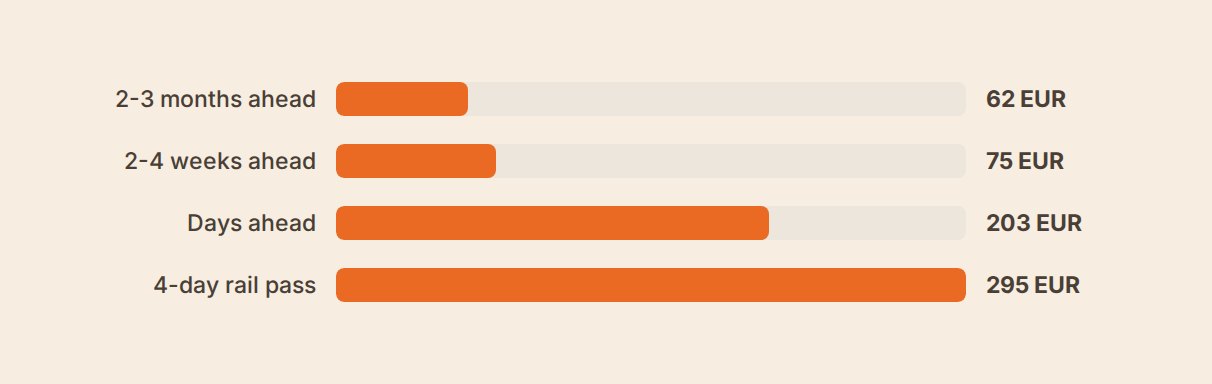
| 2 to 3 months ahead | €37.90 (Supersparpreis Europa) | about €24 Cheapest | about €62 |
| 2 to 4 weeks ahead | from €44.90 (Sparpreis Europa) | closer to €30 | about €75 |
| Days ahead / walk-up | about €167 (Flexpreis) Most expensive | about €36 | about €203 |
Amsterdam to Berlin fares are drawn from NS International's published fare tiers, Supersparpreis from €37.90, Sparpreis from €44.90, and full flexible Flexpreis at €167 (amsterdamtips.com, NS International). Berlin to Prague uses Rail Europe's reporting that EuroCity fares run around $24 when booked a month ahead, versus roughly $36 a week out (Rail Europe); Matador Network separately cites a flat fare around $33.60 (€29.90) for the same route (Matador Network). Even the worst case here, walk-up pricing on both legs, still lands under the pass total.
The gap between Supersparpreis and Flexpreis on the Amsterdam to Berlin leg, roughly €38 versus €167, is roughly a 4.4x spread for the identical seat on the identical train. That's the trade every point to point buyer makes: cheap tickets in exchange for locking in a date and time months out, no changes, no refunds in most fare classes. A pass sells you the opposite trade, flexibility to travel any day within the validity window, at a price that assumes you'll use it often enough to make that flexibility worth paying for.
What Flying Actually Costs Once You Add the Real Stuff
The advertised base fare is never the real number, and this itinerary shows why in two completely different ways on its two legs.
Amsterdam to Berlin has real nonstop flights: KLM is the only airline flying it nonstop, in about 1 hour 20 minutes, while other carriers route through a connecting hub. One-way fares start from about €72 to €75 at the cheapest, per momondo and Trip.com's KLM fare tracker (checked August 2026), with fares around €118 also common depending on the date. Even at the lower end, that looks like a clear win against a 5 hour 42 minute train, until you count what isn't in the headline price.
- Checked 20kg bag on a budget carrier: €25 booked online in advance, rising to €40 to 50 if added late or at the airport (My Baggage)
- Schiphol Airport to Amsterdam Centraal: €5.50 for a 2nd class single, or €7.10 for a paper ticket bought at the station (€5.50 plus a €1.60 disposable-ticket surcharge), 16 to 18 minutes by train
- Berlin Brandenburg Airport (BER) to Berlin Hauptbahnhof: €5.00 airport express fare, about 23 minutes
- Airport arrival buffer, typically 2 hours before a budget short haul departure
- No seat included by default; selecting one is usually another line item
A €25 bag and roughly €12 combined in airport transfers (€7.10 for a paper Schiphol ticket plus €5.00 for the BER Airport Express) add about €37 to whichever fare you land on, pushing even a cheap €75 advance fare to around €112 and a more common €118 fare to about €155, before counting the extra hours spent at two airports instead of walking straight onto a train. That's still competitive with the pass on this leg, but it's no longer dramatically cheaper than the €37.90 early-booked train ticket, and it doesn't count the 2 hour airport arrival buffer both ends effectively demand.
Berlin to Prague is the leg that actually breaks the "just fly and it's obviously faster" assumption. Direct flights exist, about 1 hour 49 minutes, but the cheapest fares run through Trip.com are 1-stop itineraries taking 8 to 27 hours door to door (Trip.com). Rome2rio's own route data puts the fastest flight option at about 3 hours 22 minutes, with other connecting options ranging roughly 3 hours 10 minutes to 5 hours 10 minutes (Rome2rio). The EuroCity or Railjet train covers the same roughly 280 kilometers in as little as 3 hours 58 minutes, seat included, no connection, no second security line, and it beats every one of the cheap flight options on total door to door time. On a hop this short, the two cities are simply better served by rail than by air for anyone chasing a low fare.
The Full Segment by Segment Verdict
We ran all 3 methods side by side for both legs, and the pattern isn't close.
| Segment | Rail pass share Pass | Point to point, early | Flying, all-in |
|---|---|---|---|
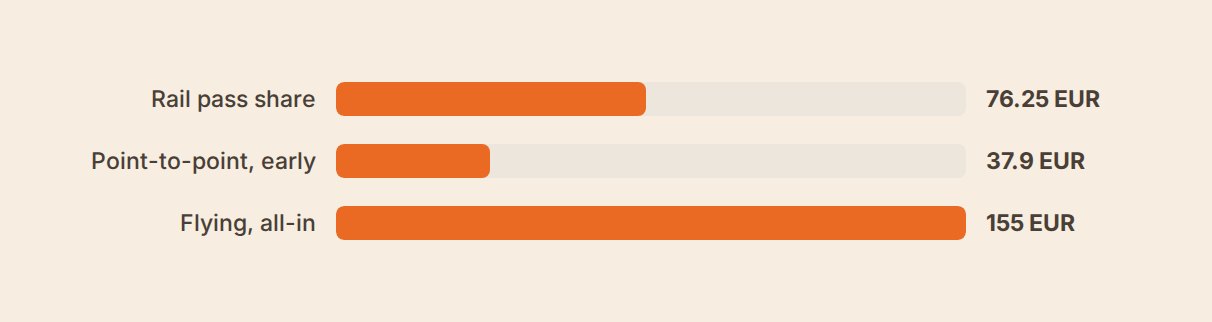
| Amsterdam to Berlin | €283 pass (÷4) + €5.50 reservation | €37.90 Best | about €155 (fare + bag + transfers) |
| Berlin to Prague | share of same pass + €6.90 reservation | about €24 Best | not practical: 1 stop, 8 to 27 hours door to door |
| Trip total, 2 legs | about €295 | about €62 | not comparable end to end |
For this specific, honest, unremarkable 3 city trip, point to point tickets booked a couple of months out beat the pass by roughly €233, almost 5 times cheaper. That's not a knock on rail passes as a category. It's what happens when a short, 2-leg itinerary meets a pass priced for people making many more journeys than that.
Once a trip has that many moving pieces, a lot of travelers stop tracking it by memory. If you're mapping legs like this yourself, a tool like TripProf's Route Overview lays every stop on one map with the route drawn between them, lists each leg's distance, duration, and mode of transport, and recalculates automatically if you add or reorder a city, which is the same segment by segment thinking this article walks through, just kept up to date as your plan changes.
The Break Even Rule: When a Pass Actually Wins
Divide the Interrail 4 day flexi price, €283, by its 4 covered days and you get roughly €70.75 per travel day before reservations. That number is the real break even test: a pass earns its price back once your average point to point fare per leg climbs above roughly €70 to €75, and only if you actually use every paid day.
- Count your actual travel days. Not trip length, the number of days you board a train. This itinerary has 2. A pass sized for 4 is already a mismatch before a single price is compared.
- Price 1 to 2 of your real legs point to point, booked at a normal lead time. If those fares sit under roughly €70, the pass is very unlikely to win, no matter how good it feels to "not think about tickets."
- Check which countries you're actually routing through. France, Italy, and Spain carry mandatory reservation fees up to €35 to €45 per international ride even with a pass in hand (Eurail). Germany, the Netherlands, and Czechia mostly don't.
- Add up total travel days across your whole trip, not per country. A pass earns its keep on itineraries with 6, 8, or 10 international legs across pricier corridors, not on a clean 2-leg hop through cheaper ones.
This is the piece that gets flattened into "it depends" on most pass guides: the same 4 day Interrail pass can be a clear win on one corridor and a clear loss on another, using the exact same price and the exact same 4 days. Run the same €283 pass against a Western European itinerary instead of this one and the verdict flips.
Swap this trip for a France to Italy run and the reservation fees alone change the outcome. Eurail's own fee table lists a Paris to Milan TGV reservation at €31 to €45, a Paris to Stuttgart, Munich, or Frankfurt TGV reservation at €19, and a mandatory Paris to Barcelona SNCF reservation at €35 (Eurail). Take 4 legs like that and the €283 flexi pass, plus reservations, comes out cheaper than buying each ticket separately, which is the exact opposite of what happens on the Amsterdam, Berlin, Prague route in this article. Same product, same price, different corridor, different answer.
Regional nuance is the whole answer here, not a footnote to it.
The rail network itself keeps shifting the math too. Eurail's partner Distribusion recently expanded passholder access to seat reservations and fares on operators that previously required a separate booking, addressing a gap that had specifically weakened Interrail's usefulness in France and Italy (Railway Gazette, May 2026). New overnight options are part of that shift too, including the European Sleeper service launching between Paris, Brussels, Liège, Hamburg, and Berlin from March 26, 2026. For more on how the network is changing route by route, see our rundown of new European rail routes.
Booking lead time matters just as much on flights and hotels as it does on trains, and if you want the general framework for when advance booking beats waiting, our direct versus third party booking guide covers the same trade off from a different angle. And if a pass is genuinely on the table because you're under 28, check current youth rail discounts before you buy anything, since they change the math on both products; our student travel discounts guide rounds up what's currently available.

Frequently Asked Questions
Is a Eurail Pass worth it for a short 2 or 3 country trip?
Usually not. As of 2026 a 4 day flexi pass runs about $328 (Eurail) or €283 (Interrail) before reservations, roughly €71 per covered travel day. If your actual point to point fares average less than that, which is common on short hops through Central and Northern Europe, buying tickets one by one is cheaper, and it's the pattern this article's own worked example shows firsthand.
What is the difference between Eurail and Interrail?
Same train network, two different products. Eurail is sold to non-European residents and priced in dollars; Interrail is the equivalent pass for European residents, priced in euros. They aren't simply currency conversions of one price, they're separately set, and buying the wrong one for your residency isn't possible at checkout, so it pays to know which product you actually need before comparing prices.
Do I still need seat reservations if I have a rail pass?
Yes, on most high-speed and international trains. Eurail's own fee schedule lists average reservation costs of €10 domestic, €15 international, and €20 on night trains, on top of the pass, and some France, Italy, and Spain routes run €19 to €45 per ride.
Is a rail pass cheaper than budget airlines in Europe?
Rarely, once bags and airport transfers are added to the flight side. In this itinerary, flying Amsterdam to Berlin all-in can cost about €155 for a common fare, against an early-booked train fare of €37.90. Passes fare even worse against budget flights than point to point tickets do, since the pass price is fixed regardless of how cheap the flight gets.
How far ahead should I book point to point train tickets instead of a pass?
Two to 3 months ahead captures most of the available discount on routes like Amsterdam to Berlin and Berlin to Prague, per NS International's and Rail Europe's published fare tiers. Waiting until the last few days out roughly quadruples the Amsterdam to Berlin fare (about €37.90 to about €167) and adds about 50% to the Berlin to Prague fare (about $24 to about $36).
How many travel days make a Eurail or Interrail Pass worth it?
There's no fixed number, it depends on the per-leg fare, but the arithmetic is straightforward: divide the pass price by its covered days, then compare that per-day figure to what your actual point to point legs would cost. On expensive Western European corridors with several long international legs, a pass often clears that bar. On a compact 2 or 3 leg trip through cheaper corridors, it usually doesn't.
Does booking a Eurail or Interrail Pass lock in a seat, or just cover the ride?
The pass only covers the ride. On trains where reservations are optional, you can board without one and simply find a seat. On trains where a reservation is mandatory, which includes most high-speed and night trains, you still have to book that seat separately and pay the fee, sometimes weeks in advance if the train is popular, so a pass doesn't remove the planning step, it just changes what you're paying for.
Key Takeaways
- For this Amsterdam to Berlin to Prague itinerary, point to point tickets booked 2 to 3 months ahead cost about €62 combined, versus about €295 for a 4 day rail pass plus reservations.
- Eurail (non-EU residents, priced in dollars) and Interrail (EU residents, priced in euros) are separate products, not currency conversions of the same number.
- Seat reservations are billed separately and recommended (mandatory on some France/Italy/Spain routes): €5.50 to €6.90 on this itinerary's German and Czech legs, up to €35 to €45 (mandatory) on France, Italy, and Spain routes.
- Flying can still win on time for well-served nonstop routes like Amsterdam to Berlin, but bags and transfers typically add €35 to €50 to the headline fare.
- On Berlin to Prague, the cheapest flight fares run through a 1 stop itinerary taking 8 or more hours door to door, against a direct train as fast as 3 hours 58 minutes.
- The break-even rule of thumb: a flexi pass pays for itself once your average per-leg fare tops roughly €70 to €75, and only if you use every paid travel day.
- For tracking a multi-leg itinerary like this one as you plan it, TripProf's Route Overview maps every stop and segment, with distance, duration, and mode of transport listed per leg and totals that recalculate as the plan changes.
- Regional nuance beats a blanket verdict: passes tend to earn their price in Western Europe's pricier corridors, while Central and Eastern Europe is often already cheap enough point to point that a pass adds cost, not savings.
Sources
- AFAR : Your Guide to Eurail Passes: Costs, Use, and How to Buy Them, updated July 2026
- Eurail : Eurail Pass discounts (youth and senior discount rates)
- Eurail : Do I need a Eurail or an Interrail Pass? (residency eligibility)
- Eurail : Reservation fees overview
- Eurail : International train reservation fees
- Eurail : Domestic train reservation fees
- Deutsche Bahn / bahn.eurail.com : official Interrail Global Pass 2026 price list, dated January 5, 2026
- NS International : Amsterdam to Berlin train fares
- Seat61 : Amsterdam to Berlin by train (journey time)
- amsterdamtips.com : Amsterdam to Berlin train fares (Flexpreis Europa)
- amsterdamtips.com : Schiphol Airport to Amsterdam Centraal (train fare)
- VBB : BER Airport transport information (airport express fare and journey time)
- highspeedtrains.com : Prague to Berlin route data (distance and journey time)
- Matador Network : These Trains Take You From Berlin to Prague Through Peaceful Countryside
- Rail Europe : Berlin to Prague train tickets
- Trip.com : Berlin to Prague flight time and schedules
- Rome2rio : Berlin Brandenburg Airport to Prague route data
- flightconnections.com : Flights from Amsterdam to Berlin (nonstop carrier and flight time)
- momondo : Cheap flights from Amsterdam to Berlin (fare tracker, checked August 2026)
- Trip.com : KLM flights from Amsterdam to Berlin (fare tracker, checked August 2026)
- My Baggage : Ryanair Baggage Allowance, referencing 2025 to 2026 fee bands
- Seat61 : European Sleeper Paris-Berlin (route and launch date)
- Railway Gazette International : Interrail expands the ability to book passholder fares and seat reservations, May 4, 2026
Keep Reading
More travel tips and guides picked for you

Christmas markets from London by train: what 3 nights really costs per person in 2026
Three nights at a Christmas market from London cost £426 to £704 per person. We priced Eurostar fares, central hotels and food for Lille, Brussels, Bruges and Cologne.

Wizz Air and Ryanair are cutting Vienna flights: what to book instead
Wizz Air has fully left Vienna and Ryanair has cut five aircraft over Austria's aviation tax. Here's exactly what changed, why it happened, and how to still book a cheap flight this winter.

Mallorca's tourist tax hike got cancelled. Here's what a 2026 trip really costs
The Balearic tourist tax hike everyone's still warning about got cancelled in February. Here's what a week on Mallorca actually costs in 2026, flights, hotel, tax, and food, with real numbers.