Student Travel Discounts and Hacks That Save Hundreds (And Most Students Never Use)
Key Highlights
- 1
- 2
- 3
+5 more in the takeaways below
You're 21, sitting in a lecture hall, scrolling through flight prices to Rome during a break. The cheapest seat is $480 round trip. You close the tab and go back to your notes. Here's what you didn't know: with the right stack of student cards, rail passes, and booking tricks, that same two-week Europe trip could cost you over $1,000 less than what the person next to you on the plane paid. Not because you found a secret website. Because you stacked six layers of student travel discounts that most students never bother to set up.
The savings aren't hiding. They're on government websites and discount card programs that take 20 minutes total to activate. Most students grab one or two and leave the rest on the table. This guide walks through all six layers of the Student Travel Stack for 2026, with verified prices and direct links for every claim.
Stack six layers of student discounts for maximum savings: identity cards (ISIC + EYCA), transportation (DiscoverEU, Interrail Youth, country rail cards), accommodation (university dorms from EUR 16/night, work exchanges), food (university cafeterias for EUR 2-4), culture (free museums in France under 26, EUR 2 entry in Italy), and funding (grants up to $25,000). A two-week Europe trip using the full stack costs roughly $1,375 vs. $2,460 for a regular tourist. Total setup time: about 20 minutes and $40 in card fees.
Layer 1: Your Identity Stack (ISIC + EYCA + Student Beans)
Before you book anything, you need proof that you're a student. Not your university ID (most businesses outside your country won't recognize it), but internationally accepted cards that unlock discounts across dozens of countries. Two cards cover nearly every scenario, and they cost less than a museum ticket.
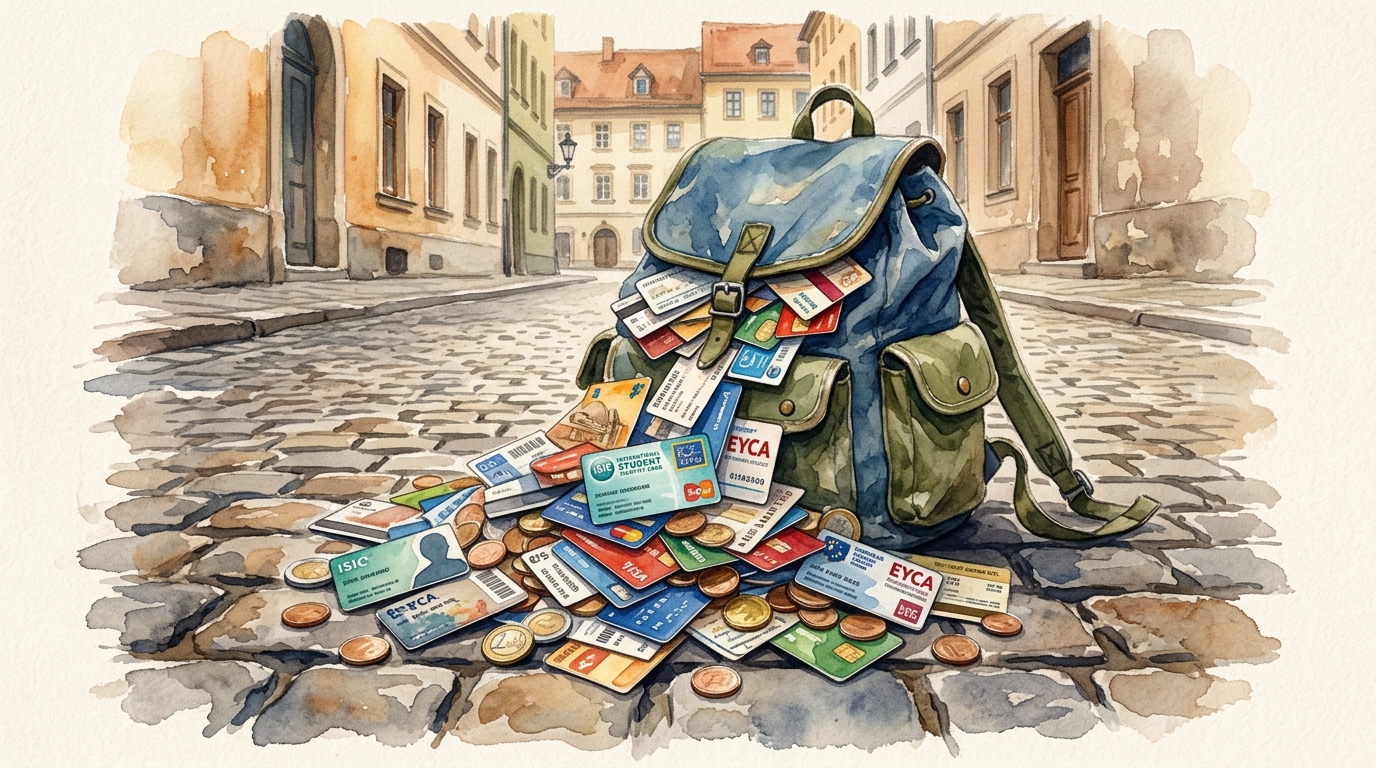
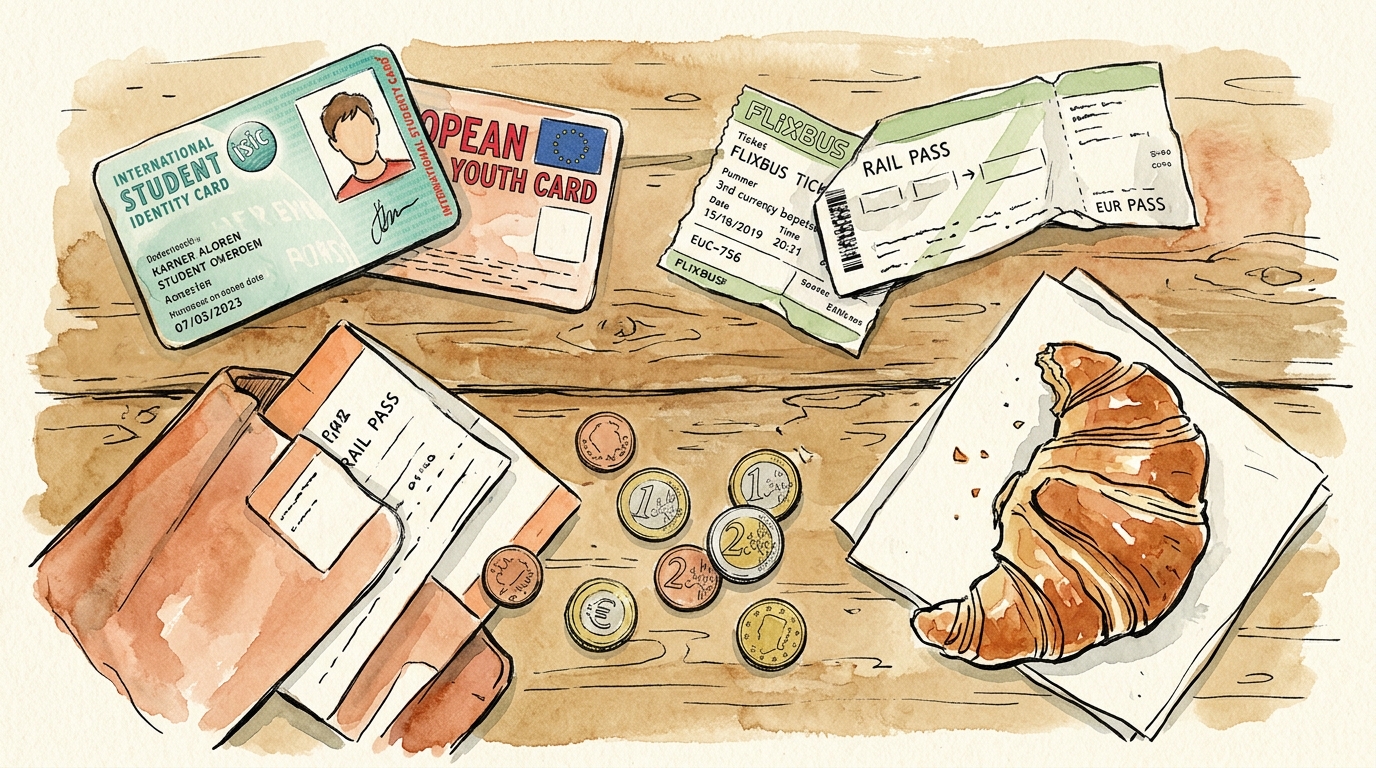
The ISIC card (International Student Identity Card) is the global standard. It's accepted in over 130 countries, costs between EUR 4 and EUR 25 depending on your country (priced by purchasing power), and works for transport, museums, software, food, and accommodation. If you're traveling outside Europe, this is the card to get.
The European Youth Card (EYCA) covers a different angle. It's age-based, not student-specific: anyone under 31 qualifies in most countries. It costs EUR 5-19 depending on country and opens up over 37,000 discounts across 36 European countries. EYCA and ISIC barely overlap, so carrying both nearly doubles your discount options.
Add free platforms like Student Beans, UNiDAYS, and your .edu email address (which unlocks deals from Amazon Prime to Adobe), and you've got an identity stack that costs under $40 total and pays for itself within the first two days of a trip.
Get both ISIC and EYCA before your trip. They cover different vendors with almost no overlap. ISIC is strongest for global transport and attractions; EYCA dominates European retail, food, and local transport. Together, they cost under $40.
Layer 2: Transportation (Where the Biggest Savings Hide)
Transport eats the largest chunk of any student travel budget, and it's also where the deepest discounts live. The trick isn't finding one cheap option. It's layering a free or discounted rail pass with country-specific youth cards and budget carriers that offer student fares.

The Free Option: DiscoverEU (18-Year-Olds Only)
If you turned 18 between July 2007 and June 2008, the European Commission will hand you a free Interrail travel pass. No catch. Around 40,000 passes are available in the spring 2026 round (applications: 8-22 April 2026). Winners travel for 7 days within a 30-day window, anytime between July 2026 and September 2027. The pass also comes with a discount card for accommodation, food, and activities.
Interrail Youth Pass: Up to 25% Off for Under-28s
Didn't win the lottery? The Interrail Youth Pass gives anyone 27 or under up to a 25% discount on standard adult prices. A 7-day Global Pass starts at around GBP 192 (roughly EUR 225) in second class. That's 15-20 countries by train for less than two budget flights with baggage fees.
If you're traveling through just one or two countries, look into Europe's expanding rail network and consider country-specific youth rail cards instead. They stack on top of each other and on top of your Interrail pass:
| Country | Card | Annual Cost | Discount | Age Limit |
|---|---|---|---|---|
| France | Carte Avantage Jeune | EUR 49 | 30% off TGV and Intercites | 12-27 |
| Germany | My BahnCard 25 | EUR 39.90 | 25% off all fares | 6-26 |
| Germany | My BahnCard 50 | ~EUR 72 | 50% off flexible fares | 6-26 |
| Italy | Carta Verde | EUR 40 | 10% off Intercity and regional fares | Under 26 |
The France card alone pays for itself in a single Paris-to-Nice TGV booking. Germany's My BahnCard 25 at EUR 39.90 is practically free money if you're taking more than two intercity trains. Note: Italy's Carta Verde doesn't apply to high-speed Frecce trains, so it's best for regional and Intercity routes.
Flights: Student-Specific Fares
StudentUniverse offers exclusive fares for verified students, with savings that vary by route (.edu email or student verification required). Lufthansa's Generation Fly gives reduced fares plus two free checked bags (23kg each) for students on qualifying routes. United's Young Adult discount gives 18-23 year-olds 5% off Economy fares on U.S.-originating flights through the MileagePlus app.
Buses: The Budget Floor
FlixBus offers a 10% student discount through Student Beans across European countries. Note: the discount has summer blackout dates (typically July through August), so book early-summer or September legs in advance. Even without the discount, FlixBus fares between major cities regularly drop below EUR 10 when booked 2-3 weeks ahead.
Layer 3: Accommodation (Sleep for EUR 16-35/Night in Capital Cities)
Hostels in central Paris hover around $40-50 for a summer dorm bed. But every June through September, hundreds of European universities empty their student housing and rent it to travelers. The prices are absurd in the best way.
UniversityRooms.com is the main booking platform, listing over 400 university residences in 100+ cities. Here's what you'll actually pay, per Reid's Guides and UniversityRooms current listings:
| City | University | Single Room/Night |
|---|---|---|
| Madrid | Various | EUR 16 |
| Malaga | Residencia Universitaria Jacinto Benavente | EUR 17 |
| London | London Metropolitan University | GBP 20 |
| Seville | Colegio Mayor Santa Maria del Buen Aire | EUR 22 |
| London | LSE Summer Residences | GBP 27 |
| Valencia | Colegio Mayor Galileo Galilei | EUR 29 |
| Milan | Residenza Universitaria Bassini | EUR 33 |
| Dublin | Trinity College | EUR 60.50 |
A single room at LSE in central London for GBP 27/night, breakfast included. That's less than a hostel dorm bed in Zone 1. The catch: rooms book fast once availability opens (January-March for summer), and you can't shorten stays below the minimum period.
Work Exchange: Free Accommodation + Local Experience
More time than money? Work exchange platforms let you trade 4-5 hours of daily work for free room and often meals. Worldpackers ($59/year) and Workaway ($59-69/year) list hostels, farms, language schools, and eco-projects. Over half of Workaway's 40,000+ hosts are in Europe. Not exactly a vacation, but the fastest way to live somewhere for weeks without paying rent.
Layer 4: Food (Eat Well for EUR 2-8/Meal)
The Reddit thread that sparked this article's research had one comment with 556 upvotes. The advice? "Grocery stores." Not revolutionary. But the students saving real money go one step further: they eat where local students eat.
German university cafeterias (Mensas) serve full hot meals for EUR 2-4. You don't need to be enrolled at that university. You'll pay the "guest" rate (slightly higher than the student rate, but still cheaper than any restaurant). A MensaCard costs EUR 1.55 and you load cash onto it. Lunch is served from 11:00 to 14:30 at most locations.
Spanish university comedores, French CROUS restaurants (EUR 3.30 meals for students, EUR 1 for scholarship holders), and Italian mense universitarie all follow the same model. The food isn't fancy, but it's hot, filling, and costs a fraction of what you'd pay at a sit-down restaurant.
Layer your food strategy like this:
- Breakfast: Grocery store (bread, cheese, fruit): EUR 2-3
- Lunch: University cafeteria: EUR 2-4
- Dinner: Cook at your accommodation or grab a lunch-menu deal (many European restaurants offer fixed-price lunch menus 30-50% below dinner prices): EUR 5-10
Total daily food budget: EUR 10-15. Compare that to EUR 35-50 if you're eating every meal at tourist-area restaurants.
Don't assume you need a student ID for university cafeterias. Most European Mensas and comedores serve anyone who walks in. You'll just pay the "guest" price, which is still dramatically cheaper than eating out. An ISIC card can sometimes get you the student rate instead.
Layer 5: Culture and Museums (Free or Nearly Free Across Europe)
This is where having a European passport or residency status becomes genuinely valuable. Two of Europe's biggest museum countries offer near-free access to anyone young enough to qualify.

France: All national museums and monuments are completely free for EU/EEA residents under 26. The Louvre, Musee d'Orsay, Centre Pompidou, Versailles, the Arc de Triomphe, Sainte-Chapelle. All of them. Free. You just need your passport or EU ID card. On top of that, Paris's 14 municipal museums (including Petit Palais and Musee Carnavalet) are free for everyone, regardless of age or nationality.
Italy: Every state museum, archaeological site, and monument offers EUR 2 tickets for EU citizens aged 18-25. The Uffizi, the Colosseum, Pompeii, the Galleria dell'Accademia. That's EUR 2 instead of EUR 20-25 at most of these sites. Under 18? Free entry entirely. Note: online booking fees (EUR 3.50-5.50) still apply even on reduced tickets.
For the rest of Europe, your ISIC and EYCA cards fill the gaps. ISIC discounts at museums range from 10-50% in most countries, and EYCA covers cultural venues across all 36 member countries.
A full day of museums in Paris that would cost an adult EUR 50+? Free with an EU passport under 26. Three days of museums in Florence and Rome at EUR 2 per entry instead of EUR 20+? Over EUR 100 saved on culture alone.
Not an EU citizen? Many discounts still apply if you're studying at an EU institution. Check each museum's policy and carry your ISIC card as backup.
The Full Stack in Action: Normal Tourist vs. Student Stack (2-Week Europe Trip)
Theory is nice. Numbers are better. Here's what a two-week trip through Paris, Berlin, Florence, and Barcelona actually costs, comparing a typical tourist approach versus the full Student Travel Stack.
| Expense Category | Normal Tourist | Student Stack | Savings |
|---|---|---|---|
| Flights (round trip) | $480 | $385 (StudentUniverse/-20%) | $95 |
| Inter-city transport | $380 (4 flights) | $225 (Interrail Youth 7-day) | $155 |
| Local transport | $140 | $100 (EYCA discounts) | $40 |
| Accommodation (14 nights) | $700 (hostels $50/night) | $350 (uni dorms ~$25/night) | $350 |
| Food (14 days) | $560 ($40/day) | $195 ($14/day mensa+grocery) | $365 |
| Museums & attractions | $200 | $25 (free France + EUR 2 Italy) | $175 |
| Card fees (ISIC + EYCA) | $0 | $40 | -$40 |
| Rail card (France) | $0 | $55 | -$55 |
| TOTAL | $2,460 | $1,375 | $1,085 saved |
That's 44% less for the same cities, the same duration, and often better experiences (a college room in Bloomsbury beats a 12-bed hostel dorm). The savings come from stacking discounts across every category, not from any single hack.
If you're planning a trip with a group, tools like expense-splitting apps help keep the math clean so nobody ends up quietly resentful about who paid for what.
Layer 6: Funding (Grants and Scholarships Most Students Ignore)
Study abroad grants exist in surprising variety, and many go undersubscribed because students don't know about them. This layer can make the difference between going and not going.

For U.S. students, the major programs:
- Gilman Scholarship: Up to $5,000 for Pell Grant recipients studying abroad. Average award is around $3,000 for semester programs, $1,500 for summer. Additional $3,000 available for critical language study.
- Boren Scholarship: Up to $25,000 for undergraduates studying in regions critical to U.S. interests (most of Asia, Africa, Eastern Europe, Latin America). Requires a one-year federal government service commitment after graduation.
- FEA (Fund for Education Abroad): Up to $10,000 for underrepresented students.
European students should look into Erasmus+ grants, which cover tuition and provide monthly stipends for studying in another EU country. According to the WYSE Travel Confederation, students studying or learning a language abroad spend an average of EUR 3,500-3,640 per trip, so even partial grant coverage makes a significant difference.
Even if you're not formally studying abroad, check your university's travel grants for research, language immersion, or conferences. Many go unclaimed every semester because nobody applies.
Bonus: What's Changing in 2026
Two developments worth watching this year:
ETIAS: Expected to launch in late 2026, this travel authorization will be required for non-EU citizens visiting Schengen countries. The fee is EUR 20 (free for under-18s and over-70s), valid for three years. Not a visa, just pre-travel registration. If you're a non-EU student, get your documents sorted well before your trip.
DiscoverEU April 2026 round: Applications open April 8-22, 2026. If you're 18 (born between July 2007 and June 2008), apply. It takes 10 minutes and the pass is worth EUR 200+.
Frequently Asked Questions
Do I need to be a current student to get student travel discounts?
ISIC requires active enrollment. EYCA and DiscoverEU are age-based (under 31 and 18 respectively), no enrollment needed. Museum discounts in France and Italy are also age-based for EU citizens. Always check each program's requirements.
Can non-EU students get free museum access in France?
The under-26 free entry at French national museums applies to EU and EEA residents specifically. Non-EU students should carry their ISIC card, which provides discounts (not free entry) at many French museums. Paris's municipal museums are free for everyone regardless of nationality.
How far in advance should I book university summer dorms?
Availability typically opens January through March for summer stays. Popular cities like London and Dublin fill up by April. Book as soon as listings appear on UniversityRooms.com. Less popular cities (Seville, Valencia, Urbino) often have availability into May or June.
Is the Interrail Youth Pass worth it for short trips?
For trips covering three or more countries over 7+ days, yes. For a single-country trip or just two cities, you're better off with point-to-point tickets plus a country-specific youth rail card. A Paris-to-Berlin ticket on its own costs less than the cheapest Interrail pass.
What's the difference between ISIC and EYCA?
ISIC is student-specific and works globally (130 countries). EYCA is age-based (under 31 in most countries, no student status needed) and works across 36 European countries. They have almost no vendor overlap, so carrying both roughly doubles your discount opportunities in Europe.
Can I eat at university cafeterias if I'm not enrolled there?
In most European countries, yes. German Mensas, Spanish comedores, and Italian mense serve visitors at a "guest" price that's still significantly cheaper than restaurants. You'll usually need to buy a prepaid dining card at the cafeteria entrance. Some may ask for student ID for the lowest price tier, but guest access is standard.
Are work exchange programs safe for solo travelers?
Both Worldpackers and Workaway have review systems with hundreds of thousands of verified reviews. Read recent reviews before committing. Solo travelers should check reviews specifically for safety and start with highly-rated urban hosts.
Key Takeaways
- Get both ISIC and EYCA before your trip. Under $40 total, they unlock 180,000+ combined discounts with almost no overlap between them.
- Apply for DiscoverEU if you're 18. Around 40,000 free rail passes are available in the April 2026 round. Ten-minute application.
- Book university dorms in January-March for summer stays. Single rooms from EUR 16/night in capital cities beat hostels on price, privacy, and location.
- Eat at university cafeterias. EUR 2-4 for a hot meal, no enrollment required at most locations. It's the single easiest daily saving.
- Stack country-specific rail cards with Interrail. A EUR 49 Carte Avantage Jeune or EUR 39.90 My BahnCard pays for itself in one or two train rides.
- Use tools like TripProf to organize multi-city student trips with built-in expense tracking, packing checklists, and personalized destination guides that factor in your budget level.
- Apply for at least one travel grant. The Gilman ($5,000) and Boren ($25,000) scholarships are specifically for studying abroad, and many go undersubscribed every cycle.
- The Student Travel Stack isn't about finding one magic discount. It's about layering six categories of small savings that compound into serious budget relief.
Sources
- ISIC.org: International Student Identity Card pricing and global discount network
- European Youth Card Association (EYCA): Card benefits and country coverage
- European Youth Portal: DiscoverEU 2026 application details and eligibility
- Interrail.eu: Youth pass pricing and age eligibility
- SNCF Connect: Carte Avantage Jeune pricing and discount structure
- Deutsche Bahn: My BahnCard youth pricing
- Trenitalia: Carta Verde discount details
- Sortir a Paris: Free museums for under-26 EU/EEA residents in France
- Wanted in Rome: Italy EUR 2 museum tickets for 18-25 EU citizens
- Reid's Guides: University summer accommodation prices across Europe
- UniversityRooms.com: University accommodation booking platform
- LSE Summer Residences: London summer dorm pricing
- Hostelz: Worldpackers and Workaway pricing comparison
- Study in Germany: University cafeteria (Mensa) information
- EuroCheapo: Berlin Mensa meal prices and access
- Etudiant.gouv.fr: French CROUS university restaurant pricing
- StudentUniverse: Student flight fares and verification requirements
- Student Beans / StudentUniverse: Student flight discount verification
- Lufthansa Generation Fly: Student flight benefits
- United Airlines Young Adult Discount: 18-23 age-based fare reduction
- Student Beans / FlixBus: FlixBus student discount details and blackout dates
- Gilman Scholarship: Award amounts and eligibility
- Boren Awards: Undergraduate scholarship amounts
- Go Overseas: Study abroad grant listings
- European Commission: ETIAS fee confirmation (EUR 20)
- ETIAS Official: European travel authorization launch timeline
- WYSE Travel Confederation: Youth travel spending statistics
Last updated: August 28, 2026
Keep Reading
More travel tips and guides picked for you
Christmas markets from London by train: what 3 nights really costs per person in 2026
Three nights at a Christmas market from London cost £426 to £704 per person. We priced Eurostar fares, central hotels and food for Lille, Brussels, Bruges and Cologne.

Wizz Air and Ryanair are cutting Vienna flights: what to book instead
Wizz Air has fully left Vienna and Ryanair has cut five aircraft over Austria's aviation tax. Here's exactly what changed, why it happened, and how to still book a cheap flight this winter.
Mallorca's tourist tax hike got cancelled. Here's what a 2026 trip really costs
The Balearic tourist tax hike everyone's still warning about got cancelled in February. Here's what a week on Mallorca actually costs in 2026, flights, hotel, tax, and food, with real numbers.