How Much Time You Need Between Connecting Flights
Key Highlights
- 1
- 2
- 3
+4 more in the takeaways below
You're at the gate in Frankfurt with a boarding pass that says 50 minutes between flights. The first plane lands 25 minutes late. You sprint past a passport queue you didn't expect, down a 600-meter corridor to a gate three terminals away. You arrive sweating, and the screen reads GATE CLOSED. The next desk wants 380 euros for a new seat. Whether that nightmare can happen to you was decided before you bought the ticket.
The safe gap between connecting flights depends on one thing: whether your flights share a single booking reference or sit on separate tickets. On one booking (a protected connection), the airline already enforced a legal minimum connection time, must rebook you free if a delay makes you misconnect, and in the EU may owe cash if you land 3+ hours late. On separate tickets (a self-transfer), none of that applies: nobody rebooks you, nobody pays you, and you re-clear bags, security and immigration yourself, so you need a much bigger self-built buffer. Count your confirmation codes first, then size your buffer.
The 10-Second Self-Test That Decides How Much Time You Need Between Flights
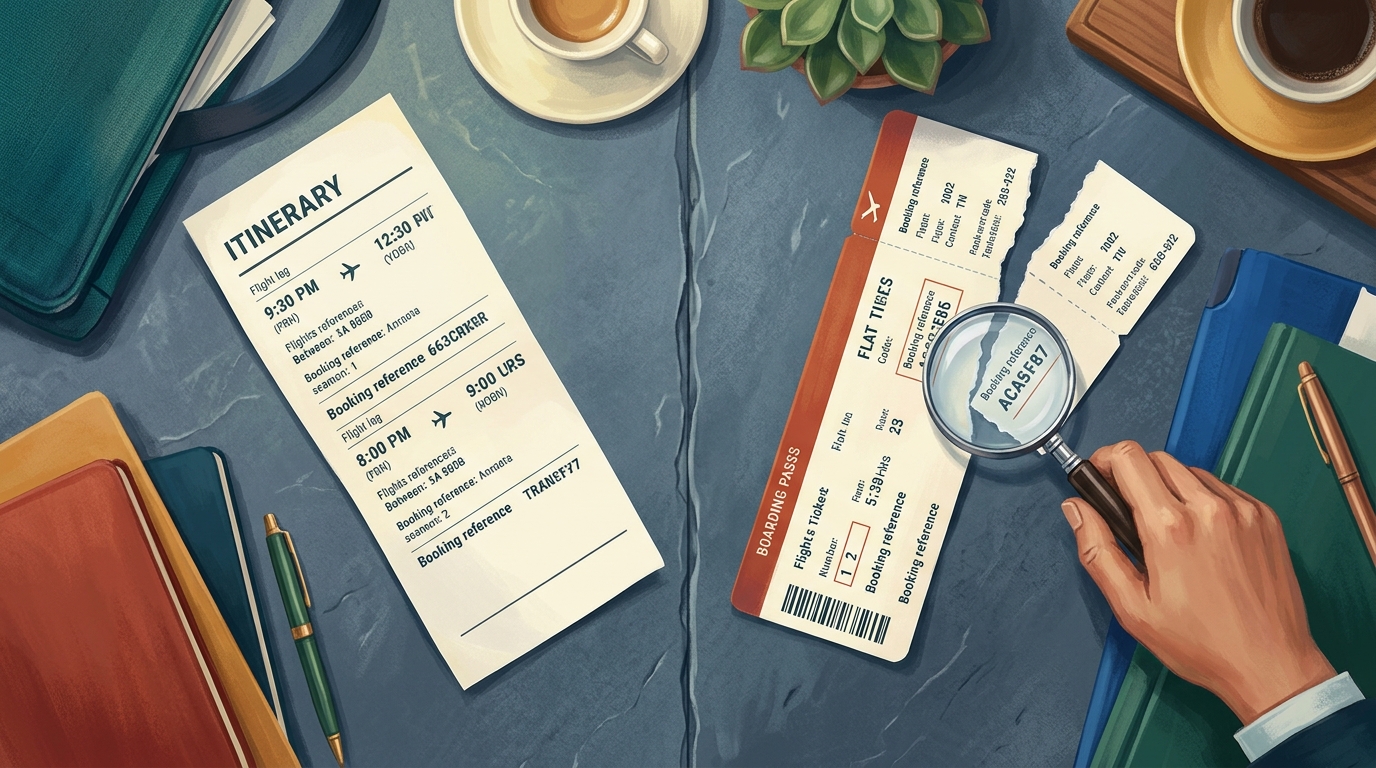
Before you worry about minutes, count your confirmation codes. If every flight in your journey sits under one booking reference (one six-character code, one ticket number), you have a protected connection: the airline owns the handoff. If you have two or more separate booking references because you bought the legs apart, or an online travel agency stitched them together, you have a self-transfer: the handoff is yours, and so is the risk.
This single distinction changes the buffer math more than the airport, the airline, or whether you're flying domestic or international. The same 50-minute gap is genuinely fine on one ticket and reckless on two.
A cheap multi-leg fare from a booking site is not automatically one ticket. If you received two separate confirmation emails with two different reference codes, you bought a self-transfer, even if the site displayed it as a single "trip." Check before you fly, not at the gate.
Why does the booking reference carry so much weight? Because on a single reservation, the airline has legally committed to getting you to your final destination. On separate tickets, each flight is its own contract, and the second airline owes you nothing if the first one runs late. The UK Civil Aviation Authority is blunt about it: separate reservations are separate contracts, and you will probably have to buy a new ticket if you miss the connecting flight. The same logic holds under US Department of Transportation rules, where self-made connections are not protected by federal regulation.
So the rest of this guide splits in two. First, what a protected connection actually buys you and why the airline's stated minimum is a floor, not a safe buffer. Then, how big a gap you need when you're on your own.
Protected Connections: The Airline's Minimum Is a Floor, Not a Buffer
On a single booking, your airline has already vetted the connection against a Minimum Connection Time (MCT): the shortest legal gap the booking system will sell for that airport and connection type. You literally cannot buy a sub-MCT connection on one ticket. But MCT is an ideal-conditions technical minimum, not a recommendation for a relaxed transfer. It assumes an on-time arrival, a nearby gate, and no surprises.
Those minimums are real and standardized. According to flight-data provider OAG, MCTs "could be as low as 30 minutes for domestic, whilst for international flights can be up to an hour and a half." OAG describes how each airport's value is agreed by the local Airport Operators Committee, submitted to IATA for approval, and then "used by global distribution systems (GDS) and connection builders" so the booking software physically rejects any itinerary shorter than the published minimum. IATA administers these airport-by-airport minimums globally (IATA's MCT standard covers 400+ of the most-connected airports). In plain terms: the system blocks the impossible. It does not protect the merely tight.

The upside of a protected connection is the safety net underneath it. If a delay on your first leg makes you miss the second, the airline must rebook you onto the next available flight at no extra cost, or refund the unused segment. And if you end up landing late enough, you may be owed real money.
What you can claim if a protected connection breaks
In the EU (and on flights departing the EU), the rule is specific. Per the European Union's Your Europe passenger-rights portal: "If you miss a connecting flight travelling within the EU or outside the EU on a flight originating from an EU country, you should be entitled to compensation, if you arrive at your final destination with a delay of more than 3 hours." That compensation runs from €250 to €600 depending on distance (per AirHelp's breakdown of EC261), and it applies only when the flights were on a single reservation.
Even on one ticket, the EU rules say you are "not entitled to compensation if you miss connecting flights due to delays at security checks or if you did not respect the boarding time of your flight at the airport of transfer" (europa.eu). Translation: dawdle in a shop or arrive late to the gate, and the protection evaporates.
The United States works differently, and it matters if you're flying there. US rules do not require airlines to pay cash for delays at all. As AirHelp states, "U.S. regulations do not require airlines to provide monetary compensation for delayed flights." What you do get is a refund right: when a flight is canceled or "significantly changed," meaning departure or arrival times more than three hours off domestically and six hours internationally, you can take a refund instead of rebooking, and per NerdWallet's summary of the DOT rule, those "cash refunds must be 'automatic and prompt' and no longer need to be explicitly requested." The DOT's own airline cancellation and delay dashboard tracks which carriers commit to rebooking and meal or hotel coverage when a controllable delay strands you. On a single ticket, the airline still must rebook you free; it just won't hand you a compensation cheque the way the EU does.
Self-Transfers: You Are the Connection Now
On separate tickets, the entire safety net disappears at once. No MCT was enforced, because the booking systems never saw the two flights as a connection. No airline will rebook you, because the second carrier's contract started fresh. No compensation is owed for the misconnection itself. You are the airline now. And you personally have to do the work the airline normally hides from you: collect your checked bag, leave the secure zone, possibly clear immigration, then re-check the bag and re-clear security for leg two.
On a single booking, the airline absorbs a missed connection. On a self-transfer, you absorb it, and the cost is a brand-new ticket bought at the gate at last-minute prices. That is the entire reason a self-transfer needs a far larger buffer than the airline's MCT would suggest.
One r/Flights traveler showed how fast a gate can vanish on you, and that was on a single, protected ticket. On a self-transfer, with a bag to recheck and an immigration hall in between, it's worse. In their thread titled "Missed my flight because the Gate closed 1 hour 05 minute before departure," they described arriving at a familiar airport on their usual routine, only to find the gate already shut more than an hour ahead of departure: "it says GATE CLOSED! Despite the flight showing the time that was 1 hour 5 minutes ahead of the current time... I had to go buy another ticket for the next flight."
So how much gap is enough? Here is the buffer table to size your connection by type. These are practical safe-buffer recommendations, not laws, and they err toward not getting stranded.
| Connection type | Recommended buffer | Who protects you | What you must redo |
|---|---|---|---|
| Domestic, one ticket | 60-90 min | Airline rebooks free | Nothing (bag transfers automatically) |
| International, one ticket | 90 min-2.5 hrs | Airline rebooks free; EU/UK may owe cash | Sometimes security/passport, rarely bag |
| Domestic, self-transfer | 2-3 hrs | No one | Collect + recheck bag, re-clear security |
| International, self-transfer | 4-6 hrs | No one | Bag, immigration, customs, re-check, security |
The takeaway: a 90-minute international self-transfer is asking for trouble. Building closer to a half-day for an international self-transfer sounds excessive until the first flight slips an hour and you still make the second one with time to spare. The buffer is insurance you only notice when you need it.
What Actually Eats Your Buffer
A layover loses 60 to 90 minutes to deplaning, queues, walking, and an early gate-close before any of it is 'free' time. A "2-hour layover" is never two hours of usable time. Real transfers get chewed up by a predictable list of delays, and on a self-transfer you pay every one of them yourself. Front-load these into your math before you accept any connection.
- Deplaning: 10-20 minutes just to get off the first aircraft, longer from the back
- Bag recheck (self-transfer only): retrieve from the carousel, then re-drop at the next airline's desk
- Immigration and customs on an international arrival: unpredictable, often 30-60+ minutes
- Security re-clearing if you left the secure zone: another full screening line
- Terminal or airport change: shuttles, trains, or a taxi between separate buildings
- The gate closing early: boarding shuts roughly 15-60 minutes before departure
- Walking distance: large hubs put gates a 10-15 minute walk apart, before any queue
The gate-closing point deserves emphasis because it surprises even frequent flyers. Your departure time is not your deadline; the gate-close time is, and it can be far earlier than you expect. The r/Flights traveler above hit a gate that closed 65 minutes early. Always treat the boarding cutoff - not the scheduled push-back - as the moment you must be standing at the gate.
Big, unfamiliar transfer airports magnify every one of these. One widely shared r/Flights post warned travelers not to attempt a solo connection through Cairo because of how slow and confusing the transfer process can be. If your connection runs through a hub you don't know, add buffer, not optimism.
Our airport survival guide goes deeper on the security side specifically, since re-clearing screening is one of the biggest and most avoidable buffer-killers on a self-transfer. The short version: if leaving the secure zone is required, assume you'll lose a full screening cycle and plan accordingly.
How to Look Up a Connection's Real Minimum Before You Book
You can check whether a connection is even feasible before committing, and a few minutes of research beats a gate-side panic. The goal is to confirm the airport's MCT for your specific transfer type, then add a generous margin on top, especially for a self-transfer where no MCT was enforced at all.
- Count the booking references first One code means protected; two or more means self-transfer and a bigger buffer. This determines everything else.
- Check the airport's published MCT Search the airport's official site or a flight-data reference for its minimum connection time by connection type (domestic-domestic, international-international, and so on). Remember this is the floor, not your target.
- Watch for the short-connection flag. Google Flights marks risky gaps in its Advisory column: per Google's help docs, it flags "short connections (less than 30 minutes for a domestic flight and less than 60 minutes for an international flight)," the same 30/60 thresholds flight-fare guides confirm. If you see that flag, don't book it on a self-transfer.
- Add your buffer on top of the MCT Use the buffer table above. For an international self-transfer, the MCT is irrelevant; aim for 4-6 hours regardless.
- Map the airport for terminal or airport changes An airport change (some "connections" route through two different airports in a city) can quietly add an hour of ground transport.
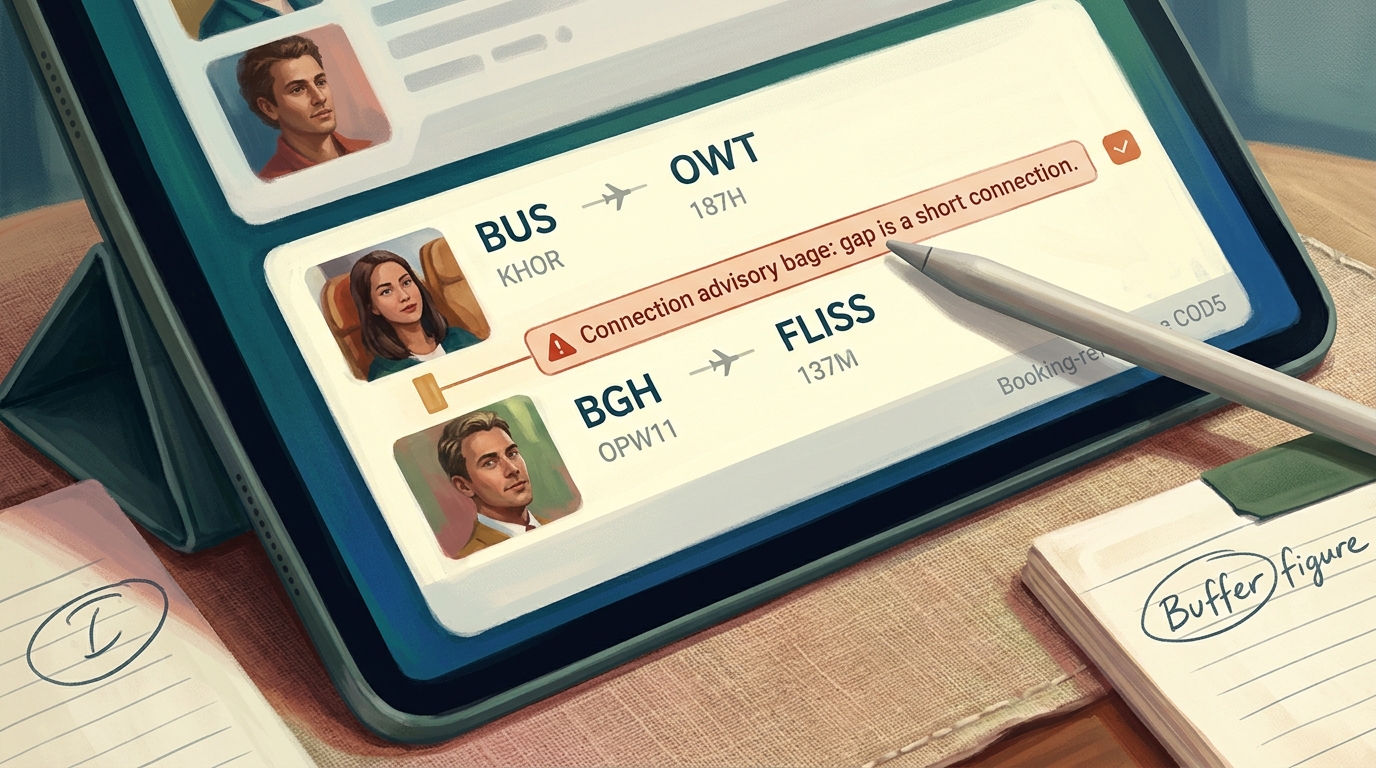
That short-connection flag is a useful tripwire, but note what it is: a generic warning, not airport-specific MCT, and not protection. It tells you the gap is risky; it does not tell you a delay is covered. On separate tickets, a Google flag is the floor of a floor.
When a Self-Transfer Is Worth the Risk
Self-transfers exist for one reason: they're often dramatically cheaper. Splitting your own legs on two budget carriers can undercut a single through-fare by a wide margin, and for some routes there is no protected option at all. The question is never "are self-transfers bad." It's "is the saving worth the buffer and the gate-rebooking risk." Decide deliberately, not by accident.
- The saving is large and your trip has slack to absorb a missed leg
- You can build a 4-6 hour international (or 2-3 hour domestic) buffer
- You travel carry-on only, removing the bag recheck step
- There's a later same-day flight as a fallback if you misconnect
- It's the last connection of the day with no fallback flight
- You're checking bags through a tight international transfer
- The destination is non-refundable and time-critical (a cruise, a wedding)
- The price gap is small relative to a last-minute replacement fare
If you go the self-transfer route, connection-protection products exist. Some booking platforms sell a paid "self-transfer guarantee" that promises to rebook you or cover costs if your own connection breaks; coverage is route-dependent and far from universal. Standard travel insurance with missed-connection cover is another layer worth checking, since policies vary widely on what counts as a covered misconnection. Treat either as a backstop, not a substitute for a real buffer.
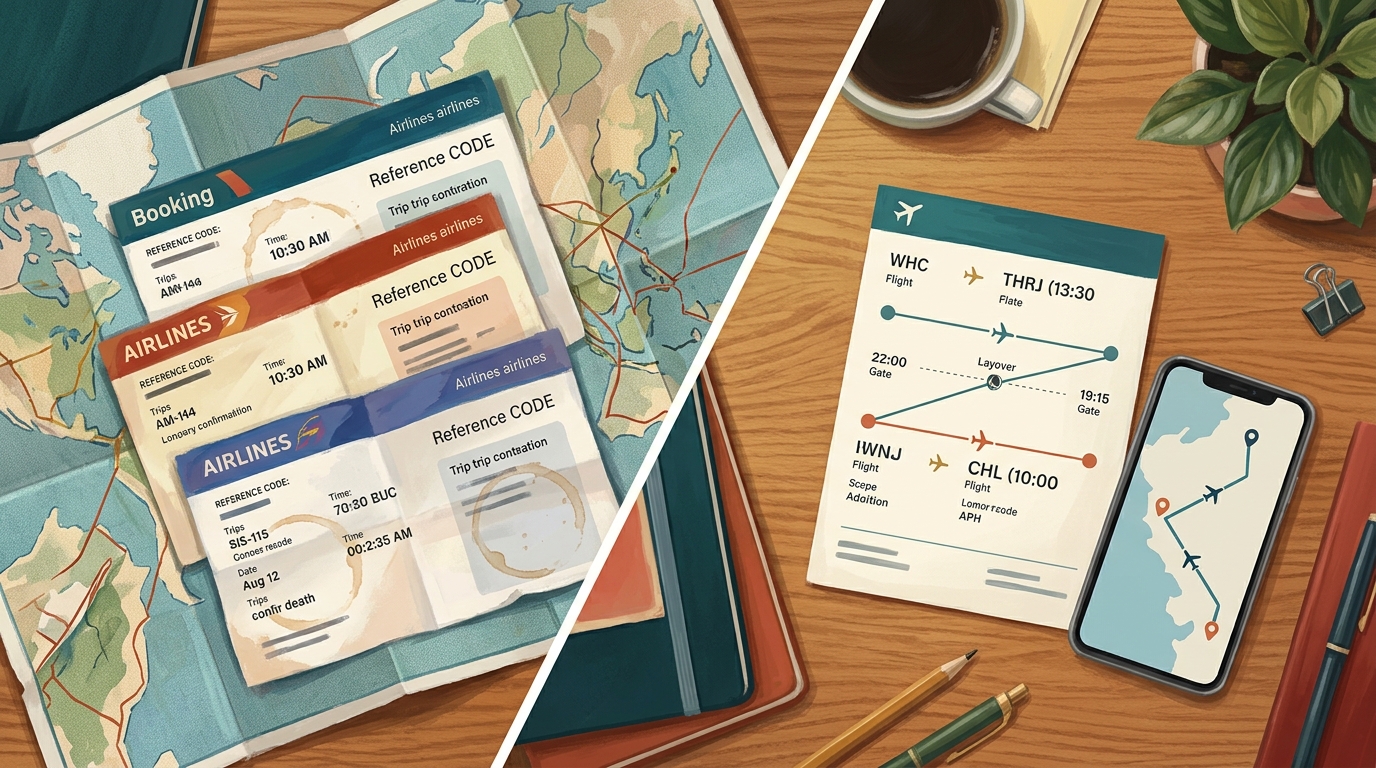
This is also where keeping your trip organized pays off. Self-transfers mean juggling two or more separate booking confirmations, and the moment something slips you need them fast. Tools like a planning app help here: TripProf keeps all your booking confirmations and boarding passes in one place and visually maps your flight routes and layovers from scanned documents, so every reference number and leg is in one view instead of scattered across three inboxes. It won't rebook you, but it means you're not digging through your email while a gate closes.
What to Do the Moment You Realize You'll Misconnect
If your first flight is running late and the math no longer works, act before you land, not after. The traveler who waits until the gate is the traveler who buys the new ticket. Your moves differ sharply depending on which kind of connection you have:
- On one ticket, contact the airline in the air or the instant you land. Use the app, the in-flight WiFi, or a transfer desk. They are obligated to rebook you free, and getting in line early beats getting in line behind 200 other passengers.
- On one ticket from the EU/UK, note the times. If you'll land 3+ hours late at your final destination and it wasn't extraordinary circumstances, you may be owed compensation. Photograph the boards and keep boarding passes.
- On a self-transfer, race the clock, then triage. No one rebooks you, so first try to make the flight. If you can't, immediately check the next available seat on leg two and price a replacement before the desk fills up.
- Check your insurance and protection product. If you bought missed-connection cover or a self-transfer guarantee, file or call right away; many have tight notification windows.
- Keep every document. Boarding passes, delay notices, receipts for any replacement ticket and meals. Whether you're claiming compensation, a refund, or an insurance payout, paper wins.
If the misconnection traces back to a cancellation rather than a simple delay, the rules shift again, and our guide to flight-cancellation refunds covers how to get your money back in that specific case. This article is about the buffer that stops you misconnecting in the first place; that one is about recovering when an airline cancels on you outright.
Frequently Asked Questions
How much time do I actually need between connecting flights?
On a single booking, 60-90 minutes domestic and 90 minutes to 2.5 hours international is comfortable, since the airline rebooks you free if you misconnect. On separate tickets (a self-transfer), aim for 2-3 hours domestic and 4-6 hours international, because no one will rebook you and you must recheck bags and re-clear security yourself.
Is a 50-minute layover too short?
It depends entirely on the ticket. On one booking reference, 50 minutes can be fine for a domestic transfer at a small airport, since the airline only sold it because it met the minimum connection time. On separate tickets it's reckless: there is no protection, and a single late arrival means buying a new flight.
What is a minimum connection time (MCT)?
MCT is the shortest legal gap an airline's booking system will sell for a given airport and connection type, typically around 30 minutes domestic and 60-90 minutes international. It exists to block physically impossible connections from being sold. It assumes ideal conditions, so treat it as a technical floor, not a safe buffer.
Do separate tickets count as a protected connection?
No. Separate tickets are independent contracts. If your first flight is late and you miss the second, the airline operating the second flight owes you nothing and can treat you as a no-show. You lose the fare and typically buy a new ticket. This is the defining risk of a self-transfer.
Will I get compensation if I miss a connecting flight?
Only on a single reservation. In the EU, if you arrive 3+ hours late at your final destination and the cause wasn't extraordinary, you may be owed €250-€600. In the US, there's no cash compensation for delays, but you can take an automatic refund if a flight is significantly changed. Self-transfers get none of this.
Does carry-on-only make a tight connection safer?
Yes, especially on a self-transfer. Skipping checked baggage removes the slowest steps, retrieving a bag from the carousel and re-dropping it at the next airline's desk. You still face immigration and security on an international transfer, but carry-on-only can shave a meaningful chunk off the buffer you need.
Key Takeaways
- Count your booking references first. One code means a protected connection; two or more means a self-transfer with far higher risk.
- MCT is a floor, not a buffer. The 30/60/90-minute minimums block the impossible, not the merely tight. Always add margin on top.
- Protected connections come with a safety net. The airline rebooks you free, and EU/UK departures may owe €250-€600 if you land 3+ hours late.
- Self-transfers leave you fully exposed. No rebooking, no compensation, and you redo bags, immigration, customs and security yourself. Build 2-3 hours domestic, 4-6 hours international.
- Buffer-killers are predictable. Deplaning, bag recheck, immigration, security, terminal changes, and an early gate-close all eat your gap.
- Decide self-transfers on purpose. Worth it when the saving is large and you have slack; skip it for the last flight of the day or a time-critical destination.
- Keep your bookings together. A tool like TripProf that holds all your confirmations and visualizes your flight routes and layovers in one place makes a tight connection far less stressful to manage.
Size the buffer to the ticket, not the timetable, and the connecting flight that used to be the scariest part of the trip becomes the part you stop worrying about.
Sources
- European Union, Your Europe : Air passenger rights, missed connecting flights and 3-hour compensation : europa.eu/youreurope/citizens/travel/passenger-rights/air
- UK Civil Aviation Authority : Connecting flights and self-transfer guidance : caa.co.uk/Passengers/Before-you-fly/Making-a-booking/Connecting-flights
- US Department of Transportation : Fly Rights, passenger guidance : transportation.gov/airconsumer/fly-rights
- US Department of Transportation : Airline Cancellation and Delay Dashboard : transportation.gov/airconsumer/airline-cancellation-delay-dashboard
- OAG : Minimum Connection Times, an insider's guide : oag.com/blog/minimum-connection-times-insiders-guide
- IATA : Station Standard Minimum Connecting Time (MCT) manual : iata.org/en/publications/manuals/station-standard-minimum-connecting-time-mct
- Google Travel Help : Sorting and filtering, short-connection advisory thresholds : support.google.com/faqs/answer/2736487
- Going : Google Flights self-transfer guide, 30/60-minute thresholds : going.com/guides/google-flights-self-transfer
- AirHelp : Flight delay compensation, EU261 amounts and US vs EU comparison : airhelp.com/en/flight-delay-compensation
- NerdWallet : DOT automatic refund rule and significant-change thresholds : nerdwallet.com/travel/learn/flight-delay-compensation
- r/Flights : "Missed my flight because the Gate closed 1 hour 05 minute before departure" (April 2026) : reddit.com/r/Flights/comments/1sjskip
- r/Flights : "Do not travel alone through Cairo Airport for a connecting flight" (March 2026) : reddit.com/r/Flights/comments/1rtcy3l
Last updated: July 3, 2026
Keep Reading
More travel tips and guides picked for you

The fake SBB ticket website stealing credit card and Twint data from travelers
Zurich cantonal police confirmed a fake SBB ticket website is stealing credit card and Twint payment details from travelers who find it through an ordinary Google search. Here is how to spot it and what to do if you already paid.

UK ETA scam warning: fake websites are charging Austrians up to €900
Fake UK ETA websites are charging Austrian and EU travellers hundreds of euros for a form that costs £20. Here's how the real one works, and how to spot a scam before you pay it.

The vignette scam targeting eight European countries this autumn
Fake toll-sticker sites just got a fresh warning from consumer-protection agencies in Germany and Switzerland. Here is who is being targeted, what the scam looks like, and the eight official links to bookmark before your next road trip.