How to Fly Around the Middle East Airspace Crisis: Rerouting Strategies, Alternative Hubs, and Booking Tactics for 2026
Key Highlights
- 1
- 2
- 3
+5 more in the takeaways below
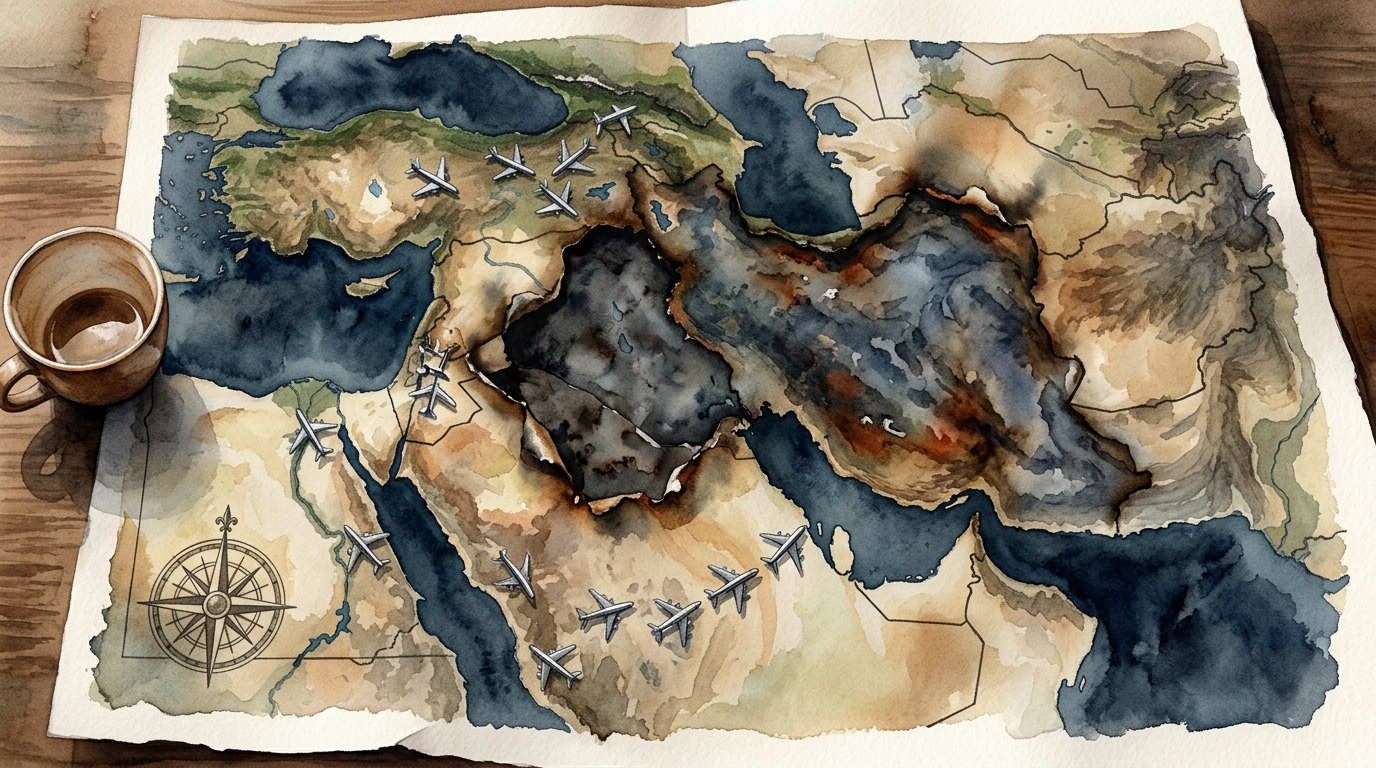
Your flight from London to Bangkok just got six hours longer. Not because of a layover or a delay - but because the shortest path between Europe and Asia no longer exists. Since February 28, 2026, when joint US-Israeli strikes on Iran triggered retaliatory attacks across the Gulf, the airspace over Iran, Iraq, Kuwait, and Syria has been closed by NOTAM.
Israel, Bahrain, the UAE, and Qatar remain heavily restricted. The corridor that carried roughly 70% of the region's transit volume is, for all practical purposes, a hole in the sky. And if you have flights booked through this region, you need a plan.
The Middle East airspace crisis has grounded 60,000+ flights and cut regional air traffic by 59% since late February 2026. Gulf carriers are operating at a fraction of normal capacity, fares on alternative routes have surged up to 300%, and the situation won't normalize before autumn at the earliest. Your best options: rebook through Istanbul, Helsinki, or Southeast Asian hubs; fly carriers with Russian or northern airspace access; avoid third-party booking sites; and buy CFAR insurance for any new trips. Check SafeAirspace.net and Flightradar24's Gulf Recovery Index daily.
What's Actually Closed (and What's Barely Open)
Airspace conditions change weekly, sometimes daily. Here's where things stand as of early April 2026, based on NOTAM data tracked by OpsGroup and the EASA Conflict Zone Information Bulletin renewed March 28.
| Airspace | Status | What It Means for Travelers |
|---|---|---|
| Iran, Iraq, Kuwait, Syria | Closed | No commercial overflights. All routes rerouted. |
| Israel | Closed | Limited PPR arrivals/departures only. No transit. |
| Bahrain | Closed | Gulf Air grounded indefinitely. |
| UAE | Restricted | Partially open. Single western routing via LUDID corridor. |
| Qatar | Restricted | Approved arrivals via LAEEB, departures via DATRI only. |
| Saudi Arabia | Open* | Open with contingency routes. Some disruptions at Riyadh/Jeddah. |
| Oman | Open* | Muscat operating as evacuation hub. NOTAM routings in place. |
| Jordan | Open | Fully reopened March 3. Normal operations. |
EASA's advisory covers airspace over Bahrain, Iran, Iraq, Israel, Jordan, Kuwait, Lebanon, Oman, Qatar, Saudi Arabia, and the UAE at all altitudes. It runs through at least April 10, with extension almost certain if the conflict persists.
Bookmark SafeAirspace.net for real-time conflict zone maps and OpsGroup's operational picture for NOTAM-level detail. These update faster than airline websites.
The Numbers Behind the Disruption
This is not a minor schedule adjustment. The scale of what's happened to global aviation since February 28 is unlike anything since the early days of the pandemic.
Gulf mega-carriers tell the story most clearly. Emirates has been rebuilding toward full capacity, operating roughly 60% of its pre-crisis network as of late March, with a stated goal of 100% restoration subject to airspace conditions. Etihad is hovering around 40%, running 60-71 daily flights from Abu Dhabi. Qatar Airways has been hit hardest: the airline reduced operations to as few as 43 daily flights and relocated 22 widebodies to storage in Teruel, Spain. Qatari airspace remains effectively closed to most traffic.
For passengers, the math is brutal. Benchmark jet fuel prices have roughly doubled since late February. Airlines flying detour routes burn 15-25% more fuel per Europe-Asia rotation, and those costs land directly on ticket prices. One-way Bangkok-London economy fares surged to over $2,000, with some routes seeing increases of up to 900% compared to pre-crisis pricing.
The Rerouting Map: How Planes Are Getting Around
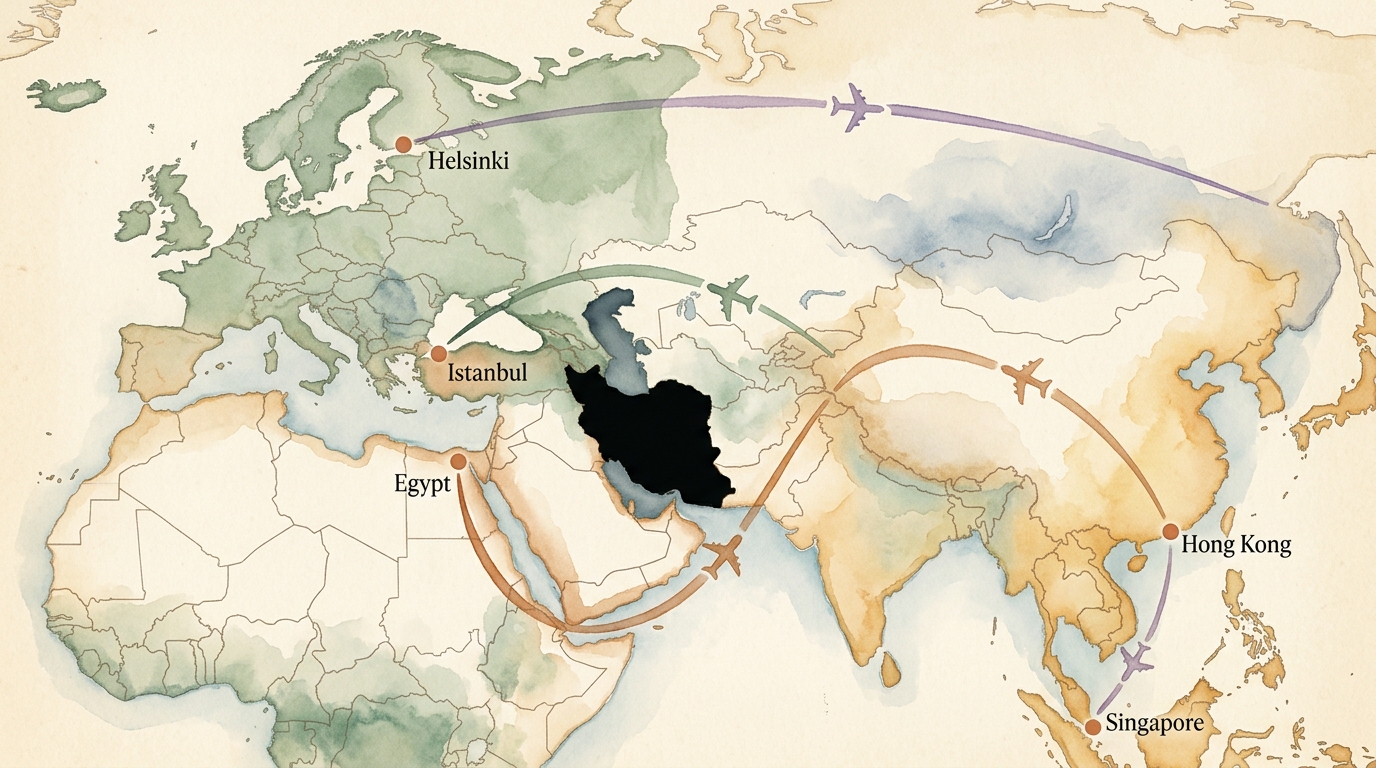
Every Europe-to-Asia flight that used to cruise over the Persian Gulf at 40,000 feet now has to pick one of two detour corridors. Neither is quick, and both have complications.
The Northern Bypass threads through Turkish airspace, across the Caucasus (Armenia and Azerbaijan), then over Afghanistan and into South or Southeast Asia. It adds 2-4 hours to a typical flight. The problem: this corridor is now absorbing massive volumes of rerouted traffic, which creates congestion in airspace that was never designed for it. Flights from Singapore to London that normally took 13 hours are now clocking 18-22 hours with the detour.
The Southern Bypass routes through Egyptian airspace, down Saudi Arabia's western coast, and around via Oman. It adds 3-5 hours and works best for flights heading to East Africa, the Indian subcontinent, or Southeast Asia from southern Europe.
There's also a third option that only some carriers can use. Chinese airlines fly directly through Russian airspace, which shaves 2-3 hours off the detour and saves significant fuel. Air China, China Southern, and China Eastern have collectively added 2,891 Europe-bound flights for the summer 2026 schedule. If you don't mind connecting through Beijing or Shanghai, these routes are often the fastest option between Europe and Asia right now.
GPS spoofing is hitting over 700 Gulf flights daily, and feeds false position data to aircraft systems. This is one reason airlines are avoiding even technically "open" airspace near the conflict zone. If your rerouted flight passes through the eastern Mediterranean or Caucasus corridor, longer routings through known-safe airspace are actually the safer choice.
Which Airlines Are Flying Where
Not every airline is equally disrupted. Some are grounded, some are limping along - and a few are actively expanding. Knowing who's doing what will save you hours of searching dead-end booking pages.
| Airline | Status | Key Detail |
|---|---|---|
| Emirates | ~60% capacity | Refunds/rebooking extended through April 15. Some routes restored. |
| Etihad | ~40% capacity | 60-71 daily flights from Abu Dhabi. Limited schedule. |
| Qatar Airways | Severely reduced | Operations cut to ~43 daily flights. 22 aircraft in storage. Refunds available through April 30. |
| British Airways | Suspended | Abu Dhabi until Oct 2026. Dubai, Amman, Bahrain, Tel Aviv until May 31. |
| Lufthansa Group | Suspended | 8 Middle East destinations until Oct 24, 2026. Dubai/Tel Aviv until May 31. |
| Turkish Airlines | Mixed | Middle East routes suspended until April 13. Istanbul hub fully operational for transit. |
| Finnair | Operating | 11 Asian destinations via northern routing. Increased Bangkok frequencies. |
| Cathay Pacific | Expanding | London increased to 35 weekly flights. Extra Paris and Zurich services. |
| Air India | Adding capacity | 78 extra flights (17,660 seats) on 9 routes. Plus 36 additional flights through late March. |
| Chinese carriers | Expanding | 2,891 extra Europe flights via Russian airspace. Often the fastest routing. |
A clear pattern has emerged: airlines based outside the conflict zone are picking up the slack, while Gulf and European carriers with Middle East exposure are in retreat. American Airlines has also been affected, with its Philadelphia-Doha route suspended through May 7 and New York-Tel Aviv pushed back to at least April 23. If you're flying transatlantic and connecting to Asia, your options through the Gulf have shrunk dramatically.
The Alternative Hubs: Where to Connect Instead
Before the crisis, Dubai, Doha, and Abu Dhabi were the default connection points between Europe and Asia. That's over for now. Here's where the traffic is flowing instead.
Istanbul (IST)
Istanbul Airport served 84 million passengers in 2025 and serves as the hub for Turkish Airlines, which flies to over 300 international destinations across 132 countries. It sits at the geographic crossroads of the crisis: close enough to capture demand, far enough to keep operating. Turkish Airlines flies direct to Delhi, Bangkok, Singapore, Kuala Lumpur, Tokyo, Beijing, Hong Kong, and Seoul. The catch: its own Middle East routes are suspended until at least April 13, and the airport is under enormous pressure from rerouted traffic. Expect longer connection times and crowded terminals.
Helsinki (HEL)
Finnair's northern routing is the crisis-proof option. Helsinki connects to 11 Asian destinations via a polar/northern corridor that doesn't go anywhere near the conflict zone. Tokyo, Seoul, Singapore, Bangkok, Shanghai, Hong Kong, Osaka, Delhi, and Phuket are all on the network. The airline is even launching Helsinki-Bangkok-Melbourne in October 2026. Downsides: limited frequencies compared to the Gulf mega-hubs, and Helsinki is a small airport so connections are less flexible.
Singapore (SIN), Hong Kong (HKG), Kuala Lumpur (KUL)
Southeast Asian hubs are absorbing massive volumes of rerouted Europe-Asia traffic. If you're heading to or from Asia, connecting through one of these instead of a Gulf hub eliminates the airspace issue entirely. Cathay Pacific (Hong Kong), Singapore Airlines (Singapore), and Malaysia Airlines (KL) all fly direct to major European cities without crossing conflict zones.
Addis Ababa (ADD)
Ethiopian Airlines, a Star Alliance member, connects Africa and the Middle East to the rest of the world without touching Gulf airspace. Useful for travelers heading between Europe and East Africa or South Asia who would normally connect through Dubai or Doha.
Muscat (MCT)
Oman has emerged as an evacuation and rerouting hub since the crisis began. Muscat's airspace remains open with NOTAM-based contingency routings, and Oman Air is operating. For travelers stuck in the Gulf region or trying to reach the Indian subcontinent, Muscat is often the most accessible departure point. It won't work as a major Europe-Asia connector like Istanbul, but it fills an important gap for anyone already in the region.
The bottom line: Istanbul and Helsinki are your best bets from Europe. Singapore, Hong Kong, and KL are the moves from Asia. For Africa connections, Addis Ababa fills the gap Doha left behind. And if you're stuck in the Gulf itself, Muscat is your way out.
How to Actually Rebook (Without Losing Your Money)
You're staring at a cancellation email, your departure is in two weeks, and the airline's hold music has been playing for 47 minutes. Here's what to do, in order.
- Check your booking source. If you booked directly with the airline, you're in the best position. If you booked through an OTA (Expedia, Booking, etc.), brace yourself: OTAs and airlines often point fingers at each other, and you'll be caught in the middle. Reddit's r/flights megathread is full of travelers who booked through third parties and couldn't get anyone to help them rebook.
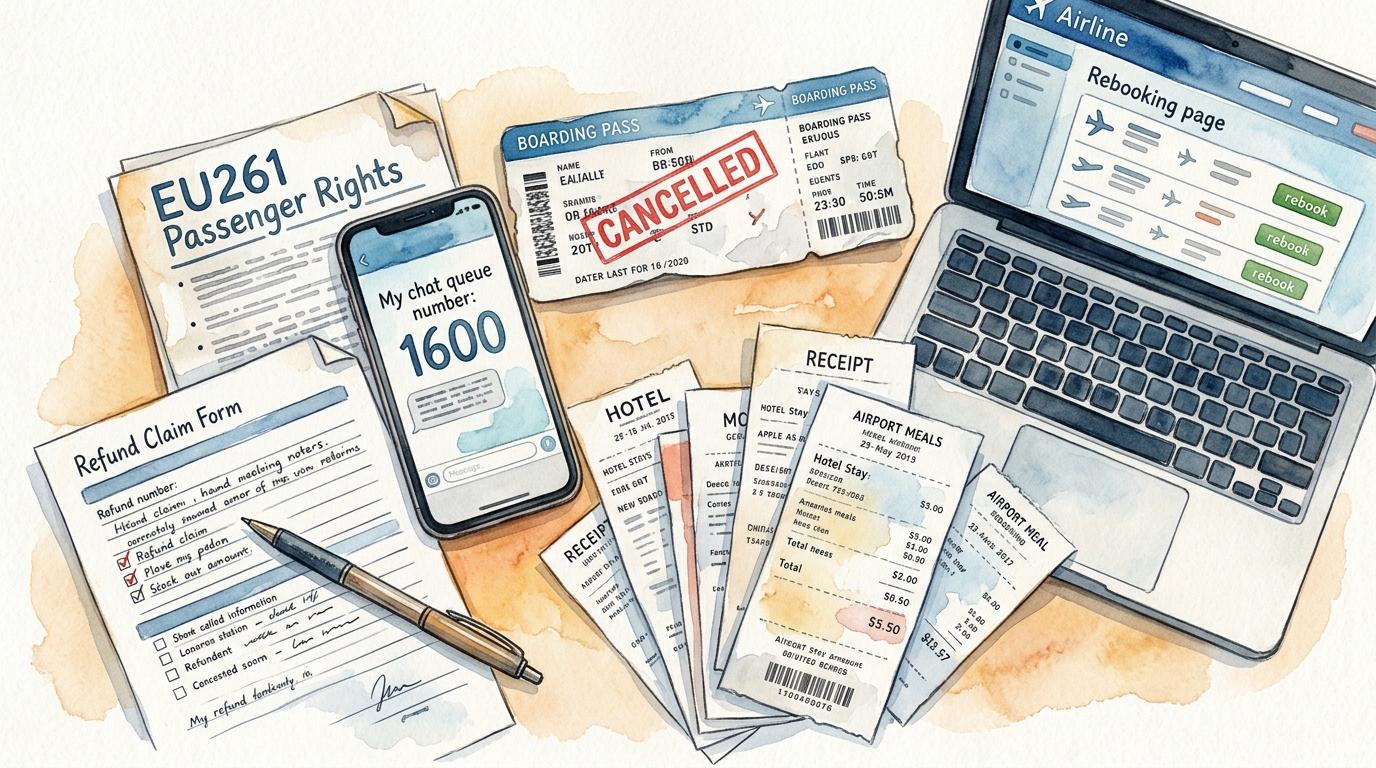
- Know your rights. Under EU261, if your flight departs from an EU airport (or arrives on an EU carrier), you're entitled to a full refund or rebooking, plus meals and accommodation if you're stranded. The standard compensation of EUR 250-600 probably won't apply here because airspace closures count as "extraordinary circumstances." But the refund and care rights are non-negotiable.
- Call, don't wait for email. Airlines are processing rebookings at a massive scale. Emirates, Qatar Airways, and Etihad are all offering extended rebooking windows (Emirates through April 15, Qatar Airways through April 30). Call the airline directly, use social media DMs as a backup channel, and document everything in writing.
- Consider a separate ticket. Sometimes the fastest solution is buying a new ticket on an unaffected carrier and pursuing a refund on the cancelled one separately. One traveler in the r/flights megathread booked a separate Dallas-to-Sri Lanka ticket via Hong Kong on Cathay Pacific while waiting for their original Gulf carrier to sort things out. It's not ideal, but it gets you where you need to go.
- File everything. Keep receipts for meals, hotels, and transport if you're stranded. Screenshot cancellation notices. Save chat transcripts. You'll need all of this for insurance claims or chargeback disputes later.
I booked through a third party and was stuck in Etihad's chat queue with 1,600 people ahead of me, processing at roughly 250 per hour.
- r/flights megathread, March 2026
If you're planning new travel through the affected region, our guide to getting refunds on cancelled flights covers the full process. And if you've already been rebooked onto a route you didn't choose, check whether your travel insurance policy covers the additional costs of the longer journey.
Travel Insurance: What's Covered, What's Not
Here's the uncomfortable truth: most standard travel insurance policies exclude "acts of war." If you bought a basic policy before the conflict started, it might cover trip cancellation due to your airline ceasing operations. But if your airline is still flying (just on a longer route or a different schedule), your policy probably won't pay out for the inconvenience.
Squaremouth, one of the largest travel insurance comparison sites, reported an 18x increase in customer inquiries linked to UAE and Dubai travel since the conflict began. Their guidance is straightforward: policies purchased before the conflict are more likely to cover cancellations, because the event was unforeseeable at the time of purchase.
For new bookings, your best protection is Cancel For Any Reason (CFAR) coverage. CFAR lets you cancel for any reason and get 50-75% of your prepaid, non-refundable costs back. But there's a window: CFAR must be purchased within 14-21 days of your first trip deposit. Interest in CFAR has surged 27% since early March 2026. If that window has passed, CFAR is off the table for that trip.
Once a conflict or airspace closure is widely reported, insurers treat it as "foreseeable." New policies purchased after February 28 typically won't cover cancellations caused by this specific crisis. CFAR is the exception, but only if you buy it within the required window.
Note: Insurance coverage varies by provider and policy. This is general guidance; always read your specific policy terms or consult your insurer directly before making coverage decisions.
For the full breakdown of what travel insurance covers and where the gaps are, see our deep dive on travel insurance in 2026.
Booking Tactics That Actually Work Right Now
Knowing the alternatives is step one. Getting a decent fare on them is step two. We've been tracking fare changes on these corridors daily, and the pattern is clear: prices drop Tuesday-Wednesday and spike Friday-Sunday. These strategies are working for travelers right now.
One traveler in the r/flights megathread described sitting in Etihad's chat queue with 1,600 people ahead -- all because they booked through a third party. Book direct, not through OTAs. When disruptions hit, airlines prioritize rebooking their own direct customers. Third-party bookings get pushed to the back of every queue, and horror stories like that one are everywhere right now.
Look at positioning flights. Instead of booking one ticket from your home city through a Gulf hub, consider splitting it: a cheap flight to Istanbul, Helsinki, or Singapore, then a separate ticket onward. You'll have more routing flexibility and better rebooking options if things change again.
Data from Aviation Week shows Air China, China Southern, and China Eastern are currently offering some of the most direct Europe-Asia routings, thanks to Russian airspace access. The trade-off: you'll connect through a Chinese hub city, and service standards vary. But travel time and price can both be significantly better than the alternatives.
Consider timing carefully. Lufthansa Group has suspended 8 Middle East destinations until October 24, 2026. British Airways won't fly to Abu Dhabi until at least October. These aren't short-term disruptions. If your travel window is flexible, autumn 2026 is the earliest realistic point where major carrier networks might start resembling normal. But don't count on it.
Use flexible fare classes. If you're booking new travel through any region near the conflict zone, the extra cost of a flexible or refundable ticket is worth it. The EASA advisory runs through April 10 with near-certain extension. The situation could improve or deteriorate at any point.
Monitor recovery closely. Flightradar24's Gulf Airline Recovery Index tracks capacity restoration across Emirates, Etihad, Qatar Airways, and other affected carriers in near-real-time. If you have summer travel planned, watch this weekly. Prices will drop as capacity returns, but waiting too long means missing the remaining affordable options. Tools like TripProf can help you organize the moving pieces of a disrupted trip, from rebooked flights to updated documents and adjusted budgets, all in one place.
If you're rethinking your summer plans entirely, our guide to keeping summer 2026 travel affordable covers how the fuel crisis affects different destinations and routes. And for travelers considering completely different destinations to avoid the disruption, here's where the conflict is making travel cheaper (and more expensive).

Your Pre-Flight Checklist for Conflict-Affected Routes
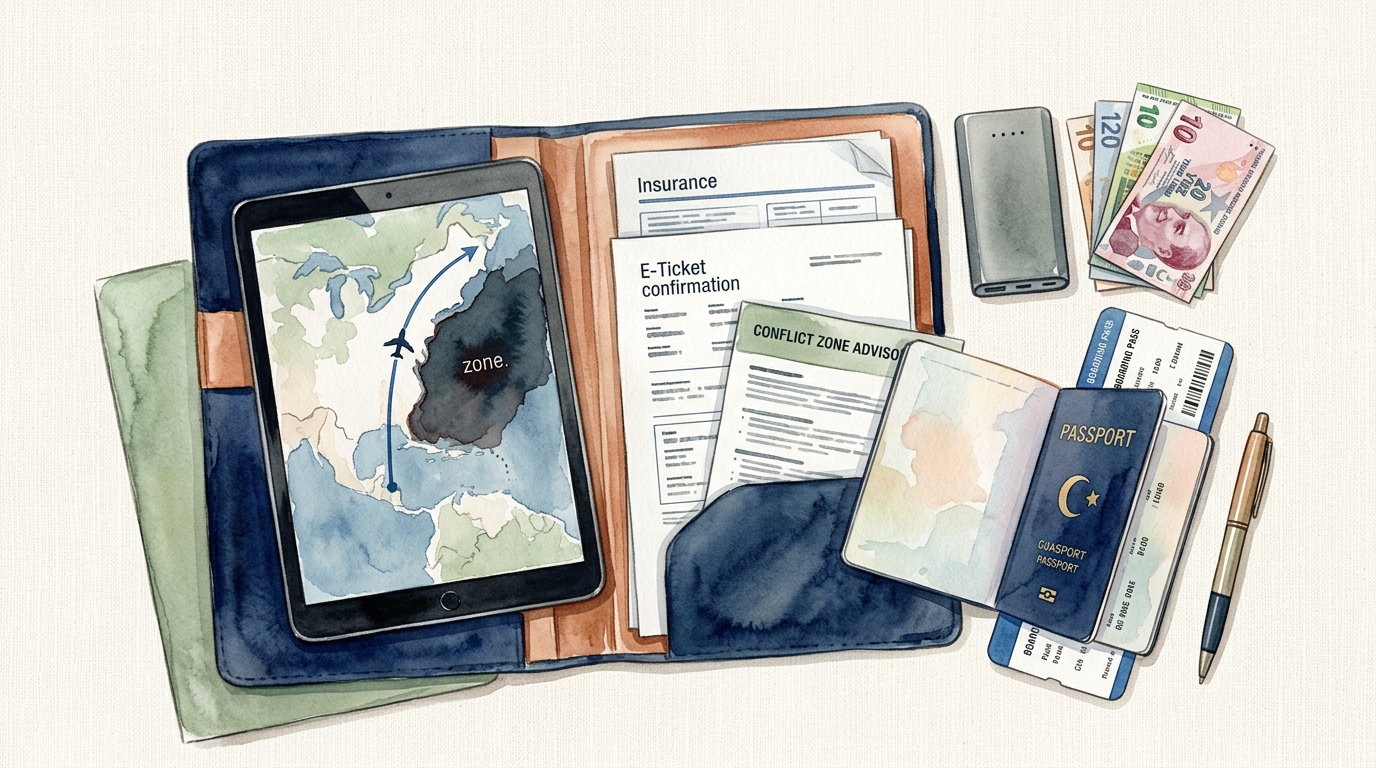
Even if your flight isn't cancelled, flying near or around a conflict zone requires preparation that a normal trip doesn't. Use this before any upcoming departure on affected corridors.
- Verify your exact routing on Flightradar24 (your airline's route may have changed since booking)
- Check SafeAirspace.net for current risk assessments on every country your flight crosses
- Confirm your airline's rebooking and refund policy for your specific ticket class
- Purchase CFAR insurance within 14-21 days of your first trip payment (if you haven't already)
- Download offline copies of all booking confirmations, e-tickets, and insurance documents
- Set up flight alerts for your specific flight number (apps like Flightradar24 push real-time updates)
- Have a backup routing planned (know which alternative hub and carrier you'd switch to)
- Carry enough cash and cards to cover 48 hours of unexpected expenses if stranded in transit
For the full pre-trip document setup, our 2026 travel document checklist covers everything beyond the conflict-specific items listed above.
Frequently Asked Questions
Which Middle East airspaces are closed right now?
As of early April 2026, Iran, Iraq, Kuwait, Syria, Israel, and Bahrain are fully closed to commercial overflights. The UAE and Qatar are operating under heavy restrictions with limited corridors. Saudi Arabia and Oman are open with contingency routings. Jordan fully reopened on March 3. Check OpsGroup for daily updates.
How do I check if my flight goes through affected airspace?
Use Flightradar24 to track your flight number and see its actual routing. Compare this against the SafeAirspace conflict zone map. Your airline may also update the routing on your booking page after schedule changes.
Can I get a refund if my flight is cancelled due to airspace closures?
Yes. Under EU261 (for EU-departing flights or EU-carrier flights), you're entitled to a full refund or rebooking. Emirates, Etihad, and Qatar Airways are also offering refunds on their own policies. However, the standard EU261 cash compensation of EUR 250-600 likely won't apply because airspace closures qualify as extraordinary circumstances.
What are the alternative routes from Europe to Asia that avoid the Middle East?
Three main options: the northern bypass via the Caucasus and Afghanistan (adds 2-4 hours), the southern bypass via Egypt, Saudi Arabia, and Oman (adds 3-5 hours), or connecting through hubs like Istanbul, Helsinki, Singapore, or Hong Kong. Chinese carriers flying through Russian airspace offer the most direct alternative routings.
Does travel insurance cover flight cancellations due to war?
Most standard policies exclude acts of war. Policies purchased before the conflict began (before February 28, 2026) have the best chance of covering related cancellations. For new bookings, Cancel For Any Reason (CFAR) insurance is the most reliable option, but it must be purchased within 14-21 days of your first trip payment.
Is it safe to fly near the Middle East conflict zone?
Airlines and aviation authorities are rerouting flights to avoid direct conflict zones. The main risks in nearby airspace include GPS spoofing (affecting 700+ daily flights) and the possibility of sudden airspace closures. Established reroute corridors through Turkish, Saudi, and Omani airspace are considered safe for commercial aviation by EASA and national regulators.
Which airlines are still flying to Dubai and Doha?
Emirates is operating at roughly 60% capacity with some Dubai routes restored. Qatar Airways is running a very limited schedule from Doha on select routes. British Airways, Lufthansa Group, and Cathay Pacific have all suspended Gulf routes through at least May 2026. Turkish Airlines' Gulf routes are suspended until at least April 13.
Key Takeaways
- The Middle East airspace crisis has cut regional flights by 59% and affected roughly 6 million passengers since February 28, 2026. This won't normalize before autumn at the earliest.
- Istanbul, Helsinki, Singapore, Hong Kong, and Kuala Lumpur are the primary alternative connection hubs. Helsinki (via Finnair) offers the only routing that completely avoids the conflict zone.
- Book directly with airlines, not through OTAs. When disruptions hit, direct customers get priority for rebooking and refunds.
- Chinese carriers (Air China, China Southern, China Eastern) offer some of the fastest Europe-Asia connections right now, thanks to Russian airspace access.
- Standard travel insurance won't cover this crisis if purchased after February 28. Buy CFAR coverage within 14-21 days of any new trip deposit.
- Monitor SafeAirspace.net, Flightradar24's Gulf Recovery Index, and the EASA CZIB page weekly. The situation changes fast.
- Keep all trip elements (rebooked flights, insurance documents, adjusted budgets) organized in one place. Tools like TripProf help when you're juggling multiple disruptions.
- Fares on alternative routes have surged up to 300%. Prices will come down as capacity returns, but the window for affordable summer 2026 bookings is narrowing.
Sources
- OpsGroup: Middle East Airspace Current Operational Picture: ops.group
- EASA: Conflict Zone Information Bulletin for Middle East and Persian Gulf (2026-03-R4): easa.europa.eu
- AviTrader / IBA: Airspace Closures Cut Middle East Flights by 59%: avitrader.com
- AFAR: How Global Flights Are Being Affected by the Middle East War: afar.com
- Flightradar24: Gulf Airline Recovery and Fleet Tracking: flightradar24.com
- Euronews Travel: Middle East Flights Update (Emirates, Qatar Airways): euronews.com
- Wego Blog: Etihad Airways Review 2026: blog.wego.com
- SkySONAR: Middle East Airspace Closures 2026 Traveler Guide: skysonar.com
- Air Traveler Club: Asia-Europe Fares Surge: airtraveler.club
- AirHelp: SE Asia Airports Benefit from Mideast Flight Shutdowns: airhelp.co.uk
- Squaremouth: Travel Insurance Coverage for Military Action: squaremouth.com
- Wego Blog: CFAR Travel Insurance 2026: blog.wego.com
- Travel Daily News: British Airways Suspends Abu Dhabi Until October 2026: traveldailynews.com
- Air Traveler Club: Lufthansa Group Suspends Middle East Flights: airtraveler.club
- Wego Blog: Turkish Airlines as Alternative During Gulf Crisis: blog.wego.com
- Simple Flying: European Airlines and Australian Routes Analysis (Finnair): simpleflying.com
- Travel Weekly: Cathay Pacific Redirects Capacity to London: travelweekly.co.uk
- Zee Business: Air India 78 Extra Flights Amid Crisis: zeebiz.com
- South China Morning Post: China Airlines Add 2,900 Flights to Europe: scmp.com
- Aviation Week: China-Europe Routes Grow: aviationweek.com
- The Brew News: GPS Spoofing Hitting 700+ Gulf Flights Daily: thebrewnews.com
- CNN: The Hole in the Sky (Middle East Airspace Map): cnn.com
- flight-delayed.com: Passenger Rights During Iran War Disruptions: flight-delayed.com
- SafeAirspace: Conflict Zone Risk Database and Map: safeairspace.net
- IATA: Middle East Conflict Exposes Jet Fuel Supply Vulnerabilities: iata.org
- Nation Thailand: Bangkok-London Fare Surge Amid Airspace Crisis: nationthailand.com
- Flightradar24: Qatar Airways Dominates Aircraft Storage Surge in Teruel: flightradar24.com
- Air Traveler Club: EASA Middle East Airspace Advisory April 2026: airtraveler.club
Last updated: July 3, 2026
Keep Reading
More travel tips and guides picked for you

Airport liquid rules in 2026: which airports actually allow more than 100ml
Some UK airports now let you carry 2 litres of liquid through security. Others, and every US airport, still cap you at 100ml. Here is exactly which is which, airport by airport, and which rule to pack for when your outbound and return airports disagree.

The best group packing list apps in 2026
PackParty nails the everyone-vs-one-person split gear needs. whobrings.com skips the app. TripProf holds the whole trip. Five tools, tested against each other.

The 2026 Hand-Luggage Trap: The EU "Free Cabin Bag" Law Did Not Pass - And the Rules Just Got Stricter
Everyone shared the headline about free cabin bags coming to the EU. The law never passed, and for summer 2026 the rules tightened instead. Exact free allowances for every airline DACH travelers fly, and how to avoid a €70 gate fee.