How Airports Are Secretly Engineered to Make You Spend More Money
You haven't even reached your gate yet, and you've already spent $40. A latte, a neck pillow, a "quick browse" through duty-free that somehow ended with a bottle of gin you don't need. This isn't a lack of willpower. It's airport design, and every element of it is designed to make you spend money. Every curve, every missing clock, every shift from tile to carpet was engineered to separate you from your wallet. The airport commercial revenue machine hit $67.63 billion in 2025. Here's how that machine works.
Airports use a layered system of psychological tricks to maximize spending: curved walkways that funnel you past shops, delayed gate announcements that create enforced browsing time, sensory manipulation through scent and flooring changes, and (in 2026) real-time smartphone tracking with personalized push offers. The industry generates $67+ billion annually from non-flight revenue alone. Knowing the playbook is the first step to keeping your wallet intact.
The $67 Billion Machine You Walk Through Every Flight
Airports aren't transportation hubs that happen to have shops. They're shopping malls that happen to have runways. That distinction matters, because it explains every design decision you encounter between the security checkpoint and your boarding gate.
Non-aeronautical revenue (retail, food, advertising, parking, lounges) comprised 40% of total airport earnings as of 2019, per Airports Council International. That figure has only grown since. Duty-free shops alone convert 52-66% of browsing passengers into buyers, a staggering number when you consider that online retail conversion rates hover around 2-3%.
Dubai Duty Free pulled in $2.38 billion in 2025 alone. Estee Lauder's travel retail division generated $4.7 billion at its peak in 2021, representing 29% of total company revenue, a figure that has since contracted significantly, though it remains a multi-billion-dollar channel. These aren't side businesses. They're the business.
The average passenger drops $128 per airport visit globally. That's not a typo. Millennial business travelers average $151. And the market is accelerating: travel retail is forecast to reach $145.46 billion by 2032 at 10.46% annual growth.
So when you're wondering why the walk from security to your gate feels like an obstacle course of perfume counters and chocolate displays, now you know. Somebody ran the numbers, and the numbers said: make the walk longer.
This didn't happen overnight. The evolution from "airports as transit points" to "airports as retail destinations" has been a deliberate, decades-long transformation.
- 1947 Shannon Airport in Ireland opens the world's first duty-free shop, creating a new revenue category from scratch.
- 1956 Victor Gruen's Southdale Center introduces enclosed mall design; airports begin studying the same behavioral principles.
- 1990s Copenhagen Airport pioneers the walk-through duty-free format, forcing 100% passenger exposure and boosting revenue by 20%+.
- 2010s Scent marketing, flooring psychology, and delayed gate announcements become standard practice across major international hubs.
- 2025-2026 Smartphone tracking, push notifications, and facial recognition add a digital surveillance layer to the classic physical manipulation playbook.
The Maze: How Layout Forces You Past Every Shop
Airport terminals don't just point you toward your gate. They route you through a carefully engineered retail gauntlet where every turn, every curve, and every sight line has been optimized by behavioral design firms using eye-tracking research.
Walkways in most modern terminals curve gently to the left. This isn't aesthetic. Most people are right-handed, which means they naturally drift counterclockwise when pulling luggage. Shops are placed on the right side of corridors, exactly where your eyes naturally look when you're walking left. Architectural firms like HOK use eye-tracking studies to confirm these patterns, with aviation director Robert Chicas noting that spatial design directly shapes passenger behavior.
Copenhagen Airport changed the game with the "walk-through" duty-free concept, where passengers can't reach their gates without physically walking through the retail floor. This serpentine format produces 60% more sales than traditional storefronts because 100% of passengers are exposed to merchandise, compared to maybe 30% who'd voluntarily enter a shop.
Airport labyrinth layouts increase passenger exposure to retail by 40% compared to linear designs. If you feel like you're walking in circles, you're not imagining it.
This isn't accidental. It's a technique borrowed directly from casino design. Victor Gruen, the architect who invented the modern shopping mall in 1956, described a psychological phenomenon now called the Gruen Transfer: the moment a person shifts from purposeful walking to aimless browsing. Airport designers have spent decades perfecting the exact corridor geometry, lighting angles, and sight-line interruptions that trigger this shift as reliably as possible.
Environmental psychologist Sally Augustine of Design With Science and aviation practice leader Derek Moore of SOM both confirm that airports employ spatial design strategies drawn from decades of consumer psychology research. The goal isn't subtle: maximize the time you spend looking at products.
You've just been patted down, your laptop is back in your bag, and you're standing in a wide-open space. That pause isn't accidental. It's the decompression zone, the transitional area right after security, before the shops begin. It exists to let you adjust psychologically: put away your boarding pass, check your phone, reorient. By the time you've decompressed, you're calmer, more receptive, and walking straight into the retail corridor at your most psychologically vulnerable.
The Golden Hour: Why Your Gate Is Always a Mystery
You've cleared security, you've checked the departure board, and your gate hasn't been announced yet. So you wander. You browse. You buy a $7 water bottle because you're thirsty and there's literally nothing else to do. This is the "golden hour," and it's the most profitable window in the airport's day.
The term refers to the first 60 minutes after security, when passengers enter what psychologists call a "self-indulgent mood." You've already endured the stress of check-in and security screening. Your cortisol is dropping. You feel relief. And that emotional state makes you significantly more willing to spend.
Airports actively extend this window. Gates are frequently announced only 30-50 minutes before boarding, creating enforced shopping time. You can't sit at your gate because you don't know where your gate is. The terminal becomes a holding pen with retail therapy as its primary entertainment.
The psychology behind this involves a concept called the prepayment effect. You've already paid for your flight, and that money is gone. This creates a mental "spending permission" that loosens your wallet for everything else. Researchers find that more than half of airport purchases are impulse buys, driven by this combination of boredom, relief, and the feeling that you've already committed financially to the trip.
| Psychological Trigger | How Airports Exploit It | Your Counter-Move |
|---|---|---|
| Prepayment effect | You already paid for the flight, so smaller purchases feel insignificant | Set an airport spending budget before you arrive |
| Temporal construal | Being far from home shifts your decision-making toward indulgence | Ask: "Would I buy this at home for this price?" |
| Gruen Transfer | Winding paths shift you from purposeful walking to aimless browsing | Walk with destination in mind; don't stop to browse |
| Enforced idle time | Late gate announcements create boredom that shopping fills | Bring a book, download a podcast, or use the time to plan your trip |
| Scarcity framing | "Duty-free exclusive" and "last chance" signage creates urgency | Price-check on your phone before buying anything |
Stores within 100 meters of boarding areas see a 28% uplift in luxury sales, and spending intensifies in the final 30 minutes before boarding. The closer you are to your gate, the more likely you are to buy something expensive. Airports know this, which is why the highest-margin stores cluster near the gates, not near security.
Think about what's happening psychologically in those final 30 minutes. You know you're about to be trapped in a metal tube for hours with no shopping options. The scarcity isn't artificial: it's real. This is genuinely your last chance to buy that whisky or those chocolates for weeks. The airport didn't create that scarcity, but it positions its most expensive products exactly where that feeling peaks. If you've ever been curious about how airlines pull similar pricing tricks, our analysis of why flights cost so much in 2026 covers the supply-side economics.
Sensory Manipulation: Floors, Scents, and Missing Clocks
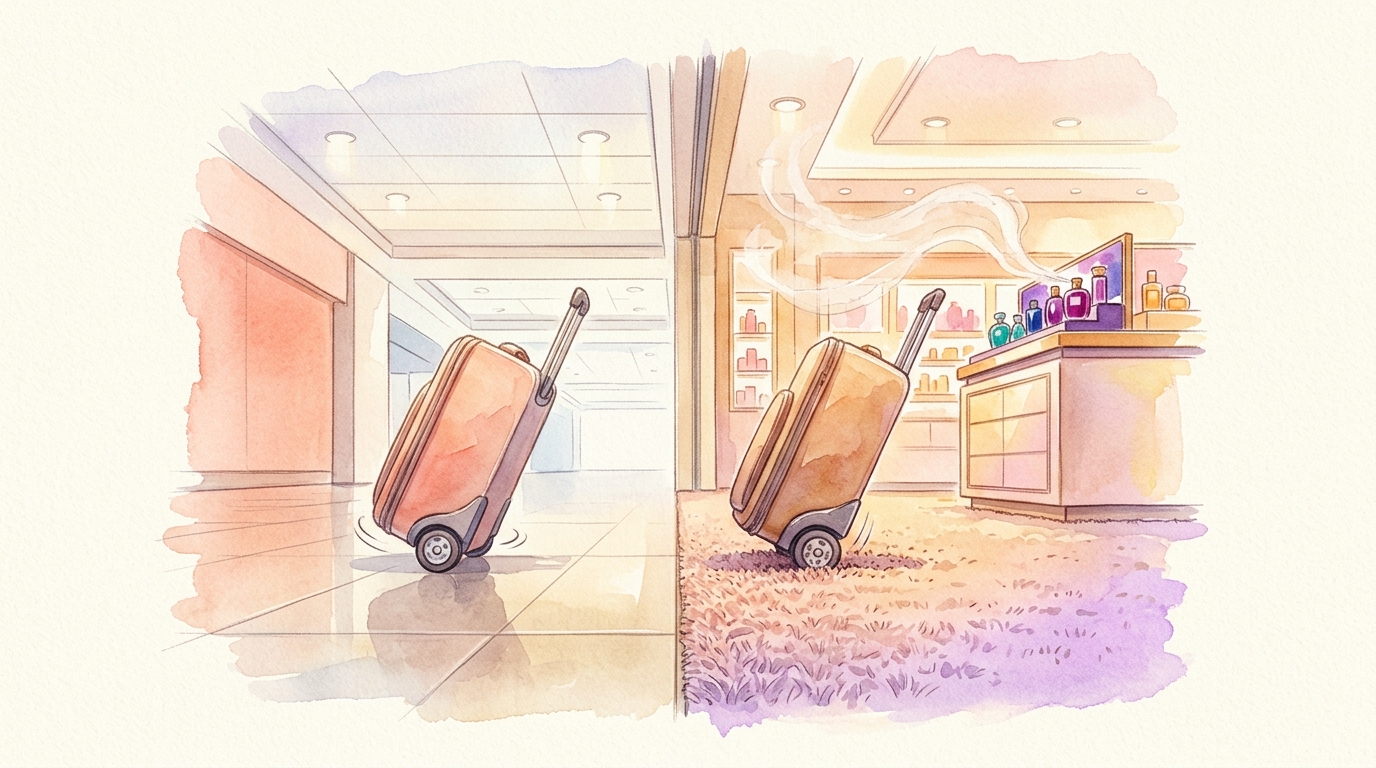
Here's a detail most people never notice: the flooring changes beneath your feet as you move through the terminal. It's not because the airport ran out of one material. It's a deliberate psychological technique called cognitive friction.
Hard linoleum or polished stone lines the main walkways, keeping your pace brisk and your luggage rolling smoothly. But near shops and restaurants, the floor switches to carpet or textured surfaces. Your wheels drag slightly. Your pace slows. You look up. And there, right at eye level, is a storefront that wasn't on your radar five seconds ago. Next time you're in a terminal, look down at your feet as you pass a shop entrance. The floor changes. Once you see it, you can't unsee it.
Carpet appears again in gate areas, and the effect is home-like comfort that encourages you to settle in and (conveniently) notice the cafe or bar positioned right next to your cluster of seats. Those comfortable chairs placed near restaurants and shops aren't an afterthought. They're positioned there because seated, relaxed passengers are spending passengers.
Research from Amadeus found that satisfied passengers spend 45% more on airport retail than dissatisfied ones. Airports have internalized this completely. The comfort isn't free. It's an investment in your spending.
Airport scent marketing near luxury stores can increase dwell time by up to 44% and boost sales by 30% or more. If you suddenly smell something pleasant near a shop entrance, you're being marketed to.
Then there's the clock problem. Or rather, the absence of clocks. Airports are conspicuously clock-free environments, a design choice borrowed directly from casinos. Duty-free zones are built to be bright, sprawling, and deliberately disorienting. Without visible time cues, passengers lose their sense of urgency and linger longer. And lingering, as every airport retail consultant knows, converts to spending.
The researcher Paco Underhill identified the "butt-brush effect": shoppers instinctively avoid products in narrow, crowded aisles where they might be bumped from behind. Airport retail compensates with unusually wide aisles, high ceilings, and open floor plans that make you feel less watched and more willing to touch merchandise. It's the opposite of a cramped convenience store, and that's entirely by design.
Layer all of these together and you get a sensory environment calibrated to a single outcome: keep you relaxed, disoriented about time, walking slowly, and surrounded by products. The individual techniques might seem minor. A carpet change here, a missing clock there. But combined, they create a retail atmosphere more effective than any shopping mall on earth, which is exactly why duty-free conversion rates dwarf those of every other retail format.
The 2026 Layer: Smartphones, Facial Recognition, and Push Notifications
The classic tricks still work. But in 2026, airports have added a digital surveillance layer that makes the old techniques look quaint. Your phone is now part of the system.
London Heathrow's "Passenger Flow" system uses anonymous smartphone tracking to map passenger movement through the terminal in real time. This data feeds back into retail placement decisions: if data shows most passengers on Tuesday evening flights take a specific corridor, high-margin pop-ups appear along that route.
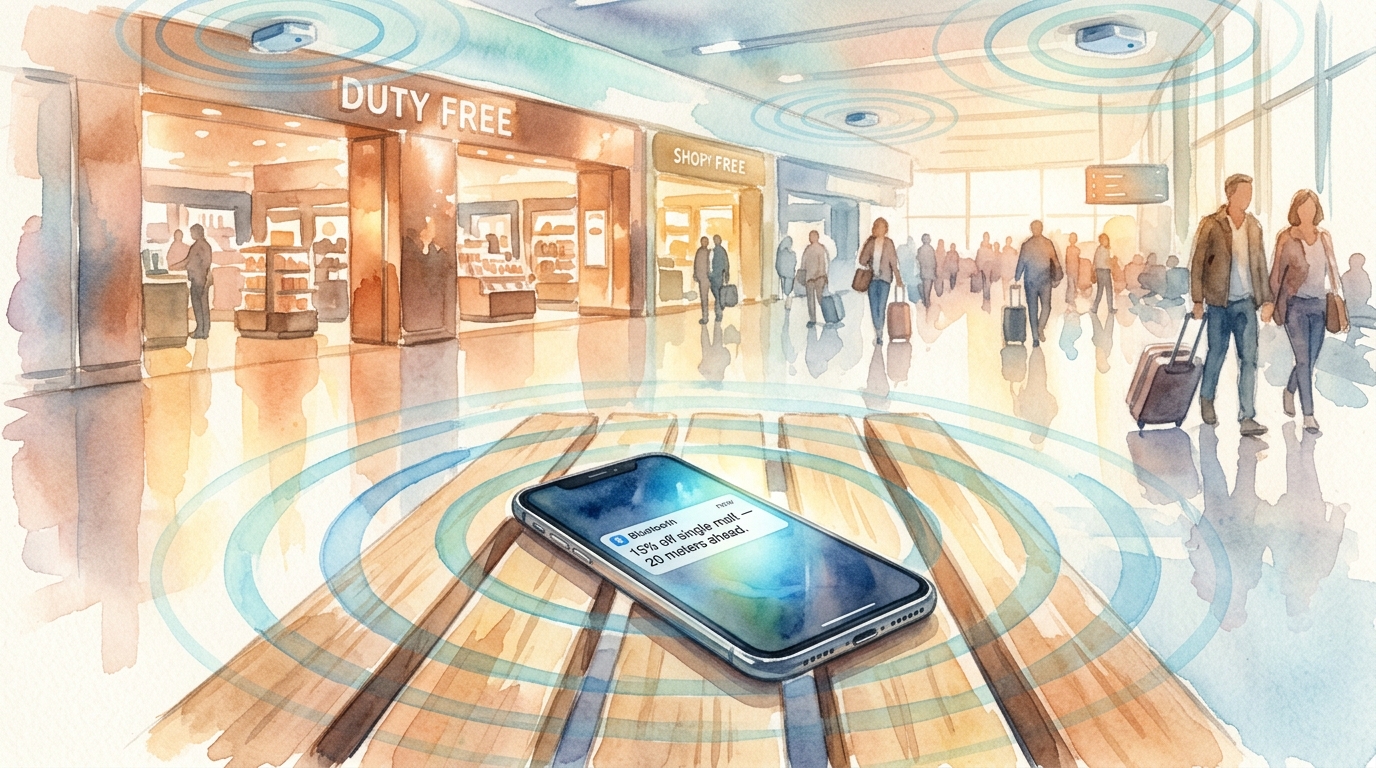
Real-time passenger location tracking now enables push notifications with personalized offers sent directly to your phone as you walk past specific stores. You're near the whisky shop? Here's 15% off single malt. Approaching the cosmetics counter? A loyalty bonus appears. This isn't a hypothetical future. It's operating right now across multiple major international hubs.
Meanwhile, TSA facial recognition is expanding to 84 airports via the CAT-2 system, with plans for 400 airports (passengers can opt out, though the process varies by airport). The official purpose is security and speed. But here's the quiet part: airports report 12-18% concession revenue uplifts when checkpoint speeds improve by 20% or more. Faster security means more time in the terminal. More time in the terminal means more spending. The security "improvement" is, in part, a retail strategy.
Faster security checkpoints aren't purely about convenience. When airports cut security wait times, they're also reclaiming minutes for the golden hour, the window where passengers are most likely to shop impulsively.
If you've been on TikTok recently, you might have encountered "airport theory," the viral trend of arriving at the airport as late as possible. It's racked up 400 million+ views, and the TSA has publicly warned it's "a recipe for disasters." But from a spending psychology perspective, the trend is ironic: the people most aware that airports manipulate them are responding by creating the exact conditions (rush, stress, missed flights) that cost even more money. Google searches for "I missed my flight" surged 645% following the trend.
The irony runs deeper than missed flights. "Airport theory" followers who do make their gates end up sprinting past every retail trap in the terminal. They've accidentally found the most effective counter-tactic: not having time to browse. But the cost of failure (rebooking fees of $50-200, plus the potential cost of a brand-new ticket if your original fare is non-refundable) makes it a terrible strategy overall. A better approach: arrive with enough time, but arrive prepared.
For a deeper look at the current state of airport operations and what's changing, our airport survival guide for the 2026 TSA situation covers the practical side of getting through security efficiently. And if you're worried about scams at your destination, the manipulation doesn't stop at the terminal exit.
The Duty-Free Illusion: Are You Actually Saving Money?
The word "duty-free" implies a bargain. You're not paying import taxes, so the price should be lower, right? Sometimes. But not as often as you'd think.
Duty-free shops benefit from a powerful framing effect: the assumption that everything inside them is discounted. In reality, the savings are concentrated in specific categories (spirits, tobacco, and certain luxury perfumes) where excise taxes are genuinely high. For everything else (snacks, electronics, clothing, sunglasses), prices are often equal to or higher than regular retail.
The conversion rates tell the real story. Duty-free shops convert 52-66% of visitors into buyers. Compare that to online retail's 2-3% conversion rate. The gap isn't because duty-free offers dramatically better value. It's because the environment (captive audience, emotional state, perceived scarcity, and the word "free" right there in the name) creates purchasing conditions that no normal store can replicate.
There's also the temporal construal effect at work. When you're physically distant from your normal life, standing in an international terminal about to fly somewhere, your brain processes purchases differently. You think more abstractly, focus on desirability over practicality, and become more open to splurging. It's the same reason people spend more on vacation in general, concentrated into a retail space designed to amplify the effect.
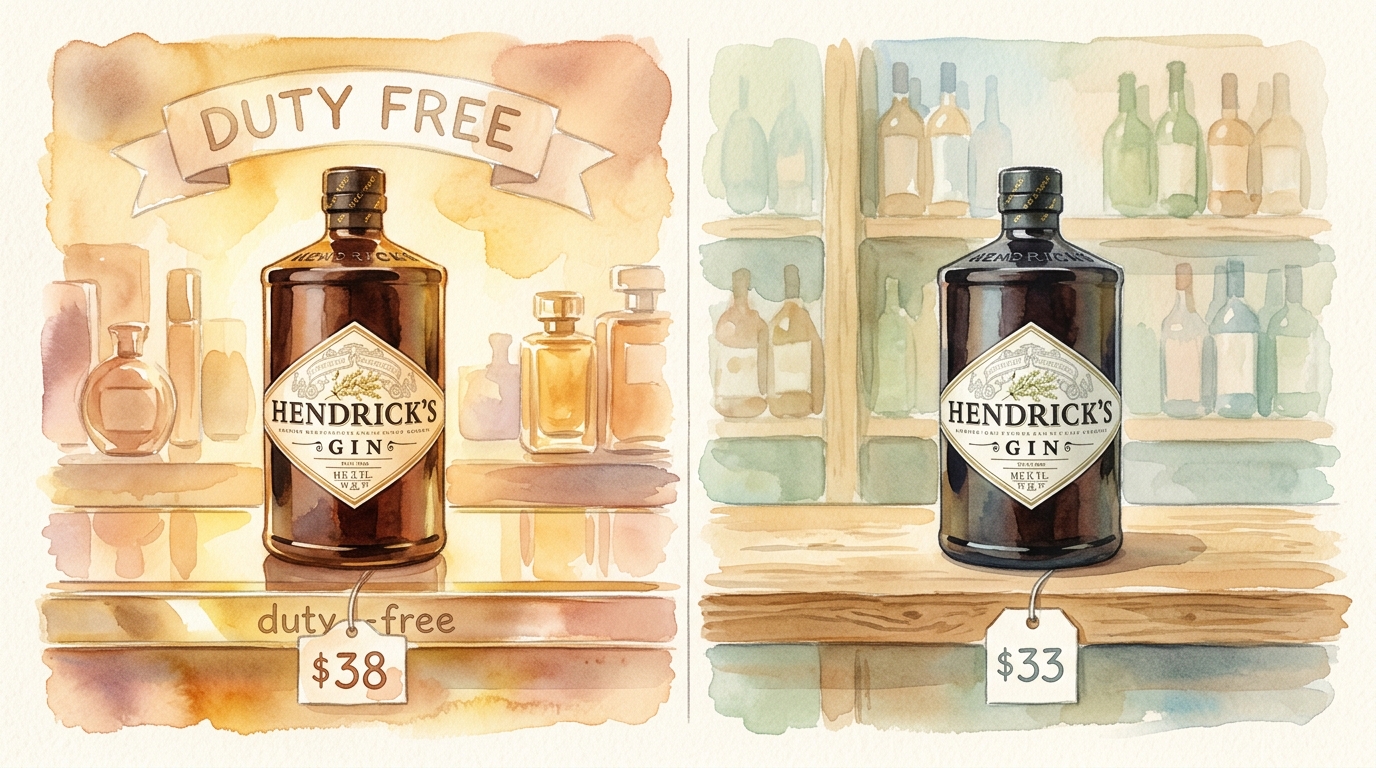
The math is revealing. Say you're eyeing a bottle of Hendrick's Gin in duty-free for $38. At your local liquor store, the same bottle might run $32-36 depending on state taxes. You're paying roughly the same price while believing you're getting a deal. The "duty-free" label did its job without actually saving you money. Spirits with high excise taxes (like Scotch whisky in the UK or cigarettes in Australia) are the genuine bargains. Everything else deserves skepticism.
| Category | Duty-Free Price Range | Regular Retail Price | Real Savings? |
|---|---|---|---|
| Premium spirits (whisky, gin) | $30-80 | $28-75 | 0-15% in high-tax regions; near-zero elsewhere |
| Luxury perfume | $80-150 | $85-160 | 5-10% on popular brands |
| Cosmetics & skincare | $25-90 | $22-85 | Minimal; often the same or higher |
| Electronics & accessories | $15-300 | $12-280 | Rarely cheaper; markup common |
Before buying anything in duty-free, do a 30-second price check on your phone. If you're not sure what something costs at home, you're not in a position to know whether you're getting a deal. If you're budget-conscious about your trip, our breakdown of hidden fees in budget travel applies the same skepticism to airline pricing. And if you're flying on a budget carrier, know that bag fees alone can exceed your duty-free "savings" by a wide margin.
How to Fight Back: A Counter-Tactics Playbook
Knowing how airports are designed to make you spend money is half the battle. The other half is having a plan before you walk through security. Here are specific defenses against each manipulation layer.
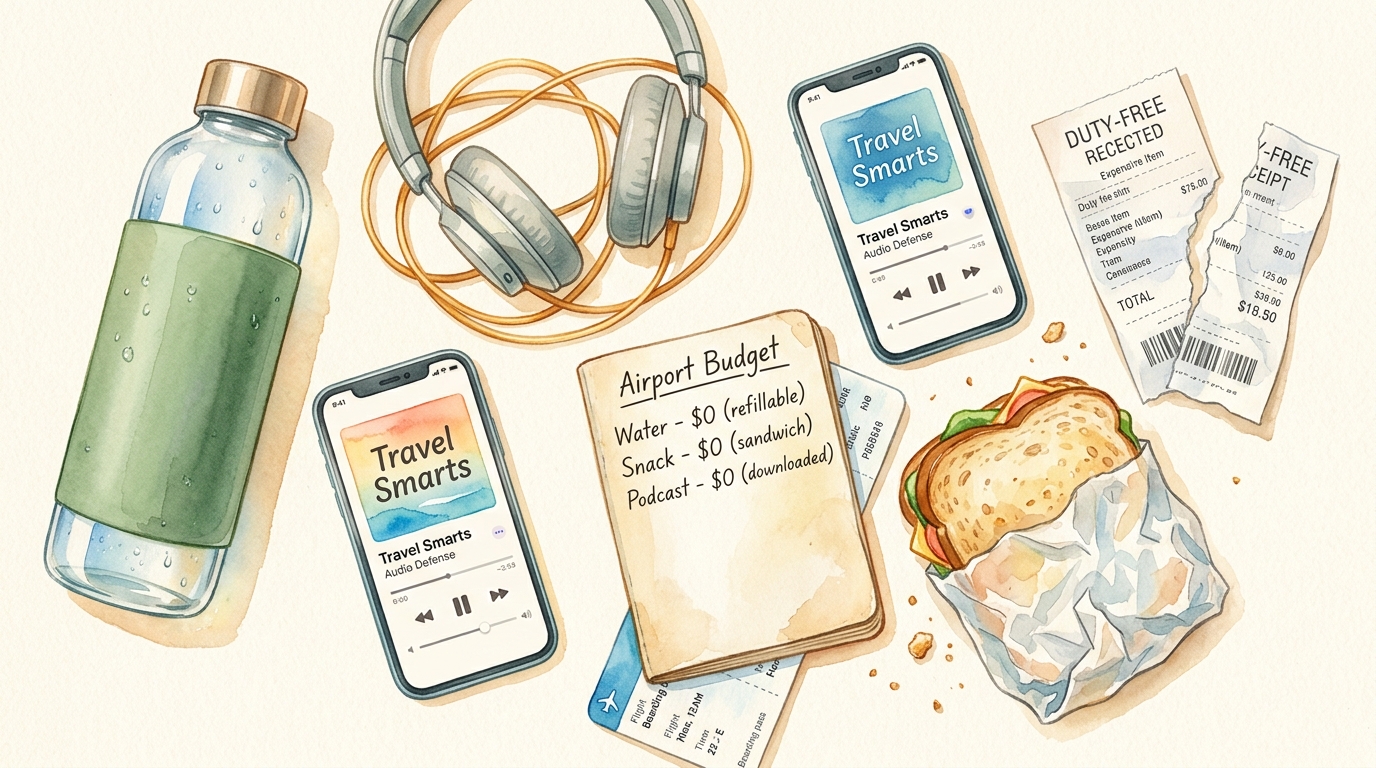
- Set an airport budget in advance Decide what you're willing to spend before you arrive. Write the number down. The prepayment effect loses its power when you've already allocated your money mentally.
- Eat and hydrate before security Hunger and thirst are the two most common triggers for airport spending. GOBankingRates data shows Americans spend an average of $135 per airport visit, with food and beverages topping the list. A meal before you leave home eliminates the biggest category.
- Bring a refillable water bottle Fill it after security at a water fountain. A single bottle of water costs $4-8 at airport retail. Over a year of regular flying, that adds up fast.
- Download entertainment before you arrive Books, podcasts, shows on your phone. The golden hour only works when you're bored. If you have something to do, you won't wander into shops to kill time.
- Price-check before every duty-free purchase If you can't confirm the price is lower than what you'd pay online, don't buy it. The perceived discount is the product being sold, not the item itself.
- Disable Bluetooth and location services This blocks the push notification systems that send personalized offers as you walk past stores. Your phone can't be used to target you if it's not broadcasting your location. But re-enable before boarding if your airline app requires Bluetooth for your mobile boarding pass.
- Plan your trip spending before you leave home A recent survey found that 70% of Americans make impulse purchases at airports, mostly on items they could have packed. When your budget, checklists, and itinerary are already organized in a trip planning app, the "I should grab this for the trip" impulse loses its trigger. You've already thought about what you need.
None of this means you should never buy anything at an airport. Sometimes you genuinely need something, or you spot a good deal on a bottle of local spirit that's actually cheaper than downtown. The point is making conscious choices instead of being funneled into unconscious ones. Tools like TripProf let you organize budgets, checklists, and expense tracking for your trip before you even leave home, which removes most of the "I forgot to pack that" impulse purchases. If you're flying internationally and want to prepare thoroughly, our pre-trip countdown checklist covers everything from documents to packing to budgeting, all before you reach the terminal.
Frequently Asked Questions
How are airports designed to make you spend money?
Airports use curved walkways that route passengers past retail stores, walk-through duty-free layouts that force 100% exposure, delayed gate announcements that create enforced browsing time, and sensory techniques like scent marketing and floor material changes that slow your pace near shops. There are no clocks in most terminals for the same reason casinos remove them: without visible time cues, passengers linger longer and spend more. Non-flight revenue hit $67+ billion globally in 2025.
Why is airport food so expensive?
Airport food prices reflect a captive audience with no alternatives. Vendors pay premium lease rates for terminal space, and airports take a percentage of revenue. Passengers can't leave to find cheaper options, and hunger during the golden hour is one of the strongest purchase triggers.
What is the "golden hour" at airports?
The golden hour is the first 60 minutes after clearing security, when passengers are in a relaxed, "self-indulgent" psychological state. Stress from check-in and security has subsided, and gates haven't been announced yet, creating an ideal window for impulse purchasing.
Are duty-free prices actually cheaper?
Sometimes, but not universally. Savings are real for spirits, tobacco, and certain luxury perfumes where excise taxes are high. For electronics, clothing, and snacks, duty-free prices are often equal to or higher than regular retail. Always price-check on your phone before buying.
How do airports track your movements in 2026?
Many airports use anonymous smartphone tracking via Wi-Fi and Bluetooth signals to map passenger flow in real time. Some systems send personalized push notifications with retail offers as you pass specific stores. Disabling Bluetooth and location services blocks most of this tracking.
What is the Gruen Transfer in airports?
The Gruen Transfer is the psychological moment when a person shifts from walking with a purpose to browsing aimlessly. Named after shopping mall inventor Victor Gruen (1956), it's deliberately triggered in airports through winding corridors, interrupted sight lines, and strategically placed retail displays.
What is "airport theory" on TikTok?
Airport theory is a viral TikTok trend with 400M+ views where travelers arrive at the airport as late as possible. While it's partly a reaction to airport spending manipulation, experts have warned it's "a recipe for disasters." Missing a flight costs far more than any impulse purchase.
Key Takeaways
- Airport non-flight revenue is a $67+ billion global industry built on behavioral psychology, not convenience.
- Curved walkways, walk-through duty-free layouts, and labyrinth designs increase retail exposure by up to 40% compared to straight corridors.
- The "golden hour" after security is the highest-spending window, and delayed gate announcements extend it deliberately.
- Sensory manipulation (scent marketing, floor material changes, and missing clocks) operates below conscious awareness to slow your pace and increase dwell time near shops.
- In 2026, smartphone tracking and push notifications add a personalized digital layer to the physical manipulation. Disable Bluetooth to opt out.
- Duty-free isn't automatically cheaper. Price-check every purchase on your phone before buying.
- Pre-trip planning tools like TripProf help you organize budgets and checklists before you reach the terminal, so impulse triggers have less power.
- The best defense is awareness. Once you know the playbook, every design choice in the terminal becomes visible and resistible.
- Next time you walk through a terminal with a $40 latte and a bottle of gin you don't need, at least you'll know exactly which design trick got you.
Sources
- OpenPR / Market Research Future: Airport Non-Aeronautical Revenue Market Size: $67.63 Billion in 2025
- Explore.com: Sneaky Ways Airports Trick You Into Spending Money
- Inside Retail Asia: How Psychology Made Airports Luxury's Most Lucrative Laboratory
- Your Mileage May Vary: The Secrets of Why Airports Are Designed Like They Are
- Kim Hatton: Engineered to Spend: The Hidden Psychology Behind Airport Layouts
- Wikipedia: Gruen Transfer
- Marketing Science: The Butt-Brush Effect and Shopper Movements
- SecurityInfoWatch: TSA Rolls Out Facial Recognition at 84 Airports
- Al Jazeera: Airports Embrace Technology to Manage Growing Global Passenger Traffic
- Wheere: Smart Airport 2026: 5 Technologies Shaping the Intelligent Airport
- HelloVacay: The New Airport Experience: How Terminal Design Is Changing
- CNN: Airport Theory TikTok Travel Trend
- Newsweek: Experts Warn Against Viral TikTok Airport Theory
- The Points Guy: The Secret Psychology of Airports
- Mental Floss: 12 Behind-the-Scenes Secrets of Airports
- TED Blog: Design Mystery: Why Airports Lack Clocks
- Amadeus: Happy Airports Make More Money: Satisfied Passengers Spend 45% More
- GOBankingRates: Americans Spend $135 at the Airport: Top Impulse Buys
- Palmer Retail Solutions: Psychology of Store Layouts
- ACI World: Maximizing Non-Aeronautical Revenues: Key to Airport Financial Sustainability
- Glossy: Inside Estee Lauder's $14 Billion Reset
- Moodie Davitt Report: Dubai Duty Free Shatters All-Time Record with $2.4 Billion in 2025 Sales
- Upgraded Points: Airline Ticket Change and Cancellation Fees
- CardRates: Airport Shopping Habits Study
- View from the Wing: Airport Water Bottle Pricing
- Hyscent: Can Fragrance Influence Airport Retail Sales and Dwell Time?
Keep Reading
More travel tips and guides picked for you
The Complete Pre-Trip Countdown: 15 Things Every Traveler Must Do Before a 2026 Trip
Start trip prep 8 weeks out, not 8 days. This countdown covers 15 tasks organized by deadline, from passport checks to airport-day moves, with every 2026 rule change woven into the timeline.
15 Biggest Changes to Travel in 2026 (vs. Last Year)
New entry fees, airline policy overhauls, a fuel-driven airfare surge, and tourist taxes popping up across Europe and Japan. These are the 15 biggest changes reshaping travel in 2026, and what they mean for your next trip.
Your RTO Costs $17K a Year. Here's What That Buys You Abroad
The average return-to-office worker spends $12,000-17,000/year on commuting, meals, and wardrobe. That same money covers a full year in Chiang Mai or Ho Chi Minh City. Here's the city-by-city breakdown.