How Many Cities Is Too Many for One Trip? (2026 Guide)
Key Highlights
- 1
- 2
- 3
+5 more in the takeaways below
Five friends, eleven cities, fourteen days. On paper it looks ambitious. In practice it's a forced march with luggage. By city six somebody's sick, somebody's broke, and a single cancelled flight can knock the whole row of dominoes flat. The summer of 2026 is not the summer to over-pack a route.
Wondering how many cities is too many for one trip? For a two-week route, cap it at 4 to 5 cities and give each one at least 3 nights. Every city-to-city move eats roughly half a day. Plan fewer stops, build in slack, and settle the friend fight early, because the real argument is never about where you go, it's about pace. And with strike action hitting European airports across June 2026, an over-stuffed itinerary has zero margin to survive one cancelled leg.
The hidden math: every city costs you half a day
Here's the rule that ruins most ambitious itineraries: a city-to-city move costs about half a day, even when nothing goes wrong. The flight might be an hour, but the day around it isn't. Pack, check out, get to the station or airport, clear security, wait, fly, land, clear the terminal, find a taxi, check in, unpack. That's not travel time. That's friction, and it stacks up fast.
A short hop between European cities may take an hour in the air, but the logistics around it routinely absorb half the day. This is why slow-travel guides keep landing on the same advice for 2026: stay longer, move less, and treat every transfer as a cost, not a free jump. American Express Travel's 2026 Global Travel Trends Report found that travelers are increasingly choosing to extend a single stay rather than tack on extra destinations (American Express). Do the math five times in two weeks and you've burned two and a half days standing in transit lines. So count moves, not just stops. Six cities means five transfers. Five transfers is two and a half days gone before you've ordered a single coffee.
Then there's the nights-versus-days trick that almost everyone gets wrong. Two nights in a place equals one full day on the ground. Three nights gives you maybe a day and a half of real time, because your arrival afternoon and departure morning are both half-eaten by logistics. So when your friend says "we'll do three nights in Florence," what they actually mean is "we'll get a day and a half in Florence." That gap between the plan on the spreadsheet and the time on the clock is where good trips quietly fall apart.
"3 nights in Rome" reads like three days of Rome. It's not. Subtract the arrival evening and the departure morning and you're left with roughly a day and a half of actual city. Plan around the real number, not the calendar squares.
Run a real example. A "12-day, 6-city" trip sounds like twelve days of cities. It isn't. Five transfers cost you two and a half days. Of the nine and a half days that remain, your arrival and departure days are both half-trips. Net it out and you're looking at maybe seven full days spread across six cities, a little over a day each. You'll spend more time hauling bags through stations than sitting in any one square. The same twelve days split across three cities gives you roughly three and a half full days per city, plus the energy to actually use them.
So how many cities is too many for one trip?
For a two-week trip, four to five cities is the ceiling, and three to four nights per city is the floor. More than five and you're not traveling, you're commuting between hotels. The expert consensus on a 2-week Europe itinerary lands on 4 to 5 cities maximum, with big cities like Paris, Rome, and Berlin needing at least three days each because they're packed with neighborhoods you can't see in an afternoon (Travel Notes & Beyond).
The trend data backs this up hard. Slow travel, staying longer and moving less, is shaping up as one of the defining travel trends of 2026, with travelers trading checklist sightseeing for fewer, richer stops. And it's not a fringe idea. American Express Travel's 2026 Global Travel Trends Report found that 72% of respondents building buffer days around a milestone trip plan to extend their stay by at least three to four days, and nearly 42% of those who extend plan to stay in the same place or nearby rather than tack on a new destination (American Express).
Money is pushing the same way. YouGov's US International Traveler Outlook 2026 found that 43% of Americans who travel abroad went less in the past year, and a substantial share say they'll take fewer overseas trips or pivot to domestic destinations if prices keep rising (YouGov). When the budget tightens, the smart move isn't to cram more cities in to 'make it count.' It's the opposite. Fewer stops, less spent on transfers and one-night hotels, more spent on the places you actually came for. An over-packed route is the most expensive way to see the least.
Use this as a quick gut-check. Here's what different city counts actually feel like over two weeks.
| Cities in 14 days | Avg nights/city | Days lost to transfers | Verdict |
|---|---|---|---|
| 3 cities | 4-5 nights | ~1 day | Relaxed, room for day trips Ideal |
| 4 cities | 3-4 nights | ~1.5 days | Balanced, the sweet spot Great |
| 5 cities | 2-3 nights | ~2 days | Brisk but doable Pushing it |
| 6 cities | 2 nights | ~2.5 days | A blur of check-ins Too many |
| 7+ cities | <2 nights | 3+ days | Commuting, not traveling No |
The takeaway: every row past "4 cities" trades real time on the ground for time in transit. A trip with three or four bases plus a few day trips will show you more of a region than a trip that sprints through seven cities and remembers none of them.
Why over-packing causes group burnout (and resentment)
Travel burnout isn't caused by traveling. It's caused by traveling too fast. The number one cause is the checklist mentality, rushing between attractions, always on a bus to somewhere new, never taking a day to do nothing (The Slow Living Guide). On a solo trip, you absorb that exhaustion alone. On a group trip, it leaks out sideways as friction.
Picture day eight. You're in your fifth city. One person wants to push through to the cathedral on the far side of town, another hasn't slept properly since the overnight train, and a third is quietly recalculating whether they can afford the next two restaurant dinners. Nobody's actually angry about the cathedral. They're tired, and the over-packed schedule gave them no slack to recover. The pace is the problem. The cathedral is just where it surfaces.
The pace of our itinerary is ridiculous and my friend refuses to cut a single city, we're at eleven stops and I don't know what to do.
This is the most common group-travel fight, and it's almost always misdiagnosed. One friend wants to "see more places." The other wants to "actually do things." Both think they're arguing about the destination list - they're not. They're arguing about pace, and until someone names that out loud, the fight just recycles every time you sit down to plan. If you're already feeling the strain mid-trip, our piece on recognizing and recovering from travel burnout applies to groups too, the cure is the same: fewer places, real rest days.
Schedule at least one genuine do-nothing day per week of travel. Not a "light" sightseeing day. An actual rest day where the only plan is coffee and a slow lunch. It's not wasted time. It's what keeps the group from cracking by day ten.
There's a quieter cost to over-packing that nobody puts on the spreadsheet: decision fatigue. Every travel day asks you to make fifty small choices, where to eat, which platform, whose turn to pay, which way to walk. On a fast trip, that mental load never lets up, and the person carrying most of it is usually the organizer, the one who researched everything and now feels responsible when it goes sideways. Slowing down isn't just kinder to the group. It's kinder to the friend who volunteered to plan the whole thing, the one most likely to come home swearing off group trips forever.

Settling the friend fight: non-negotiables vs nice-to-haves
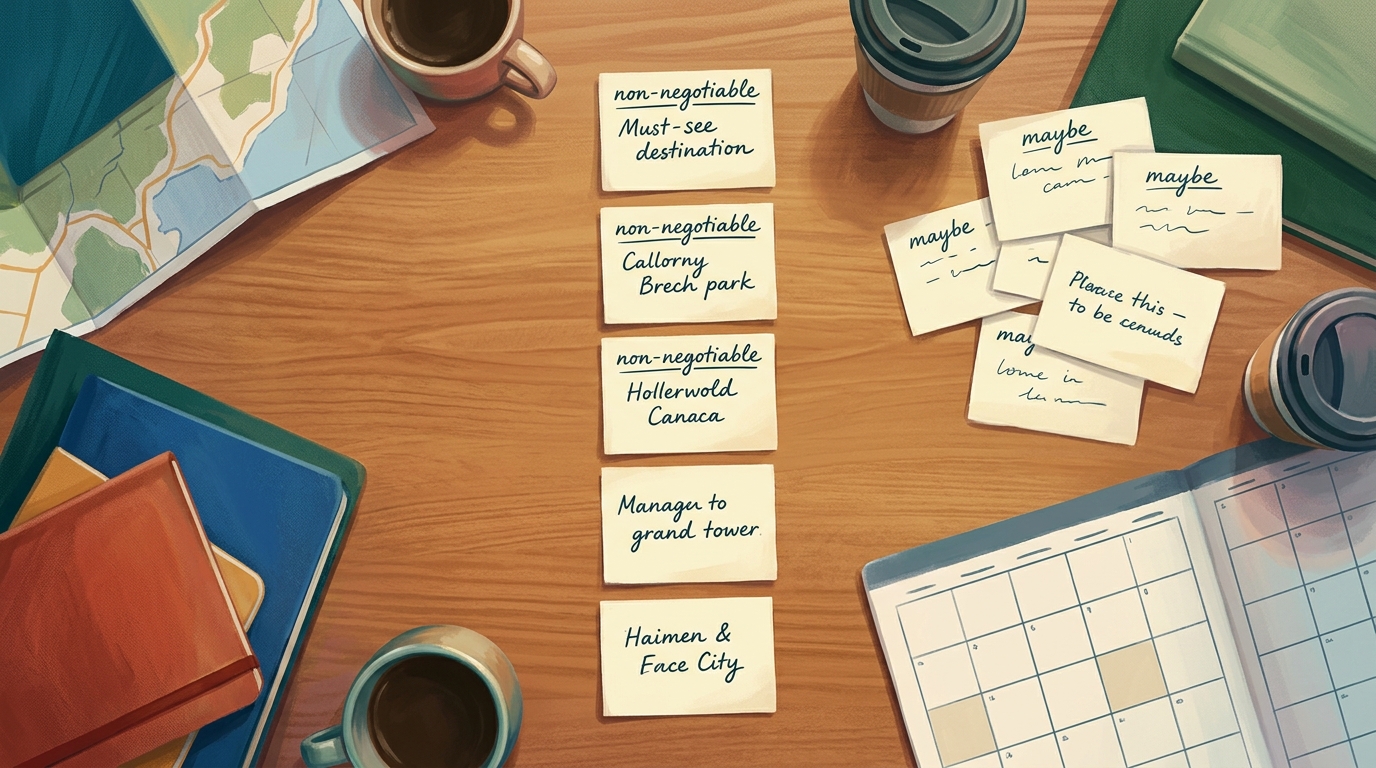
The fastest way to end the pace argument is to separate non-negotiables from nice-to-haves before anyone books anything. Everyone lists the two or three things they genuinely cannot miss, then everything else goes into a flexible pool. This turns a vague tug-of-war into a short, concrete conversation, and it surfaces the real disagreement, which is usually about how fast to move, not which city wins.
Planning a trip with friends who have different travel styles is less about compromise and more about making the differences explicit. The packer and the lingerer aren't wrong, they just want different trips. Name it. Here's a sequence that works.
- Each person lists their top 3 non-negotiables One specific thing per person they'd be genuinely sad to skip. A city, a meal, a museum, a hike. Keep it to three.
- Agree on a pace number first, before the route Decide nights-per-city as a group: are we a 4-cities-in-14-days crew or a 3-cities-plus-day-trips crew? Settle this before arguing over which cities.
- Map the non-negotiables onto the pace If five people each have one must-see city, that's already five cities. The pace number tells you whether that fits or whether some must-sees become day trips.
- Everything else goes in a shared "maybe" pool Nice-to-haves live in a wishlist, not the fixed schedule. You pull from it only if you have time and energy on the day.
- Reserve roughly 30% of the time as unplanned Don't book every hour. Leave gaps for naps, weather, a place you fell in love with, or a strike that scrambles your flight.
That last point matters more than it sounds. A schedule with no empty space can't absorb a single surprise. And in the summer of 2026, surprises are close to guaranteed. The money side has the same logic, by the way, sort the splitting rules before you go and you remove a whole second source of friction. Our guide on splitting trip costs fairly with friends walks through the methods that hold up across a multi-city route.
- Wants maximum cities ticked off
- Energized by movement and novelty
- Risk: burns the group out by day 8
- Wants fewer cities, deeper
- Energized by lingering and routine
- Risk: misses places the group wanted
Neither is right. The fix is a pace number both can live with, agreed before the route. Pick a middle gear, write it down, and stop relitigating it every night at dinner.
The 2026 strike wave: why over-packing has zero margin
An over-stuffed itinerary has no slack to survive one cancelled leg, and June 2026 is cancelling legs all over Europe. When every day is booked and every connection is tight, a single strike doesn't just dent one day, it collapses the rest of the chain. Miss the Tuesday flight and your Wednesday hotel, your Thursday museum, and your Friday onward train all fall over with it.
This isn't hypothetical. On 2 June 2026, an air traffic control walkout by Skeyes controllers led Brussels Airport to cancel around 200 flights in its afternoon window, with passengers booked between 2pm and 9pm told not to come to the airport at all (Aviation24.be). The very next day, a 24-hour nationwide strike in Portugal threatened more than 500 flights, with TAP Air Portugal facing up to 300 cancellations, roughly a third of its daily program (Euronews).
Now imagine your six-city sprint had Brussels as stop three and Lisbon as stop four. One strike day doesn't cost you one city. It costs you the connection out, the non-refundable hotel in the next city, the timed museum ticket, and the cheap onward flight you booked weeks ago. The tighter the chain, the more it shatters. A trip with margin shrugs off a strike day. A trip without it loses a week.
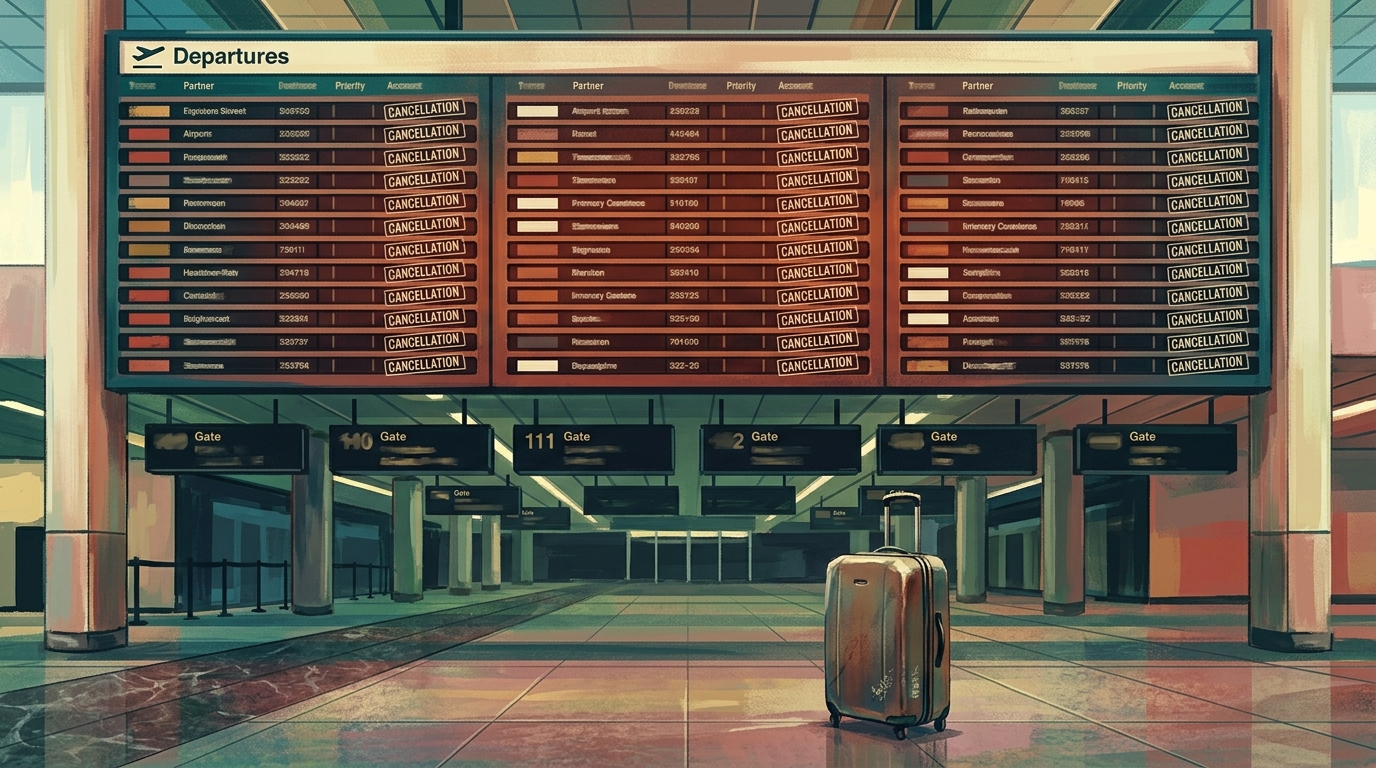
And it keeps going through the month. Here's the June 2026 picture as it stood.
- June 2, Belgium Skeyes air traffic control walkout halts flights; ~200 cancellations at Brussels (Aviation24.be).
- June 3, Portugal 24-hour nationwide general strike, 500+ flights at risk across Lisbon, Porto, Faro, Funchal (Euronews).
- June 11, Italy Nationwide rail strike; Trenitalia staff out 9am-5pm (The Local Italy).
- June 13, Italy Airport-staff walkout, 1pm-5pm nationwide, longer at some airports.
- June 18, France Ground-staff strike called at Paris CDG, Orly and Le Bourget, slower boarding and baggage expected (Connexion France).
- June 19-20, Italy General strike hits national and regional rail, buses, and metro.
- June 26, Italy Full 24-hour strike covering ground handling across all Italian airports.
Summer 2026 is shaping up as one of the most volatile stretches for European travel in recent memory, with nationwide walkouts stacking on top of the new EU Entry/Exit System, which has already triggered long airport queues and missed flights (Euronews). If your route threads through any of these hubs on these dates with no buffer, you're betting the whole trip on nothing going wrong. That's a bad bet this summer. For the wider picture on delays, queues, and the border-tech mess piling on top, our breakdown of Europe's airport perfect storm goes deeper.
What you actually get when a strike hits your flight
Know this before you go, because it changes how much buffer you need. Under EU Regulation 261/2004, your rights depend on who is striking. Strikes by air traffic control or airport staff are usually treated as "extraordinary circumstances," which means no cash compensation, because the airline didn't cause them. Strikes by an airline's own staff are different, and cash compensation may apply.
Either way, the airline still owes you a refund or rerouting, plus a right to care. The official EU passenger-rights page sets compensation at €250, €400, or €600 (roughly $270/$430/$645 at current rates) depending on flight distance, but notes that "air traffic management decisions" and similar events let airlines off the compensation hook, while "strikes by air carrier staff" typically don't qualify for that exemption (europa.eu).
Air traffic control and airport-staff strikes: refund, rerouting, and meals/hotel yes, cash compensation no. Airline-own-staff strikes (pilots, cabin crew): cash compensation of €250-600 may apply on top (AirHelp, europa.eu).
So the right to care, meals, refreshments, and a hotel if you're rebooked to the next day, applies regardless of who's striking (europa.eu). Keep your receipts. And if your flight does get cancelled outright, the step-by-step in our flight cancellation refund guide covers exactly how to claim what you're owed.
How to build slack into the route (the buffer rules)
The fix for a fragile itinerary is deliberate slack: open-jaw flights, rest days, and roughly 30% of your time left unplanned. Slack isn't wasted, it's the shock absorber that lets your trip survive a cancelled leg, a tired group, or a city you love too much to leave on schedule. Here's how to engineer it in from the start. One easy version of this: pick one strong base city and treat everything else as an optional day trip. Our 4 days in Milan itinerary is built that way, with Lake Como and Bergamo as add-on days rather than separate stops on a moving route.
Fly open-jaw. Land in one city, leave from another. You skip the pointless backtrack to your arrival airport, which often saves a whole transfer day and a night's accommodation. For a Barcelona-to-Rome route, flying into Barcelona and out of Rome beats looping back to Barcelona to fly home.
Put a buffer day before any hard deadline. If you have a non-refundable flight home or a booked event, don't schedule a tight connection into it. Leave a full day of margin so a strike-delayed train doesn't make you miss the thing you can't rebook.
Keep one base longer than feels necessary. Anchor the trip with a 4-5 night base in the middle. It gives the group a routine, a known coffee spot, a place to do laundry, and a psychological reset before the next move. The longer base is also where you'd ride out a strike day if one lands - far better to lose a buffer day in a city you already like than to be stranded mid-transfer with three onward bookings collapsing.
This is exactly the kind of thing a shared planning tool earns its keep on. When the whole group can see the same day-by-day itinerary, with each day's stops plotted on a map and the walking or driving route between them, the over-packing becomes visually obvious. Four pins crammed across town on a single afternoon looks as exhausting as it'll feel. A shared planner like TripProf gives a route overview that lists every leg with its distance and travel time, plots each day's stops on a map with the walking or driving route between them, and keeps your itinerary, multi-currency split expenses, and documents available offline when a strike knocks out the airport WiFi. The point isn't the app, it's seeing the pace honestly before you've paid for it.
Run your own numbers, too. Before you book, total up the transfer half-days and subtract them from your trip length. If a "12-day, 6-city" trip really delivers nine days on the ground after transfers, ask whether four cities and a couple of day trips wouldn't give you more actual travel for the same flight cost. The multi-city mechanics are worth getting right, our multi-city Europe trip planning guide covers routing and connections in detail.
- City count capped at 4-5 for a two-week trip
- At least 3 nights in each major city
- One genuine rest day per week scheduled
- ~30% of the itinerary left unplanned
- Open-jaw flights booked where possible
- Buffer day before any non-refundable deadline
- Strike dates checked against your travel days
- Refund and right-to-care rules understood before departure
Frequently Asked Questions
How many cities can you visit in 2 weeks in Europe?
Four to five cities is the realistic maximum for two weeks, with three to four nights in each. Travel experts widely recommend not exceeding 4-5 stops, because more than that means spending half your trip moving between stations instead of seeing places. Three cities plus a few day trips often delivers a richer trip.
How many nights should you spend in each city?
At least three nights per major city, four to five for big ones like Paris, Rome, or Berlin. Remember the math: two nights equals one full day on the ground, so three nights gives you roughly a day and a half of actual time once arrival and departure logistics are subtracted.
How do you decide how many cities is too many for one trip?
Count your transfers, not your cities. Each city-to-city move costs about half a day even with no delays. If your transfer days add up to more than a quarter of your trip, you have too many cities. For two weeks, anything past five stops usually crosses that line.
How do you settle disagreements with friends about travel pace?
Agree on a pace number before you pick the route. Each person lists their top three non-negotiables, you decide nights-per-city as a group, and everything else goes in a flexible wishlist. The fight is usually about pace, not destinations, so settle the pace explicitly and the route argument mostly resolves itself.
Do you get compensation if a strike cancels your flight in 2026?
It depends who's striking. Air traffic control and airport-staff strikes count as extraordinary circumstances under EU261, so no cash compensation, though you still get a refund, rerouting, and meals or a hotel. Strikes by an airline's own pilots or cabin crew can trigger cash compensation of €250-600 by distance.
How much unplanned time should a group trip have?
Leave about 30% of your itinerary unplanned. That slack absorbs naps, weather, a place you want to linger in, and disruptions like cancelled flights. A trip booked hour-to-hour can't survive a single surprise, and in summer 2026 surprises are nearly guaranteed.
Key Takeaways
- Cap a two-week trip at 4-5 cities. More than that and you're commuting between hotels, not traveling. Three cities plus day trips often beats six cities in a sprint.
- Every city-to-city move costs about half a day. Count transfers, not just stops. Five transfers in two weeks burns two and a half days.
- Three nights equals a day and a half on the ground. Plan around the real number, not the calendar squares.
- The friend fight is about pace, not destinations. Agree a nights-per-city number first, sort non-negotiables from nice-to-haves, then build the route.
- Leave roughly 30% of the trip unplanned. A schedule with no slack can't survive one cancelled leg, and June 2026 is full of cancelled legs.
- Know your EU261 rights before you go. ATC and airport strikes mean no cash, but you still get a refund, rerouting, and a right to care.
- A shared, mapped itinerary makes over-packing obvious. Tools like TripProf show each day's route, the full leg-by-leg overview, and shared expenses, so the group can see the real pace before paying for it.
- Slow down on purpose. The whole travel world is moving this way in 2026. Fewer places, more time, less regret.
Sources
- American Express 2026 Global Travel Trends Report: 72% plan to extend a stay 3-4 days; 42% of extenders stay in the same place or nearby.
- Travel Notes & Beyond: 4-5 city maximum and 3+ nights per major city for a two-week Europe itinerary.
- The Slow Living Guide: travel burnout caused by moving too fast and the checklist mentality; cure is fewer places and rest days.
- Aviation24.be: Belgium June 2 2026 Skeyes ATC strike, ~200 Brussels cancellations.
- Euronews: Portugal June 3 2026 strike, up to 500 flights affected.
- YouGov: US International Traveler Outlook 2026, 43% traveled abroad less.
- Connexion France: Paris CDG/Orly ground-staff strike called for 18 June 2026.
- The Local Italy: June 2026 Italian transport strike calendar (rail, airports, general strike).
- European Commission, Your Europe: EU261 compensation tiers (€250/€400/€600), refund, rerouting, right to care, extraordinary circumstances.
- AirHelp: EU261 explained, airline-staff vs third-party strike distinction.
- Euronews: EES border queues and summer 2026 disruption.
Last updated: July 16, 2026
Keep Reading
More travel tips and guides picked for you

What a Friendsgiving trip actually costs, and how to split it fairly
Eight friends, one cabin, one long weekend before Thanksgiving: here's what a real Friendsgiving getaway costs per person, and a simple way to split it before anyone starts keeping score.

The Group Trip Questionnaire: 16 Questions to Ask Before Anyone Books
Most group trips break on four answers: flexible, easygoing, whatever works, and around $2k. Here are 16 questions that make all four impossible to give, what each answer is really for, and a copy-paste template to send before anyone books.

How Many States Have You Visited? One Retiree's Real Answer (And How to Find Yours)
A 58-year-old retiree paints his USA map for the first time and finds a very different number than he guessed. The real YouGov stats, the honest limits, and how to track your own states visited checklist.