Every Long Weekend in Europe This May (and How to Double Your Time Off)

Key Highlights
- 1
- 2
- 3
+5 more in the takeaways below
15 leave days. 25 days off. That's not a typo.
May 2026 stacks more long weekends than any other month on Europe's holiday calendar, and most people won't realize it until the cheap flights are gone. Labour Day lands on a Friday. Ascension Day falls on a Thursday. Pentecost Monday closes the month. France throws in a bonus Friday holiday on May 8. And the Netherlands runs free Liberation Day festivals across 14 cities on May 5.
Europeans have a word for this. Germans call it Brückentage. The French say faire le pont. Spaniards know it as puentes. The English translation is "bridge days," and the concept is simple: take a single vacation day between a public holiday and the weekend, and you "bridge" them into one long break. Stack a few bridges together and suddenly your 25 annual leave days cover half the summer.
Euronews reported a 34% year-over-year increase in European short trips (four days or fewer) in early 2026. Short trips to Italy alone quadrupled. The micro-break isn't a trend anymore. It's how Europeans travel now. And May is where the math works best.
Here's your complete playbook: every long weekend in Europe this May, the bridge day strategies that multiply your time off, where to actually go for each one, and what's open when half the continent shuts down on May 1.
May 1 (Friday) is a free 3-day weekend across most of Europe. Take 4 leave days and you get 9 off. Ascension Day (May 14, Thursday) plus 1 leave day = 4-day weekend. Combine everything from May 14–25 with 9 leave days for 17 days off. Best bets: Barcelona for the Gaudí centenary, Amsterdam for Liberation Day festivals (May 5), Paris for the double-Friday (May 1 + May 8). Stock up on groceries April 30 because shops close hard on May 1.
The May 2026 Cheat Sheet: Every Holiday at a Glance
May 2026 packs at least four distinct public holidays across Europe, and they don't all hit the same countries. That's the part most planning guides skip. Your German colleague gets Ascension Day off. Your Spanish one doesn't. The French get a bonus Victory Day Friday. The British have their bank holiday on a completely different date altogether.
Here's the full picture for May 2026:
| Date | Day | Holiday | Who Gets the Day Off | Key Notes |
|---|---|---|---|---|
| May 1 | Friday | Labour Day | Germany, France, Spain, Italy, Austria, Belgium, Portugal, Poland, Sweden, Norway, Finland, most of EU | UK (bank holiday is May 4), Netherlands, Denmark |
| May 4 | Monday | Early May Bank Holiday | UK, Ireland | Not observed in continental Europe |
| May 5 | Monday | Liberation Day | Netherlands: schools + many employers (not an official day off in 2026) | Festivals in 14 cities. Official holiday only every 5 years (next: 2030) |
| May 8 | Friday | Victory in Europe Day | France | Not observed in Germany, Spain, Italy, UK |
| May 14 | Thursday | Ascension Day | Germany, France, Belgium, Netherlands, Austria, Switzerland, Nordics, Luxembourg | NOT in Spain, Italy, UK, Poland, Portugal |
| May 25 | Monday | Whit Monday (Pentecost) | Germany, France, Belgium, Netherlands, Austria, Switzerland, Luxembourg, Hungary | NOT in Spain, Italy, UK, Poland, Nordics |
Count them. If you're based in France, that's four Fridays or Mondays off in a single month (May 1, May 8, May 14 bridge, May 25). Germany gets three. Spain and Italy get one, but it's on a Friday.
Ascension Day catches Americans off guard every year. It's a public holiday in 15+ European countries but doesn't exist in the US, UK, Spain, or Italy. If you're flying into Frankfurt or Amsterdam on May 14, expect Sunday-schedule transit and closed shops.
And if you're planning a multi-city Europe trip, check which holidays apply in each city on your route. Crossing from Barcelona (May 1 off) to Amsterdam (May 1 normal, May 5 off) means different closures on different days.
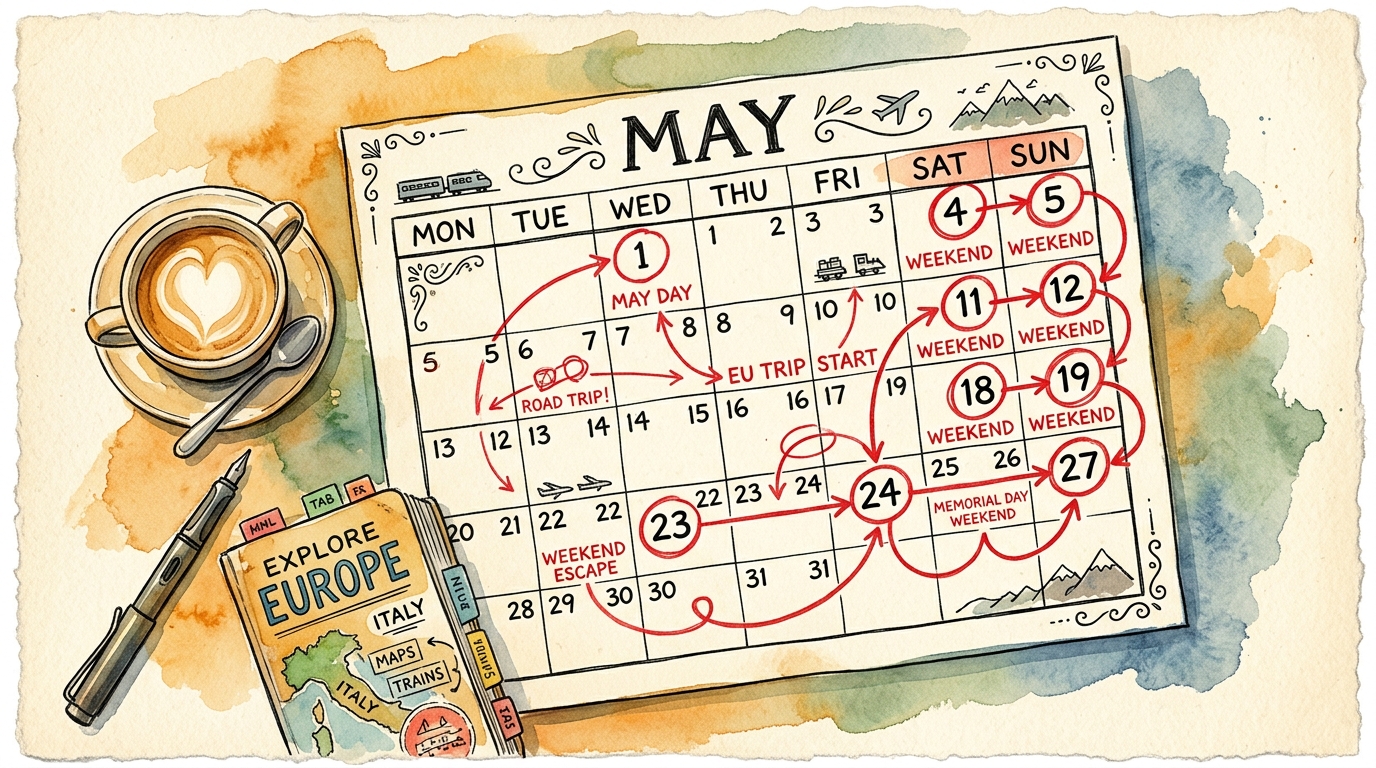
The Bridge Day Playbook: How to Turn Long Weekends into Real Vacations
Bridge days are Europe's best-kept productivity secret. The math is blunt: by placing leave days in the gaps between holidays and weekends, you get two to three times more consecutive time off than the leave days alone would give you. Limehome calculated that strategic bridge-day planning lets workers hit 40–50 days of actual time off while using only 25 vacation days.
Here's exactly how it works in May 2026, from smallest commitment to largest.
1. The May 1 Stretch: 4 Leave Days → 9 Days Off
May 1 (Friday) is already a day off. Take Monday April 27 through Thursday April 30 as leave. You now have Saturday April 25 through Sunday May 3 free. Nine consecutive days.
That's enough for a full week in Portugal, a road trip through Tuscany, or a slow loop from Vienna to Budapest to Ljubljana. We did the Vienna–Ljubljana leg of a Balkans trip two years ago during the same May 1 window, and the route ran under €85/day including trains, mid-range hotels, and eating out twice daily.
2. The Ascension Grab: 1 Leave Day → 4 Days Off
Ascension Day is Thursday, May 14. Take Friday May 15 off. Done. Four-day weekend, Thursday through Sunday.
The lowest-effort bridge day in the entire calendar. One day of leave, four days of freedom. iamexpat.de calls it the classic timing for the "first short trip to the Mediterranean" in Germany. Rhodes, Kos, the Turkish Riviera, and the Croatian coast all start hitting swimmable temperatures by mid-May.
3. The Pentecost Mega-Break: 9 Leave Days → 17 Days Off
Now it gets interesting. Ascension Day (May 14, Thursday) and Whit Monday (May 25) sit only 11 days apart. Here's the math, step by step:
- Take Friday May 15 off (Ascension bridge) = 4-day weekend
- Add Monday May 18 through Friday May 22 as leave = 5 more days
- Pentecost weekend (May 23–25) is free = another 3 days
- Add the weekend before (May 9–10) plus Monday–Wednesday May 11–13 as leave
Total: 9 leave days, 17 days off from May 9 through May 25. Your HR department might raise an eyebrow, but the calendar math checks out.
Aviation.Direct calls this the most efficient leave-to-time-off ratio in the entire 2026 calendar for Germany and Austria. Seventeen days covers a proper two-week trip with travel days on either end.
4. The Full May: 15 Leave Days → 25 Days Off
Connect the May 1 bridge (Strategy 1) with the Ascension–Pentecost combo (Strategy 3). Take April 27–30, May 4–8 (or adjust around the French May 8 holiday), and May 11–22. That's 15 leave days covering April 25 through May 25. A full month.
Is it worth blowing 15 of your ~25 annual days on one stretch? For a serious backpacking trip through the Balkans, a Mediterranean sailing trip, or a Gaudí-centenary deep dive in Barcelona followed by a slow train through the South of France? Yes. Your coworkers will hate you, but they'll also ask you to plan their next trip.
Where to Go for Each Long Weekend
Five holidays, five different character breaks. Here's where the calendar meets the map, with specific picks that match the timing, the weather, and (honestly) the crowds.
May 1–4: Barcelona, Lisbon, or Prague
The classic 3-day city break weekend. May weather in all three cities sits at a comfortable 18–23°C, restaurants have outdoor seating, and summer prices haven't kicked in yet.
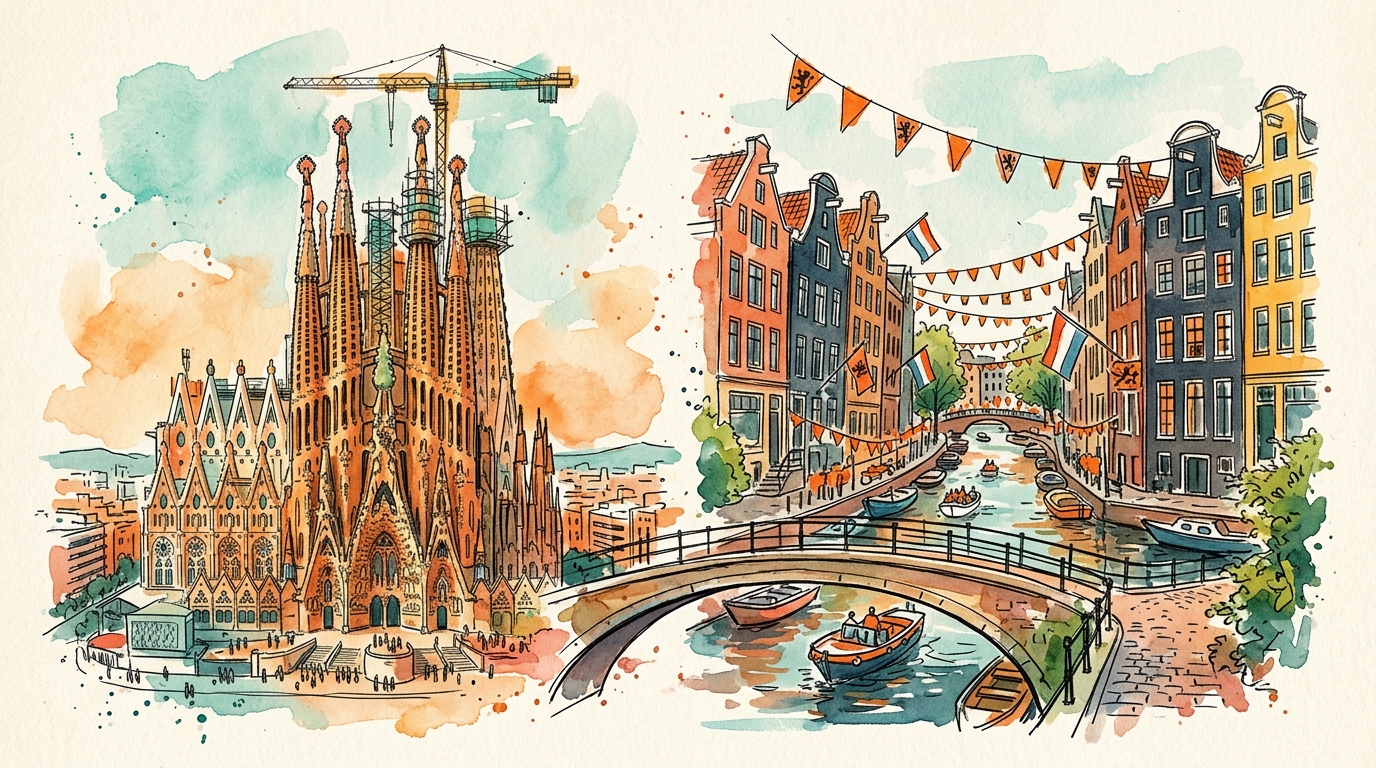
Barcelona is the standout pick for 2026 specifically. The city holds the UNESCO World Capital of Architecture title this year, and June 10 marks the centenary of Gaudí's death. The buildup starts in May with over 1,500 planned events, nightly facade projections on Casa Batlló, and special access to Park Güell and La Pedrera. The Sagrada Família's Tower of Jesus Christ was completed in February 2026, making it the tallest church in the world at 172.5 meters.
Skip Barcelona if you hate crowds, though. May 1 brings locals out in force for Labour Day celebrations. Lisbon is quieter, cheaper (expect €60–80/day budget including a hostel), and was Euronews's top destination for British travelers in 2026. Prague is denser and more walkable for a short stay, with free attractions like Old Town Square and the Charles Bridge that don't care about holiday hours.
May 5: Amsterdam and the Netherlands (Liberation Day Festivals)
Liberation Day isn't an official public holiday in 2026 (that only happens every five years, and the last was 2025 for the 80th anniversary). But the celebrations still run every single year, and they're worth planning around.
Free music festivals happen in 14 cities, from Haarlem's Bevrijdingspop to Nijmegen's Liberation Festival in Hunnerpark. Amsterdam hosts the Amsterdams Verbond at the Olympic Stadium. Many employers and all schools give the day off anyway. The night before (May 4), the Remembrance Day ceremony at Dam Square is one of the most powerful two minutes of silence you'll ever witness. We stood in that crowd in 2024 and the entire city just... stopped. No phones, no talking, nothing for 120 seconds.
Fly in Saturday May 3, catch Remembrance Day Sunday evening, enjoy Liberation Day Monday, fly home Tuesday. A 3-night trip built around a genuinely moving national tradition.
May 8–11: Paris or Lyon (France's Victory Day)
France gets a bonus this May. Victory in Europe Day (May 8) falls on a Friday, creating a second natural 3-day weekend just one week after Labour Day. If you're based in France, that's two back-to-back long weekends without spending a single leave day.
Paris on May 8 is surprisingly manageable. The official ceremony at the Arc de Triomphe draws a crowd, but the city otherwise feels relaxed. Most major museums stay open (the Louvre closes Tuesdays, not Fridays). Book a table at a bistro in the Marais, catch the Foire du Trône fair in the 12th arrondissement, and walk the Seine without the July crush.
But our actual recommendation? Lyon. It's cheaper, less crowded, warmer, and the food is better (sorry, Paris). A less-crowded alternative that doesn't sacrifice quality.
May 14–17: The Ascension Opener (Go South)
One leave day. Four days off. Mid-May is when the Mediterranean coast switches on. Sea temperatures in the Aegean hit 19–20°C, the Croatian islands start their ferry schedules, and beach bars open in the Algarve.
Budget pick: the Montenegrin coast. Kotor to Budva is roughly a €5 bus ride (as of early 2026), accommodation runs €30–50/night for a private room, and the Bay of Kotor is routinely called Europe's southernmost fjord. We spent an Ascension long weekend there in 2024, and for the same daily budget that gets you a hostel dorm in Barcelona, we had a sea-view apartment with a kitchen in Kotor's old town.
Premium pick: Mallorca or Sardinia. Low-season flight prices (often under €100 return from major hubs), uncrowded beaches, and restaurant reservations you can actually get.
For Ascension weekend flights, book by early April. EuropeZigZag's analysis found that spring 2026 flights are cheapest 6–10 weeks before departure. After that, Ascension and Pentecost demand spikes prices by 15–25%.
May 23–25: Pentecost in Nature
By late May, the Alps are thawed, the lakes are warming up, and you've earned something slower after a month of city breaks. Whit Monday gives you a 3-day weekend without touching your leave balance (if you're in a country that observes it).
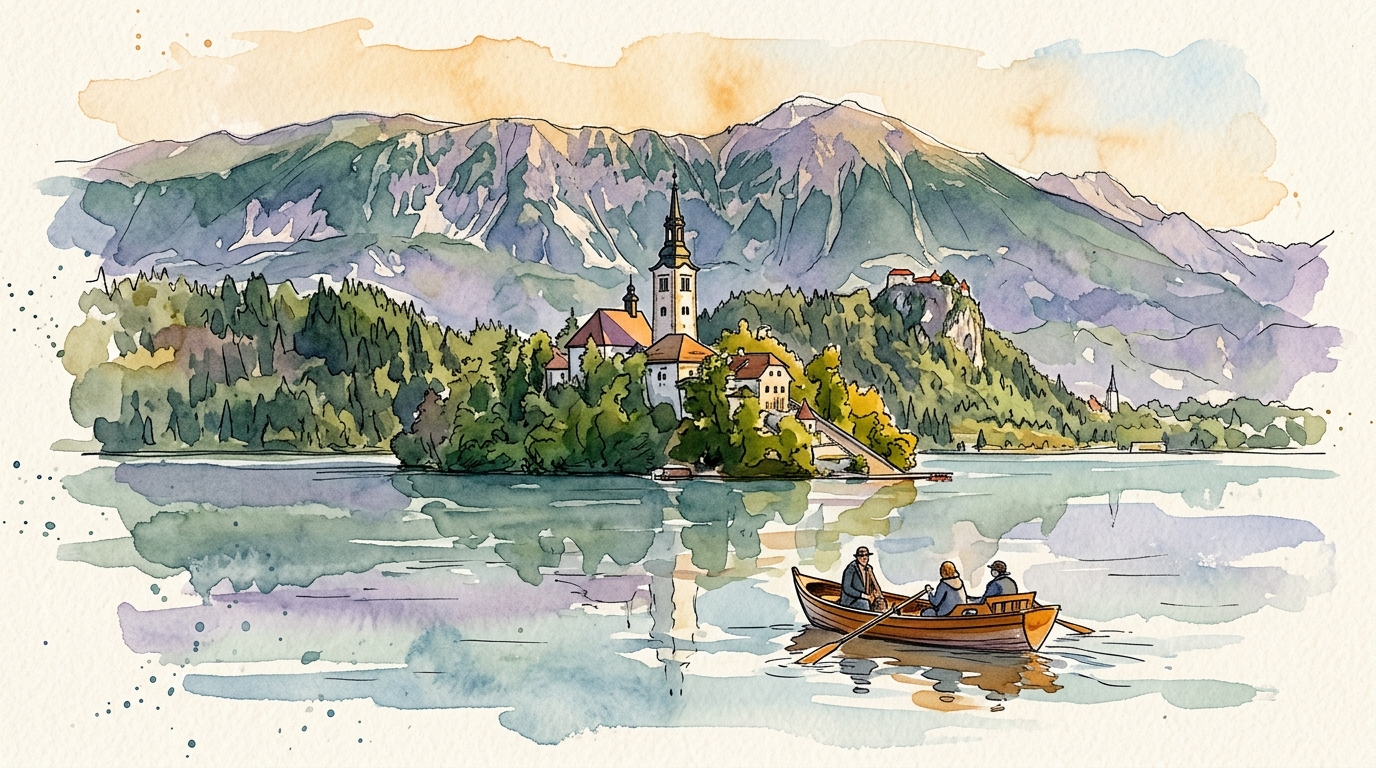
Lake Bled, Slovenia. It's 40 minutes from Ljubljana by bus (about €7 as of early 2026), the water hits 18–20°C by late May, and the whole scene with the island church looks exactly like the postcards except better in person because at that time of morning, when the mist is still lifting off the water and the Julian Alps are pink behind the church spire, you'll have the viewpoint at Mala Osojnica almost entirely to yourself. Rent a pletna boat for about €15 and row yourself to the island. Or don't. The shore trail is free and takes about 90 minutes.
The Italian Dolomites are another strong pick. The cable cars and rifugios reopen in late May, trails are empty compared to July, and wildflower meadows are at peak color. Budget €90–120/day for mountain huts, meals, and cable car passes.
What's Actually Open on May 1 (The Survival Guide)
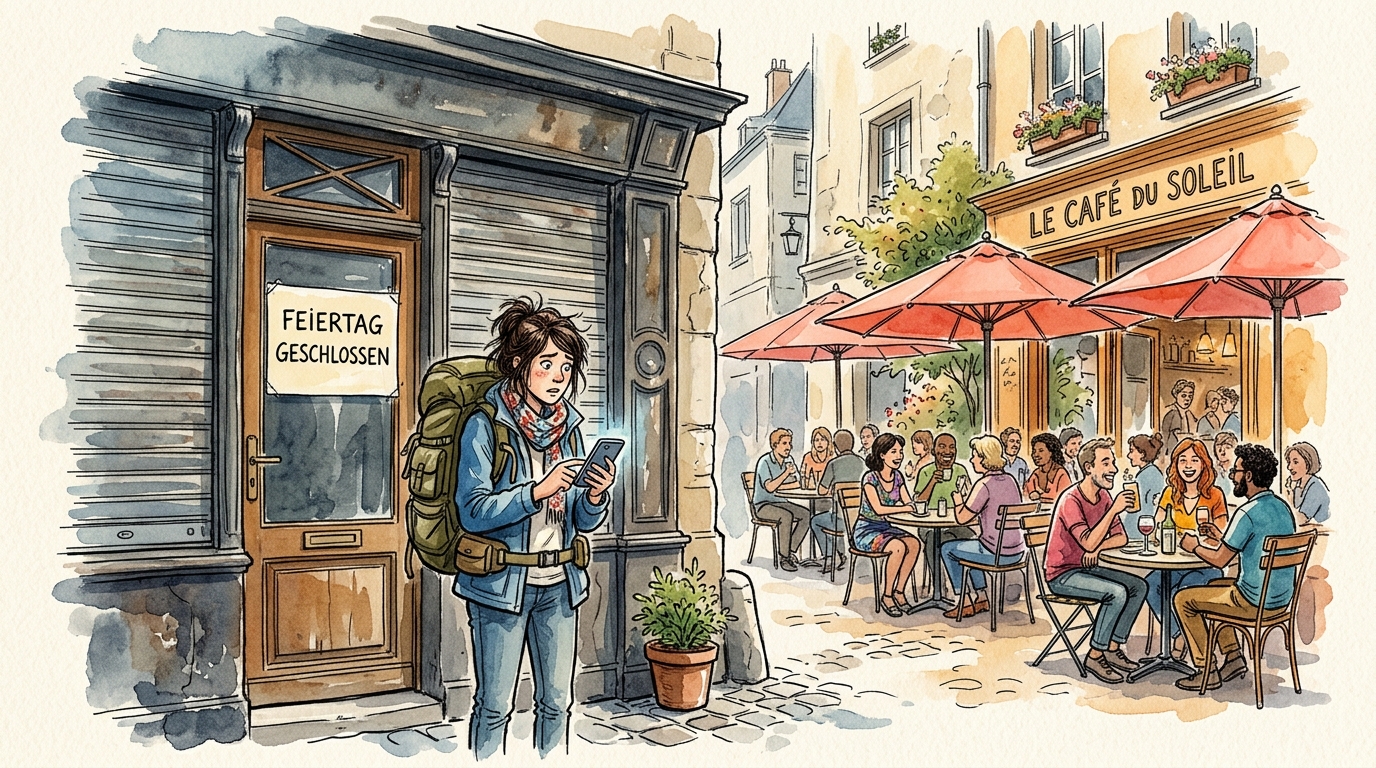
May 1 is one of Europe's three biggest shutdown days, alongside December 25 and January 1. If you've only traveled to Europe in summer, the extent of the closures will surprise you. A city-by-city breakdown from Visit Ukraine confirms: assume everything is closed unless you've verified otherwise.
Here's what to expect in major cities:
| City | Shops & Supermarkets | Museums | Transit | Restaurants |
|---|---|---|---|---|
| Paris | Closed (even most bakeries) | Most closed; Eiffel Tower open | Sunday schedule | Tourist areas open; local spots 50/50 |
| Berlin | Closed ("dead day" for retail) | Mostly closed | Sunday schedule | Kreuzberg street festival; otherwise limited |
| Rome | Closed (some tourist shops open) | Colosseum & Vatican open (reduced hrs) | Holiday schedule | Most open in centro storico |
| Barcelona | Closed | Mixed; Sagrada Família open | Holiday schedule | Widely open (it's a celebration day) |
| Amsterdam | Normal (May 1 isn't a Dutch holiday) | Normal hours | Normal service | Normal |
| London | Normal (UK bank holiday is May 4) | Normal hours | Normal service | Normal |
| Vienna | Closed | Major ones open (Kunsthistorisches, Belvedere) | Holiday schedule | Most open; book ahead |
| Prague | Closed (larger malls may open) | Most open (it's a tourist day) | Holiday schedule | Widely open |
Look at that Amsterdam column. The Netherlands doesn't observe Labour Day at all, which makes it the contrarian May 1 destination. Everything runs normally while the rest of Europe sleeps. If you want a full day of shopping, museum-hopping, and canal-side dining on May 1 with zero closures, book Amsterdam.
And don't make the mistake of arriving in Berlin on May 1 expecting a quiet day. The MyFest street festival in Kreuzberg draws hundreds of thousands of people, the vibe is part celebration and part protest, and you won't find a quiet café within a kilometer of Kottbusser Tor. Plan for it or avoid it. There's no middle ground.
Buy your groceries on April 30. Seriously. If you're in a self-catering apartment in Germany, France, or Italy, the shops on May 1 are not "maybe closed." They're locked. Even gas station shops run limited stock. Stock up the night before, or plan to eat out.
If you're visiting from outside the EU, public holidays don't affect borders. Airports run normally. The new EES biometric entry system processes your fingerprints and photo on arrival regardless of the date. Make sure your travel documents are sorted before you fly, but don't worry about holiday closures at the border. It's the supermarkets, not the passport gates, that shut down.
The Money Side: What May Travel Costs vs. Summer
May is shoulder season in most of Europe. That means better prices than June–August but not rock-bottom winter rates. The sweet spot is the first two weeks of May, before Ascension weekend drives a demand spike.
Here's what you'll actually pay across five popular long-weekend cities (approximate prices as of March 2026, based on Google Flights and Booking.com spot checks):
| City | Return Flight (within Europe) | Hotel/Night (midrange) | Daily Budget | July Premium |
|---|---|---|---|---|
| Lisbon | €80–140 | €80–120 | €55–75 | +25–40% across the board |
| Prague | €60–110 | €65–95 | €45–60 | +20–30% |
| Barcelona | €70–150 | €100–160 | €65–85 | +30–50% (Gaudí year premium) |
| Amsterdam | €70–130 | €120–180 | €70–90 | +15–25% |
| Lake Bled | €80–140 (fly to Ljubljana) | €60–90 | €40–55 | +20–35% |
The math is clear: a 3-day Barcelona trip in May runs roughly €450–650 per person. The same trip in July? €600–900. That Gaudí centenary premium will only grow as June 10 (the actual anniversary) approaches.
For group trips where you're splitting costs with friends, May's shoulder pricing makes the difference between "sure, I'm in" and "I'll sit this one out." A four-person group splitting a €180/night apartment in Lisbon pays €45 each. In July, that same apartment is €260.
Book flights 6–10 weeks out for the best prices. For Ascension weekend specifically, don't wait past the first week of April. Once German and French families lock in their plans, availability drops fast and prices jump 15–25% on popular Mediterranean routes.
Frequently Asked Questions
Is May 1 a public holiday in all of Europe?
No. Most EU countries observe it (Germany, France, Spain, Italy, Austria, Belgium, Nordics), but the UK has its bank holiday on the first Monday of May (May 4 in 2026), and the Netherlands doesn't observe Labour Day at all.
What is a bridge day?
A bridge day (Brückentag in German, pont in French) is a regular working day between a public holiday and a weekend. You take one leave day to "bridge" the gap into a longer break. In May 2026, taking Friday May 15 off bridges Ascension Thursday into a 4-day weekend.
Can I really get 25 days off with 15 leave days in May 2026?
Yes, in countries that observe Labour Day, Ascension Day, and Whit Monday (Germany, France, Belgium, Austria, etc.). Take April 27–30, May 4–8, and May 11–22 as leave. Combined with weekends and holidays, that's April 25 through May 25.
When is Ascension Day in 2026?
Thursday, May 14. It's a public holiday in Germany, France, Belgium, Netherlands, Austria, Switzerland, and the Nordic countries. It is NOT a holiday in Spain, Italy, the UK, Poland, or Portugal.
Is Liberation Day (May 5) a public holiday in the Netherlands in 2026?
Not officially. Liberation Day is an official day off only every five years (last was 2025 for the 80th anniversary, next is 2030). But the celebrations still run annually: free music festivals in 14 cities, and many employers and all schools give the day off. It's worth visiting even without the official holiday status.
Are flights more expensive around Ascension weekend?
Yes. Prices spike 15–25% on popular routes once German, French, and Dutch families book. Book by early April (6–10 weeks before departure) for the best rates. Tuesday–Thursday departures are cheapest.
Is May shoulder season or peak season in Europe?
Early May (1st–14th) is firmly shoulder season with 20–30% savings over July. Late May (Ascension onwards) transitions toward peak, with prices creeping up and popular destinations filling faster. For budget travelers, the first two weeks are the sweet spot.
Key Takeaways
- May 1 is a Friday in 2026, giving most of continental Europe a free 3-day weekend. Take Mon–Thu off the week before for 9 consecutive days.
- Ascension Day (May 14) is the easiest bridge: 1 leave day → 4 days off. Book your Mediterranean flight now.
- France gets two Friday holidays (May 1 + May 8). Two long weekends, zero leave days spent.
- Netherlands Liberation Day (May 5) isn't an official day off in 2026 (that's every 5 years; next is 2030), but free festivals run in 14 cities and most employers give the day off anyway. Worth building a long weekend around.
- Barcelona in May 2026 is a once-in-a-lifetime combination: Gaudí centenary, UNESCO architecture capital, Sagrada Família tower completion.
- May 1 = closed in most of Europe. Buy groceries April 30. Amsterdam and London are the exceptions.
- Early May is 20–30% cheaper than July for flights and hotels. Book Ascension flights by early April before prices spike.
- For multi-destination bridge day trips, tools like TripProf help you map out day-by-day itineraries and track expenses across currencies when you're hopping between countries on back-to-back long weekends.
Sources
- Euronews: European micro-break trend data (34% YoY increase)
- Limehome: Bridge day strategies and vacation optimization math
- iamexpat.de: Germany 2026 public holidays and bridge days
- Aviation.Direct: Germany/Austria vacation optimization strategies
- Visit Ukraine: May Day closures city-by-city across Europe
- Dutch Government: Official public holidays in the Netherlands
- Sagrada Família: Tower of Jesus Christ completion (February 2026)
- Idealista: Barcelona UNESCO World Capital of Architecture 2026
- EuropeZigZag: Spring 2026 flight booking timing
- Office Holidays: Ascension Day country-by-country coverage
Last updated: July 3, 2026
Keep Reading
More travel tips and guides picked for you

What counts as visiting a state? Layovers, drive-throughs and the rules 50-staters use
Only 2% of Americans name a plane change as the minimum that counts as visiting a state, while 27% set the bar at driving through. Here's a three-tier rubric, a lookup table for the edge cases from Four Corners to D.C., and one trip counted three ways.

The fake SBB ticket website stealing credit card and Twint data from travelers
Zurich cantonal police confirmed a fake SBB ticket website is stealing credit card and Twint payment details from travelers who find it through an ordinary Google search. Here is how to spot it and what to do if you already paid.

UK ETA scam warning: fake websites are charging Austrians up to €900
Fake UK ETA websites are charging Austrian and EU travellers hundreds of euros for a form that costs £20. Here's how the real one works, and how to spot a scam before you pay it.