Why AI Can't Actually Plan Your Trip (And What to Do Instead)
Key Highlights
- 1
- 2
- 3
+4 more in the takeaways below
More than half of American travelers now use AI to plan their trips, according to Phocuswright's latest research. That number doubled in under a year. And yet, when Spanish influencer Mery Caldass asked ChatGPT whether she needed a visa to fly to Puerto Rico, it said no - without mentioning that Spanish citizens still need an ESTA to enter the U.S. territory. She was denied boarding at the airport and posted a tearful video that racked up millions of views.
That's not a freak accident. It's a pattern.
AI trip planning limitations are real, documented, and surprisingly consistent. The tools are fast, impressive, and wrong often enough to ruin a vacation. This article breaks down exactly where AI travel planners fail, why they fail, and what actually works for the parts of trip planning that matter most.
AI chatbots are useful for brainstorming destinations and drafting rough outlines, but they hallucinate restaurants, get visa rules wrong, ignore geography, and can't handle anything that happens after you land. A north9 study found 90% of ChatGPT itineraries contained errors. Use AI for inspiration, but verify every detail and rely on purpose-built planning tools for logistics, expenses, documents, and group coordination.
The Promise: Why Everyone's Using AI to Plan Trips
The appeal is obvious. You type "plan me a 5-day trip to Lisbon" into ChatGPT, and within seconds you've got a day-by-day itinerary with restaurant recommendations, museum suggestions, and walking routes. No scrolling through 47 blog posts. No cross-referencing three different apps. Just ask, and the machine answers.
And it's working, at least in terms of adoption. Phocuswright reports that 56% of travelers used AI for planning, booking, or in-destination help in the past 12 months, up from 33% in early 2025. Every generation posted double-digit gains. According to TakeUp's 2026 survey of 300 U.S. leisure travelers, 78% of AI users say they save one to three hours per trip. And 84% of them started using AI for travel within the past year alone. That's a fast shift.
The brainstorming phase is where AI shines brightest. You don't know where to start? Ask it. You want a rough sense of what five days in Japan might look like? It'll give you one in 15 seconds. Need to compare Dubrovnik and Split for a long weekend? It'll lay out the trade-offs in a tidy table. For early-stage inspiration and getting unstuck, these tools are genuinely useful.
But inspiration isn't a plan. And the gap between "sounds about right" and "actually works on the ground" is where everything falls apart.
The 90% Problem: Where AI Trip Planning Fails
ChatGPT travel planning looks polished. The formatting is clean, the language is confident, and the recommendations sound authoritative. That confidence is exactly what makes the errors dangerous. You don't question something that reads like it was written by an expert.
north9 (formerly SEO Travel) ran one of the most thorough tests to date. They asked ChatGPT to generate 100 two-day weekend itineraries across the world's top 10 city destinations. The results were bad.
- 52% suggested visiting attractions outside opening hours
- 24% recommended permanently closed restaurants or attractions
- 25% had illogical routing with unnecessary backtracking across cities
- 30% included Michelin-starred restaurants without mentioning prices or reservation requirements
And then there are the places that simply don't exist. ChatGPT invented a fictional cafe called "Antico Caffe Ponit" during a Rome itinerary, according to the north9 study. It sounds real. It reads real. It's not real.
This isn't just a ChatGPT problem. Researchers at Ohio State University built TravelPlanner, a rigorous benchmark for evaluating AI trip planning, and presented it at ICML 2024. They tested GPT-4 against 1,225 planning scenarios with access to nearly four million real data records. GPT-4's success rate for producing a fully valid plan? 0.6%.
Not 60%. Not 6%. Zero point six percent.
Why AI Gets Travel So Wrong (The Structural Problems)
AI travel planning errors aren't bugs. They're structural. Large language models lack real-time data, have no geographic reasoning, can't truly personalize beyond a single prompt, and learn from commercially biased web content. These four problems are baked into how the technology works, and understanding them tells you when to trust AI output and when to verify it yourself.
The Staleness Problem
Large language models are trained on data that's weeks to months old at best. Restaurants close. Routes change. Visa policies update. A Euronews journalist testing ChatGPT on a Tallinn trip found it recommended Restaurant Vanaema Juures and Kohvic Komeet, both permanently closed. She only discovered this when she was already hungry and looking for a place to eat.
The Mark Pollard incident is worse. The Australian author asked ChatGPT about visa requirements for Chile. It said Australians could stay visa-free for 90 days. Wrong. A consular visa with a 20-day processing period had been required since 2019. He was stranded in Mexico City and missed his conference entirely. His Instagram post about the disaster hit 15 million views.
The Geography Problem
No map data. No spatial reasoning. No sense of distance. AI generates text based on word associations, not spatial reality. AFAR magazine flagged this as one of the most common AI travel mistakes: itineraries that assume direct routes where none exist, compress travel times unrealistically, or suggest attractions are within walking distance when the route involves steep terrain or inaccessible paths.
We've seen this firsthand. An AI-generated Prague itinerary scheduled the castle, Vysehrad, and a restaurant in Vinohrady as a "morning walk." That's 12 kilometers with a 200-meter elevation change. Not a morning walk.
Rick Steves noted that when he asked an AI assistant for directions to a Budapest bus station, it gave the correct Metro stop but on the wrong line entirely. ChatGPT also suggested a flamenco club in Cadiz that was "far across town" from the neighborhood it had just recommended.
The north9 study confirmed this at scale: 25% of itineraries required travelers to backtrack across cities or take unnecessary detours. Pack five museums into one day on opposite sides of a city, and the plan looks great on screen but falls apart by lunch. Anyone who's tried to follow an AI-generated multi-city Europe itinerary knows the feeling: the map makes it obvious that the AI had no idea where anything actually was.
The Personalization Paradox
Ask ChatGPT for a week in Barcelona, and you'll get the same basic itinerary whether you're a vegan solo traveler, a couple celebrating an anniversary, or a family with two toddlers. The complaint you'll hear most often: "It just gives you the top 10 tourist traps." Steakhouse recommendations for vegetarians. Bar crawls for someone who doesn't drink. A packed 14-hour sightseeing schedule for a 70-year-old with mobility concerns.
You can add constraints to your prompt, and it'll try to adjust. But it doesn't know you. It doesn't remember your last trip. It doesn't understand that you hate crowds, or that your partner refuses to eat anywhere without outdoor seating, or that you always regret overpacking your first day.
Real personalization requires context that builds over time: your dietary restrictions, your fitness level, your budget comfort zone, how many hours of sightseeing you can handle before you need to sit in a park with a coffee. A chatbot that forgets everything the moment you close the tab can't do that.
The Commercial Bias Problem
This one's subtle, and Rick Steves put it bluntly: "Companies are figuring out ways to manipulate underlying algorithms and cleverly keyword to push their content artificially higher in AI results."
Here's the thing about training data. The internet is full of sponsored content, affiliate-driven recommendations, and SEO-optimized pages designed to rank, not to inform. When ChatGPT suggests a specific restaurant or tour, it may be reflecting what was most heavily marketed online, not what's actually good. That's not a bug. That's how the training data works.
The north9 study caught a version of this: 30% of itineraries included Michelin-starred restaurants without mentioning price points or the fact that you'd need a reservation weeks in advance. The AI doesn't distinguish between "this place exists" and "this place makes sense for the traveler asking." It optimizes for sounding impressive, because the text it trained on rewarded impressive-sounding recommendations. A survey published in September 2026 puts a number on exactly that gap: 1 in 6 AI-using travelers were sent to a place that doesn't exist at all.
Treating AI itineraries as ready-to-use plans. They're rough drafts at best. Every restaurant, opening hour, visa requirement, and distance claim needs verification against a primary source.
What AI Actually Does Well (And Where to Stop)
Honesty makes criticism credible, so here's the honest part: AI tools aren't useless for travel. They're genuinely good at a specific set of tasks. The problem is that people use them for everything.
Here's what works:
| Task | AI Quality | Why It Works |
|---|---|---|
| Destination brainstorming | Good | Low stakes; you'll research further anyway |
| Rough itinerary outlines | Decent | A starting point, not a final plan |
| Language translation | Good | Better than phrasebooks for casual use |
| Packing list drafts | Good | Generic but useful as a baseline to customize |
| Formatting questions | Good | "How do I say X in Japanese?" works well |
| Visa and entry requirements | Unreliable | Outdated info, high-stakes consequences |
| Restaurant recommendations | Unreliable | Can't verify current status or quality |
| Distance and routing | Poor | No real map data; guesses based on text patterns |
| Real-time info | Poor | Opening hours, transit schedules, weather: all stale |
The pattern is clear. AI does well on tasks where being approximately right is fine and you'll double-check anyway. It fails on tasks where accuracy matters and the information changes frequently.
Honestly? That table is generous. "Decent" for rough itinerary outlines means "a starting point you'll spend an hour correcting." That's not time saved. That's time spent differently.
According to TakeUp's 2026 survey, 54% of AI users cross-check recommendations on review platforms, and 51% confirm details on traditional booking sites. The travelers who get value from AI are the ones who treat it as a first draft, not a finished product.
So use it to brainstorm. Use it to get unstuck. Use it to draft a packing list that actually works and edit it. Then close the chat window and start actually planning.
The Missing Middle: What AI Travel Planning Can't Do
Here's what most AI-versus-human-planning debates miss entirely: the itinerary is the easy part. The hard part - documents, expenses, group coordination, real-time adjustments - is everything that actually determines whether a trip goes smoothly or falls apart.
Think about what actually makes or breaks a trip:
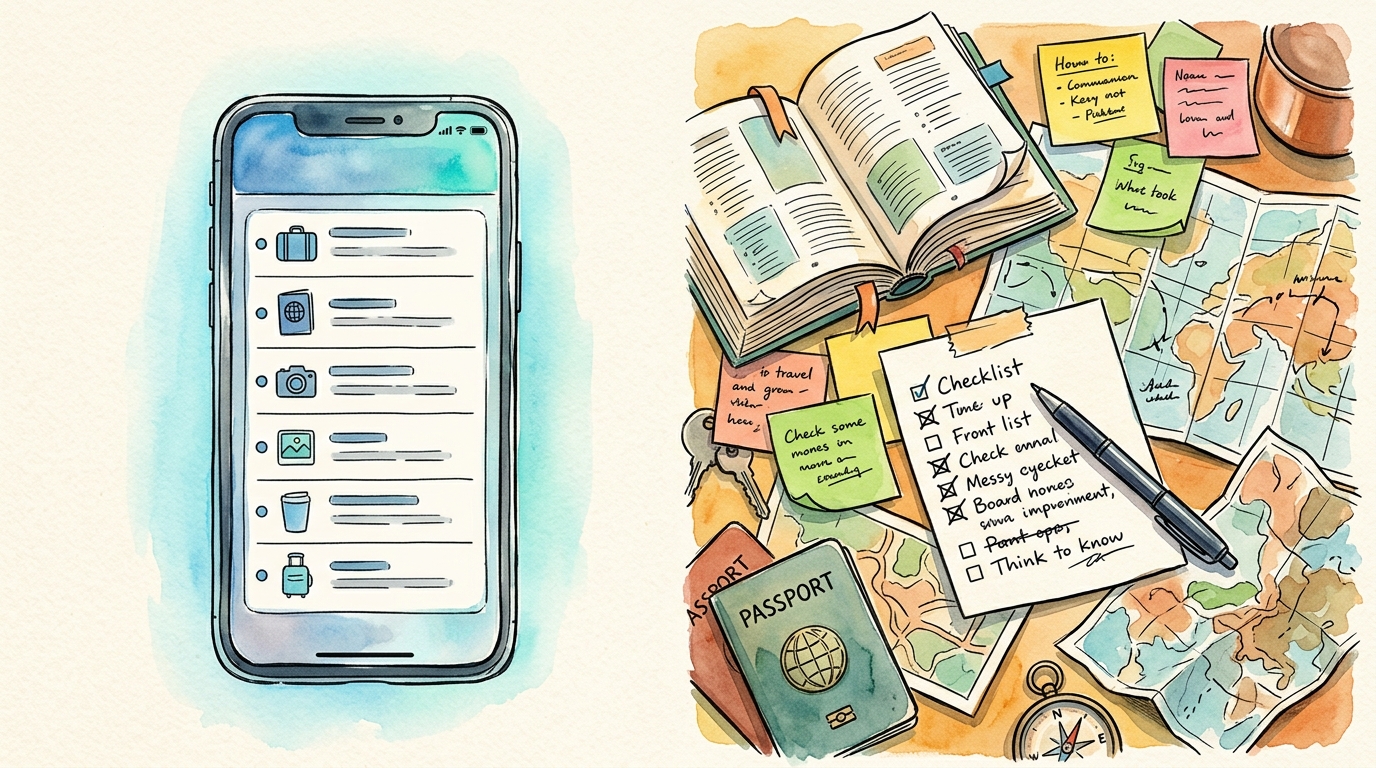
- Documents. Passports, visas, travel insurance, hotel confirmations, boarding passes. Scattered across three email accounts and a downloads folder you never organize.
- Expenses. Who paid for dinner? How much was that taxi in a currency you don't understand? What's the running total? Is the group budget on track?
- Checklists. Did you pack the adapter? Did anyone book the airport transfer? Has everyone confirmed their dietary requirements?
- Group coordination. Five people, three opinions on restaurants, two who haven't booked flights yet, and one who keeps changing the dates.
- Real-time adjustments. It's raining. The museum's closed for renovation. Your flight got delayed by four hours. Now what?
Before your next trip, ask: where are my documents stored? Who's tracking expenses? Does everyone have the same info? If the answer to any of these is "I'll figure it out later," you're not done planning.
ChatGPT can't track your expenses. It can't store your boarding pass. It doesn't know your friend just Venmoed you for last night's dinner. It can't send a reminder that you haven't packed your medication. It can't split a bill in three currencies and tell you who owes what.
Look, the itinerary is the fun part of planning. It's the part that feels productive. But it's also the part that matters least when things go sideways. Nobody's trip was saved by having the perfect museum order. Trips get saved by knowing where your insurance documents are when you're in an ER in Barcelona at 2am, or by having a clear expense log when your group of six needs to settle up on the last night.
This is where purpose-built trip planning tools fill the gap. Apps like TripProf handle the full planning lifecycle: document storage, expense splitting, smart checklists, day-by-day itineraries, and offline access for when you're in a country where your data plan doesn't work. The point isn't that AI is bad at brainstorming. It's that brainstorming was never the hard part.
"It nearly got us stranded." That's a line that shows up in Reddit threads about AI trip planning more often than you'd expect. And it's never about the itinerary being boring. It's about the logistics failing.
A Global Rescue survey of over 1,400 travelers found that only 22% would let AI plan their next international trip, and 79% said they'd be uncomfortable with AI booking flights or hotels without their approval. Travelers want help, not autopilot.
And that trust gap makes sense when you read the horror stories. In Japan, travelers got stranded on top of Mount Misen because ChatGPT gave them the wrong ropeway closing time. In Peru, hikers walked to a "sacred canyon" that turned out to be completely AI-generated. In Malaysia, a couple traveled to a scenic cable car destination that didn't exist.
None of those failures were itinerary problems. They were logistics problems. And logistics is what AI isn't built for.

Frequently Asked Questions
Can I trust ChatGPT to plan my trip?
For brainstorming destinations and drafting rough outlines, yes. For specific details like restaurant recommendations, visa requirements, opening hours, and routing, no. A north9 study found 90% of ChatGPT itineraries had at least one error. Always verify details against primary sources.
Why does ChatGPT recommend closed restaurants?
Large language models are trained on data that's weeks to months old. They can't check whether a restaurant is currently open. A Euronews journalist found two permanently closed restaurants in a single ChatGPT-planned Tallinn trip.
Is AI travel planning getting better?
The models are improving, but the structural problems remain. AI still lacks real-time data, geographic reasoning, and true personalization. Even GPT-4 (as of early 2024) achieved only a 0.6% success rate on a rigorous travel planning benchmark. Incremental improvements don't fix the fundamental architecture.
What should I use AI for when planning a trip?
Use it for destination inspiration, rough itinerary outlines, packing list drafts, language translation, and formulating questions. Don't use it for visa and entry requirements, restaurant picks, transit routing, or anything where being wrong has real consequences.
Are AI travel planning apps better than ChatGPT?
Some specialized AI travel tools connect to real-time data sources and mapping APIs, which reduces certain errors. But they still share the core limitations of language models for personalization and accuracy. Purpose-built planning apps that handle documents, expenses, and coordination solve a different (and often more important) set of problems.
Can AI replace a travel agent?
Not for complex trips. AI can't verify real-time availability, negotiate group rates, handle disruptions, or provide accountability when things go wrong. For a simple weekend getaway, AI might generate a decent starting point. For multi-city international trips, family travel, or group coordination, human expertise and dedicated tools remain more reliable.
How do I verify AI travel recommendations?
Check restaurant hours on Google Maps or the venue's own website. Verify visa requirements on official government sites (not travel blogs). Cross-reference distances on Google Maps or Apple Maps. Look up attractions on their official pages. According to TakeUp's survey, 54% of AI users already cross-check recommendations on review platforms.
Key Takeaways
- 90% of ChatGPT itineraries contain at least one error, including closed restaurants, wrong opening hours, and fictional places.
- AI doesn't have access to real map data, real-time schedules, or current visa policies. It generates plausible text, not verified facts.
- Use AI for brainstorming and early-stage inspiration, then verify every detail against primary sources before acting on it.
- The biggest AI travel planning failures aren't about bad restaurant picks. They're about wrong visa information, dangerous routing errors, and logistics that don't survive contact with reality.
- Trip planning is more than an itinerary. Document management, expense tracking, group coordination, and real-time adjustments are where most trips succeed or fail.
- 54% of travelers who use AI already cross-check its recommendations. Do the same, or you're outsourcing your vacation to a tool that was right 0.6% of the time in academic testing.
- Purpose-built trip planning tools handle the logistics that AI can't: expenses, documents, checklists, and offline access when you're actually on the ground.
Sources
- north9 (formerly SEO Travel): 90% of AI Travel Itineraries Are Inaccurate
- TravelPlanner: A Benchmark for Real-World Planning with Language Agents (ICML 2024)
- Phocuswright: The AI Surge, Travel's Fastest Behavioral Shift in a Decade
- TakeUp: How Travelers Use AI to Plan and Book Trips in 2026
- Global Rescue: Why Travelers Trust AI To Plan Trips But Not Agentic AI
- Euronews: How Good Is ChatGPT at Planning Holidays? A Tallinn Trip Test
- CamJon Travel: Stop Trusting AI for Travel, ChatGPT Is Ruining Vacations
- HuffPost: ChatGPT Visa Misinformation Ruined Spanish Tourists' Vacation
- Rick Steves: AI for Trip Planning? Tread with Caution
- AFAR: The 4 Most Common Mistakes AI Makes When Planning Travel
Last updated: July 3, 2026
Keep Reading
More travel tips and guides picked for you

1 in 6 AI trip planners got sent to a place that doesn't exist, survey finds
A new survey found 1 in 6 AI trip planners got sent to a place that doesn't exist, and 55% hit at least one wrong recommendation. Here's the checklist to run before you book anything AI suggests.

Should You Let AI Book Your Trip? What ChatGPT and Gemini Actually Do in 2026
OpenAI pulled ChatGPT's travel checkout button, Google is testing AI-booked hotels, and one study caught chatbots pushing pricier sponsored flights. Here's the real 2026 verdict on letting AI handle the purchase.

Travel Blogging Myths 2026: 7 Debunked With Real Data
Most new travel bloggers earn $4.44 a month. AI search cut median blog traffic 85%. Here's what 2026 income surveys, traffic data, and real blogger accounts say about the myths still circulating.