Thailand Just Killed the 60-Day Visa-Free Stay: What Summer 2026 Travelers Need to Know

Key Highlights
- 1
- 2
- 3
+5 more in the takeaways below
Your Bangkok flight leaves August 3 and your return is six weeks later. Under the rules Thailand has run since July 2024, that's fine: 60 visa-free days, no paperwork beyond an arrival card. Under Thailand's new visa rules approved on May 19, 2026, your trip is nearly two weeks too long. Which version applies depends on one thing: the date you land.
Here's how to work it out, and what to do if your plans don't fit inside 30 days.
Thailand's 60-day visa-free stay is ending. The Cabinet approved a cut to 30 days for 54 nationalities on May 19, 2026, but the change still isn't active: as of August 25, 2026, more than three months later, the Royal Gazette still hasn't published the notices that start the 15-day countdown. Enter now and you still get the full 60 days. Need longer than 30 once it does land? Extend once for 1,900 THB at any immigration office, or get the 60-day Tourist Visa before you fly. We're tracking the TAT Newsroom's visitor-info feed and will update this guide the day it publishes, but verify with the TAT Newsroom the week you fly.
Thailand's New Visa Rules: What the Cabinet Actually Approved
On May 19, 2026, Thailand's Cabinet voted to revoke the 60-day visa exemption that travelers from 93 countries and territories have used since July 15, 2024 (Royal Thai Government PRD), confirmed two days later by the Tourism Authority of Thailand. Once in force, the replacement framework gives 54 nationalities a 30-day visa-free stay, creates a new 15-day tier for three countries, and slashes Visa on Arrival eligibility from 31 countries to just 4.
The government calls the principle "one country, one privilege": every nationality gets exactly one entry scheme, no overlaps. The official breakdown from the Royal Thai Government's Public Relations Department looks like this:
| Entry scheme | Who qualifies | Maximum stay | Status |
|---|---|---|---|
| 30-day visa exemption | 54 countries: US, UK, Canada, Australia, Japan, Singapore, most of the EU | 30 days + one 30-day extension | Reduced |
| 15-day visa exemption | Seychelles, Maldives, Mauritius | 15 days | New tier |
| Visa on Arrival | Azerbaijan, Belarus, Serbia, India | 15 days | Cut from 31 |
The bolded row is the one that matters for most readers: if you hold a Western passport, odds are you're in the 54. One notable absence from that list is South Korea, which keeps its own longer stay under a separate bilateral agreement rather than the exemption scheme. Nation Thailand has the full country-by-country breakdown.
Two smaller details from the official announcement deserve attention. The new 30-day exemption is granted for tourism purposes only, so expect more pointed questions if your answers at the booth sound like remote work. And countries dropped from the lists entirely don't fall into a void; they revert to whatever entry conditions applied to them before the July 2024 expansion, per the TAT.
Why the rollback? Security, mostly. Nation Thailand reports the Foreign Ministry pointed to nominee businesses, illegal work, and transnational crime operating inside the generous 60-day window. Bangkok Post notes Thai authorities revoked the licences of 40 tourism companies in 2024 after finding foreigners had quietly taken control through proxy shareholders. The tourism minister framed the shift as a focus on "quality tourists" over raw visitor volume.
And honestly, the math backs the government's bet that most visitors won't notice. Bangkok Post data shows short-haul tourists average around seven days in Thailand, while long-haul visitors typically stay 14 to 21. The Foreign Ministry's own figure is blunter still: the average stay across all foreign tourists is just over nine days, and even the longest-staying nationality, Norway, averages 21 (Nation Thailand). The people this actually hits are slow travelers, six-week winter escapers, and anyone stringing Thailand into a longer Southeast Asia route.

When Do the New Rules Take Effect? Watch the Royal Gazette, Not the Headlines
As of August 25, 2026, the 30-day rule is still not in force. Thailand's 60-day visa exemption still applies and keeps applying until the Ministry of Interior announcements are published in the Royal Gazette, Thailand's official legal journal. The TAT Newsroom confirmed the revised conditions take effect 15 days after that publication back in July, and its visitor-info archive shows nothing newer on the topic since then — over three months after the Cabinet's May 19 vote, still no publication date.
So a publication most travelers have never heard of currently controls thousands of summer itineraries - welcome to Thai administrative law.
Monitoring it doesn't require reading Thai legal notices. The TAT Newsroom publishes an English summary within hours of any Gazette movement, your nearest Thai embassy posts entry-rule updates, and a saved news alert for "Thailand visa exemption" catches the rest. Five minutes of checking in the week before departure replaces hours of airport stress.
The practical consequence: the switch can land mid-summer with roughly two weeks of public notice. If the Gazette publishes in late June, the 30-day cap starts in mid-July. Publish in August, and the whole peak season runs on the old rules. Nobody outside the Ministry of Interior knows which it'll be, and specialist trackers like tdac.info are watching the Gazette daily precisely because of that uncertainty.
But here's the detail that headline coverage keeps burying: the transition rule. Travelers who enter Thailand before the effective date keep their full permitted stay. Your stamp is your contract. Land on day one of a 60-day window and the rule can flip on day five without shortening your visit.
Planning a 31-to-60-day trip with flexible dates? Move your arrival up. An entry stamped before the effective date locks in the full 60 days under the official transition rule, even if the new framework starts while you're mid-trip. It's the only legal way to guarantee a long stay without extra paperwork.
Thailand isn't tightening alone, by the way. 2026 is shaping up as the year destinations re-price and re-regulate tourism, from Japan's stack of new tourist fees and taxes to entry systems rolling out across Europe.

Which Rule Applies to Your Trip? Work It Out in Five Steps
Your entry date decides everything. Trips that begin before the new framework's effective date run under the 60-day exemption for their entire length. Trips that begin after it run under the 30-day cap. Since the effective date isn't known yet, the decision guide below covers both branches.
- Check the current status the week you fly. Search the TAT Newsroom for "visa exemption" or check the Thai embassy site for your country. Until the Royal Gazette publishes, 60 days still stands.
- Entering before the effective date? You get the full 60 days, guaranteed by the transition rule, even if the change happens during your stay. Nothing else to do.
- Entering after the effective date? You get 30 days if your passport is on the 54-country list. Count your nights; an August 1 arrival must exit by August 30.
- Trip 30 days or shorter? The change doesn't touch you. File your digital arrival card, bring proof of funds, done.
- Trip longer than 30 days, entering after the switch? Pick one of the three options in the next section before you board, not after you land.
Run your own dates through that once and you'll know more than most of the comment sections currently panicking about this.
A concrete example. Say the Gazette publishes on June 25: the new rules start July 10. A July 5 arrival keeps 60 days through early September. A July 15 arrival gets 30. Two travelers, ten days apart, with a month's difference in permitted stay.
That cliff edge is the whole story.
Already in Thailand when the Gazette drops? You're covered too: the official transition rule preserves the full permitted stay attached to your existing entry stamp. What the announcements don't address is whether a pre-switch 60-day entry can still add the 30-day extension afterward, restoring the old 90-day total. Until immigration clarifies, budget for the conservative reading and treat day 60 as your exit.

Staying Longer Than 30 Days: Extension, Tourist Visa, or DTV
Once the 30-day cap is live, three realistic routes get you more time in Thailand: a one-time 30-day extension at an immigration office inside the country, the 60-day Tourist Visa (TR) arranged before you fly, or the five-year Destination Thailand Visa for remote workers. Here's how they compare:
| Option | Total stay | Cost | Where to arrange |
|---|---|---|---|
| 30-day extension | 60 days (30+30) | ฿1,900 (~€50) | Immigration office in Thailand, before day 30 |
| Tourist Visa (TR) | 90 days (60+30 extension) | ~฿1,000 + e-visa fees by country | thaievisa.go.th, before flying |
| Destination Thailand Visa | 180 days per entry, 5-year validity | ฿10,000 (~€260 / $280) + ฿500,000 (~€13,000 / $14,500) in savings | Thai e-visa or embassy, outside Thailand |
The extension is bolded because it's the default answer for most holiday-length overruns. But the right pick depends on how long you're actually staying. And worth saying plainly: "I'll sort it out once I'm there" is the one strategy we'd avoid this year, because immigration offices get slammed after every rule change and the fine print may still be settling.
1. The 30-Day Extension: The 31-to-60-Day Fix
Visit any Thai immigration office (Chaeng Watthana in Bangkok, or regional offices in Phuket, Chiang Mai, and elsewhere) before your initial 30 days expire. Bring your passport, a photo, a completed TM.7 form, and 1,900 THB, roughly €50 (~$55). You walk out with 30 more days, for a ceiling of 60 days total. ExpatDen's breakdown confirms the extension survives the rule change; what's gone is the old 60+30 ceiling of 90 visa-free days.
Budget half a day for the office visit and go early. The queues at Chaeng Watthana after a rule change are their own form of tourism.
2. The Tourist Visa (TR): Get It Before You Fly
If you already know your trip runs past 45 days, skip the extension gamble and apply for the 60-day Tourist Visa on the official Thai e-Visa portal before departure. The official base fee is 1,000 THB, but in practice e-visa pricing is set per country, budget around €35-45 ($40), and processing takes from a few days up to two weeks. The TR is itself extendable by 30 days in-country, restoring the old 90-day ceiling for people willing to do paperwork in advance.
Our take: do this, not the border run. Pre-arranged beats improvised every time immigration policy is in flux.
3. The DTV: For Remote Workers, Not Holidays
The Destination Thailand Visa gives remote employees and freelancers 180 days per entry across a five-year validity. It costs 10,000 THB (~€260 / $280) and requires showing roughly 500,000 THB (~€13,000 / $14,500) in savings. The money doesn't need to sit in a Thai bank, but you do need to apply from outside Thailand, through the e-visa system or a Thai embassy.
Eligibility is wider than "digital nomad" suggests. The official Thai e-Visa portal lists the qualifying categories: remote work for a foreign employer, freelancing for non-Thai clients, and "soft power" activities like Muay Thai training camps, Thai cooking courses, and extended medical treatment. Siam Legal's DTV guide walks through how each category plays out in practice. Overkill for a six-week holiday. Exactly right if Thailand is your winter office.
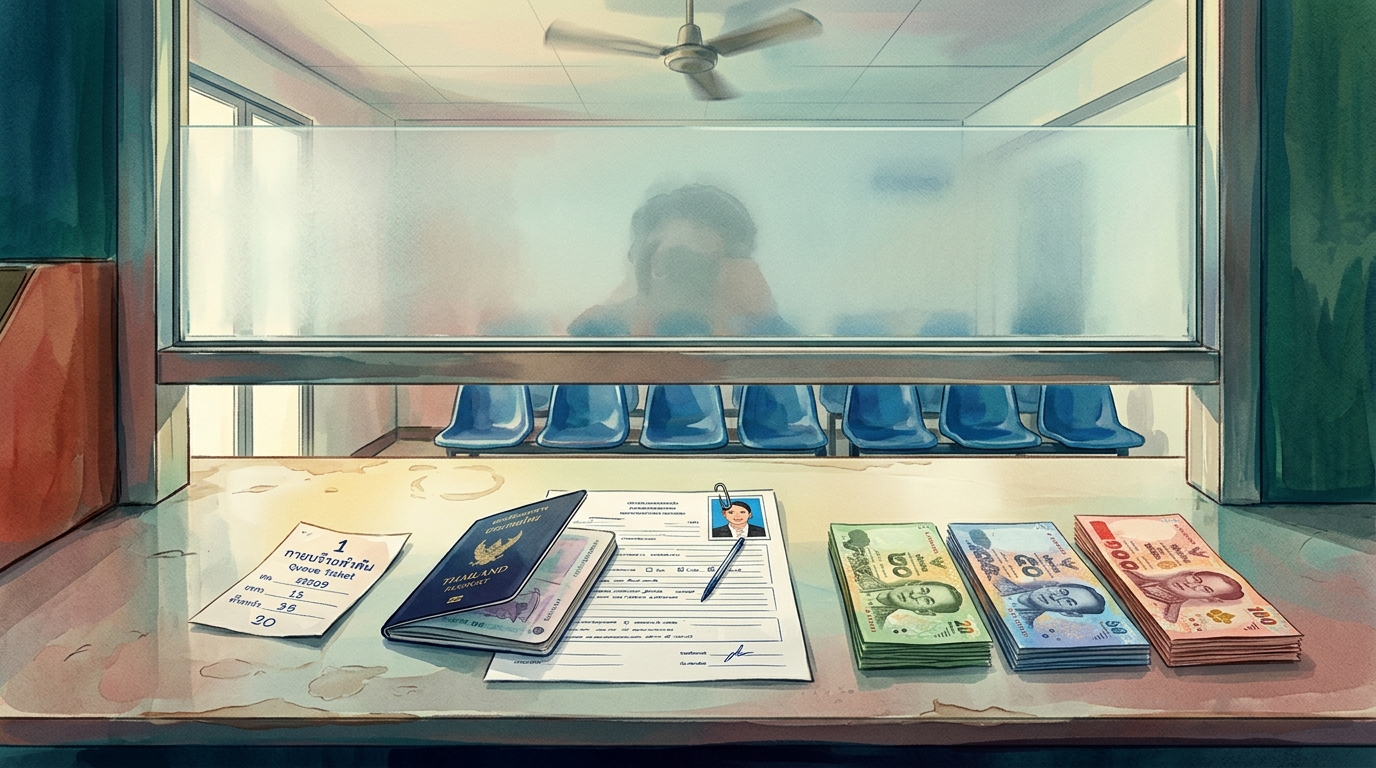
Thailand Entry Requirements 2026: Cash, Onward Tickets, and the TDAC
The visa-free clock isn't the only thing checked at the Thai border. Immigration officers can ask for proof of 20,000 THB per person (roughly €520 / $590) or 40,000 THB per family (roughly €1,040 / $1,180), airlines can refuse boarding without a paid onward ticket inside your permitted stay, and every foreign arrival must file the free Thailand Digital Arrival Card before landing.
Start with the money. The 20,000 baht rule is real, longstanding, and rarely enforced against ordinary tourists. Integrity Legal, a Bangkok law firm, reports checks are targeted mainly at travelers with frequent back-to-back entries or prior overstays, not families on a two-week beach holiday. The catch is what counts as proof.
When officers do check funds, Integrity Legal's analysis describes them asking to see 20,000 THB in cash - they want to see it, not take it. Don't count on a banking app being accepted as proof. Carry the equivalent of about €520 ($590) per person in actual notes if your entry pattern might draw attention.
Next, the onward ticket. Airline check-in staff enforce this more often than immigration does, because carriers eat the cost of flying back anyone refused entry. After the rule change, your exit booking needs to fall within 30 days of arrival instead of 60, a direct consequence of the shorter permitted stay that will catch out plenty of travelers running on autopilot. tdac.info reports officers already asking solo travelers on one-way tickets for onward bookings, proof of funds, and hotel reservations more frequently. A paid, dated ticket out of Thailand answers the question before it's asked.
And then there's the step people forget entirely: the Thailand Digital Arrival Card. Mandatory for all foreign arrivals since May 1, 2025, free, and completable only within 72 hours before you arrive, according to the official immigration portal. Use that exact address - lookalike sites charge for what the government gives away.
The form itself takes about five minutes: passport details, flight number, and your first night's accommodation. It applies whether you arrive by air, land, or sea, and the system rejects submissions earlier than the 72-hour window, so don't try to clear it a month out. Set a reminder for three days before departure instead; our pre-trip countdown slots it in alongside everything else due that week.
That's also where a little organization pays off. Keep your TDAC confirmation, onward ticket, insurance, and visa documents in one place you can open at a check-in desk; a folder works, and so does a trip planning app like TripProf that stores documents per trip alongside an entry-requirements rundown for your destination. That same folder habit carries over to Europe: our Schengen visa for Indian travelers 2027 guide walks through the visa fee, the EES border check, and why ETIAS never applies to Indian passports. Our travel document checklist covers the full paperwork stack for 2026.
Your pre-departure list for Thailand now looks like this:
- Royal Gazette status checked the week you fly (TAT Newsroom)
- TDAC filed at tdac.immigration.go.th within 72 hours of arrival
- Paid onward ticket dated inside your permitted stay
- 20,000 THB (roughly €520 / $590) per person equivalent in physical cash
- Passport valid 6+ months beyond arrival
- Extension or visa plan if staying past 30 days
Save the TDAC confirmation QR code offline before you board. Airport WiFi at 6am after a red-eye is nobody's friend.
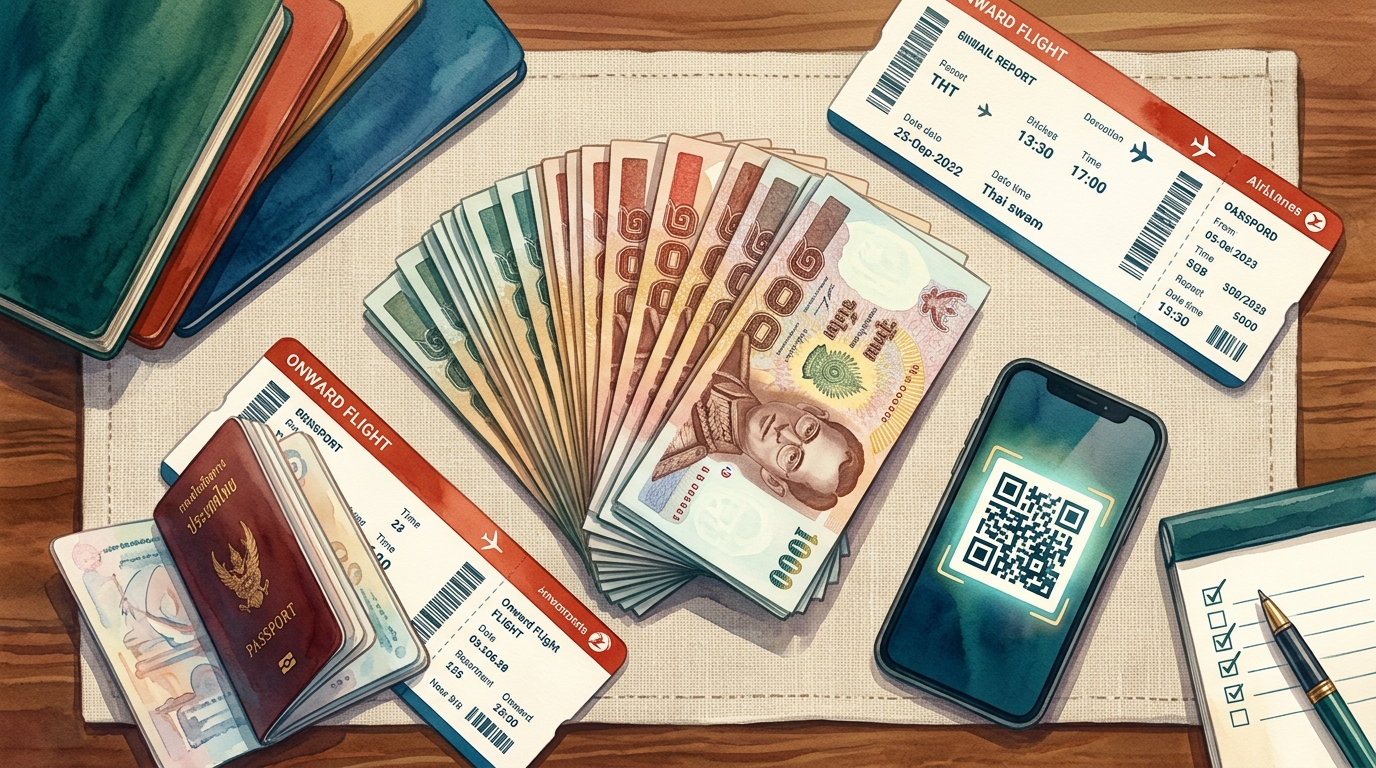
Border Runs, the Southeast Asia Loop, and the Two-Entries Question
The classic Bangkok-Chiang Mai-Laos-Cambodia-Vietnam circuit usually re-enters Thailand at least once, often by land. That's where the new framework bites hardest, because visa-exempt entries at land borders were already capped at two per calendar year before this change, as ExpatDen documents. Cross at Nong Khai twice and your third land entry needs a visa.
What about flying back in? Here we owe you some honesty. Several secondary outlets report the new framework caps all visa-exempt entries, air included, at two per calendar year. That cap doesn't appear in the official TAT announcement or the PRD statement, so treat it as reported but unconfirmed until the Royal Gazette text is public. We'd rather flag the gap than launder a rumor into a fact.
Plan as if it's real anyway. If your route touches Thailand three or more times in a year, the Tourist Visa or DTV stops being optional and starts being the itinerary's foundation. Immigration officers also hold broad discretion to question frequent visa-exempt entrants regardless of any formal cap, a point the Thai Tourist Police announcement of the revision underlines with its emphasis on screening.
The confusion out there is genuinely thick. The r/Thailand subreddit receives so many visa questions that moderators require them all to go into a monthly FAQ thread, and the May 19 decision drew wire-service coverage worldwide, including Al Jazeera. For the wider context on why 2026 feels like every rulebook is being rewritten at once, our roundup of the 15 biggest changes to travel in 2026 connects the dots.
What if the rules flip while you're mid-loop? Your existing Thai stamp stays valid under the transition rule, but any re-entry after the effective date runs on the new framework, with the shorter clock and tighter screening. Book the legs that cross back into Thailand as refundable or changeable fares until the Gazette date is known. A €15 fare-flexibility fee is cheaper than rebuilding a three-country route at a border crossing in Nong Khai.
One more reassurance: Thailand still wants you to come. The government's own Thailand NOW platform frames the change as a return to the pre-2024 norm rather than a door slamming shut. For a one or two-week holiday, the only thing that changed is a form and a number on a stamp.

Frequently Asked Questions
Is Thailand still 60 days visa-free?
Yes, as of August 25, 2026. The Cabinet approved ending the 60-day exemption on May 19, 2026, but more than three months on, the Royal Gazette still hasn't published the notices that start the 15-day countdown. Until it does, eligible nationalities still receive 60 days on arrival.
When do Thailand's new visa rules take effect?
No date is set. The rules become law 15 days after the Ministry of Interior announcements appear in the Royal Gazette. Once publication happens, you'll have roughly two weeks' notice. Check the TAT Newsroom or your local Thai embassy in the week before you travel.
How long can I stay in Thailand without a visa after the change?
30 days, if your passport is among the 54 eligible countries (including the US, UK, Canada, Australia, Japan, and most EU states). Three countries get 15 days. Everyone entering before the effective date keeps the full 60 days of the old scheme for that entire stay.
Can I still extend my visa-exempt stay by 30 days?
Yes. The one-time 30-day extension at Thai immigration offices survives, priced at 1,900 THB (~€50). Under the new framework that makes 60 days your visa-exempt ceiling (30+30), down from the old 90 (60+30). Apply before your first 30 days expire, with passport, photo, and a TM.7 form.
Do I really need 20,000 baht in cash to enter Thailand?
Officially, immigration can require proof of 20,000 THB per person (40,000 per family). In practice, checks are rare for ordinary tourists and target frequent entrants. When checked, officers ask to see cash; don't rely on app screenshots being accepted. Carrying the equivalent of about €520 ($590) per person is cheap insurance.
Do I need an onward ticket for Thailand?
Bring one. Airlines frequently verify a paid onward or return ticket at check-in because they're liable for refused passengers. After the rule change, your exit date must fall within 30 days of arrival rather than 60. A real, dated booking ends the conversation before it starts.
How many times per year can I enter Thailand visa-free?
By land, twice per calendar year; that cap already exists. Some reports say the new framework extends a two-entry annual limit to all visa-exempt arrivals including air, but that isn't confirmed in official announcements yet. Frequent entrants should expect questions either way, and consider a Tourist Visa.
Key Takeaways
- Thailand's Cabinet voted on May 19, 2026 to end the 60-day visa exemption for 93 countries; 54 nationalities will get 30 days instead.
- The change still isn't in force as of August 25, 2026 — over three months after the Cabinet vote. It starts 15 days after Royal Gazette publication, which still hasn't been announced.
- Your entry date is everything: arrive before the effective date and you keep the full 60 days for your whole stay.
- Staying 31-60 days after the switch? Use the 1,900 THB extension. Past 45-60 days? Get the 60-day Tourist Visa at thaievisa.go.th before flying.
- File the free TDAC at tdac.immigration.go.th within 72 hours of arrival, carry an onward ticket inside your permitted stay, and have 20,000 THB (roughly €520 / $590) per person available in cash.
- The reported two-entries-per-year cap on all visa-exempt arrivals is unconfirmed; only the land-border version is official so far.
- Keeping entry rules, documents, and checklists in one place, whether in a folder or a planning app like TripProf, means a Gazette announcement two weeks before departure is an adjustment, not a crisis.
- Rules will keep moving through 2026. Check the official status the week you fly, and your Thailand trip stays exactly as good as it was before the headlines.
Sources
- TAT Newsroom: Official announcement of the Cabinet approval, transition rule, and the 15-day Royal Gazette mechanism
- TAT Newsroom Visitor Info archive: Checked August 25, 2026 — no visa exemption update since July 16, 2026, confirming the Royal Gazette still hasn't published
- Royal Thai Government PRD: Official breakdown of the revised visa exemption and Visa on Arrival schemes
- Nation Thailand: Country lists for the 30-day, 15-day, and Visa on Arrival tiers, plus ministry reasoning
- Nation Thailand: Foreign Ministry data on average tourist stay duration
- Bangkok Post: Reporting on the end of the 60-day stay and the 40 revoked tourism company licences
- Bangkok Post: Average tourist stay durations and the minister's case that 30 days is sufficient
- Al Jazeera: International coverage of the May 19, 2026 Cabinet decision
- Thai Immigration Bureau: Official Thailand Digital Arrival Card portal, 72-hour window, free of charge
- Thai Ministry of Foreign Affairs e-Visa: Official portal for the 60-day Tourist Visa (TR) and Destination Thailand Visa
- Integrity Legal Bangkok: Legal analysis of the 20,000 THB proof-of-funds rule and its enforcement patterns
- ExpatDen: Extension mechanics, land-border entry caps, and long-stay alternatives after the change
- tdac.info: Effective-date tracking and onward-ticket guidance under the revised framework
- Thai Tourist Police: Official notice of the revised visa exemption and Visa on Arrival schemes
- Thailand NOW: Government framing of the return to the 30-day scheme
Last updated: August 25, 2026
Keep Reading
More travel tips and guides picked for you

Ireland at Rugby World Cup 2027: what the trip costs from Dublin
Following Ireland at Rugby World Cup 2027 costs roughly 3,800 to 6,500 EUR per person from Dublin. Here are the fixtures in Irish time, how Irish fans buy packages in euro, the free eVisitor, and the route that keeps a Melbourne knockout open.

Japan Cherry Blossom Trip 2027: What It Costs and When to Land
A cherry blossom week in Japan costs about $2,600 per person from New York and $2,200 from Los Angeles, flights included. We priced it line by line and tested 36 seasons of bloom records to find the date to land.

Gibraltar eclipse 2027: where to watch 4.5 minutes of totality, and where to sleep when the Rock is full
The Moon covers the Sun over Gibraltar for 4 minutes 28 seconds on 2 August 2027. Levanter cloud can pile up on the Rock's sunrise side, the airport is now a Schengen border, and Rock hotels are filling. Here's how seven bases compare for a UK group, and what the core trip costs.