RV Road Trip: Europe vs USA, Which Is Cheaper in 2026?
Key Highlights
- 1
- 2
- 3
+3 more in the takeaways below
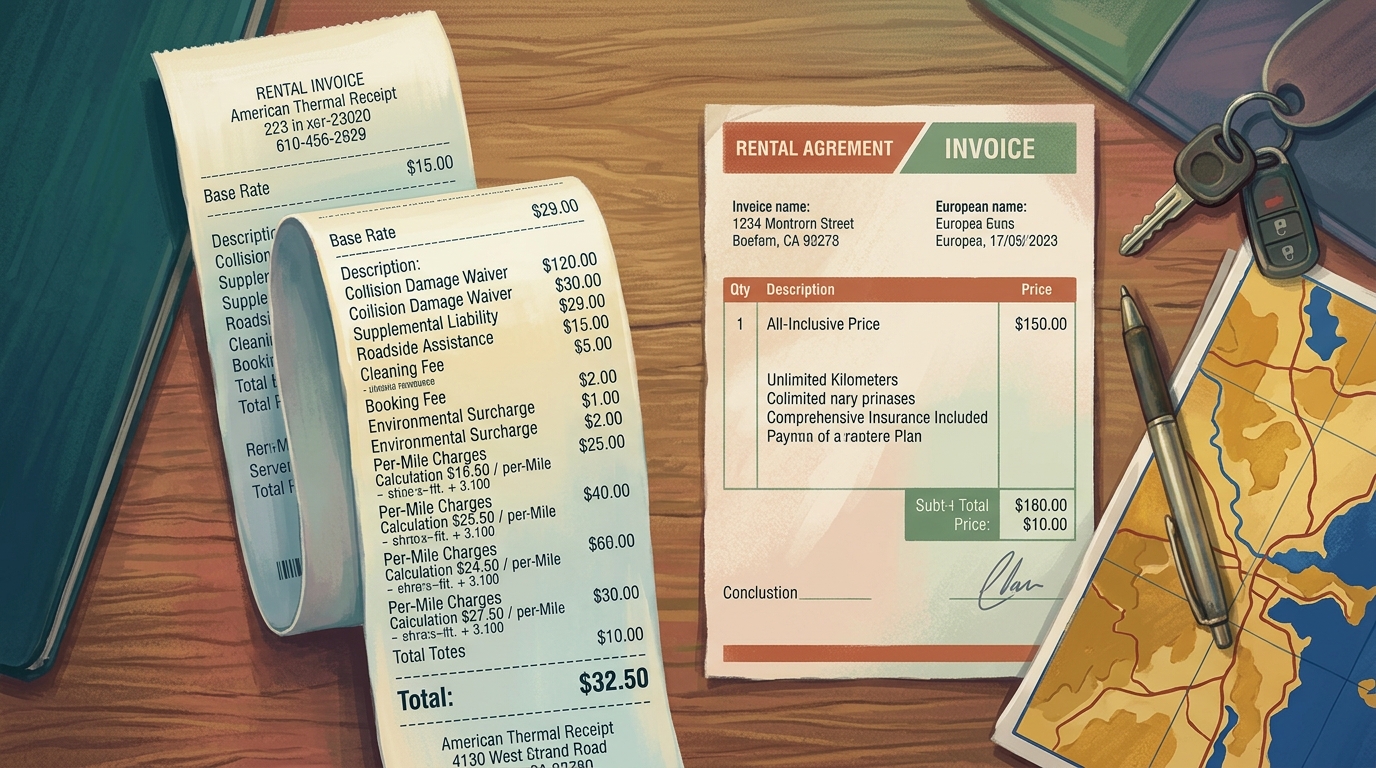
You booked the Class C online for $185 a night. Fourteen nights, so you budgeted around $2,600 and felt clever about it. Now you're in the rental lot outside Las Vegas, reading the final paperwork on the counter. Mandatory insurance. A cleaning fee. A booking fee. A charge for every mile over a hundred a day. The number at the bottom says $4,200, and you haven't bought a single gallon of gas yet.
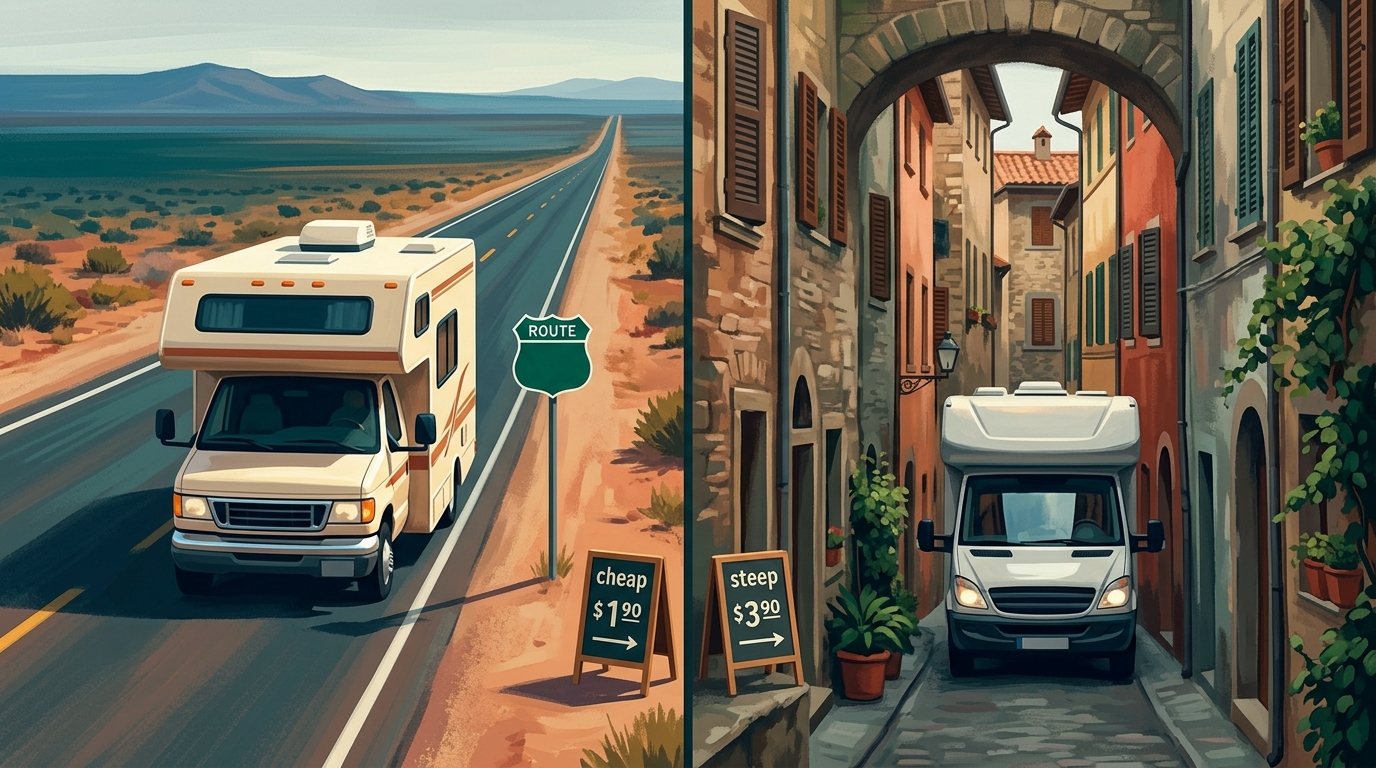
Here's the real-numbers answer to the RV road trip Europe vs USA cost question for 2026: for a typical two-week trip with two adults, Europe usually comes out cheaper, mostly because American rentals stack fees while European motorhomes bundle mileage and insurance into one price. The US flips ahead only on long, high-mileage, mostly-driving routes where cheap fuel and free interstates finally pay off. Below is a full line-by-line cost table, plus a framework for picking the one that fits your trip.
The verdict first: which is actually cheaper in 2026
For a standard two-week trip with two adults, renting a motorhome in Europe is usually cheaper than renting an RV in the USA. The reason is structural, not seasonal: a European rental from a company like Roadsurfer advertises one price that already includes unlimited miles and a free second driver, while a US rental advertises a low nightly rate and then adds insurance, cleaning, booking, and per-mile charges at the counter.
But "cheaper" flips depending on how you travel. The US has two genuine advantages: fuel costs around 60% of the European price per equivalent gallon, and its interstates are almost entirely free. Drive far enough and those two things claw the gap back. Park more than you drive, keep the trip short, and Europe wins by a wide margin.
Short trip or slow trip where you park a lot: Europe is cheaper. Long, high-mileage, drive-every-day trip: the US closes the gap and can pull ahead. The deciding variables are trip length and your drive-to-park ratio, not the sticker price.
The rest of this guide proves that with a line-by-line table, then hands you a decision framework so you can run your own trip through it. Every price below was checked against a primary source in 2026, and the sources are listed at the end.
The all-in cost table: one 14-day trip, two continents
Here's a typical two-week trip costed on each continent: two adults, 14 nights, a mid-range vehicle, shoulder season, returned to the depot you collected it from (no one-way fee). These are not identical routes - they reflect how people actually travel on each side: a higher-mileage Class C loop in the US (roughly 2,600 driven miles) versus a park-heavy compact-campervan trip in Europe (roughly 1,800 km). The US column is a Class C; the Europe column is a compact campervan. Figures are rounded and illustrative, built from verified per-unit prices, not a single quoted package.
| Cost line (14 nights, 2 adults) | USA (Class C) | Europe (campervan) |
|---|---|---|
| Vehicle, advertised nightly rate | ~$2,590 $185/night | ~€1,820 €130/night |
| Insurance + cleaning + booking fees | +~$1,150 stacked | included €0 |
| Mileage charges | +~$545 over 100mi/day | included unlimited |
| Fuel | ~$1,085 | ~€300 |
| Overnight stops | ~$840 RV parks | ~€330 aires + sites |
| Tolls / vignettes | ~$30 | ~€130 |
| Estimated all-in total | ~$6,250 | ~€2,580 (about $2,600) |
The headline gap is real: this trip runs roughly $6,250 in the US versus about $2,600 in Europe. Notice where it comes from. The US fuel line is bigger than Europe's even though American gas is cheaper per gallon, because a thirsty Class C burns far more of it over longer American distances. The decisive difference is the rental itself: the US base rate nearly doubles once fees and mileage land, while the European price is the price.
A few honest caveats. The euro and dollar have traded close to parity recently, so the totals are roughly comparable head to head, but check the current rate before you budget. The fuel lines assume a thirsty Class C around 8 to 10 mpg and an efficient diesel van near 9 L/100km; your rig and route will move them. And the US "fees" line is built from a 2026 pricing analysis showing all-in costs landing roughly 44% above the advertised number once insurance, cleaning, and booking fees are counted.
One line that can blow up either budget is a one-way rental. Drop the vehicle somewhere other than where you collected it and you'll pay a relocation fee on both continents; in Europe a cross-border drop-off can run from 300 euros to over 1,000 euros. The table above assumes a loop back to base, which is almost always the cheapest shape for a road trip. If a one-way route is the whole point, price that fee in before you compare anything else, because it can swing the totals more than fuel ever will.
Where the US wins: cheap fuel and free roads
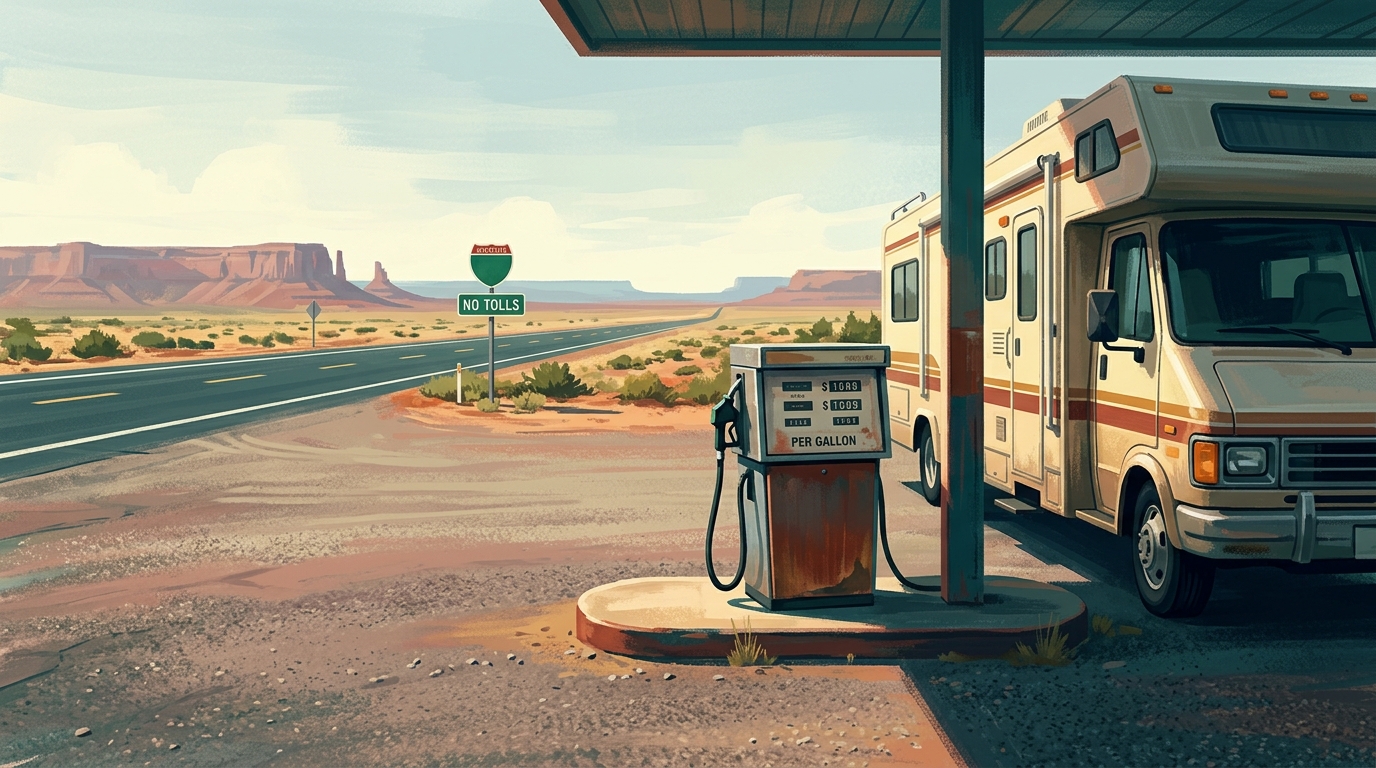
The US has two structural cost advantages, and both are about the road, not the rental. Fuel is far cheaper at the pump: regular gas averaged $3.914 a gallon in the week of June 22, 2026, with on-highway diesel at $4.832 (EIA). Europe's pump price works out more than 50% higher per equivalent gallon, and almost the entire US interstate network is toll-free.
That second point is bigger than people expect. TollGuru's analysis notes that 93.8% of Interstate highways are completely toll-free, because the system was designed that way. You can cross a dozen states without paying a cent in tolls. In Europe, a single long drive can rack up tolls and vignettes before lunch.
Here's the trap in the table above. US gas costs less per gallon, yet the US fuel line came out higher. A big Class C drinking a gallon every 8 to 10 miles over American distances can out-spend an efficient European van on double-priced diesel. Cheap fuel does not mean a cheap fuel bill.
So the US fuel advantage is genuine but conditional. It pays off when you drive an efficient rig, when you rack up serious mileage on free interstates, or when your trip is long enough that the fixed rental fees spread thin. This is also the continent where the vehicle goes almost anywhere: no historic-centre bans, no low-emission stickers, parking lots sized for a 30-foot rig. If your dream is the wide-open kind, with long days behind the wheel and national parks as the backdrop, the US is built for it. Just budget the park entry too, because the 2026 national park fees for international visitors add up across a multi-park route.
Scale quietly favors the US wallet too. American distances are long, but the roads are free and the fuel is cheap, so a big driving day costs less than the equivalent in Europe. A route that would cross three European countries, each with its own tolls, vignettes, and emission stickers, is in the US a single free interstate run on one cheap tank. Buy those vignettes from anywhere other than the country's own official site, though, and a fake-site scam wave is currently targeting exactly that purchase across Austria, Switzerland and six neighboring countries. The trade-off is time: you'll spend more of the trip behind the wheel, and a lot of the scenery between stops is highway. That's the deal the US offers, vast cheap mileage in exchange for long days driving.
Where Europe wins: €12 aires and included mileage
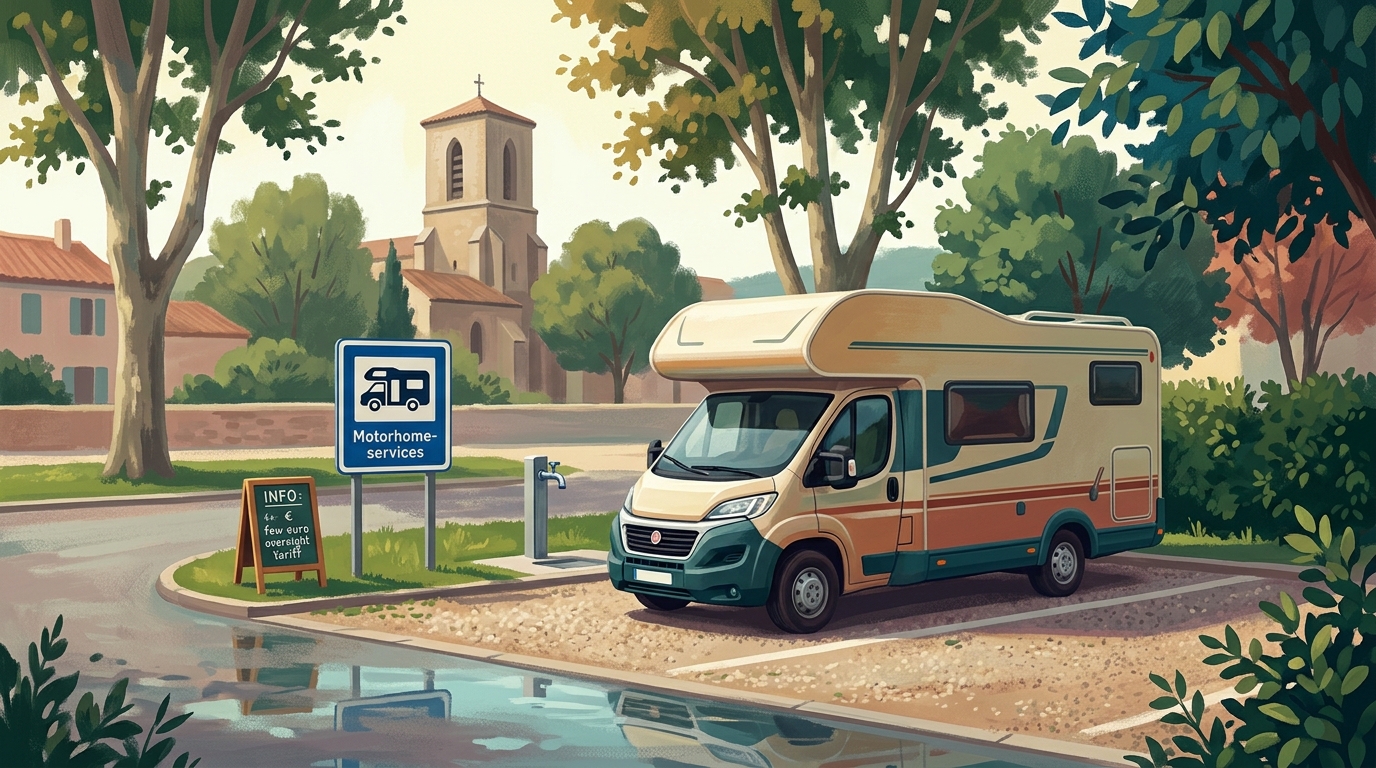
Europe's cost advantage comes from two places: where you sleep and what's bundled into the rental. Across France and Germany, motorhomes can overnight at "aires" and "Stellplätze," designated stopovers that run from free to about €15 a night, often with water and waste facilities. A guide to French aires describes them plainly: "Some are totally free, unless you make use of the facilities. Some cost a couple of Euros and others cost as much as 15€."
Compare that to the US, where a private full-hookup RV park runs between $55 and $95 per night, and even a roadside campground sits well above a European aire. Sleep 14 nights and that single difference is hundreds of dollars. Full European campsites are not free either, with the average two-person night across popular countries now topping the €40 mark in 2026, but a smart mix of cheap aires and the occasional campsite keeps the European overnight line low.
Use a stopover-finder app to chain together free and low-cost aires for most nights, and book a full campsite only when you need a long shower, laundry, or an electric hookup. Done well, your average overnight in Europe lands near €12 a night instead of $60.
The second European win is the rental structure itself. The price you see usually includes unlimited mileage and insurance, and often a second driver, so there's no counter-side surprise. The flip side: fuel costs more (EU petrol averaged €1.728 per litre in June 2026), and you'll pay tolls and vignettes. A Swiss motorway vignette is CHF 40 for the year, an Austrian 10-day vignette is €12.80, and French autoroute tolls add up fast for a heavier motorhome. On the Paris-to-Marseille autoroute, a Class 3 motorhome pays roughly 130% of the car toll, so a single long motorway day can top €70 in tolls alone. Paying for all of it on a foreign card is its own small tax, which is why a low-fee travel card matters; our breakdown of the best bank cards for spending abroad covers how to avoid the conversion markup on fuel and tolls.
The catches nobody prices in: manuals, ZTLs, and IDPs
Before you pick a side on cost alone, three differences can change the trip entirely, and none of them show up in the rental quote. They cover how you drive, where you can drive, and what paperwork you need.
European vans are usually manual. Most European rental motorhomes come with a manual gearbox, as rental guides like Mortons on the Move point out; automatics exist but cost more and book out early. US RVs are the opposite: Cruise America states it only uses RVs with automatic transmission. If you've never driven stick, that's a real consideration on the European side.
European city centres are largely off-limits to big rigs. Italy alone has roughly 350 cities with limited-traffic zones and 250 camera-enforced low-emission zones, usually enforced with camera surveillance, with fines that arrive weeks later by mail. France adds its own layer: an official Crit'Air sticker costs €3.85 including postage and is required to enter low-emission zones in major cities (ignore resellers charging 20-40 euros for the same thing). A 24-foot motorhome simply can't drive into a medieval core, so you'll park on the edge and walk or take transit in. US cities have nothing equivalent.
US drivers need an International Driving Permit for parts of Europe. AAA issues one for a $20 permit fee, and it's valid for one year from the date of issue. Some countries are stricter than others about requiring it, so carry it. Your standard licence covers a motorhome up to 3,500kg, which is most rental campervans, so you don't need a special category for the typical hire.
Age cuts the other way, in Europe's favor. Most European operators rent to drivers from 18, with Roadsurfer setting that floor for campervans in Europe, though heavier motorhomes and a few countries push it to 21 or 25. US companies start at 21, and several won't hand the keys to anyone under 25. If you're a younger traveler, Europe is simply more open to you, and that availability is its own kind of saving. It's the rare line where Europe is both cheaper and easier.
- Can everyone in your party drive a manual? (Europe) or is automatic standard? (US)
- International Driving Permit ordered if you're a US driver heading to Europe
- Crit'Air or equivalent low-emission sticker bought for any French or Italian city stops
- A plan for parking outside historic centres in Europe, not driving into them
- Vignettes pre-bought for Switzerland and Austria if your route crosses them
- Mileage cap and per-mile overage rate checked on any US rental
One more shared cost worth flagging on both continents: the damage deposit and the "inspection" at drop-off. Rental companies make real money on alleged scratches and cleaning disputes. Photograph everything at pickup and return, inside and out. Our guide to defending against rental damage charges applies just as much to a motorhome as a sedan.

Which should you pick: a decision framework
The cheapest option depends on five things: budget, group size, whether you want cities or nature, trip length, and how confident you are behind a big wheel. Run your trip through the matrix below, then read the tie-breaker underneath.
| Your trip looks like | Pick | Why |
|---|---|---|
| One to two weeks, slow pace, lots of parking | Europe | Cheap aires and bundled mileage crush US fees |
| Three weeks or more, long daily drives | USA | Cheap fuel and free roads finally outweigh fees |
| City-hopping, historic centres, short hops | Europe | Compact van fits where big rigs are banned |
| National parks, wide spaces, few cities | USA | Drive anywhere, park anywhere, big-rig friendly |
| Nervous driver, no manual experience | USA | Automatic fleet, wide roads, generous parking |
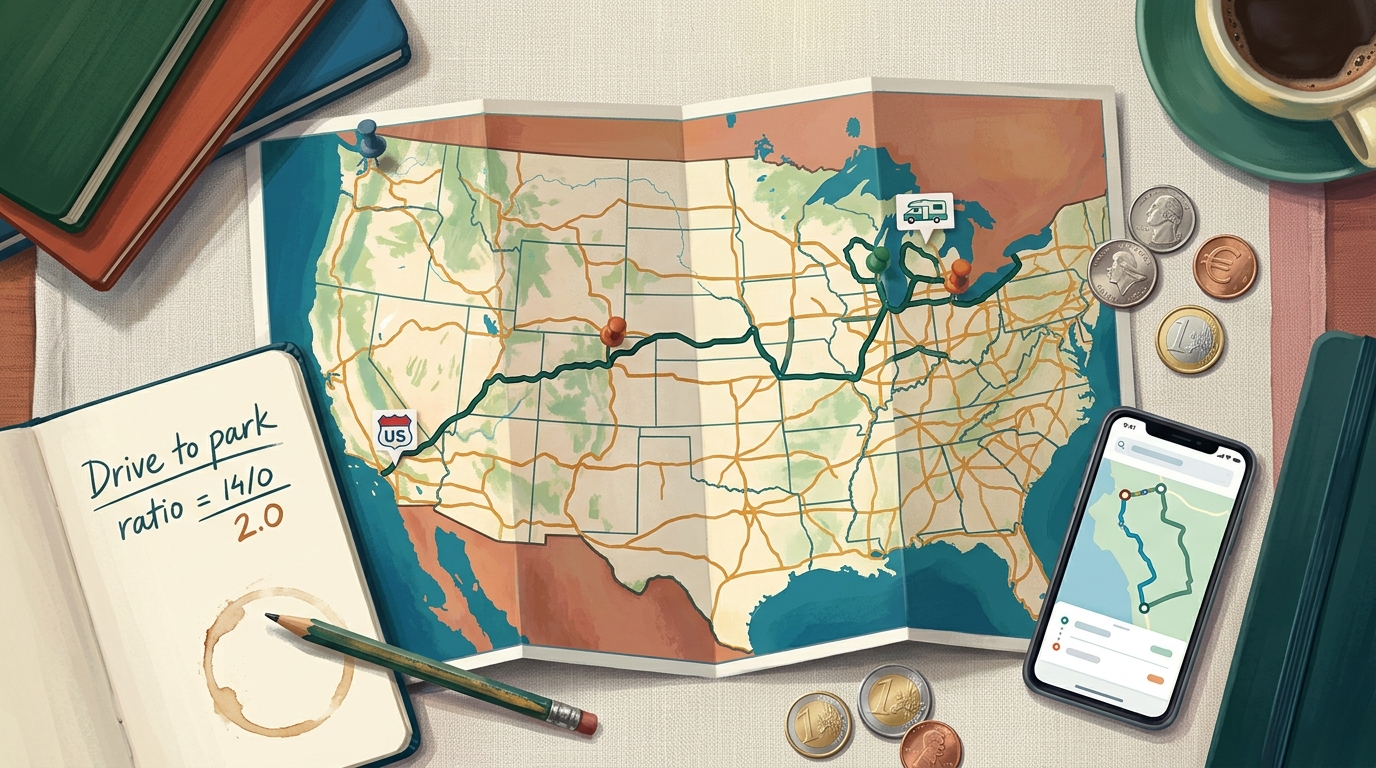
The single sharpest tie-breaker is your drive-to-park ratio. The more you park, the more Europe's €12 aires beat $60 RV parks. The more you drive, the more the US cheap-fuel and free-road advantage compounds, until somewhere past a few thousand miles it overtakes Europe's bundled pricing. Map your actual route first, total the real distance, and the answer usually picks itself.
That mapping step is where most people guess and overspend. Pinning your stops on a route map shows the true distance and the longest legs before you commit to a continent, and tracking fuel, tolls, and campsite spend in one shared place keeps two adults honest about the running total. Tools like TripProf bundle a route overview with multi-currency expense tracking and per-destination guide sections such as Driving Guide, Car Rental Guide, and Fuel Price per Litre, so the cost picture is in one place instead of four browser tabs. If you're splitting everything down the middle with a travel partner, our guide to splitting trip costs without drama handles the money side so the trip doesn't.
- You want cities, history, and short scenic hops
- You'll park more than you drive
- You hate counter-side fee surprises
- You can drive a manual or pay up for an automatic
- You want big distances and national parks
- Your trip is three weeks or more
- You want a large, automatic, drive-anywhere rig
- You'd rather pay flat fees than learn vignette rules
Frequently Asked Questions
Is it cheaper to rent a motorhome in Europe or the USA?
For a typical two-week trip with two adults, Europe is usually cheaper. European rentals bundle unlimited mileage and insurance into the advertised price, while US rentals add insurance, cleaning, booking, and per-mile fees that push the all-in cost roughly 44% above the sticker rate. The US only wins on very long, high-mileage trips.
Is RVing cheaper than hotels in Europe?
It can be, if you sleep at cheap aires and Stellplätze rather than full campsites. Those stopovers run from free to about €15 a night, well under a hotel. But once you add fuel at €1.73 a litre, tolls, and the rental itself, a two-person motorhome trip is not automatically cheaper than budget hotels. It buys flexibility more than pure savings.
Is it worth renting an RV in Europe?
Yes, if you want nature, flexibility, and short scenic routes, and you accept that big rigs can't enter historic city centres. The included mileage and the aire network make it cost-effective. It's less worth it if your trip is mostly cities, since you'll park on the outskirts and walk in anyway, where a train and hotels might serve you better.
Can you boondock or wild-camp free in Europe?
Free wild camping is restricted or banned in much of Western Europe, but the aire and Stellplatz network is the legal, designed-for-it alternative: thousands of official motorhome stopovers, many free or only a few euros, with basic facilities. It's not the open boondocking US travelers know, but it covers most of the same need at low cost.
What's the difference between an aire and a US RV park?
An aire or Stellplatz is a compact, often unstaffed overnight stopover for self-contained motorhomes, with water and waste service but rarely full hookups, priced from free to around €15. A US RV park is a larger commercial site with full hookups, amenities, and staff, typically $55 to $95 a night. You trade amenities for a much lower price.
Do I need an International Driving Permit to drive an RV in Europe?
If you hold a US licence, yes, carry one. AAA issues an IDP for a $20 fee, valid one year, and several European countries require or strongly recommend it alongside your home licence. It's cheap insurance against a roadside problem. Your standard licence covers a motorhome up to 3,500kg, which is most rental campervans.
Are European rental RVs manual?
Most are. The large majority of European rental motorhomes have a manual gearbox, and automatics cost more and sell out earlier. If no one in your group can drive a manual, reserve an automatic well ahead or expect a higher rate. US rental RVs, by contrast, are automatic across the board.
Key Takeaways
- For a standard two-week, two-adult trip, Europe is usually cheaper: roughly €2,600 all-in versus about $6,250 in the US, driven mostly by US rental fee-stacking.
- The US wins on fuel price ($3.91/gal versus about $6.50 equivalent) and free interstates, but a thirsty rig can still produce a bigger fuel bill than an efficient European van.
- Europe's edge is cheap aires (free to about €15) and rentals that include unlimited mileage and insurance in one price.
- The "cheaper" answer flips with trip length and drive-to-park ratio: long, high-mileage US trips amortize fixed fees and reward cheap fuel.
- Hidden differences matter as much as cost: European vans are usually manual, big rigs are banned from historic city centres, and US drivers need a $20 IDP.
- Map the route and total the real distance before choosing a continent. Keeping the route, fuel, tolls, and shared spend in one place, with tools like TripProf, turns a guess into a number you can trust.
Sources
- US EIA Gasoline and Diesel Fuel Update: current US average gasoline and on-highway diesel prices per gallon, June 2026.
- fuel-prices.eu: EU-27 average petrol and diesel prices per litre, updated June 2026.
- GlobalPetrolPrices Europe diesel: per-country European fuel price spread, June 2026.
- 2026 Q1 RV Rental Pricing Report: an all-in cost roughly 44% above the advertised nightly rate (advertised rate ≈ 53% of total).
- RVshare RV rental prices: US nightly rates by class and the note that rental rates are 40 to 60% of total trip cost.
- Cruise America mileage: 39 cents per mile, charged per night on included-mileage estimates.
- Cruise America FAQs: minimum age 21 and $3.50 per hour generator charge.
- Cruise America transmission: US RVs are automatic across the fleet.
- Mortons on the Move: renting an RV in Europe: European rental motorhomes are usually manual, with automatics costing more and booking out early.
- Roadsurfer Europe: rentals from around €85/night (rates vary by season and country) including unlimited miles and a free second driver; minimum driver age 18 in Europe.
- Worldwide Motorhome Hire guide: European one-way drop-off fees from 300 to over 1,000 euros.
- EcoFlow RV park costs: US private RV parks charge $55 to $95 per night, May 2026.
- Wandering Bird French aires: aire pricing from free to about €15 a night.
- Tragento European camping 2026: average two-person campsite night now exceeds €40.
- TollGuru France tolls: autoroute tariffs and motorhome class surcharges, 2026.
- TollGuru toll-free interstates: 93.8% of US Interstate highways are toll-free.
- Swiss BAZG motorway vignette: CHF 40 annual vignette for vehicles up to 3.5t.
- ASFINAG Austria vignette: 10-day car vignette at €12.80.
- Service-Public.gouv.fr Crit'Air sticker: €3.85 low-emission sticker required for French low-emission zones.
- Limited traffic zone (Italy): about 350 Italian cities with LTZs and 250 camera-enforced low-emission zones.
- AAA International Driving Permit: $20 permit fee for US drivers.
- AAA IDP guide: IDP valid one year from date of issue.
- Camping and Caravanning Club: a category B licence covers vehicles up to 3,500kg.
Last updated: September 19, 2026
Keep Reading
More travel tips and guides picked for you

Wizz Air and Ryanair are cutting Vienna flights: what to book instead
Wizz Air has fully left Vienna and Ryanair has cut five aircraft over Austria's aviation tax. Here's exactly what changed, why it happened, and how to still book a cheap flight this winter.

Mallorca's tourist tax hike got cancelled. Here's what a 2026 trip really costs
The Balearic tourist tax hike everyone's still warning about got cancelled in February. Here's what a week on Mallorca actually costs in 2026, flights, hotel, tax, and food, with real numbers.

The best value destinations for Swiss francs right now
The Swiss franc is near decade highs, and Switzerland just got confirmed as Europe's second priciest country. Here are eight real destinations, ranked by an official price index, where that gap is worth planning a trip around.