How to Plan a Company Retreat: An Organizer's Playbook
Key Highlights
- 1
- 2
- 3
+4 more in the takeaways below
You volunteered for this. Or you got volunteered. Either way, 30 people are now flying to one city for three days, and you're the one holding the passport numbers, the flight times, the dietary restrictions, and the receipts. The trip hasn't even started and you've already opened six tabs.
That's the real job of organizing a company retreat: not picking a venue, but keeping 30 humans and their logistics in sync.
The hardest part of a company retreat isn't the agenda, it's the logistics: chasing 30 people for flight times, documents, and who-paid-for-what across a spreadsheet, a WhatsApp group, a shared drive, and an expense app. This playbook runs the whole offsite from one app instead. In TripProf, every attendee opens the same shared trip: they add their own flights and tickets, the itinerary builds itself, documents live in one place, and expenses get tracked and split as you go. Plan 17+ weeks out, lock the location first, invite the team as editors, and stop being the human router.
The real problem isn't the agenda, it's the logistics
The hardest part of planning a company retreat isn't deciding what the team does once everyone arrives. It's getting 30 people, their flights, their passports, their dietary needs, and their reimbursements into one coherent picture before they land. Most organizers try to do this across four or five disconnected tools, and that fragmentation, not the offsite itself, is what burns them out.
And it's a job more people are getting handed every year. As of 2025, roughly 22% of the U.S. workforce works remotely, and in a survey of offsite organizers, 91% of companies said they run on a fully remote or hybrid model (Surf Office). When the team rarely shares a room, the retreat becomes the one time a year everyone is physically together. The stakes are high. The tooling, usually, is a mess.
And the connection gap is real. In Buffer's 2023 State of Remote Work survey of 3,000 remote workers, 23% named loneliness as a top struggle of working remotely. A retreat is the rare chance to close that gap in person, which is exactly why botching the logistics of it stings so much.
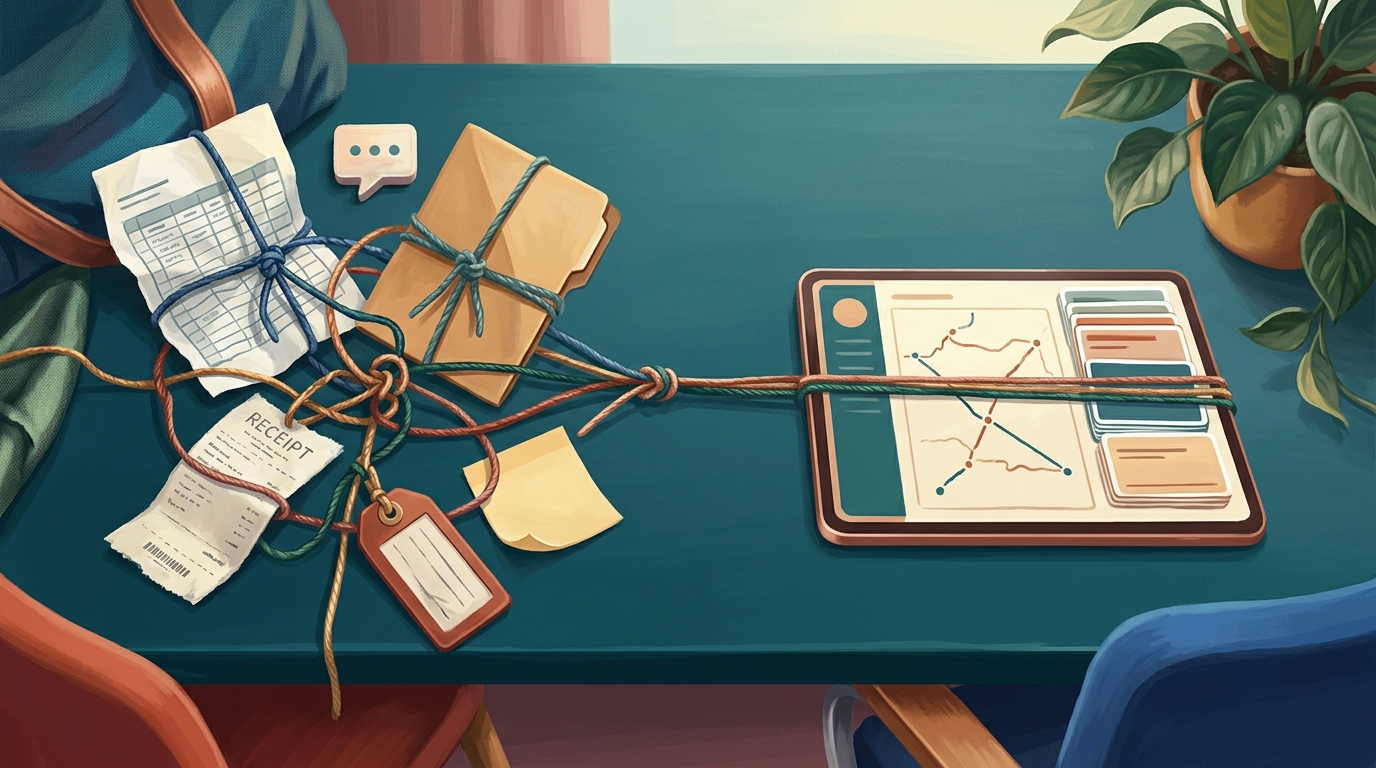
Here's what that mess actually looks like. A spreadsheet for the budget. A second spreadsheet for who's flying when. A WhatsApp group where the real-time chaos happens. A shared drive nobody can find. An expense app one person uses and nobody else opens. You become the human router, copying details from one tool to another, answering the same three questions on loop.
Gallup's 2025 research found fully remote employees are more likely to report loneliness than their hybrid or on-site colleagues (Gallup). Disengagement, separately, cost the world economy an estimated $438 billion in 2024 (Gallup). The retreat is your one shot to push back on that. Don't lose it to spreadsheet admin.
The toggling tax is real and measurable. A Harvard Business Review study that tracked 137 users across three Fortune 500 companies found workers toggled between apps and websites roughly 1,200 times a day, losing close to 9% of their work time just reorienting. Other research puts the average at 33 app switches a day. Now multiply that by an organizer juggling six tools for one trip. So the first decision you make about your retreat isn't the destination - it's how few places the information lives in.
The argument of this whole piece is simple: run the entire trip from one app that every attendee can open, and most of the organizer's pain disappears. We built TripProf for exactly this, as two people who kept being the ones organizing the trip, so the rest of this guide walks the retreat through it: one shared trip, the whole team inside it, nothing scattered across heads and inboxes.
How to Plan a Company Retreat: Start Earlier Than You Think
Lock your retreat dates and venue at least 17 weeks out for a group under 100 people, and longer for bigger gatherings. That's not padding. According to Surf Office's 2026 offsites report, offsites for fewer than 100 attendees are typically confirmed 17 weeks in advance, larger ones around 23 weeks, and the booking process alone eats about 6 weeks. Plan backward from the trip date, not forward from today.

Why so early? Because the thing that wrecks budgets and calendars is the venue, not the airfare. In the same report, 51% of companies named location selection and venue sourcing as their single biggest planning challenge. Group accommodation that fits 30 people, has meeting space, and isn't booked out for the dates you want is genuinely scarce. Find it first. Everything else bends around it.
So here's the order that actually works. Lock the dates. Lock the venue. Then create the trip in TripProf, invite the team, and let the logistics fill in over the following weeks while you focus on the parts that need your judgment.
Don't start by polling 30 people for their preferred dates. You'll get 30 answers and consensus on none. Pick a date window that clears the obvious conflicts, confirm the venue, then announce. A decided date beats a democratic one every time.
Once the skeleton is set, the timeline below keeps you honest. Think of it as the minimum viable plan, not a wish list. Each phase has one job.
- 17+ weeks out Lock dates and venue. This is the long pole. Confirm capacity, meeting space, and a cancellation policy you can live with.
- 12 weeks out Set the budget per person and announce the retreat. Create the trip in TripProf and invite the whole team as editors.
- 8 weeks out Everyone books their own flights and adds them to the trip. You watch arrival times converge instead of chasing them.
- 4 weeks out Collect documents (passports for international, insurance, dietary needs) into the shared trip. Build the day-by-day agenda.
- 1 week out Send the final checklist. Confirm airport pickups against the actual arrival times already in the itinerary.
- During Track and split expenses in real time. Capture photos and notes as the shared trip memory.
Notice what's missing from that list: no "chase Dave for his flight info" step. That's the point. When the trip is shared and everyone's an editor in TripProf, the chasing turns into self-service.
Set the budget before anyone books a thing
Decide your per-person number first, communicate it clearly, then let the trip get planned inside that envelope. A realistic 2025 benchmark for a well-run domestic retreat lands around $750 to $850 per person, per night, plus flights, covering lodging, food, and activities. International or incentive-style trips run higher. The point isn't the exact figure. It's that the number exists before the first booking, not after.
For context on how wide the range gets: the Incentive Research Foundation's Incentive Travel Index pegs North America's average per-person spend at roughly $6,000 in 2025 for premium incentive travel, the most expensive end of the spectrum. A scrappy startup offsite can come in under $1,000 a head. Both are valid. What's not valid is finding out your real number after everyone's already booked.

The money question for a retreat isn't a corporate travel budget. It's simpler and more immediate: can you see who paid for what while the trip is happening, or only once everyone's home and comparing notes? In TripProf, every expense is logged the moment it lands, in the currency it was paid, so there's nothing to reconstruct three weeks later.
This is where TripProf earns its keep on the money side. Picture a 25-person product offsite in Porto. Someone fronts the group dinner. Someone else covers the van to the winery. A third person pays for the welcome drinks. TripProf's built-in expense tracking and splitting logs every one of those the moment it happens, in whatever currency it was paid, with the split worked out automatically. No end-of-trip reckoning. No detective work.
Decide upfront which costs are company-paid and which are personal, and write it into the trip where everyone can see it. The awkwardness in group money isn't the spending, it's the ambiguity about who's covering what. Remove the ambiguity and the tension goes with it.
For a deeper framework on keeping the money side drama-free across a group, the mechanics in our guide to splitting trip costs fairly apply directly to a retreat. The difference at work scale is just volume: more people, more transactions, more reason to log them as they happen rather than reconstruct them later.
How TripProf puts the whole trip on one board
The single most useful move an organizer can make is consolidating the trip into one app that every attendee can open and edit, replacing the spreadsheet-plus-WhatsApp-plus-drive-plus-expense-app stack. That's the whole reason TripProf exists. The value isn't any one feature. It's that flights, documents, the agenda, expenses, and memories stop living in five places and start living in one shared trip, where the whole team can see and update them.
Let's be specific about what that consolidation replaces. Here's the typical retreat stack versus what one shared trip in TripProf absorbs.
| The job to be done | The usual scattered tool | One shared trip in TripProf |
|---|---|---|
| Who's flying when | A flight-times spreadsheet you maintain by hand | Each person adds their own flight; arrival times appear on the shared itinerary |
| The day-by-day plan | A shared doc nobody opens twice | One itinerary with timeline and map-of-the-day views, visible to all |
| Passports, insurance, tickets | A shared drive folder with mystery file names | Documents stored by category, scannable, shared with the group |
| Who paid for what | A separate expense app one person uses | Multi-currency expenses tracked and split in trip context |
| What to bring / verify | A pasted checklist in the chat that scrolls away | A shared checklist grouped by category, generated from the trip profile |
| The photos afterward | Three different camera rolls and an empty Slack channel | A collaborative trip journal everyone adds to during and after |
The right-hand column is exactly what TripProf does: one organizer creates the trip, adds the team as editors, and from there everyone contributes to the same shared trip in real time. It's the same job any group faces when coordinating a group trip, scaled up to a colleague-sized crowd, which is the use case TripProf was built around.
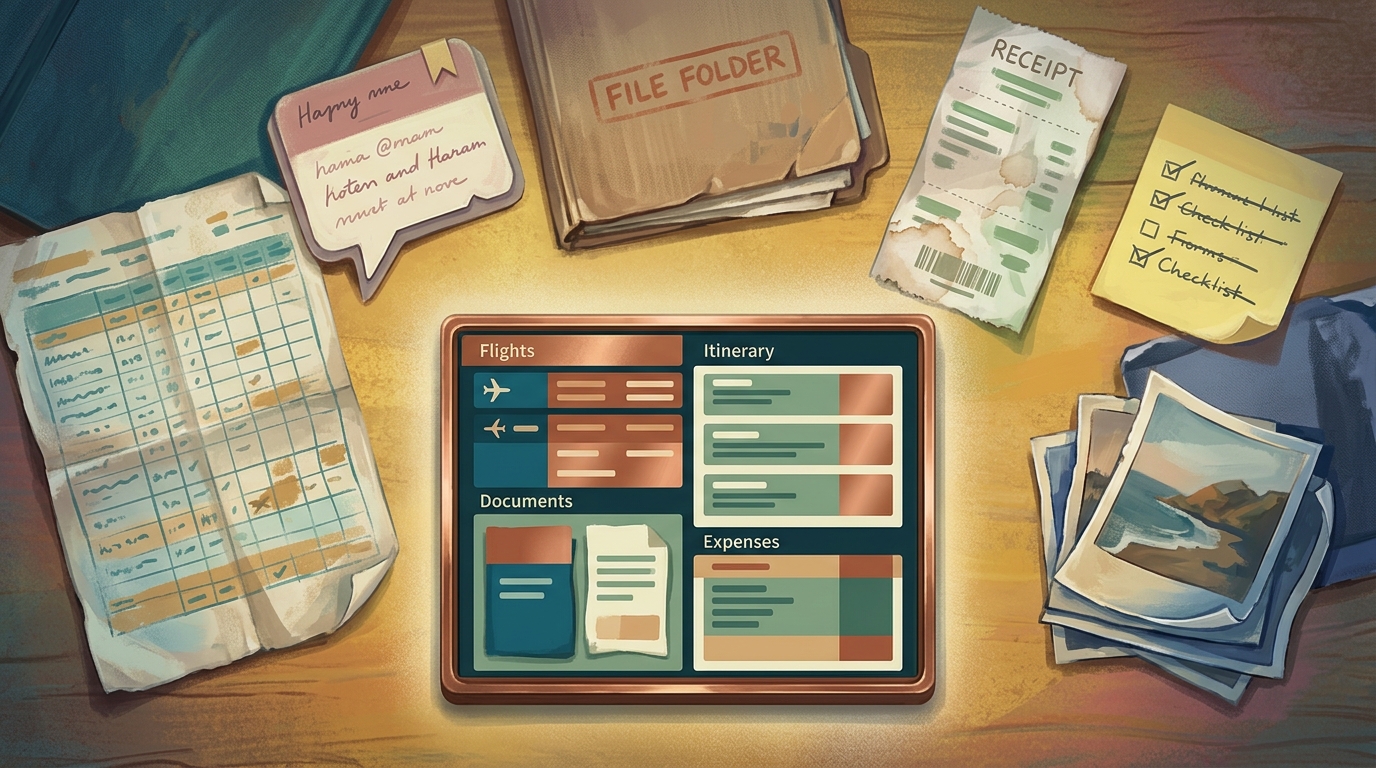
TripProf's collaboration model matters here, so be clear about how it works. One person is the organizer (the trip's creator). Everyone else gets added as a viewer (read-only) or an editor (can add and change things). For a retreat, you make most attendees editors, so they add their own flights, drop in their own documents, and log expenses they paid. You stay the organizer, but you stop being the bottleneck.
And because TripProf works offline once the trip is downloaded, none of this falls apart when the retreat venue's WiFi does. The guide, the itinerary, the documents, and the expenses are all there on each person's phone, and any edits made offline sync back when the signal returns. For a group out at a countryside estate or a mountain lodge, that's the difference between a plan everyone can actually see and a plan stuck on a dead network.
Make everyone do their own logistics
The fastest way to stop being the human router is to push each person's logistics back to them, inside TripProf. When 30 people book 30 different flights, you do not want to be the one typing 30 arrival times into a spreadsheet. You want each person to add their own flight to the trip, so the shared arrival picture assembles itself and you just read it.
This is the scenario that breaks most organizers, so let's walk it. Say you're running a 40-person engineering offsite in Lisbon. People are flying in from six cities across two continents. On the old model, you'd email everyone asking for flight details, get half of them back, chase the rest, and manually build an arrivals timeline that's out of date the moment someone rebooks. In TripProf, each person adds their flight once. The arrivals view updates itself. You schedule the airport vans against real data, not a half-filled spreadsheet.
Trying to centralize what should be distributed. The organizer who insists on personally entering everyone's flight, document, and dietary detail becomes the single point of failure for the whole trip. Make people editors and let them own their own row. Your job is the structure - not the data entry.
The TripProf setup itself is short. Here's the whole thing, start to finish.
- Create the trip One organizer sets up the retreat with dates, destination, and the basic profile (group size, trip type).
- Invite the team as editors Add every attendee. Editors can add and change content; give read-only access to anyone who only needs to watch.
- Everyone adds their own flights and documents Each person drops in their flight, passport, and any tickets. A scanned boarding pass can autofill the flight details.
- The shared itinerary builds itself As flights and activities land, the day-by-day agenda fills in, with timeline and map-of-the-day views the whole group sees.
- Expenses get tracked and split as you go Whoever pays logs it in TripProf, in any currency, split across the group automatically.
- Memories get captured Photos and notes go into a shared trip journal during and after, so the retreat doesn't vanish into six separate camera rolls.
Documents deserve a special mention because they're where international retreats quietly fall apart. Passports that expire too soon. A visa nobody checked. Insurance details scattered across inboxes. TripProf stores them by category in the trip, and it can scan a physical document and autofill the trip fields, which turns a frantic week-before scramble into a calm checkbox. A scanned boarding pass even drops the flight straight onto the itinerary, so that's one less thing you transcribe by hand.
Build the agenda, then protect the unstructured time
Design the agenda around the one thing a retreat does that remote work can't: build real human connection, fast. The instinct is to fill every hour with sessions to justify the cost. Resist it. The data is clear that intentional in-person time is what moves the needle, and that it doesn't take much of it.
Atlassian studied its own program of bringing teams together on purpose and found in-person gatherings boosted team connection by 27% on average, more than sporadic office attendance did (Atlassian). The catch: that boost decays. Connection scores returned to pre-gathering levels after about four months, which is why their research points to gathering roughly three times a year rather than once. For new graduates, the jump was bigger still, with team-connection agreement climbing from 74% before an event to 96% after.
Those figures come from a Harvard Business Review Analytic Services survey of 425 business decision-makers, conducted with American Express Global Business Travel in 2023, where 79% said in-person meetings outperform virtual ones for team-building. The practical takeaway for your agenda: the sessions matter less than the meals, the walks, and the unscheduled hours where people actually talk. Build in white space on purpose.
And put the agenda where everyone can see it. TripProf's shared itinerary with a day-by-day timeline means nobody's asking "what are we doing at 3pm?" or "where's dinner?" in the group chat. Better still is its map of each day: every stop plotted in order, with the walking or driving route drawn between them, breakfast spot to meeting venue to team dinner to the bar after. For a group of 40 who are new to the city, that map shows where they're going and exactly how to get there, so the difference is everyone arriving together instead of a dozen people lost on the wrong tram. The organizer answers the question once, by building the itinerary, instead of forty times in the chat.

The retreat's job is connection, and connection has a half-life. A great three days that nobody captures and nobody plans to repeat is a one-time sugar high, not a strategy.
One more thing TripProf does that's easy to overlook: it captures the trip. Photos and notes logged into its shared trip journal during the retreat become a collaborative record afterward, which is both a morale asset and a planning reference for next time. If you care about capturing trip memories in a way that survives past the flight home, having one place everyone adds to beats hoping someone eventually posts the good photos.
The company retreat planning checklist
Here's the working checklist. It's deliberately short, ordered roughly by when each item comes due, and built around the idea that most of it lives in one shared trip the whole team can reach.
- Dates and venue confirmed at least 17 weeks out (longer for 100+ people)
- Per-person budget set and communicated before anyone books
- TripProf trip created; whole team invited as editors
- Company-paid vs. personal costs written down where everyone can see
- Every attendee has added their own flight to the trip
- Passports valid past the trip dates (check expiry for international)
- Travel insurance and key documents stored in the shared trip
- Dietary needs and accessibility requirements collected
- Day-by-day agenda built, with deliberate unstructured time
- Airport pickups scheduled against real arrival times
- Expense tracking live for the during-trip spend
- Someone owns capturing photos and notes into the shared journal

Print it, paste it, or run it as a TripProf trip the whole team shares. The format matters less than the discipline of having every item in one place everyone can see, rather than spread across your memory and six apps.
If you're still deciding which destination makes sense for the group, our roundup of group trip destinations is aimed at friend groups but the selection logic, accessibility, cost, and how easily a crowd moves around, carries straight over to a team offsite.
Frequently Asked Questions
How much does a company retreat cost per person?
A realistic 2025 benchmark for a well-run domestic retreat is around $750 to $850 per person, per night, plus flights, covering lodging, food, and activities (The Offsite Co). Premium incentive trips run far higher, averaging roughly $6,000 per person in North America. Scrappy startup offsites can land under $1,000. Set your number before anyone books.
How far in advance should you plan a company retreat?
At least 17 weeks for a group under 100 people, and around 23 weeks for larger gatherings, according to Surf Office's 2026 report. The venue is the long pole: group accommodation with meeting space books out early, and the sourcing process alone averages about six weeks. Lock dates and venue first, then build everything else around them.
How do you plan a retreat for a fully remote team?
Treat the retreat as the team's main connection event for the quarter, since it may be the only time everyone's together. Atlassian's research found in-person gatherings boost team connection 27%, but the effect fades after about four months. Prioritize unstructured time over packed sessions, and keep all logistics in one shared TripProf trip everyone can access, including offline when the venue WiFi gives out.
What do you do when everyone books different flights?
Don't try to track them yourself. Have each person add their own flight to the shared trip in TripProf, so arrival times assemble into one view automatically. Then schedule airport pickups and the first day's start against real data instead of a spreadsheet you maintain by hand. A scanned boarding pass can autofill the flight details.
How do you handle expenses on a company retreat?
Decide upfront which costs are company-paid versus personal, and write it where everyone can see it. During the trip, log each expense in TripProf as it happens, in whatever currency it was paid, with splits calculated automatically. This beats reconstructing who-paid-what from receipts after everyone's home and the memories have faded.
How long should a company retreat be?
Most modern offsites run about three nights, up from two before 2020. That's long enough to clear travel days and still leave real time together, without the cost and fatigue of a full week (The Offsite Co). Shorter, more purposeful retreats are the 2025 trend, with companies favoring deliberate connection time over a marathon of sessions.
What's the biggest mistake organizers make?
Becoming the single point of failure. Trying to personally enter every flight, document, and detail into tools only you control means the whole trip stalls whenever you do. Make attendees editors on a shared board, let them own their own logistics, and keep your energy for the structure and the agenda, not the data entry.
Key Takeaways
- The hard part of a retreat is logistics, not the agenda. Coordinating 30 people's flights, documents, and expenses across six tools is what burns organizers out.
- Lock dates and venue at least 17 weeks out. The venue is the bottleneck, so source it first and plan everything backward from the trip date.
- Set a per-person budget before anyone books, and write down which costs are company-paid versus personal to kill money ambiguity early.
- Consolidate the trip into one app the whole team can open and edit, replacing the spreadsheet, chat, drive, and expense-app stack. TripProf is built for exactly this: one organizer, the team added as editors, The complete feature tour shows what the team actually sees. with flights, documents, multi-currency expenses, the itinerary, and memories all in one shared trip, online or off.
- Make everyone do their own logistics. When each person adds their own flight, document, and expense, the organizer stops being the human router.
- Build the agenda around connection, with deliberate unstructured time. In-person connection boosts fade in about four months, so the meals and walks matter more than the sessions.
- Capture the trip as it happens. A shared journal of photos and notes turns a three-day sugar high into a record you can build on next time.
Run your next offsite from TripProf instead of six tools, and the job shrinks from herding cats to reading a dashboard. That's a retreat your whole team plans together, with you finally able to enjoy the trip you organized.
Sources
- Surf Office, The State of Company Offsites Report 2026: 91% remote/hybrid, 17-week lead time, 51% cite venue sourcing as the top challenge.
- Atlassian, Intentional Togetherness Research: 27% team-connection boost from in-person gatherings, ~4-month decay, new-grad rise from 74% to 96%.
- Gallup, The Remote Work Paradox (2025): fully remote employees are more likely to report loneliness than hybrid or on-site colleagues.
- Gallup, Global Employee Engagement Continues Decline: global engagement decline and the economic cost of disengagement.
- Harvard Business Review, App Toggling Study: ~1,200 app toggles per day, ~9% of work time lost, 137 users across three Fortune 500 companies.
- Amex GBT / HBR Analytic Services: 79% say in-person meetings beat virtual for team-building, 74% stronger relationships, survey of 425 decision-makers.
- GBTA, Business Travel Index: global business travel spend reaching $1.57 trillion in 2025.
- MPI on the IRF/SITE Incentive Travel Index 2025: North America average per-person incentive spend of roughly $6,000.
- The Offsite Co, Budgeting for Company Retreats: ~$750-$850 per person per night benchmark plus flights, typical 3-night length.
- Lokalise, Tool Fatigue Productivity Report: average of 33 app switches per day and the productivity cost of context switching.
- Neat, State of Remote Work 2025: roughly 22% of the U.S. workforce working remotely.
- Asana, Context Switching: supporting data on context-switching costs and refocus time.
- Buffer, State of Remote Work 2023: 23% of remote workers named loneliness a top struggle, from a survey of 3,000 remote workers.
- Gallup (via PR Newswire): global disengagement cost the world economy an estimated $438 billion in 2024.
Last updated: July 3, 2026
Keep Reading
More travel tips and guides picked for you

The Group Trip Questionnaire: 16 Questions to Ask Before Anyone Books
Most group trips break on four answers: flexible, easygoing, whatever works, and around $2k. Here are 16 questions that make all four impossible to give, what each answer is really for, and a copy-paste template to send before anyone books.

How Many States Have You Visited? One Retiree's Real Answer (And How to Find Yours)
A 58-year-old retiree paints his USA map for the first time and finds a very different number than he guessed. The real YouGov stats, the honest limits, and how to track your own states visited checklist.

Getting Your Friend Group Into Glastonbury 2027
The lead-booker mechanic, the registration window, and what a group of four actually paid last time tickets sold. A real plan for getting your friends into Glastonbury 2027 without losing anyone at the ballot.