The 2026 Hand-Luggage Trap: The EU "Free Cabin Bag" Law Did Not Pass - And the Rules Just Got Stricter
Key Highlights
- 1
- 2
- 3
+4 more in the takeaways below
The headline went viral: Europe is about to make hand luggage free again. Here is what the viral version left out - the law did not pass, it is not in force, and cabin-bag rules got stricter for summer 2026. So let us be precise about the EU hand luggage rules 2026: who gives you a free bag, who quietly took one away, and how not to get burned at the gate.
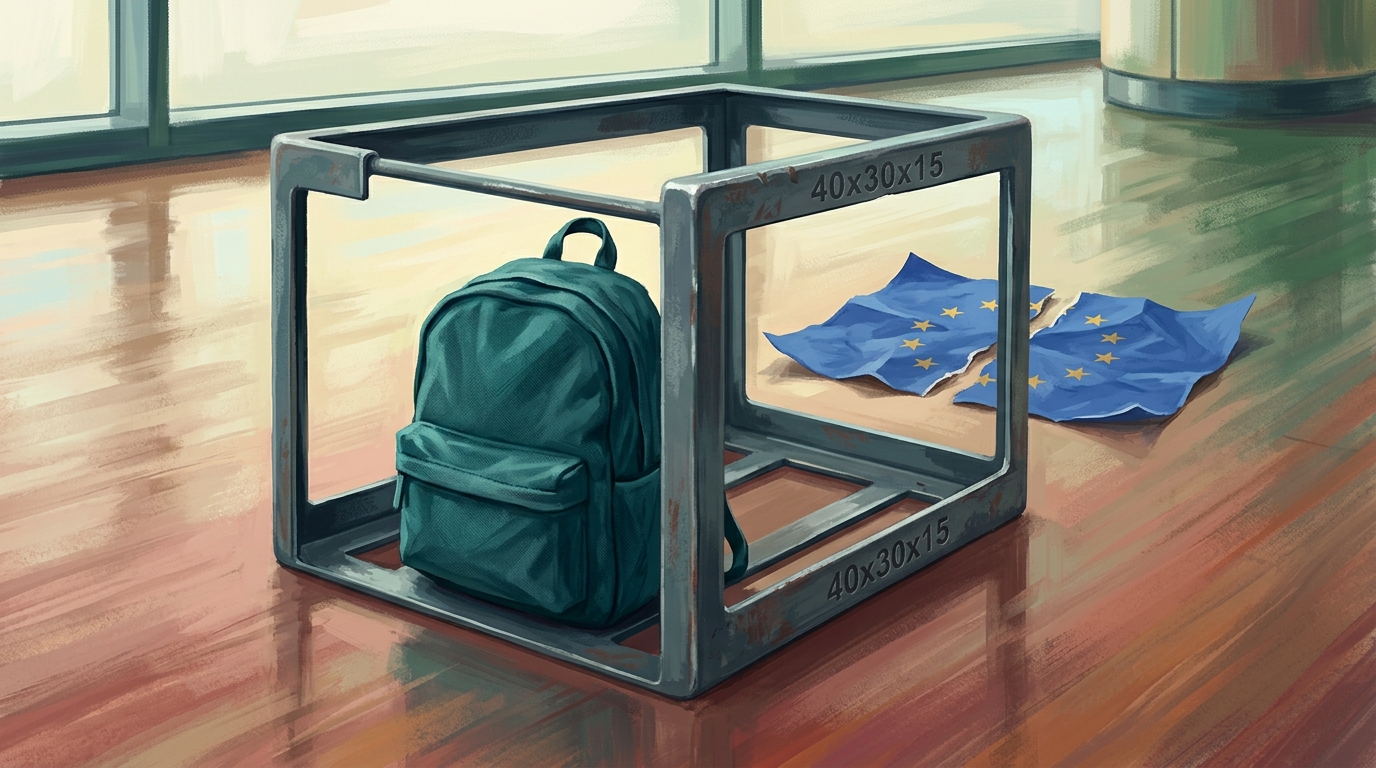
The EU "free cabin bag" rule is a European Parliament position, not law. The Council rejected it, and a conciliation committee was still negotiating into June 2026 with a mid-June deadline and no deal reported as of publication. Meanwhile the rules tightened: the Lufthansa Group's new Economy Basic fare (travel from May 19, 2026) includes only a 40×30×15 cm personal item, and Ryanair enforces a €70-75 gate fee on bags that miss the sizer. Free allowances now range wildly by airline. Check your specific fare before you book, measure your bag against the exact dimensions below, and never assume the headline applies to your flight.
The EU Free Hand Luggage Law: What Actually Happened
The EU free hand luggage law is not a law. On January 21, 2026, the European Parliament voted 632 to 15 to back a position that would give every passenger a free personal item plus a small cabin bag. Then EU ministers in the Council rejected it. As of publication, June 3, 2026, the two sides were still in a conciliation committee with no agreement reported. Nothing has changed at the gate.
Here is the timeline that got compressed into one viral headline. The European Parliament adopted its second-reading position on a passenger-rights overhaul that had been stuck since 2014. Parliament's text would entitle every flyer to a free personal item (40×30×15 cm) and a small wheeled cabin bag of up to 100 cm total and 7 kg. Euronews reported the vote alongside a three-hour delay-compensation threshold and pre-filled refund forms.
A Parliament position is not the finish line. The Council of member states has to agree to the same text. It did not. In March, ministers rejected the MEPs' version, which triggered a conciliation committee: a closed-door negotiation between Parliament, Council, and Commission to find a compromise. Euronews noted the committee was aiming for a deal by mid-June 2026. Talks were still running with no deal reported.
If the conciliation committee fails, the whole proposal is scrapped and the process restarts from scratch. Even if a deal lands this summer, implementation runs 12 to 24 months out. Translation: do not pack for a free-bag rule that does not exist on your 2026 boarding pass.
It helps to understand why the two institutions disagree so sharply. The Parliament represents passengers and pushed for a hard guarantee. The Council represents member-state governments, several of which host major airlines and worry about the cost to carriers, especially low-cost ones whose entire business model assumes baggage is a separately priced product. That is not a small drafting quibble; it is a fight over who pays for the bin space, and it is the reason a popular-sounding reform has crawled for over a decade.
So the honest status, dated: as of publication, June 3, 2026, the free-cabin-bag guarantee is a Parliament proposal in conciliation, not enacted law, and no deal has been reported. Anyone telling you to "enjoy your new free bag this summer" is reading the headline, not the legislative record. The summer 2026 reality is the opposite of free - airlines spent the spring tightening allowances while the law sat frozen.
- 2013-2014 The European Commission and Parliament push to reform EU air-passenger rights. The file stalls for years.
- October 2025 Council finally opens negotiations on the long-frozen file.
- January 21, 2026 Parliament votes 632-15 to back free cabin bags, a 3-hour compensation deadline, and simpler refunds.
- March 2026 EU ministers in the Council reject the MEPs' position. A conciliation committee is formed.
- May 19, 2026 A conciliation round ends without agreement; further talks are scheduled.
- June 2026 Conciliation talks were still running into June 2026 with a mid-June deadline and no deal reported as of publication. If the committee fails, the proposal is scrapped and restarts.
Lufthansa's Free Cabin Bag Just Shrank to a Backpack
While everyone celebrated a free-bag law that does not exist, a flag carrier went the other way. For travel from May 19, 2026, the Lufthansa Group's new Economy Basic fare includes only one personal item measuring 40×30×15 cm. No wheeled cabin bag. Euronews called it Europe's smallest free cabin allowance, and it comes from a full-service airline, not a budget carrier.
That is the genuinely surprising part. We expect Ryanair to nickel-and-dime the overhead bin. We do not expect it from Lufthansa. The previously included full-size carry-on (55×40×23 cm, 8 kg) now becomes a paid add-on on the cheapest fare.
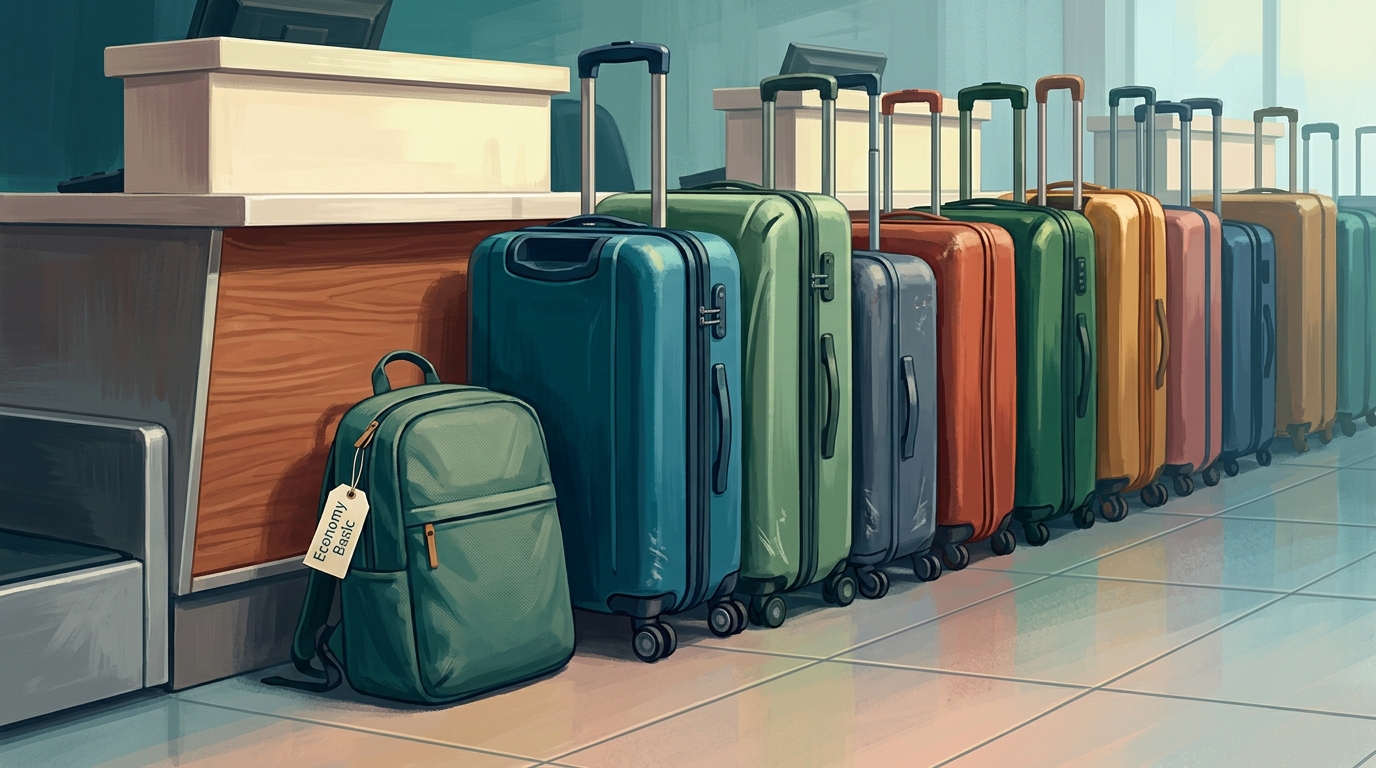
This is not just a Lufthansa-branded change. According to the Lufthansa Group, the Economy Basic fare rolls out across Austrian Airlines, SWISS, Brussels Airlines, Discover, Lufthansa City Airlines, and Air Dolomiti, bookable from April 28 for travel from May 19. So if you fly Austrian or SWISS on a Basic fare this summer, the same backpack-only rule can hit you. The previously included full-size carry-on (55×40×23 cm, 8 kg) becomes a paid add-on, reported by swissinfo alongside the 40×30×15 cm personal-item limit.
Two caveats worth knowing. The older Economy Light fare across the group has historically still included a standard carry-on (55×40×23 cm) plus a personal item, and swissinfo notes Economy Light stays in place. The squeeze is specifically the new Basic tier. Check which fare bucket your ticket sits in, because the airline name on the tail tells you nothing anymore.
"I'm flying Lufthansa" used to mean a carry-on was included. In 2026 it means almost nothing. The fare class (Basic vs Light vs Classic vs Flex) decides your bag allowance. Open the fare comparison before you click pay, not at the gate.
Ryanair's €70 Gate Fee Is the Real Summer Threat
Ryanair still gives you a free personal bag of 40×30×20 cm, but bring anything bigger to the gate without paying in advance and you face a €70-75 charge on the spot. The free bag is real. The penalty for getting it wrong is the trap.
Here is how Ryanair's system actually works. Every fare includes one small personal bag (40×30×20 cm) that fits under the seat. The 10 kg overhead cabin bag (55×40×20 cm) is not free: you need Priority boarding, which Ryanair prices from about €6 to €36 when booked in advance, climbing toward €60 if you add it late. Bring an oversized bag to the gate and, per Ryanair's own fees page, it is refused or placed in the hold for roughly €70 to €75.
An oversized cabin bag brought to the boarding gate is either refused or, where space allows, placed in the aircraft hold for a gate bag fee of roughly €70 to €75.
Ryanair, official fees and bag-rules pages
The math is brutal precisely because it is avoidable. A few euros of Priority booked in advance versus a €70 gate fee for the same bag is the most expensive 20 centimetres in travel. And it is not unique to Ryanair. We have written before about how budget airlines hide the real price behind a low headline fare, and cabin-bag gate fees are the clearest example.
Condor applies the same logic. Its standard carry-on size is 55×40×23 cm, and on its cheapest Economy Light fare you get a small personal item plus a carry-on, but bringing an extra hand-luggage piece to the gate unbooked draws a gate fee in the €75 to €100 range. Eurowings' BASIC fare, meanwhile, includes a 40×30×25 cm underseat item, with the 55×40×23 cm trolley costing extra, per the airline's BASIC fare page.
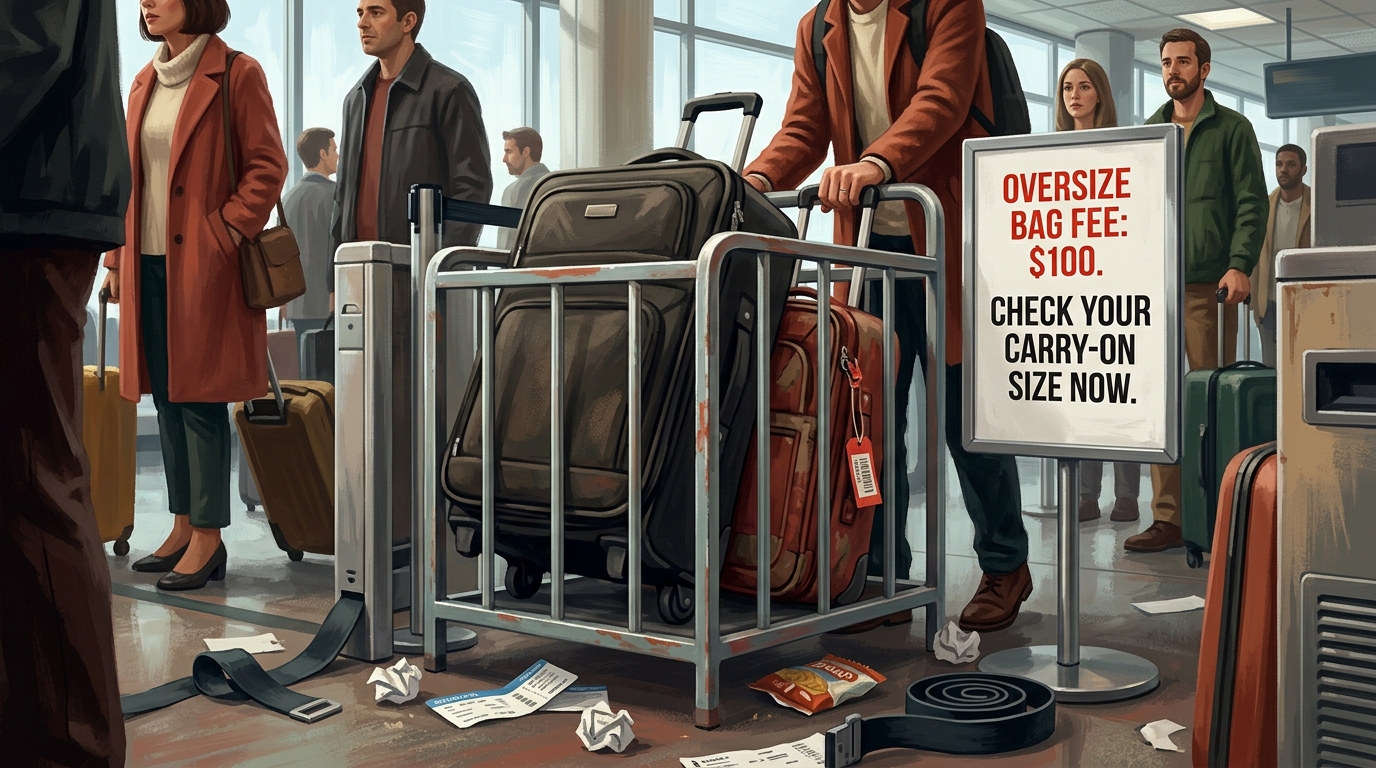
Notice the common thread across Ryanair, Wizz Air, Condor, and Eurowings BASIC: the free item is a small underseat bag, and the thing most travellers actually think of as "hand luggage", the wheeled trolley that goes in the overhead bin, is a paid extra. The €70-plus gate fee is not a punishment for breaking a rule you did not know about. It is the price of the cabin bag, marked up sharply for buying it at the worst possible moment. Booking that same bag online when you reserve the flight typically costs a fraction of the gate rate, which is the entire point of the gate rate.
One subtle Ryanair trap deserves its own warning: the Priority queue is capped at roughly half the plane and regularly sells out. If you bought Priority specifically for the overhead bag and the queue is full, you can still be told to check it. Buying Priority early protects the allowance; buying it late on a busy summer route may not. Treat the cabin bag as something you confirm at booking, not something you hope to sort out at the gate.
EU Hand Luggage Rules 2026: The Cabin Bag Cheat Sheet
Free allowances now vary so much between airlines that there is no single "European" rule to memorise. The table below is your summer 2026 reference, drawn from each carrier's official baggage page. The pattern: easyJet and Wizz Air give the most generous free underseat bag, the Lufthansa Group's Basic fares give the least, and full-service legacy carriers like British Airways still include both a personal item and a real cabin bag for free.
| Airline / Fare | Free Personal Item | Free Cabin Bag | Status |
|---|---|---|---|
| Lufthansa Economy Basic | 40×30×15 cm | None (paid add-on) | Smallest |
| Austrian / SWISS Basic | 40×30×15 cm | None (paid add-on) | Tightened |
| Ryanair | 40×30×20 cm | None (Priority only) | Priority needed |
| Wizz Air | 40×30×20 cm (10 kg) | None (Priority only) | Priority needed |
| Eurowings BASIC | 40×30×25 cm | None (paid trolley) | Fare-based |
| easyJet | 45×36×20 cm (15 kg) | 56×45×25 cm (paid) | Generous free |
| British Airways | 40×30×15 cm | 56×45×25 cm (free) | Two free bags |
Read that easyJet row carefully, because it is the counterintuitive one. easyJet still lets every passenger bring a 45×36×20 cm underseat bag (up to 15 kg) for free, which is physically larger than what Lufthansa's Basic fare allows. The large 56×45×25 cm cabin bag costs extra, but the free underseat allowance is among the most generous in Europe.
Wizz Air mirrors Ryanair's structure: a free 40×30×20 cm personal bag (10 kg) per the Wizz baggage page, with the larger 55×40×23 cm trolley bundled into WIZZ Priority. British Airways sits at the opposite end: BA includes both a 40×30×15 cm handbag and a full 56×45×25 cm cabin bag free across all cabins. Same continent, wildly different rules.
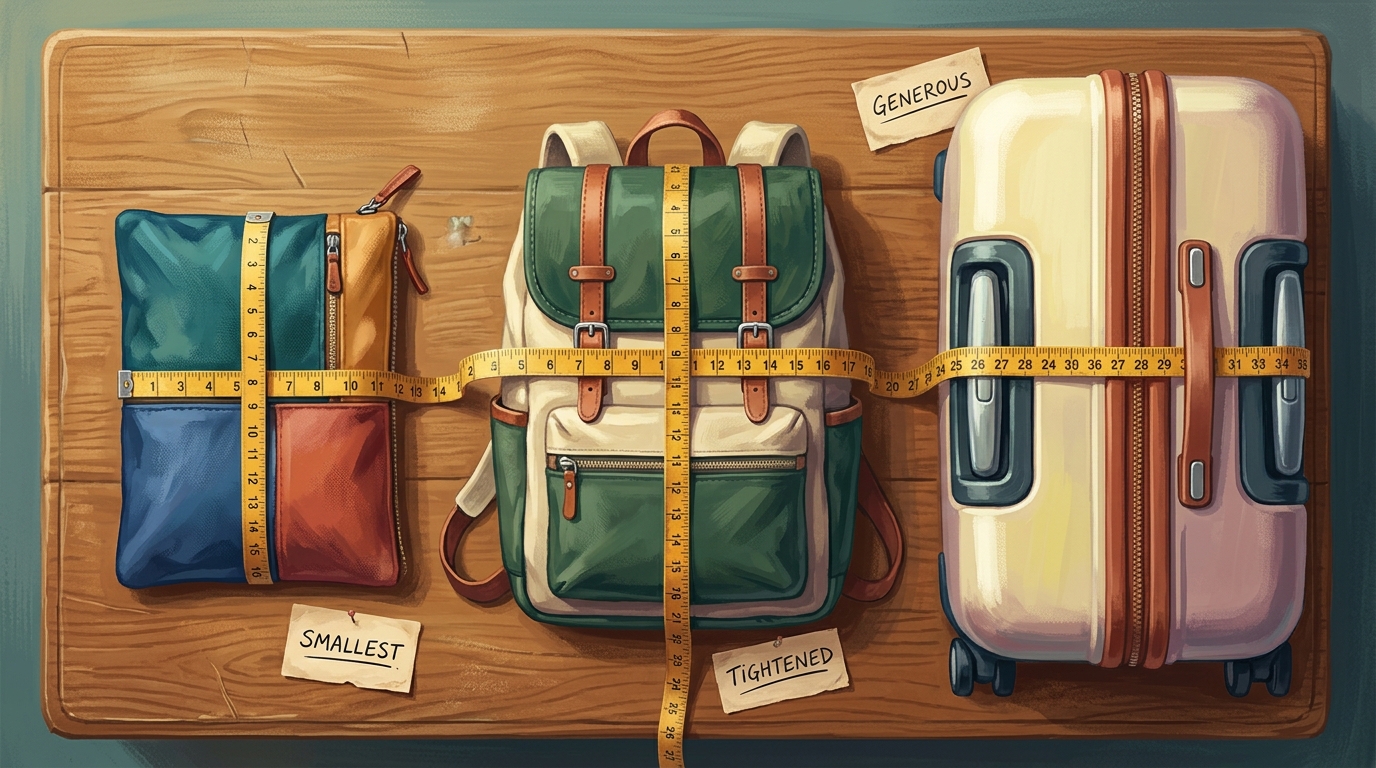
There is a practical lesson buried in that variance. If you fly several different European airlines in a summer, no single bag is "safe" for all of them. A 45×36×20 cm bag sails through easyJet but is too tall for Lufthansa's 15 cm Basic limit. A bag built to British Airways' generous cabin allowance will be refused on a Ryanair flight unless you have paid for the overhead slot. The only durable strategy is to size your bag to the strictest airline you will fly, then enjoy the slack on the others.
Europe's smallest free cabin allowance in summer 2026 (Lufthansa Group Basic, 40×30×15 cm) and one of its most generous (easyJet, 45×36×20 cm) differ by enough volume to fit several days of clothing. The airline brand no longer predicts the allowance.
Why Spain Tried to Ban Cabin Bag Fees (and Why It Did Not Stick)
In late 2024, Spain fined five low-cost airlines a combined €179 million for charging passengers to bring a cabin bag on board. It was the boldest move yet against carry-on fees. But the fines were suspended pending appeal, and the European Commission sided with the airlines, leaving the practice legal across the EU. This is why your bag is not free this summer despite the lawsuit you may have read about.
The numbers were striking. Spain's Ministry of Consumer Affairs hit Ryanair with €107.8 million, Vueling €39.3 million, easyJet €29.1 million, Norwegian €1.61 million, and Volotea €1.19 million, calling cabin-bag charges and other practices "abusive."
Then it unravelled. Ryanair's Michael O'Leary called the sanctions "illegal and baseless" and the airlines appealed. More importantly, the European Commission opened an infringement procedure against Spain, arguing that under EU law airlines may price baggage freely as part of their fare structure. RTÉ reported that a Spanish court suspended enforcement of the fines pending appeal and that the Commission issued a formal notice opening the infringement procedure. Business Travel News Europe documented the standoff: the fines sit in legal limbo, and carry-on fees remain legal across the bloc.
It is worth sitting with how strange this is. One arm of the EU is fighting to make cabin bags free, while another arm is actively defending the airlines' right to charge for them and threatening Spain for trying to stop it. If the people who wrote the rules cannot agree on what the rules should be, you can see why a viral "it's free now" post is, at best, wishful.
So you have two contradictory forces in 2026. Parliament wants to ban cabin-bag fees; the Commission is defending airlines' right to charge them. That tension is exactly why nothing is settled, and why the safest assumption this summer is that your cabin bag is a paid product unless your fare explicitly says otherwise. If you are also flying within or to the US this year, the same fee-creep is visible in the 2026 checked-bag fee hikes on American carriers, so the cabin-bag squeeze is one symptom of a broader trend.
How Not to Get Burned at the Gate This Summer
The single most reliable way to avoid a cabin-bag gate fee is to measure your bag against your specific airline's sizer before you leave home, and to add any cabin bag online at booking rather than at the airport. Gate fees of €70 to €100 exist precisely because airport add-on prices are punitively higher than the same option bought in advance. Plan the bag, not just the trip.
Run this check before every flight. It takes five minutes and saves the price of a checked bag.
- Find your exact fare class Open your booking and read the fare name (Basic, Light, Classic, Priority). The allowance lives there, not on the airline's homepage.
- Measure with handles and wheels Every airline counts handles and wheels in the dimensions. Measure the bag at its widest real points, not the marketing size on the tag.
- Match it to the official sizer Check the exact cm figures on the airline's own baggage page, not a third-party blog. The numbers change monthly.
- Buy the cabin bag online if you need it Adding Priority or a cabin bag at booking is far cheaper than the gate. Never gamble on "it'll probably fit."
- Weigh it Lufthansa Group and Condor weigh carry-ons at check-in and the gate. A 9 kg bag in an 8 kg fare is a fee waiting to happen.
For the packing side of the equation, fitting a trip into a personal item is its own skill, and our guide to packing hacks that actually work covers what genuinely saves space versus what just sounds clever. The smaller your free allowance gets, the more those techniques matter.
One more wrinkle for summer 2026: liquids. The EU approved CT scanners that lift the 100 ml limit, but rollout is uneven. Euronews reported that you might fly out of one airport with a two-litre liquid allowance and return under the old 100 ml rule, sometimes with different rules between terminals at the same airport. Pack to the strictest rule (100 ml) unless you have confirmed your specific departure terminal. It is one more moving part in a summer that already brings EES border delays and strike risk at European airports, so the less you have to argue about at security, the better.
- Fare class confirmed (Basic vs Light vs Priority)
- Bag measured with handles and wheels included
- Dimensions matched to the airline's official sizer
- Cabin bag or Priority added online, not at the gate
- Bag weighed against the fare's kg limit
- Liquids packed to the 100 ml rule unless terminal confirmed
- Booking confirmation and bag receipt saved offline
This is where keeping your travel details in one place earns its keep. When your fare rules, bag dimensions, documents, and checklists live across six tabs and three apps, the gate fee finds the gap. Tools like TripProf pull a trip's checklists, documents, and details into a single offline-ready place, so the fare rules and bag dimensions you saved as a document or checklist are still there when you reach the airport with no signal. The point is not the app; it is not carrying the rule in your head.
Frequently Asked Questions
Is hand luggage free in the EU in 2026?
No. The European Parliament voted in January 2026 to make a personal item plus a small cabin bag free, but the Council rejected it and the proposal was still in conciliation as of publication on June 3, 2026, with a mid-June deadline and no deal reported. It is not law. Airlines can legally charge for cabin bags, and several tightened their rules for summer 2026.
What is the free cabin bag size for Ryanair in 2026?
Ryanair includes one free personal bag of 40×30×20 cm that must fit under the seat. The larger 10 kg cabin bag (55×40×20 cm) requires paid Priority boarding. Bring an oversized bag to the gate without paying and Ryanair charges roughly €70 to €75 to place it in the hold.
Does Lufthansa include a free cabin bag?
Not on the new Economy Basic fare. For travel from May 19, 2026, Economy Basic includes only one personal item of 40×30×15 cm, Europe's smallest free cabin allowance. A wheeled carry-on is a paid add-on. Higher Lufthansa fares (Classic, Flex) still include a full cabin bag.
Which airline has the most generous free hand luggage in 2026?
Among major European carriers, easyJet gives one of the largest free underseat bags at 45×36×20 cm (up to 15 kg), and British Airways includes both a 40×30×15 cm handbag and a full 56×45×25 cm cabin bag free. Both beat the Lufthansa Group Basic fare's backpack-only allowance.
What size is a personal item across airlines?
Personal item sizes vary: Lufthansa and British Airways use 40×30×15 cm, Ryanair and Wizz Air allow 40×30×20 cm, Eurowings BASIC allows 40×30×25 cm, and easyJet's underseat bag is 45×36×20 cm. Always measure including handles and wheels, and check your airline's official page before flying.
Were the Spanish fines on airlines for cabin bags upheld?
No. Spain fined five airlines €179 million in 2024 for cabin-bag charges, but the fines were suspended pending appeal, and the European Commission opened an infringement procedure against Spain, arguing airlines may price baggage freely under EU law. Carry-on fees remain legal across the EU.
Is the 100 ml liquid limit still in force in 2026?
It depends on the airport. The EU approved CT scanners that allow up to two litres of liquids, but adoption is voluntary and uneven, sometimes differing between terminals at the same airport. Pack to the 100 ml limit unless you have confirmed your specific departure terminal allows more.
Key Takeaways
- The EU "free cabin bag" rule is a Parliament position the Council rejected. As of publication on June 3, 2026 it is in conciliation, not law, with a mid-June deadline and no deal reported, and even a deal is 12 to 24 months from taking effect.
- Summer 2026 rules got stricter, not looser. The Lufthansa Group's new Economy Basic fare (travel from May 19) includes only a 40×30×15 cm personal item, Europe's smallest free allowance.
- Ryanair's free personal bag is 40×30×20 cm; the overhead bag needs paid Priority, and an oversized bag at the gate costs around €70 to €75.
- Free allowances now vary wildly: easyJet (45×36×20 cm) and British Airways (two free bags) are generous; Lufthansa Group Basic and Ryanair are the tightest.
- Spain's €179 million in cabin-bag fines was suspended, and the European Commission is defending airlines' right to charge. Assume your cabin bag is a paid product.
- Measure your bag with handles and wheels, match it to the airline's official sizer, and add any cabin bag online, never at the gate.
- Keeping fare rules, bag dimensions, and documents in one offline-ready place (tools like TripProf can consolidate the lot) closes the gap where gate fees hide.
The rules will keep shifting through the conciliation deadline and beyond, so the habit that protects you is the same one that always has: check your specific fare, this summer, before you pay.
Sources
- European Parliament: official press release on the January 2026 vote and air-passenger-rights position
- Euronews: MEPs back free cabin bags, 3-hour compensation deadline, and simpler refunds
- Euronews: EU lawmakers fail to agree, conciliation committee and mid-June 2026 target
- Euronews Travel: Lufthansa launches Europe's smallest free cabin allowance
- Lufthansa Group Newsroom: Economy Basic fare rollout across Austrian, SWISS, Brussels, Discover, Lufthansa City, and Air Dolomiti
- swissinfo: Lufthansa Group new fares, 40×30×15 cm personal item, Economy Light retained
- Ryanair: official fees and baggage charges page
- Condor: official carry-on baggage rules and gate fees
- Eurowings: official BASIC fare baggage rules
- easyJet: official cabin-bag size and allowance page
- Wizz Air: official baggage allowance page
- British Airways: official hand-baggage essentials page
- Euronews: Spain fines five low-cost airlines €179M for abusive practices
- RTÉ: Spanish court suspends cabin-bag fines; European Commission opens infringement procedure
- Business Travel News Europe: Spain fines, appeals, and European Commission infringement procedure
- Euronews: which European airports have scrapped the 100 ml liquid limit
Last updated: August 28, 2026
Keep Reading
More travel tips and guides picked for you
Airport liquid rules in 2026: which airports actually allow more than 100ml
Some UK airports now let you carry 2 litres of liquid through security. Others, and every US airport, still cap you at 100ml. Here is exactly which is which, airport by airport, and which rule to pack for when your outbound and return airports disagree.

The best group packing list apps in 2026
PackParty nails the everyone-vs-one-person split gear needs. whobrings.com skips the app. TripProf holds the whole trip. Five tools, tested against each other.

What the Hondius Outbreak Tells Us About Booking an Expedition Cruise in 2026
Three deaths, six confirmed cases of Andes hantavirus, 17 Americans heading to a Nebraska quarantine unit. Here's what the Hondius outbreak reveals about expedition cruise insurance, medevac costs, and the eight questions to ask before you wire the deposit.