The Booking.com Breach Is Now a WhatsApp Scam Wave Hitting Travelers Before Summer 2026
Key Highlights
- 1
- 2
- 3
+5 more in the takeaways below
The script documented across Gen Digital's Reservation Hijack research and the r/travel threads piling up in May 2026 is always close to identical. A WhatsApp arrives from a Czech +420 or Indian +91 number, greets the recipient by full name, quotes a real Booking.com reservation (correct hotel, correct check-in date), and warns of "less than 12 hours" to re-verify a card or lose the room. Every detail checks out. People almost pay. Then they open the official Booking.com app and there's no matching message in the in-app inbox. The data is real. The urgency isn't.
On April 13, 2026 Booking.com confirmed that hackers accessed reservation data through compromised hotel-partner accounts, not through Booking.com itself. The company has not disclosed how many customers were affected and has told The Guardian that no financial information was accessed in this incident. The fallout is a wave of Booking.com WhatsApp scam messages that quote real names, real hotels, and real check-in dates from foreign country codes (+420 Czech Republic, +91 India, others), demanding card re-verification within 24 hours. Booking.com never asks for card details by WhatsApp, SMS, email, or phone. To verify any payment request: open the Booking.com app yourself, then call the hotel on a number you find via Google Maps. If you already paid, freeze the card today and dispute through your card issuer immediately (in the US, FCBA gives you 60 days from the statement showing the charge; in the UK, Section 75 of the Consumer Credit Act covers credit purchases of £100 to £30,000 for up to six years). Report to Action Fraud or the FTC.
This article zooms in on the Booking.com WhatsApp scam specifically. For the broader 2026 scam landscape - voice clones, fake confirmation emails, AI-generated rental listings, and the family code-word defence - see our companion guide: AI Travel Scams 2026: Booking Sites, Voice Clones, and Fake Confirmations (And How to Stop Them).
What Actually Happened on April 13, 2026
Booking.com began notifying customers on April 13, 2026 that unauthorized parties had accessed guest reservation data through compromised hotel-partner accounts. TechCrunch's coverage of the disclosure reports that Booking.com declined to say how many customers were affected. Malwarebytes' breach analysis echoes the same point: "Booking.com isn't saying." Booking.com told The Guardian that no financial information was accessed in this incident. The data accessed includes names, email addresses, physical addresses, phone numbers, booking references, and even the private messages exchanged between guests and properties (Help Net Security). Numbers thrown around online (4,000 customers, 300 cards) belong to a separate 2018 UAE incident that drew a €475,000 Dutch DPA fine in 2021. Travelers keep mixing those into the April 2026 story.
Here's the part most coverage glosses over. Your Booking.com password is fine. Rotating it changes nothing. The attackers didn't break into Booking.com's central system. They broke into individual hotels' extranet logins, then pulled the reservation lists those hotels could see. Malwarebytes traces the chain back to a phishing campaign that's been quietly hammering hotel staff for the better part of a year. One more thing the breach isn't. This isn't a Booking.com password leak. Your credentials weren't dumped on a hacker forum. If you ask "should I change my Booking.com password," the answer is "you can, but it won't fix this." The vector is the hotel side of the platform (and our comparison of direct vs third-party booking in 2026 goes deeper into why that distinction matters). The remedy lives on your side of the message.
A Which? consumer survey found that 9% of the 237 Which? UK members surveyed received a Booking.com scam message, and that survey was conducted before the April disclosure made the data even more useful to attackers. Across June 2023 to September 2024, the most recent published reporting window, UK Action Fraud logged 532 Booking.com scam reports totalling £370,000 in losses. Those numbers will look quaint by August.
How the Booking.com WhatsApp Scam Actually Works
The mechanics matter, because the mechanics tell you what to fix and what's pointless. Microsoft Threat Intelligence's writeup on the campaign maps the chain in detail, and The Hacker News documented the large-scale follow-up in November 2025. It starts with an email to a hotel's reception or reservations team: a fake guest complaint, a fake document request, or a "your listing has a problem" message. The hotel clicks. They land on a page that uses a technique called ClickFix. A fake CAPTCHA tells them to press Windows+R, paste a "verification command," and hit Enter. They do. That command installs PureRAT, a remote-access trojan that quietly hands the attacker live access to the hotel's Booking.com extranet.

From there the attacker doesn't need to break anything. They log in as the hotel. They read the reservation list. They see your name, your dates, your phone number, your messages. They have what the Gen Digital research team calls the "Reservation Hijack Scam", a script that quotes real bookings so convincingly that even seasoned travelers fold.
So why WhatsApp, why a Czech or Indian number? Two reasons. First, WhatsApp messages don't sit in a Booking.com inbox where the brand could flag them. Second, foreign country codes look weird enough to feel "international" but normal enough for a global platform. A traveler sees +420 and thinks "European travel agency," not "criminal in a basement." WhatsApp's own help center is blunt: treat unsolicited messages asking for money or codes as scams, regardless of how much they know about you.
Booking.com has stated publicly, on its own help pages, that it will never ask you to enter card details via email, phone, WhatsApp, SMS, or any link outside the official app or website. Any message that does is a scam. Full stop. No exceptions for "third-party payment processors," "secure verification," or "urgent fraud checks."
How to Verify a Booking.com WhatsApp Message in 60 Seconds
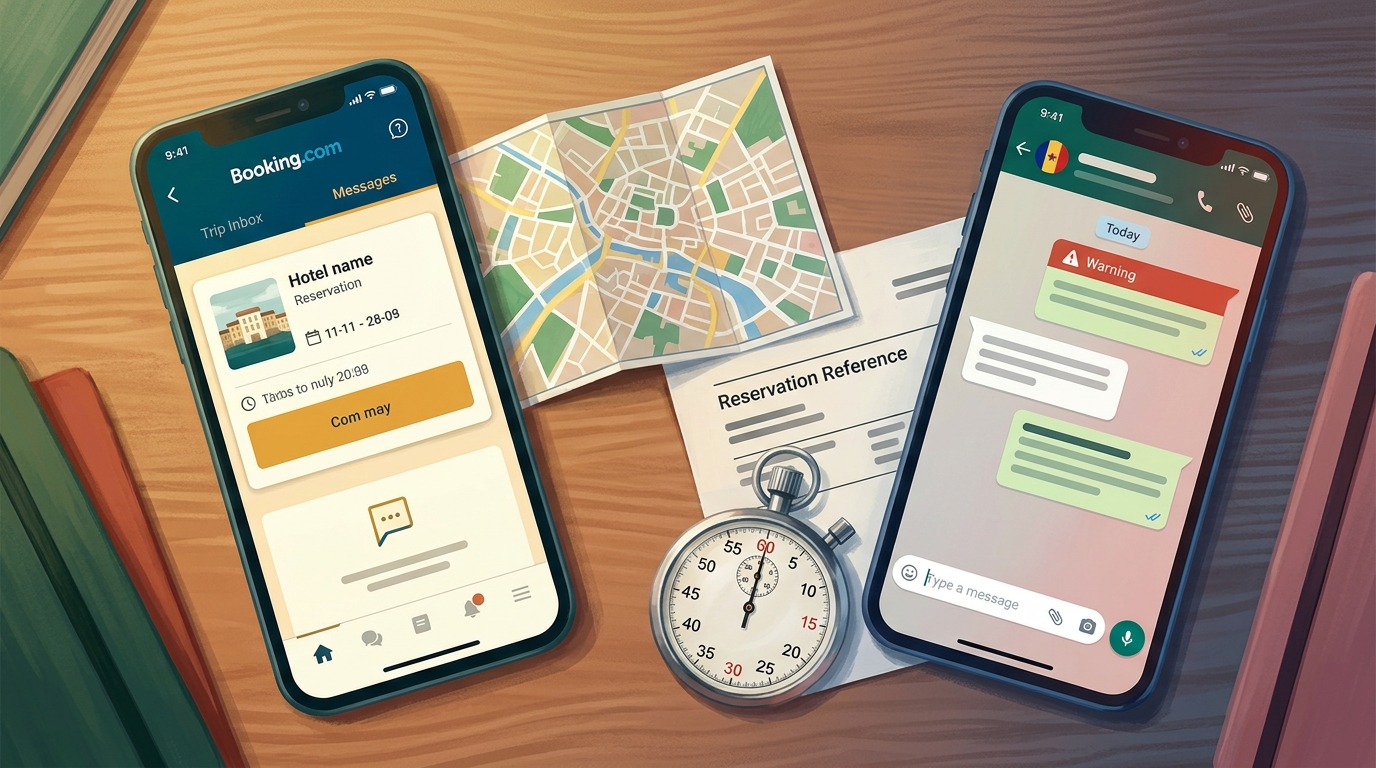
You can settle nearly every suspicious payment request in under a minute if you follow the same routine every time. The trick is muscle memory. Don't read the message twice, don't argue with it in your head, don't click anything. Open the app, then call the hotel. That's it.
- Open the Booking.com app yourself. Type "Booking" into your phone's app drawer or App Store search. Do not tap any link from the WhatsApp, SMS, or email. If your booking is real, it's in the Trips tab.
- Check the messages tab inside the app. Every legitimate request from Booking.com or the property lives here. If there's no matching message in the official inbox, the WhatsApp message is fake.
- Look up the hotel on Google Maps. Search the hotel name plus the city. Tap the phone number listed on the Google Maps business panel. Never use a number from the WhatsApp message.
- Call the hotel reception directly. Ask "I have a booking on dates X to Y under name Z. Do you have any pending payment issue on it?" The receptionist either confirms (rare and verifiable) or tells you the message is a known scam.
- Screenshot, then block and report. Screenshot the WhatsApp thread (you'll need it for any insurance or chargeback claim later), then block the number and report it inside WhatsApp.
Sixty seconds. The whole point of the 24-hour deadline in the scam message is to short-circuit this routine. Slow down on purpose. A real hotel will not lose your booking because you took ten minutes to verify. And if the message claims your card will be charged automatically without re-verification, that's another tell: card networks don't work that way.
5 Phrases That Reveal a Booking.com WhatsApp Scam
Once you've read a few of these scripts they all sound the same, because they're translated from a small library of templates. Gen Digital's Reservation Hijack research and Which? UK's consumer coverage catalogue the same handful of recycled phrases across regions and languages. Five come up in nearly every documented version, and any one of them is enough to throw the whole message out.
- "Re-verify your payment card": Booking.com never re-verifies cards by message
- "Within 24 hours" or "less than 12 hours": pressure tactic, not a real platform policy
- "Click this secure payment link": the legitimate flow is always inside the app
- "Your booking is at risk of cancellation": only your card issuer or the hotel itself can cancel, and they don't do it by WhatsApp
- "Third-party payment processor": an invented entity that exists only in these scripts
One phrase is suspicious. Two is definitive. Legitimate booking communications don't use this vocabulary, and as noted above Booking.com itself states the company never requests card details by WhatsApp, SMS, email, or phone. Even the budget chains that send the most aggressive upsell emails avoid the urgency-plus-payment combination, because their legal teams won't sign off on it.
Across the cases catalogued in Gen Digital's Reservation Hijack research and reported throughout 2025-2026 on r/travel: a foreign country code, exact booking dates, a payment link styled to look official, and a short verification window. In several documented incidents, hotel reception staff confirmed that multiple guests received the same script the same morning.
If You Already Paid: The Refund Playbook
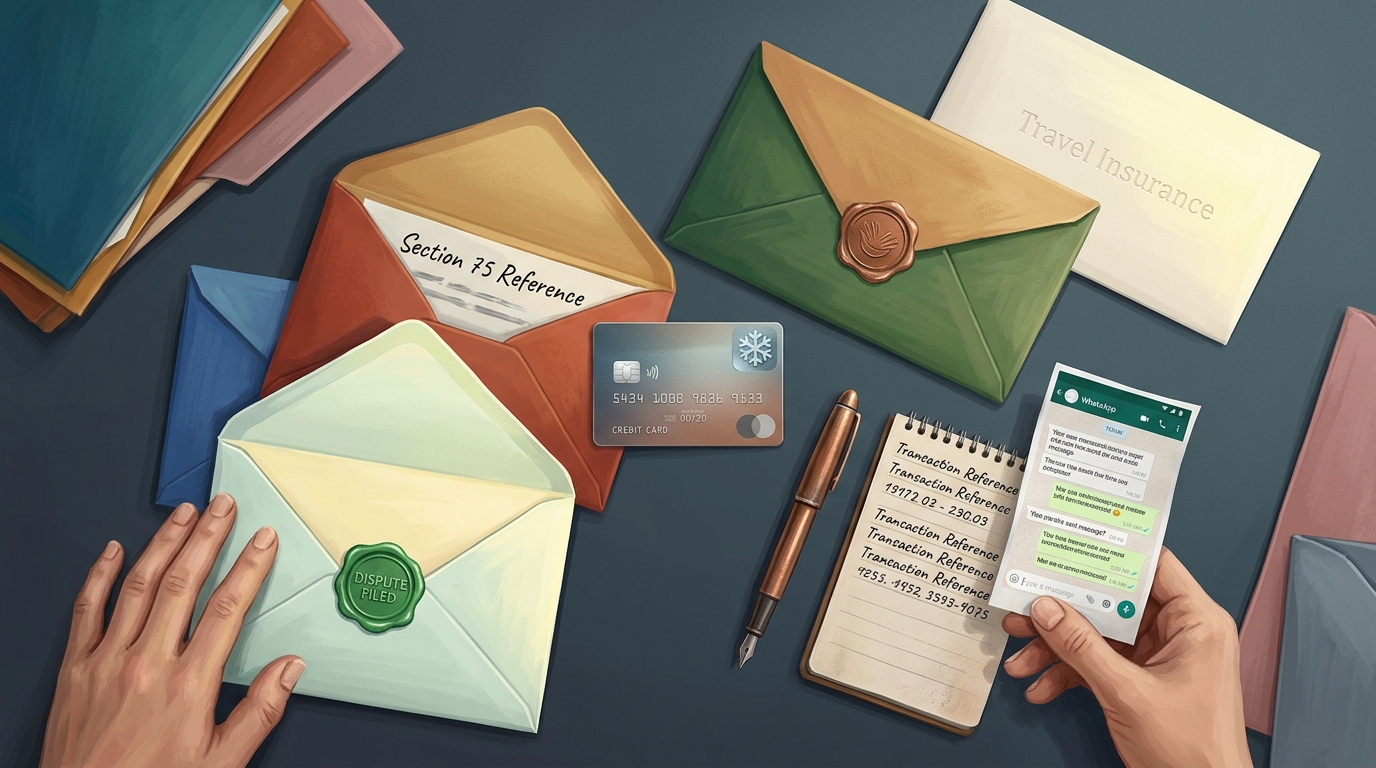
If you clicked the link and entered your card, the next 60 minutes matter more than the next 60 days. The card details are already in the attacker's hands; the question is whether they get to use them. Your refund path depends on who you ask, and the channels don't pay equally. Here's how the four most common refund channels actually compare for a typical hotel-hijack scam. The same chargeback logic applies if a flight is cancelled, and our flight-cancellation refund guide walks through that variant in detail.
| Channel | Realistic outcome | Time limit | Cover |
|---|---|---|---|
| Card issuer chargeback | Strongest path. Usually paid in full if disputed quickly | Typically 60 days from statement (CFPB) | Strong |
| UK Section 75 (£100 to £30,000) | Joint liability of card issuer for goods or services not delivered | Up to 6 years | Strong |
| Booking.com goodwill | Inconsistent, anecdotal reports across r/travel and Which? consumer-rights coverage suggest some users receive partial goodwill refunds while many get none. | No fixed limit | Variable |
| Travel insurance | Most policies exclude "fraud the policyholder consented to" (i.e., you typed the card) | Per policy | Weak |
The realistic ranking: card issuer first, then Booking.com (worth trying), then insurance (rarely pays). Insurance rarely pays because fraud where the cardholder voluntarily entered the details, even under social-engineering pressure, is treated differently from an unauthorized transaction, and most policies exclude it. Our breakdown of what travel insurance actually covers in 2026 walks through this in detail.
Don't wait for your statement. Call the number on the back of the card today, tell them "fraudulent transaction, social engineering, please freeze the card and start a dispute." The faster you flag it, the more likely the transaction reverses before it settles.
Here's the exact order to work through if you've already entered your card details:
- Freeze the card immediately. Most banking apps now have a one-tap freeze. Do it before you do anything else, even before you log into Booking.com.
- Call the card issuer's fraud line. Use the number printed on the physical card, not a number from any email or message. Tell them it's a phishing-induced transaction. Ask for the dispute case number in writing.
- Change Booking.com password and enable two-factor. This won't undo the breach, but it locks down your account against future credential stuffing using the leaked email.
- Run your email through Have I Been Pwned. If you appear in other breaches alongside this one, rotate the affected passwords through a manager. Any reputable password manager (1Password, Bitwarden, or KeePass) handles bulk rotation in a single workflow.
- Report the scam. UK travelers report to Action Fraud. US travelers report to the FTC's ReportFraud portal and the FBI Internet Crime Complaint Center. Reporting doesn't recover your money, but it builds the pattern that makes the next bust possible.
- Keep every screenshot, every transaction reference, every email. Your chargeback case lives or dies on documentation. The bank wants the WhatsApp screenshot showing the phrasing. The bank wants the email. The bank wants the timestamp.
The single biggest mistake we see is people calling Booking.com first and waiting for them to fix it. Booking.com can't reverse a transaction your card issuer authorised. Call the bank first; the platform can wait.
Why Summer 2026 Is the Peak Risk Window
Two calendar facts collide right now. Bookings made before the April 13 disclosure are still in attackers' hands, and most have check-in dates in June, July, and August. School holidays in much of Europe start the third week of June. Families have already paid, can't easily move the booking, and have the highest emotional cost if something "threatens" the reservation. That's the demographic the scripts are tuned for.
The volume signal is visible in real time. Reddit's r/travel and r/TravelHacks are filling with near-identical reports throughout May 2026; Gen Digital's Reservation Hijack research documents the same script appearing across multiple regions and languages. McAfee's 2026 travel-scam research estimates that travel-related scams cost victims approximately $13 billion globally in 2025, with an average loss near $1,000 per victim, and that figure was logged before the 2026 breach added a fresh dataset to the criminal supply chain.
If you booked any hotel through Booking.com between roughly mid-2024 and mid-April 2026 and your stay is between now and September, you're inside the highest-risk demographic. Not because your card is leaked (most aren't) but because your reservation data probably is, and that's all the scripts need.
Why the 2026 Booking.com Scam Is Different From Phishing
The Booking.com 2026 WhatsApp scam differs from generic phishing in one specific way: the attacker already has your real reservation. A normal phishing message guesses ("did you book a hotel recently?"); the reservation hijack quotes ("your booking at Hotel X, less than 12 hours to confirm"). Every defence trained on generic phishing, vague greetings, broken English, mismatched URLs, suspicious senders, collapses when the scam message gets every contextual detail right.
Compare it to the rest of the scam landscape we've covered in our regional travel-scam guide and the sister consumer-protection coverage in our piece on dirty travel marketing tricks nobody notices. A taxi overcharge in Lisbon or a card-skimmer in a Barcelona ATM is opportunistic and physical. The Booking.com hijack is the opposite. It's pre-targeted, remote, and asymmetric. The attacker knows more about your trip than your spouse does, and they're betting on the fact that you don't know they know.
The defensive logic flips too. For physical street scams the answer is awareness in the moment. For the reservation hijack the answer is process: trust your booking, not the message. If a request didn't arrive inside the official app or at the hotel reception desk, it didn't come from a real source. That's the whole rule.
This is where a single, trusted source of truth for your trip earns its keep. When your booking confirmations live in one place that you control, alongside your check-in dates, hotel addresses, and reservation references, you can open the trip, see the PDF, and compare it against any unsolicited message in five seconds, without ever touching the link. TripProf's Documents area handles this for the people who use it; a shared note in your phone works too, as long as the rule is the same: trust your booking, not the WhatsApp.
The card layer matters too. If you book on a card with strong consumer protections, and our comparison of cards travelers actually carry goes through which ones, the chargeback path is fast and predictable. The same scam against a debit card is a much longer fight, because debit disputes are governed by Regulation E in the US, which is much weaker than credit-card protection.
The One-Sentence Defence
Pre-April-2026 scam emails relied on volume: send a million messages, hope a hundred people are nervous about any Booking.com booking. Post-April-2026 hijacks are surgical. They send one message that names the hotel you actually picked, on the night you actually checked in, against a card you actually used, and play on a vulnerability you didn't know you had, which is that your booking confirmation is genuinely real and emotionally important.
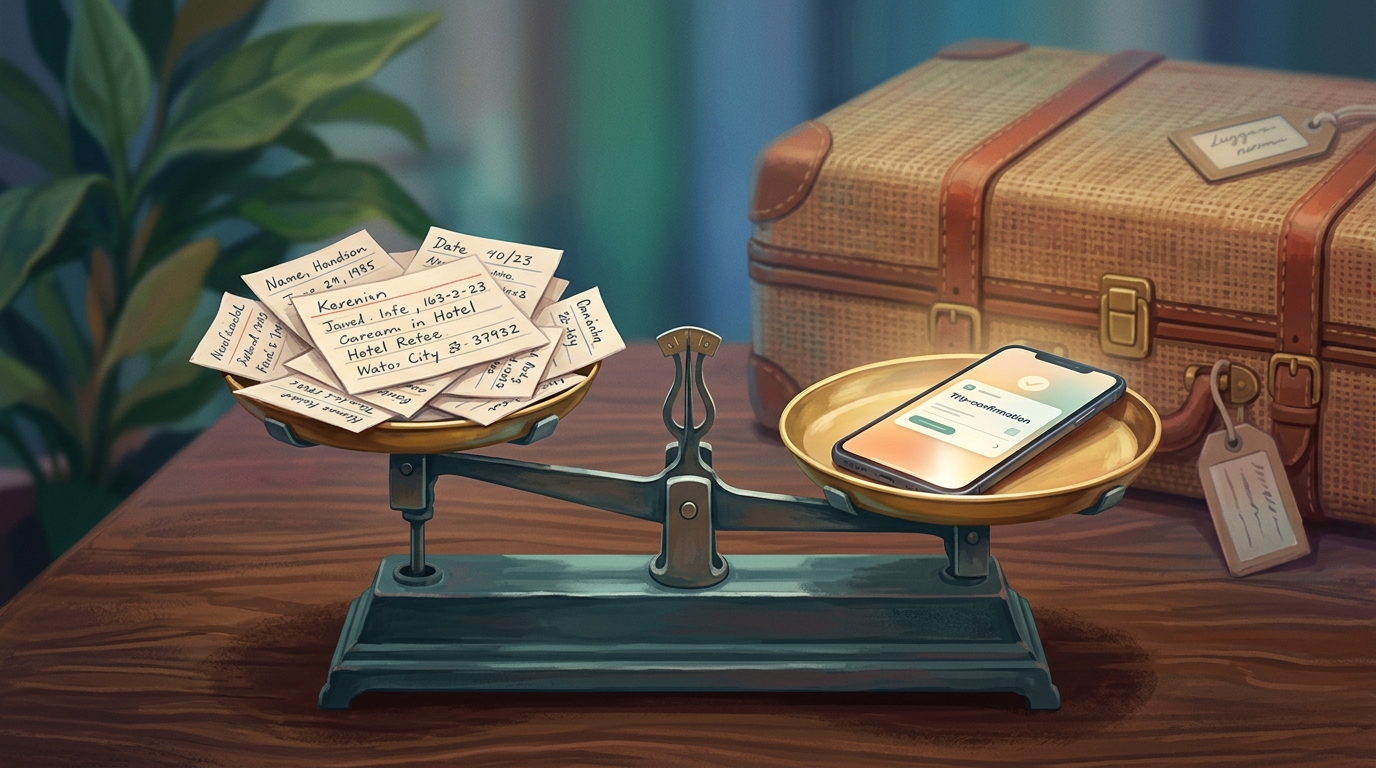
The defence is exactly that mismatch. The scammer has data; you have access. They can quote your booking from a stolen list, but you can open the live booking inside the app. They can write "your reservation is at risk," but you can call the hotel on a number they don't control. They've got data. You've got the app on your phone. That's not a fair fight in their favour, it's a fair fight in yours.
What About Travelers Outside the UK and US
The reporting channels differ but the playbook doesn't. In the EU the breach falls under GDPR Article 33, which requires data controllers to notify supervisory authorities within 72 hours of becoming aware of a personal data breach. That's why Booking.com sent the customer notification quickly. They had a legal clock running. Affected EU residents can file a free complaint with their national data protection authority if they feel the disclosure was inadequate.
For cross-border crime coordination, Europol's IC3-equivalent intake routes through national police forces; their public guidance covers the basic reporting framework. Spain, Germany, France, and Italy all have national cybercrime units that accept consumer phishing reports in the local language.
Practically, the chargeback path inside the EU is dictated by the card scheme rather than national law. Visa and Mastercard both run dispute frameworks that apply equally across the bloc. Reason codes around "fraudulent transaction" and "service not provided" are the relevant ones, and your bank's fraud team will know which to file. Australian and Canadian travelers have analogous chargeback rights through Visa, Mastercard, and Amex.
The Pre-Trip Checklist We Run Now
A practical pre-trip routine, drawn from the consumer-protection guidance in the Which? coverage and Gen Digital's research. None of it is expensive or technical. All of it makes the Booking.com WhatsApp scam far less effective when it lands. For the broader pre-departure picture, our travel-document checklist for 2026 covers the paperwork side of the same problem.
- Save the hotel's verified phone number from Google Maps into your phone contacts the day you book. So when a suspicious message arrives later, the real number is one tap away.
- Take a screenshot of the confirmation email and store it offline in a documents app or inside whatever trip planner you already use. The point is to have the booking reference somewhere the scammer can't influence.
- Book on a credit card with strong consumer protection, not a debit card. The chargeback math is different.
- Set up a low-balance virtual card for any payment outside the original booking flow. Revolut's Disposable Virtual Cards (free tier), Privacy.com in the US, and most challenger banks offer one-tap virtual cards in 30 seconds. If you genuinely need to top up a room or add an extra night, use that, not your main card.
- Tell your travel companions the rule before the trip: any payment request only goes through the app or a verified phone call. Group trips are especially vulnerable when only the organiser knows the booking details, so everyone in the group should know the booking reference too.
- If you book multiple hotels for the same trip, write down which one you booked through which channel (Booking.com, the hotel direct, another platform). When a fake message arrives quoting "your June 14 booking," knowing which booking flow it's pretending to be from is half the battle.
Frequently Asked Questions
Was I affected by the Booking.com data breach?
If you booked through Booking.com in the affected window and your hotel partner was one of the compromised properties, you were probably exposed. Booking.com is notifying affected customers directly but has not publicly disclosed the number affected. A negative email doesn't mean you're safe; it only means you weren't in the specific notification batch. Anyone with a live booking should still treat unsolicited payment messages as hostile by default.
Why does the scammer know my real hotel name and check-in dates?
Because the attacker logged into your hotel's Booking.com extranet using credentials stolen via a ClickFix phishing campaign that Microsoft Threat Intelligence has been tracking since 2024. Your data wasn't taken from Booking.com's central database. It was taken from the hotel's own access panel. That's why changing your Booking.com password does nothing useful.
How do I contact my hotel directly to verify a Booking.com message?
Search the hotel name plus the city on Google Maps. The verified business panel shows the hotel's listed phone number, use that. Never call a number that appears in the WhatsApp, SMS, or email you're suspicious of. If the hotel uses a centralised reservations line, ask the front desk to transfer you to whoever handles Booking.com reservations. The whole call takes two minutes and settles the question for real.
Is the WhatsApp message asking me to re-verify my card a scam?
Yes. Booking.com has stated it will never request payment or card re-verification by WhatsApp, SMS, phone, email, or any link outside the official app and website. Any message that claims a third-party processor, urgent 24-hour deadline, or secure payment link is a scam. Open the app yourself to confirm.
How do I check if a Booking.com message is real?
Open the Booking.com app on your phone (don't tap any link), go to Trips, find the booking, then open Messages. Every legitimate communication from Booking.com or the property lives in that thread. If the message you received by WhatsApp isn't mirrored in the in-app inbox, it's fake. As a second check, call the hotel using the phone number from Google Maps.
What should I do if I already clicked the link or entered card details?
Freeze the card in your banking app right now. Then call your card issuer's fraud line (use the number on the back of the card, not from any message), file a dispute, and ask for a case number. Change your Booking.com password and enable two-factor. Report the scam to Action Fraud in the UK, the FTC ReportFraud portal in the US, or your national police cybercrime unit in the EU. Keep every screenshot, because your chargeback will need them.
Does Booking.com refund victims of the reservation hijack scam?
Inconsistently. Some users report partial goodwill refunds, especially when the booking itself was paid through Booking.com's "secure payment" pre-payment flow. Many report nothing. Booking.com's official position is that it cannot reverse charges your card issuer authorised. The reliable refund channel is the card issuer chargeback, not Booking.com.
Should I cancel and rebook my hotel after the breach?
Usually no. The hotel can't undo data that's already left their extranet, and cancelling forfeits the booking under most policies. A cleaner move is to confirm the booking directly with the hotel by phone (using a verified Google Maps number), make sure your check-in details match exactly, and decline any future payment request that arrives by message rather than at the front desk.
Why are these scam WhatsApps coming from foreign country codes (+420, +91)?
Because WhatsApp numbers from Czech Republic, India, or Indonesia are cheap to set up at scale and harder for victims to verify. The country code looks foreign enough to fit "international travel platform" and unfamiliar enough that travelers don't immediately recognise it as suspicious. The number's origin tells you nothing useful about whether the message is real; the content is what gives it away.
Will my travel insurance cover money lost to a Booking.com phishing scam?
Usually no. Most consumer travel policies exclude losses where the policyholder voluntarily provided card details, even under social-engineering pressure. Some standalone cyber-insurance riders do cover phishing, and a few premium credit cards include identity-theft cover that can pay out. Read your policy's fraud exclusions before assuming you're covered.
Can I check whether my email has been in other breaches?
Yes. Have I Been Pwned runs a free lookup that aggregates published breach datasets. Enter your email at haveibeenpwned.com and the site lists every breach you appear in. If the Booking.com breach is one of several, rotate every affected password through a manager like 1Password, Bitwarden, or KeePass.
Key Takeaways
- Booking.com itself wasn't breached. Hotel partners were. Rotating your Booking.com password doesn't help, because the attacker is logged in as the hotel.
- Booking.com has not publicly disclosed how many customers were affected in the April 2026 incident and has confirmed no financial information was accessed. The widely repeated "4,000 customers / 300 cards" figures belong to a separate 2018 incident, not this one.
- The five tells that flag a Booking.com WhatsApp scam: "re-verify," "within 24 hours," "secure payment link," "booking at risk," "third-party processor." One is suspicious. Two is definitive.
- Sixty-second routine: open the app yourself, check the in-app inbox, search the hotel on Google Maps, call the verified number. Don't argue with the message.
- If you already paid, freeze the card and call the issuer first, not Booking.com. In the US, FCBA gives you 60 days from the statement showing the charge; in the UK, Section 75 stretches up to six years on credit purchases of £100 to £30,000.
- Tools like TripProf, or any planner where you keep your booking confirmations in one place, give you an independent source of truth to compare against any unsolicited message: "trust your booking, not the WhatsApp."
- Summer 2026 is the worst window because every pre-April booking is still live data. Travelers with June-to-September stays should treat every unsolicited payment request as hostile until verified.
- The internet doesn't get safer in time for your check-in. Your process does.
Sources
- TechCrunch: Booking.com confirms hackers accessed customer data, April 2026
- Help Net Security: Booking.com data breach exposes customer reservation data, April 2026
- Malwarebytes: Booking.com breach gives scammers what they need to target guests, April 2026
- Microsoft Threat Intelligence: Phishing campaign impersonates Booking.com, delivers credential-stealing malware
- The Hacker News: Large-scale ClickFix phishing attacks, November 2025
- Which?: Booking.com data breach, what you need to know
- Action Fraud UK alert: Booking.com scam reporting window (June 2023 to September 2024)
- Gen Digital (Norton): Reservation Hijack Scam research
- McAfee: 1 in 3 travelers face travel scams in 2026
- CFPB: Credit card fraud dispute rights and timelines
- GDPR.eu: Article 33 personal data breach notification (72-hour rule)
- Europol: Public awareness and prevention guidance on cybercrime
- FBI IC3: Internet Crime Complaint Center industry alerts
- FTC ReportFraud: US consumer fraud reporting portal
- Action Fraud UK: National reporting centre for fraud and cybercrime
- Have I Been Pwned: Public breach lookup service
- WhatsApp Help Center: How to identify and report scam messages
- Bitdefender Scamio: Free scam-message verification tool
Last updated: August 28, 2026
Keep Reading
More travel tips and guides picked for you
AI Travel Scams 2026: Booking Sites, Voice Clones, and Fake Confirmations (And How to Stop Them)
AI travel scams 2026 are no longer obvious. The April Booking.com breach, FBI voice-clone warnings, and 900% surge in booking fraud changed the rules. Here's the 6-step verification checklist and family code-word system that actually stops them.

1 in 6 AI trip planners got sent to a place that doesn't exist, survey finds
A new survey found 1 in 6 AI trip planners got sent to a place that doesn't exist, and 55% hit at least one wrong recommendation. Here's the checklist to run before you book anything AI suggests.

Should You Let AI Book Your Trip? What ChatGPT and Gemini Actually Do in 2026
OpenAI pulled ChatGPT's travel checkout button, Google is testing AI-booked hotels, and one study caught chatbots pushing pricier sponsored flights. Here's the real 2026 verdict on letting AI handle the purchase.