Wat het echt kost om Australië te verlaten: paspoortkosten en vertrekbelasting op een rij

Belangrijkste punten
- 1
- 2
- 3
+2 meer in de samenvatting onderaan
Je vist je paspoort op uit de onderste la en de vervaldatum is al achttien maanden verstreken. Het vernieuwen voor je vlucht vanuit Perth gaat meer kosten dan de vorige keer, en dat is nog voordat je hebt gekeken naar wat de luchtvaartmaatschappij er bovenop gooit om je überhaupt het land te laten verlaten.
Twee afzonderlijke overheidstarieven raken een Australiër voordat ze aan bord gaan van een internationale vlucht: een nieuw volwassen paspoort voor 10 jaar van A$422, en de Passenger Movement Charge, momenteel A$70 per vertrek. Voeg een vers paspoort toe aan de vertrekheffing en het eerlijke totaal van vandaag is A$492, niet het bedrag van A$502 dat online de ronde doet. Dat hogere getal is een prognose: de PMC stijgt pas naar A$80 zodra de Passenger Movement Charge Amendment Bill 2026 wordt aangenomen en de ingangsdatum van 1 januari 2027 aanbreekt. Sinds vandaag ligt het wetsvoorstel nog steeds bij het Huis van Afgevaardigden. Kinderpaspoorten (jonger dan 16) zijn documenten voor vijf jaar van A$213, en iemand van 16 of 17 betaalt het volledige volwassen tarief voor een boekje van 10 jaar. Vermenigvuldig beide tarieven met het aantal paspoorten dat je huishouden daadwerkelijk nodig heeft en het getal stopt ermee een weetje te zijn. Alle cijfers hieronder zijn actueel per september 2026.
Wat het nu daadwerkelijk kost om Australië te verlaten
Een alleenreizende die een vers paspoort voor 10 jaar nodig heeft, betaalt A$492 aan pure overheidskosten voordat er ook maar één vlucht is geboekt. Dat is A$422 voor het paspoort, plus A$70 voor de Passenger Movement Charge.
Geen van beide cijfers is een gok. De paspoortkosten komen rechtstreeks van het eigen tariefschema van het Australian Passport Office, van kracht vanaf 1 januari 2026, en de vertrekheffing is wat de Australian Border Force int van bijna iedereen die vandaag per vliegtuig of schip vertrekt.
Dat is de eerlijke wiskunde, en het zijn twee getallen, niet één. A$502 is het getal waar een paar koppen al op hebben afgerond, en het is niet per se fout. Het is vroeg. Het eigen dossier van het wetsvoorstel op de website van het Australische parlement laat zien dat het op 12 augustus 2026 is ingediend en voor de eerste keer is gelezen, met het debat over de tweede lezing op 19 augustus en een doorverwijzing naar de Federation Chamber op dezelfde dag. Er staat geen aannname door de Senaat vermeld, geen koninklijke goedkeuring, en het statusveld van de site zelf vermeldt "Before Reps" per deze week. Tot dat verandert, is A$492 wat het verlaten van het land een paspoortvernieuwend reiziger daadwerkelijk kost. A$502 is wat het zal kosten, op een datum die nog niet heeft plaatsgevonden. Ons bijbehorende artikel over de stijging van de Passenger Movement Charge behandelt de overgangsregels voor iedereen die al een vlucht in 2027 heeft geboekt, dus lees dat artikel voor de kwestie rond de timing. Dit artikel gaat over het totaal.
Het overzicht: paspoortkosten plus vertrekheffing, regel voor regel
Twee overheidstarieven, twee verschillende afdelingen, twee verschillende redenen waarom ze bestaan. De onderstaande tabel laat zien wat elk type reiziger vandaag daadwerkelijk betaalt, en wat er verandert zodra het hogere PMC-tarief geldt.
| Kosten | Wie betaalt het | Tarief vandaag | Tarief vanaf 1 jan 2027 |
|---|---|---|---|
| 10-jarig volwassen paspoort (18+, of 16-17) | Iedereen die een vers of vernieuwd paspoort nodig heeft | A$422 | A$422 vandaag† |
| 5-jarig kinderpaspoort (jonger dan 16) | Kinderen die een vers of vernieuwd paspoort nodig hebben | A$213 | A$213 vandaag† |
| Passenger Movement Charge | Bijna elke vertrekkende passagier, eenmaal per reis | A$70 | A$80 |
*Het PMC-bedrag geldt pas zodra de Passenger Movement Charge Amendment Bill 2026 is aangenomen en de ingangsdatum van 1 januari 2027 is aangebroken. †De paspoortkosten staan los van dat wetsvoorstel, maar bevinden zich in hun eigen jaarlijkse CPI-indexatiecyclus die eveneens rond 1 januari valt, dus zeer waarschijnlijk veranderen deze ook weer. DFAT heeft het volgende getal nog niet gepubliceerd, dus A$422 is hier het bevestigde tarief van vandaag, niet een vastgezet getal voor heel 2027.
De paspoortkosten: A$422, en het stijgt elke januari
Een standaard volwassen paspoort voor 10 jaar kost A$422 per 1 januari 2026, een stijging ten opzichte van A$412 het jaar ervoor. Dat is het getal uit het eigen huidige tariefschema van het Australian Passport Office, en geen secundair artikel.
Dat onderscheid is hier van belang, omdat veel van wat online circuleert terug te voeren is op secundaire berichtgeving in plaats van de eigen cijfers van de afdeling. Het schema vermeldt duidelijk dat de kosten "van toepassing zijn op aanvragen voor paspoorten en reisdocumenten, en onderhevig zijn aan jaarlijkse indexatie".
Die indexatie is de reden waarom de kosten slechts in één richting bewegen. The Canberra Times meldt dat de paspoortkosten voor iedereen van 16 jaar en ouder A$250 bedroegen in januari 2015, wat betekent dat ze in elf jaar tijd met A$172 zijn gestegen, waarbij een woordvoerder van het Department of Foreign Affairs and Trade (DFAT) bevestigt dat de kosten "jaarlijks op 1 januari worden aangepast in lijn met de consumentenprijsindex". Er hoeft geen wetgeving te worden aangenomen om deze kosten komende januari opnieuw te laten stijgen. Dat gebeurt gewoon, wat betekent dat het getal van A$422 in de onderstaande tabellen het bevestigde tarief van vandaag is, en niet een vastgezet getal voor heel 2027. DFAT heeft het volgende geïndexeerde getal nog niet gepubliceerd.
Een kind jonger dan 16 krijgt het goedkopere boekje van vijf jaar voor A$213. Iemand van 16 of 17 krijgt dat niet. Aan hen wordt het volledige volwassen tarief van A$422 in rekening gebracht voor een 10-jarig paspoort, dezelfde prijs als hun ouders betalen, ook al zijn ze voor de meeste andere doeleinden wettelijk nog minderjarig. Als jouw tiener dit jaar vernieuwt, houd dan uit gewoontes niet rekening met het kindertarief.
De Passenger Movement Charge: A$70 vandaag, A$80 zodra de wet verandert
De Passenger Movement Charge bedraagt momenteel A$70 per vertrek. Bijna iedereen die Australië verlaat per vliegtuig of schip betaalt dit, meestal onzichtbaar verwerkt in de ticketprijs.
Dat getal wordt rechtstreeks bevestigd op de eigen PMC-pagina van de Australian Border Force, waarin staat dat een ambtenaar die de heffing handmatig int "AUD 70 rechtstreeks van elke passagier zal innen". Het is niet nieuw. Het is al A$70 sinds 1 juli 2024, toen het voor het laatst steeg vanaf A$60.
Wat eraan komt is een stijging van A$10 naar A$80, opgenomen in de Passenger Movement Charge Amendment Bill 2026. Volgens SBS News verwacht de overheid dat de wijziging "de komende vijf jaar een extra 755 miljoen dollar" oplevert, bovenop de A$1,38 miljard die de heffing in 2024/25 al opbracht. De eigen formulering van de overheid, volgens dezelfde rapportage, is dat het hogere tarief "van toepassing zal zijn op iedereen die na die datum het land verlaat, ongeacht wanneer het ticket voor de reis is geboekt." De vertrekdatum bepaalt het tarief. De aankoopdatum over het algemeen niet. Australian Frequent Flyer meldt dat organisaties uit de luchtvaart- en reisindustrie "hebben geklaagd dat de overheid hen niet heeft geraadpleegd over deze wijziging," bovenop hun aparte klacht dat ze het hogere tarief niet wettelijk mogen innen voordat het wetsvoorstel daadwerkelijk is aangenomen.
Sommige reizigers zijn volledig vrijgesteld. Iedereen van 11 jaar of jonger op de datum van vertrek betaalt niets, en bemanning, transitpassagiers die nooit de douane passeren, diplomatiek personeel en een korte lijst van andere categorieën die de Border Force op dezelfde pagina uiteenzet doen dat evenmin. Al het overige betaalt het, eenmalig, per vertrek. Ons volledige overzicht van de PMC-stijging behandelt het overgangstarief voor tickets die zijn gekocht voordat het wetsvoorstel wordt aangenomen, wat belangrijk is als je al vluchten voor 2027 hebt vastgelegd. Hier is het punt eenvoudiger: A$70 vandaag, A$80 later, en voor geen van beide is een paspoort vereist.
Wat dit een huishouden daadwerkelijk kost
Een alleenreizende en een gezin van vier betalen niet dezelfde reis. Vermenigvuldig de twee kosten met hoeveel personen in je huishouden dit jaar daadwerkelijk een vers paspoort nodig hebben, en het getal houdt op een abstract beleidsregeltje te zijn en wordt een regel in je eigen budget.
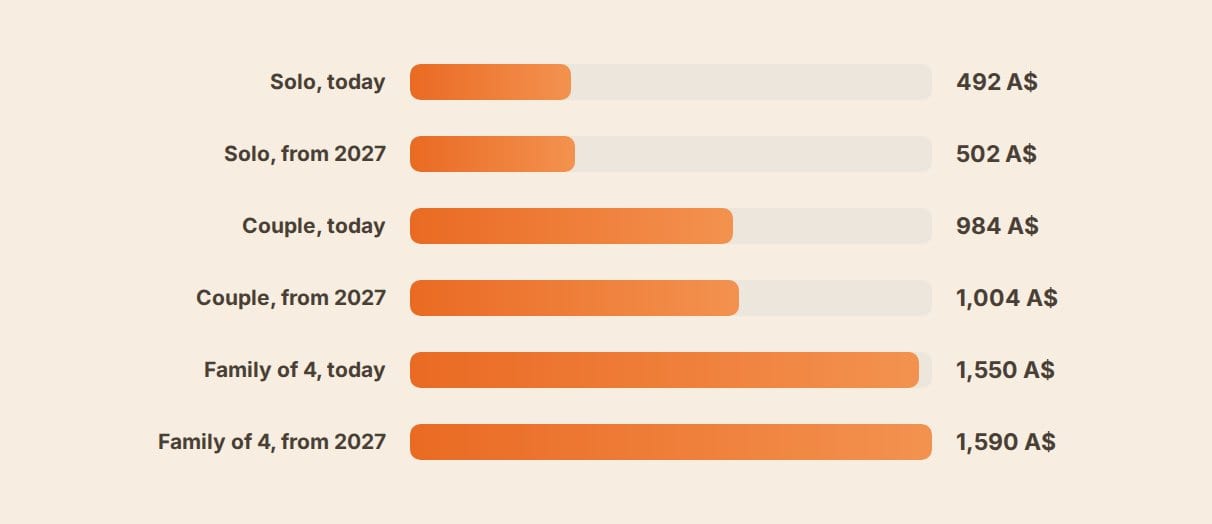
Gegevens: hcmc.consulate.gov.au, abf.gov.au, aph.gov.au
| Huishouden | Nieuwe paspoorten nodig | Totaal vandaag | Totaal vanaf 1 jan 2027* |
|---|---|---|---|
| Alleenstaande volwassene | 1 volwassene (A$422) | A$492 | A$502 |
| Koppel | 2 volwassenen (2 × A$422) | A$984 | A$1.004 |
| Gezin van vier (2 volwassenen, kinderen van 13 en 15) | 2 volwassenen (2 × A$422) + 2 kinderen (2 × A$213) | A$1.550 | A$1.590 |
*Het PMC-gedeelte van deze totalen stijgt pas zodra het wijzigingsvoorstel is aangenomen en 1 januari 2027 is aangebroken. De paspoortbedragen worden hier vlak gehouden omdat DFAT zijn geïndexeerde tarief voor 2027 nog niet heeft gepubliceerd, niet omdat de paspoortkosten zijn vrijgesteld van een eigen stijging.
Dat totaal voor een gezin van vier gaat ervan uit dat beide ouders en beide teenagers een gloednieuw boekje nodig hebben, wat het worstcasescenario is en het scenario waar het waard is om omheen te plannen als je er ooit eerder door bent getroffen. Het zijn vier volledige paspoortkosten plus vier PMC-heffingen, en niet twee volwassen kosten en een korting voor de kinderen. Als alleen de ouders vernieuwingen nodig hebben en de paspoorten van de teenagers nog een paar jaar meekunnen, daalt hetzelfde huishouden naar A$844 voor de twee volwassen paspoorten plus A$280 voor vier PMC-heffingen, oftewel A$1.124 vandaag.
Wat het getal het meeste beïnvloedt
Drie dingen bepalen of je huishouden ergens rond de goedkope kant hiervan uitkomt of rond de duurdere kant, en slechts één daarvan heb je volledig in eigen hand.
Hoeveel paspoorten in het huishouden tegelijkertijd aan vernieuwing toe zijn. Een gezin dat de vervaldatums één voor één bijhoudt, wordt nooit geconfronteerd met de volledige klap van A$1.270 in een enkel jaar. Een gezin dat vier boekjes tegelijk laat verlopen wel, plus de PMC erbovenop voor iedereen die meereist.
Ten tweede: aan welke kant van 1 januari 2027 je vertrekdatum valt, en of het wetsvoorstel tegen die tijd daadwerkelijk is aangenomen. Een ticket dat vandaag is gekocht voor een vertrek in maart 2027 is opnieuw een ander geval, en dat is de overgangskwestie waar onze gids over de PMC-stijging uitvoerig bij stilstaat, omdat het antwoord afhangt van precies wanneer je hebt gekocht, en niet alleen van wanneer je vliegt.
Ten derde, en gemakkelijk over het hoofd te zien: de leeftijd van een kind op de dag dat ze daadwerkelijk vertrekken. De PMC-vrijstelling stopt abrupt bij 11 jaar, niet geleidelijk. Een gezin dat vertrekt in de week nadat de jongste 12 is geworden, betaalt een PMC-heffing die er de week ervoor nog niet was, bovenop welke paspoortvernieuwing er toch al aan zit te komen.
Eén ding dat het getal helemaal niet verandert: vanaf welke Australische luchthaven je vliegt. Een gezin dat vertrekt vanuit Brisbane of Adelaide betaalt precies dezelfde PMC en paspoortkosten als een gezin dat vertrekt vanuit Sydney of Perth. De heffing is nationaal, niet haven-specifiek.
Foto: User:Orderinchaos · CC BY-SA 3.0, via Wikimedia Commons
De goedkope versie en de duurste versie van dezelfde reis
Hetzelfde huishouden, dezelfde bestemming, twee heel verschillende rekeningen, en de kloof daartussen draait volledig om timing.
Ieders paspoort is nog geldig. Een alleenreizende betaalt de vertrekheffing van A$70 aan pure overheidskosten om het land te verlaten. Een gezin van vier betaalt A$280. Geen bezoek aan het paspoortkantoor vereist.
Elk paspoort in het huishouden is tegelijkertijd verlopen, omdat niemand de datums in de gaten hield. Een gezin van vier betaalt vandaag A$1.550, en A$1.590 zodra de hogere vertrekheffing ingaat, nog voordat er ook maar één vlucht, hotel of maaltijd is geboekt.
We zeggen dit liever open en bloot dan eromheen te draaien: paspoortvernieuwingen uitstellen tot de maand voor een geboekte vlucht is hoe mensen uiteindelijk in de stress raken, en de kosten geven er niets om hoeveel bedenktijd je zelf hebt genomen. Vernieuw volgens een normale planning, niet uit paniek. Er is geen goedkopere optie meer beschikbaar zodra je al bij de vertrekbalie staat en je je afvraagt of je boekje nog wel genoeg lege pagina's over heeft.
De vernieuwingsdatum, de bon en de PMC-regel allemaal op één plek bewaren, in plaats van verspreid over e-mailbevestigingen en een la, is precies waarom een checklist voor reisdocumenten zijn geld waard is. De eigen documentopslag en kostenbijhouding in meerdere valuta's van TripProf zijn precies hiervoor bedoeld: leg de paspoortkosten en de PMC vast als één enkele post tegenover de reis, zodat het totaal zichtbaar is voordat je ook maar een dollar hebt uitgegeven aan de daadwerkelijke vakantie.
Hoe dit zich verhoudt tot andere overheidskosten die Australiërs betalen om te reizen
Alleen de vertrekheffing maakt het vertrek uit Australië niet het duurste ter wereld. Het haalt niet eens de top acht.
Volgens IATA-gegevens gerapporteerd in april 2026, uit een rapport dat de vereniging in november 2025 uitbracht, brengt Argentinië de hoogste gemiddelde vertrekbelasting ter wereld in rekening met ruwweg US$138 per passagier (ongeveer A$242 tegen de wisselkoersen van april 2026), gevolgd door Mauritius, Mexico, het VK, de Dominicaanse Republiek, de VS, Egypte en Kenia. De Australische PMC van A$70 komt neer op ongeveer US$40 ten tijde van dat rapport, ruim buiten de top acht. Ranglijsten over de paspoortkosten zelf zijn onduidelijker dan die van de vertrekheffing, en we konden geen onbetwiste vergelijking vinden die het waard is om hier af te drukken, dus we doen geen bewering over het "duurste paspoort ter wereld" in dit stuk. De combinatie van reële paspoortkosten en een reële vertrekheffing is wat dit specifiek voor een Australiër duur maakt, en niet een enkel recordbrekend getal.
Het is ook niet de enige heffing die zich rond dezelfde reis opstapelt. Iedereen die naar Europa of het VK reist, kijkt naar de Britse ETA en uiteindelijk ETIAS daarbovenop. Iedereen die via China reist, moet controleren wanneer het huidige visumvrije venster daadwerkelijk eindigt voordat wordt aangenomen dat de regels van vorig jaar nog gelden. Geen van al die kosten zijn Australische overheidskosten, maar ze komen wel terecht op dezelfde reis en hetzelfde creditcardoverzicht.
Veelgestelde vragen
Is A$502 de huidige kostprijs om Australië te verlaten?
Nee. A$502 is de paspoortvergoeding plus de hogere vertrekheffing van A$80, en die hogere heffing geldt pas zodra de Passenger Movement Charge Amendment Bill 2026 is aangenomen en de ingangsdatum van 1 januari 2027 is aangebroken. Sinds deze week ligt het wetsvoorstel nog steeds bij het Huis van Afgevaardigden, dus het eerlijke getal van vandaag voor een alleenreizende die een nieuw paspoort nodig heeft, is A$492.
Moet ik mijn paspoort vernieuwen alleen omdat ik internationaal reis?
Alleen als het binnenkort verloopt, beschadigd is of al is verlopen. De meeste landen vereisen ten minste zes maanden resterende geldigheid, dus controleer je vervaldatum tegen je reisdatums voordat je aanneemt dat je een nieuw boekje nodig hebt. Als je paspoort geldig is voor de hele reis, betaal je alleen de Passenger Movement Charge, en niet de paspoortkosten.
Geldt de Passenger Movement Charge voor elk internationaal vertrek?
Ja, met specifieke vrijstellingen. Iedereen van 11 jaar of jonger op de datum van vertrek is vrijgesteld, evenals bemanning, transitpassagiers die de douane niet passeren, diplomaten en een korte lijst van andere categorieën die de Australian Border Force uiteenzet op haar eigen PMC-pagina. Al het overige betaalt het eenmalig, per vertrek, ongeacht de bestemming, inclusief korte vluchten naar Nieuw-Zeeland.
Waarom stijgen de paspoortkosten elke januari opnieuw?
Omdat ze wettelijk elk jaar worden geïndexeerd aan de hand van de consumentenprijsindex, in tegenstelling tot de vertrekheffing, die alleen verandert wanneer het parlement nieuwe wetgeving aangenomen heeft. Een woordvoerder van het Department of Foreign Affairs and Trade (DFAT) heeft bevestigd dat de kosten jaarlijks worden aangepast "in lijn met de consumentenprijsindex", wat de reden is waarom ze dit jaar stegen van A$412 naar A$422 en rond 1 januari 2027 opnieuw zullen stijgen, ongeacht wat er gebeurt met de PMC-wet. DFAT heeft dat getal voor 2027 nog niet gepubliceerd, dus beschouw A$422 als het tarief van vandaag, en niet dat van volgend jaar.
Wat gebeurt er als ik al een vlucht heb geboekt voor na 1 januari 2027?
Dat hangt ervan af wanneer je het ticket hebt gekocht ten opzichte van het aannemen van het wetsvoorstel, en de regels zijn echt ingewikkelder dan een enkele datum. Onze specifieke gids over de PMC-stijging loopt de overgangsregelingen volledig door, omdat die voor die specifieke vraag belangrijker zijn dan voor de totale kostenwiskunde in dit stuk.
Krijgt iemand van 16 of 17 jaar het goedkopere kinderpaspoort?
Nee. Het paspoort van vijf jaar voor A$213 is uitsluitend voor kinderen jonger dan 16, volgens de eigen tariefcategorieën van het Australian Passport Office. Iemand van 16 of 17 betaalt het volledige volwassen tarief van A$422 voor een 10-jarig paspoort, hetzelfde als iedereen van 18 of ouder.
Belangrijkste punten
- Het echte totaal van vandaag voor een alleenreizende die een nieuw paspoort nodig heeft, is A$492: A$422 voor het paspoort plus A$70 voor de Passenger Movement Charge. A$502 is een prognose, geen huidig feit, en geldt pas zodra de PMC-wet is aangenomen en 1 januari 2027 aanbreekt.
- Een gezin van vier dat vier verse paspoorten nodig heeft (twee volwassenen, twee kinderen jonger dan 16) betaalt vandaag A$1.550 aan alleen al overheidskosten, nog los van vluchten, accommodatie of iets anders.
- De paspoortkosten stijgen elke januari door automatische CPI-indexatie. De vertrekheffing stijgt alleen wanneer het parlement een wetsvoorstel aangenomen heeft, wat de reden is waarom de twee getallen op verschillende schema's bewegen.
- Iemand van 16 of 17 betaalt het volledige volwassen paspoorttarief, niet het goedkopere kindertarief. Controleer dit voordat je gaat budgetteren voor de vernieuwing van een tiener.
- Bewaar de vervaldatum van het paspoort en de vertrekheffingsregel op dezelfde plek als je andere reisdocumenten, zodat je eromheen plant in plaats van ze pas op de luchthaven te ontdekken.
Bronnen
- Australian Passport Office (DFAT): officiële tariefschema voor paspoortaanvragen, van kracht op 1 januari 2026
- Consulaat-Generaal van Australië, Ho Chi Minh-stad: tariefschema voor paspoorten ter bekrachtiging van de binnenlandse tarieven voor 2026
- Australian Border Force: huidige tarief en vrijstellingscategorieën voor de Passenger Movement Charge
- Parlement van Australië: Passenger Movement Charge Amendment Bill 2026, status en voortgang
- SBS News: stijging van de Passenger Movement Charge, opbrengstcijfers en overheidsformulering
- Australian Frequent Flyer: reactie vanuit de industrie op de stijging van de vertrekheffing
- The Canberra Times: geschiedenis van paspoortkosten en bevestiging van CPI-indexatie
- CNN Style, via ABC17 News: wereldwijde vergelijking van vertrekbelastingen, op basis van het IATA-rapport van november 2025
- Wikipedia: achtergrond en wetgevingsgeschiedenis van de Passenger Movement Charge
Blijf lezen
Meer reistips en gidsen voor jou geselecteerd
What counts as visiting a state? Layovers, drive-throughs and the rules 50-staters use
Only 2% of Americans name a plane change as the minimum that counts as visiting a state, while 27% set the bar at driving through. Here's a three-tier rubric, a lookup table for the edge cases from Four Corners to D.C., and one trip counted three ways.

De neppe SBB-ticketwebsite die creditcard- en Twint-gegevens steelt van reizigers
De kantonpolitie van Zürich bevestigt dat een neppe SBB-ticketwebsite betaalgegevens van creditcards en Twint steelt van reizigers die deze via een gewone Google-zoekopdracht vinden. Dit is hoe je hem herkent en wat je kunt doen als je al hebt betaald.

Waarschuwing voor Britse ETA-oplichting: nepsites rekenen Oostenrijkers tot wel 900 euro
Nepsites voor de Britse ETA laten Oostenrijkse en andere Europese reizigers honderden euro's betalen voor een formulier van slechts 20 pond. Lees hier hoe de echte aanvraag werkt en hoe je oplichting herkent.