Where to travel in January 2027: warm US trips, no passport
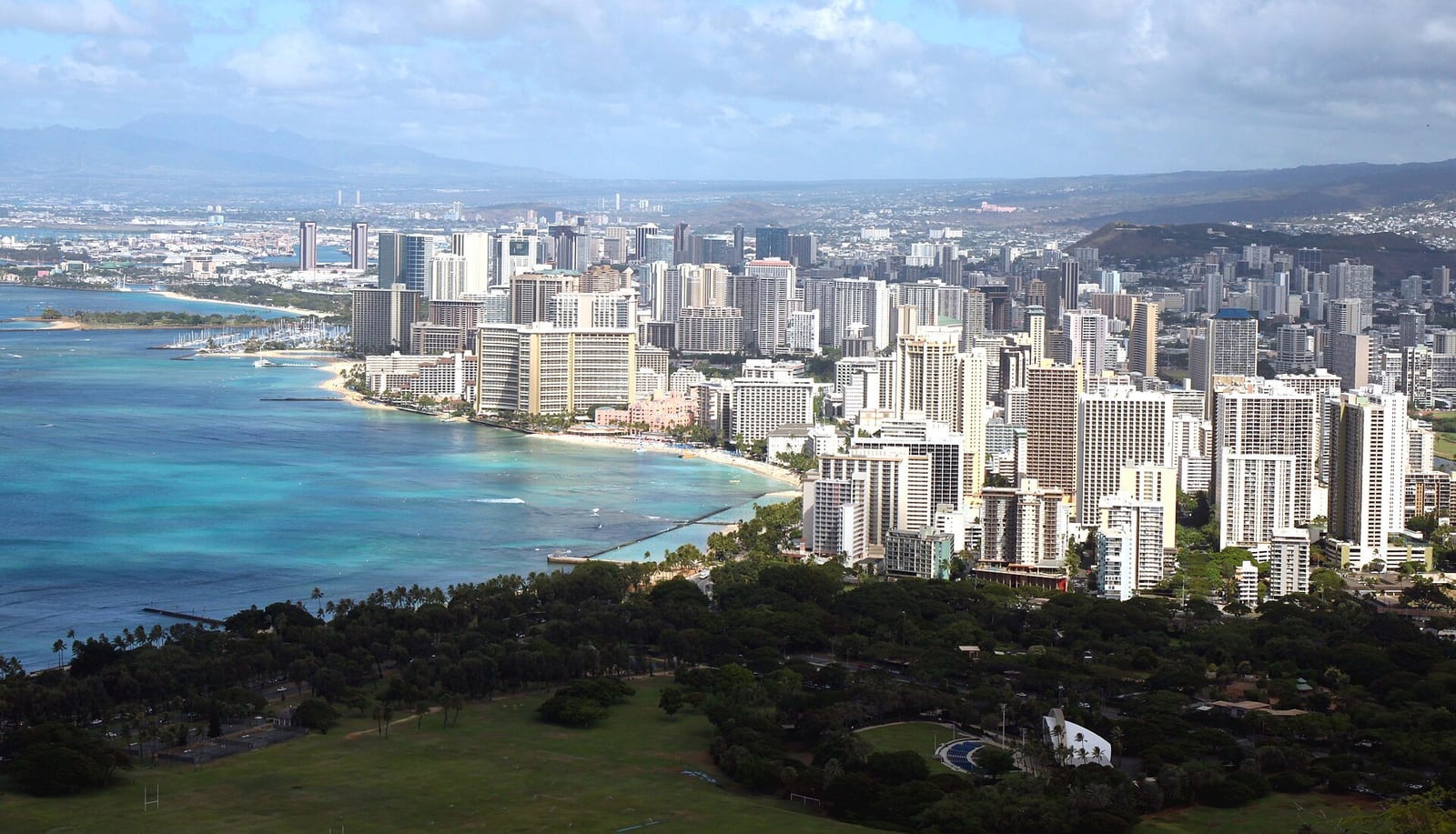
Photo: Prayitno / Thank you for (12 millions +) view from Los Angeles, USA · CC BY 2.0, via Wikimedia Commons
Key Highlights
- 1
- 2
- 3
+2 more in the takeaways below
On a normal January day, Fairbanks, Alaska tops out at 0.6°F. Charlotte Amalie, on St. Thomas, reaches 84.1°F. Both sit on US soil.
So where to travel in January 2027? For warmth, St. Thomas, San Juan or Honolulu, all in the 80s. For a trip worth the cold, Bryce Canyon, Yellowstone or Fairbanks. No pick needs a passport for a US citizen: USA.gov lists the territories, and the rest are states. The thing that can still stop you at the airport is the ID in your wallet.
We ranked eight picks, with the ID rules and one honest downside for each. Guam runs warmer than all of them at 85.9°F, but it sits 18 hours ahead of Pacific Standard Time, and the four warmest places sit close enough that the downside should decide.
- No passport needed: USA.gov says, as of March 2026, that US citizens don't need one to travel between the US and Puerto Rico, the US Virgin Islands, Guam or the Northern Mariana Islands. The USVI tourism department words it for citizens arriving from Puerto Rico or the mainland. American Samoa is the exception. Guam's own bureau asks for more than that, below.
- Still bring ID: flying within the US needs a REAL ID or a passport.
- Warm picks: Guam, St. Thomas, San Juan and Honolulu have normal January highs of 85.9°F, 84.1°F, 83.2°F and 80.5°F. That's close, so choose on the downside you can live with.
- Cold picks: Bryce Canyon under snow, Yellowstone by snowcoach and Fairbanks for the aurora.
Which places need no passport for US citizens
As of March 2026, USA.gov lists Puerto Rico, the US Virgin Islands, Guam and the Northern Mariana Islands as places US citizens can reach without a passport. It says American Samoa is different: you need a passport or a certified US birth certificate to enter. Hawaii and Florida are states, so the question never comes up.
| Place | Status | Passport for a US citizen? |
|---|---|---|
| Hawaii | State | Not needed |
| Florida | State | Not needed |
| Puerto Rico | Territory | Not needed |
| US Virgin Islands | Territory | Not needed when arriving from Puerto Rico or the mainland |
| Guam | Territory | Not needed, per USA.gov; the bureau asks for REAL ID or photo ID plus birth certificate via Hawaii |
| Northern Mariana Islands | Territory | Not needed, per USA.gov; check CBP for your exact route |
| American Samoa | Territory | Passport or certified birth certificate |
The US Virgin Islands row carries a condition. The territory's own tourism department words the exemption for citizens arriving from Puerto Rico or the US mainland. So book a routing that stays inside the US.
The same logic applies to Guam and the Northern Mariana Islands. CBP's carrier guide says citizens who travel directly between the US and its territories, without touching at a foreign port or place, don't have to present a passport. That guide is dated February 2019, and we couldn't find a current cbp.gov page stating the citizen rule.
An old Guam Visitors Bureau sheet, whose file dates from 2013, says citizens are required to possess a US passport, with photo ID and proof of citizenship accepted case by case. The bureau's current entry page says US citizens 18 and older traveling domestically to Guam via Hawaii must present a REAL ID or a valid photo ID, plus an original or certified copy of their birth certificate. Confirm with CBP before you book if your route touches a foreign airport.
If anyone in your party isn't a US citizen, check CBP's rules for that traveler before you book. Everything above is about citizens.
As of November 2026, TSA says travelers must be REAL ID compliant to board domestic flights, and a passport works in place of a REAL ID. Since Feb 1, 2026, TSA offers a $45 ConfirmID option if you show up without an acceptable ID. Our travel document checklist covers the rest of the paperwork.
We'd treat that $45 as a penalty, not a plan. Check your license for the star before you book anything.
January weather at a glance
These nine weather stations run from a normal January high of 85.9°F on Guam to 0.6°F in Fairbanks. That's an 85.3-degree spread, all on US soil.
| Place | Normal January high (°F) |
|---|---|
| Guam | 85.9 |
| St. Thomas | 84.1 |
| San Juan | 83.2 |
| Honolulu | 80.5 |
| Miami | 76.2 |
| Key West | 75.8 |
| Bryce Canyon | 36.9 |
| Old Faithful | 28.3 |
| Fairbanks | 0.6 |
Those are the NOAA NCEI 1991-2020 normals, the latest 30-year averages. Guam's comes from its international airport station. The chart shows how far the warm picks sit from the cold ones, and how close Miami and Key West are to each other.
| Place | NOAA station | Normal high (°F) | Normal low (°F) | Precipitation (in) |
|---|---|---|---|---|
| Guam | Guam Intl AP | 85.9 | 75.4 | 5.34 |
| St. Thomas | Charlotte Amalie AP | 84.1 | 73.6 | 2.64 |
| San Juan | San Juan L M Marin AP | 83.2 | 71.9 | 4.07 |
| Honolulu | Honolulu Intl AP | 80.5 | 66.8 | 1.84 |
| Miami | Miami Intl AP | 76.2 | 61.0 | 1.83 |
| Key West | Key West Intl AP | 75.8 | 65.5 | 1.83 |
| Bryce Canyon | Bryce Canyon NP HQRS | 36.9 | 17.0 | 1.91 |
| Old Faithful | Old Faithful, WY | 28.3 | 1.1 | 2.08 |
| Fairbanks | Fairbanks Intl AP | 0.6 | -17.2 | 0.61 |
Airport stations sit at sea level, so a beach resort or a mountain lodge can run a few degrees off. Treat the table as a ranking, not a forecast. The top four are close enough that those few degrees could reshuffle them.
Warm picks, from the highest January normal down
Five warm places make the list: Guam, St. Thomas, San Juan, Honolulu and Florida. Each one is reachable without a passport for a US citizen (USA.gov lists the territories; Honolulu and Florida are states), and each one comes with a trade-off we'd want to know before booking.
Guam: 85.9°F and an 18-hour time gap
Guam has the highest January normal here, a 85.9°F high and a 75.4°F low at the international airport station. It also has the most rain of the warm picks: a January precipitation normal of 5.34 inches, per NOAA.
The main trade-off is the clock. The Guam Visitors Bureau's information sheet (c. 2013) says Guam is 18 hours ahead of Pacific Time. That works out to 18 hours ahead of Pacific Standard Time, and 17 during US daylight time. We couldn't source a flight time, so we won't quote one.
Routing matters too. As covered above, the CBP exemption describes direct travel, and the bureau's current page asks US citizens flying via Hawaii for a REAL ID or photo ID plus a birth certificate, not a passport. Guam has no January event we could source. We'd pick Guam for a long trip that can absorb the time change. We'd skip it for a long weekend.
St. Thomas, US Virgin Islands: 84.1°F and a routing rule
St. Thomas has a normal January high of 84.1°F and a low of 73.6°F at the Charlotte Amalie airport station. The January precipitation normal is 2.64 inches, per NOAA.
Timing helps here. The Atlantic hurricane season runs from June 1 to November 30, so January sits well outside it.
The catch is routing. The territory's tourism department words the passport exemption for citizens arriving from Puerto Rico or the mainland, so a flight that connects through a foreign airport isn't covered by that wording. Book a US routing and keep your REAL ID handy.
St. Thomas is 0.9°F warmer than San Juan on paper, which is inside the few degrees of error we flagged. We'd pick it for its lower January rain normal than San Juan's (2.64 vs 4.07 inches), not for the extra degree.
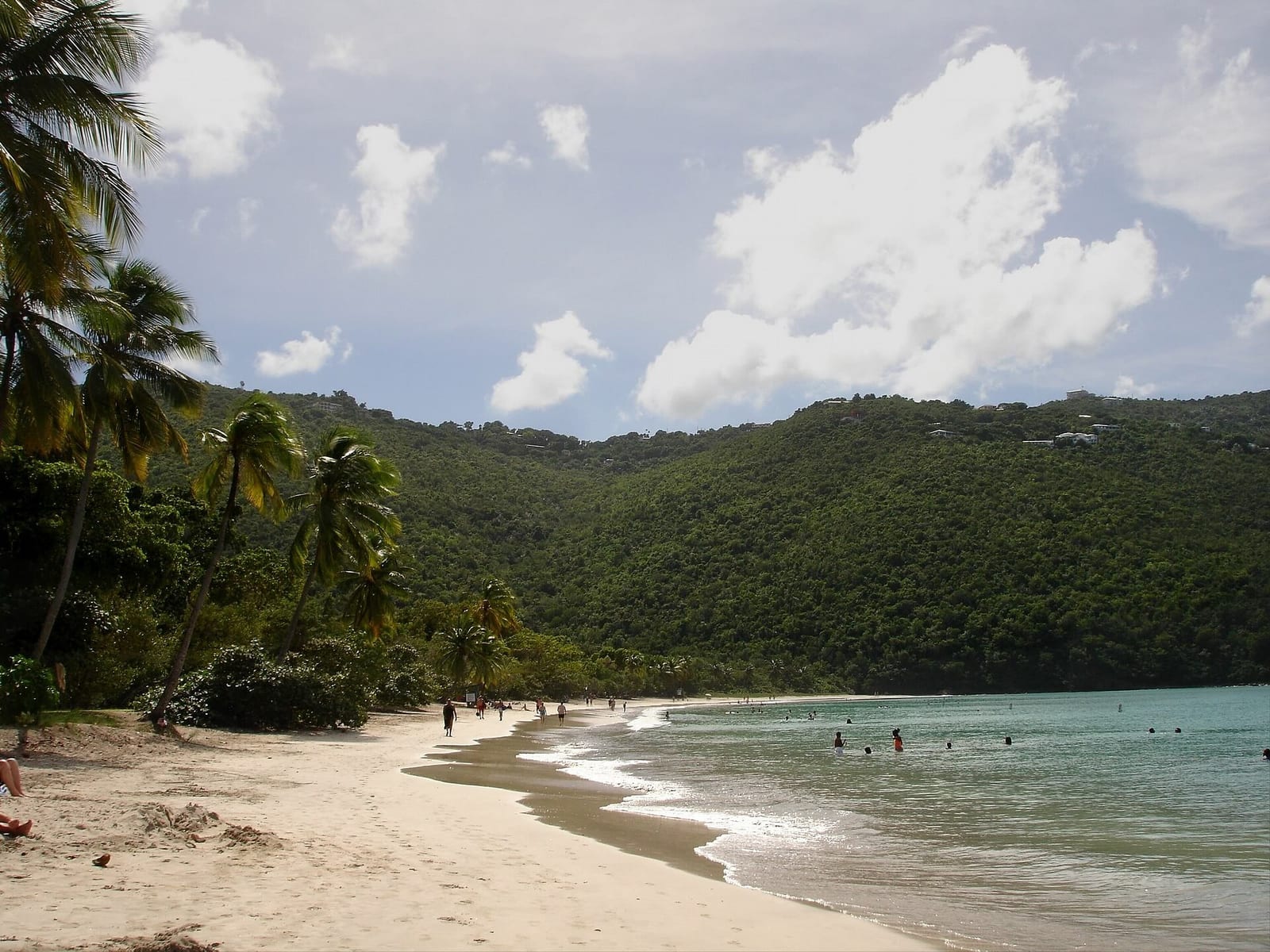
Photo: MARELBU · CC BY 3.0, via Wikimedia Commons
Puerto Rico: San Juan's 83.2°F and the San Sebastian Street Festival
San Juan runs a normal January high of 83.2°F and a low of 71.9°F, NOAA's San Juan station shows. USA.gov lists Puerto Rico among the places a US citizen can reach without a passport.
One date to know: San Juan's mayor announced the San Sebastian Street Festival for Jan 21 to 24, 2027 in Old San Juan, as Metro Puerto Rico reported in March 2026. That's a Thursday to Sunday. Dates can move, so check them against your flights before you pay for a room.
The weather is the other catch. San Juan is wetter than St. Thomas and Honolulu: its January precipitation normal is 4.07 inches, more than double Honolulu's 1.84 inches. Pack a rain jacket and plan one indoor day.
We'd skip the festival weekend unless the crowd is the point, and book the week before or after for the beach.
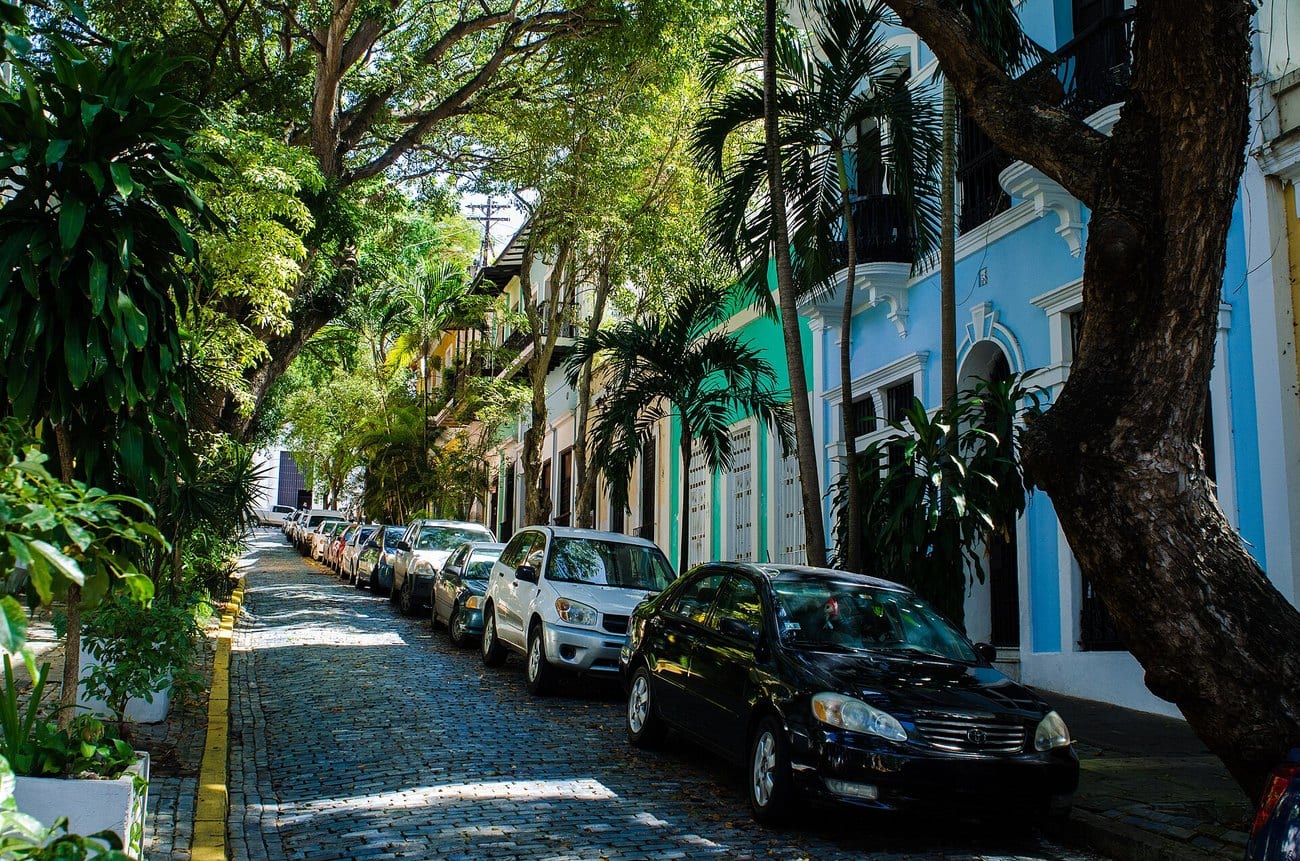
Photo: Jeff Hitchcock · CC BY 2.0, via Wikimedia Commons
Hawaii: Honolulu's 80.5°F, whale season and rough North Shore surf
Honolulu's normal January high is 80.5°F with a low of 66.8°F and 1.84 inches of rain, NOAA's Honolulu station reports. That makes Honolulu about as dry as Miami.
The reason to go now is the whales. NOAA's sanctuary says humpback season generally runs from November through May, with the usual peak from January through March. It's illegal to approach within 100 yards of a humpback, so bring binoculars, not ambitions.
The spending figure comes from the state's January 2026 visitor release, published in February 2026. It's what all visitors spent on an average day, not a price list, and January 2027 numbers don't exist yet.
Cost is the first thing to plan around, and the $276 a day average is the only Hawaii spending figure we could source. Your own number depends on where you stay and how you eat. Before you book a resort, read our guide to how the FTC's resort fee rule changes the price you see.
The second is the ocean. Hawaii's state ocean safety site lists winter season as November through April and warns of consistent huge and dangerous swells on North Shore beaches. We'd check the surf report before any North Shore beach day.
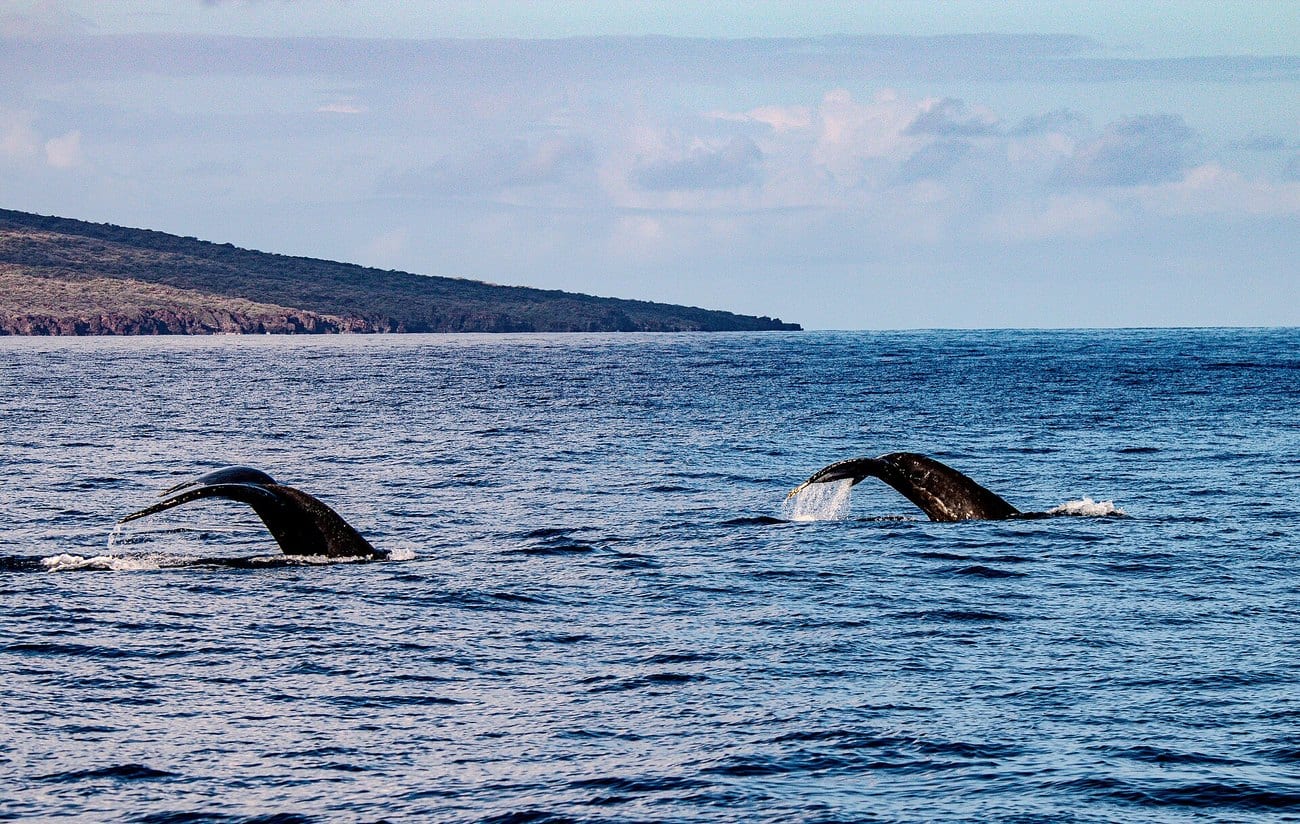
Photo: Peckphotographyart · CC BY-SA 4.0, via Wikimedia Commons
Florida: Miami and Key West, the coolest of the warm picks
Florida is the coolest of the warm picks. Miami's normal January high is 76.2°F, and its normal low is 61.0°F. Key West runs 75.8°F and 65.5°F. Both average 1.83 inches of rain in January.
Florida has no January-only draw we could source; it's the easy pick. It's a state, so no passport question exists, and January is outside the Atlantic hurricane season. You still need a REAL ID or a passport to fly there.
The trade-off is the temperature: Miami's normal high is about 8 degrees below St. Thomas's. A 61.0°F Miami morning needs a sweater.
We'd pick Florida for patios, walking and the Keys. We'd skip it if you want the hottest beach weather on this list.
Cold-weather picks for January
Three cold places earn a spot because their January appeal is real and checkable: Bryce Canyon for hoodoos under snow, Yellowstone for winter in a snowcoach, and Fairbanks for the aurora. None needs a passport for a US citizen, and all three need warm layers. They're listed warmest to coldest.
Bryce Canyon, Utah: hoodoos under snow, with closures
Bryce Canyon's headquarters station shows a normal January high of 36.9°F, a low of 17.0°F and 19.8 inches of snow. That's cold but nowhere near Fairbanks.
The draw is snow on the rock formations. Snowshoeing is allowed on all trails, and after a big snowfall most day hiking trails require snowshoes.
Road closures are the hazard to plan for. NPS says the 18-mile Main Road will occasionally close to all traffic beyond Mile 3, and ranger programs become less frequent in winter. That page was last updated in March 2024, so confirm current conditions with the park before you drive in, and plan winter driving accordingly.
We'd pick Bryce if you want a short, snowy trip. We'd skip it if you can't handle a closed road.
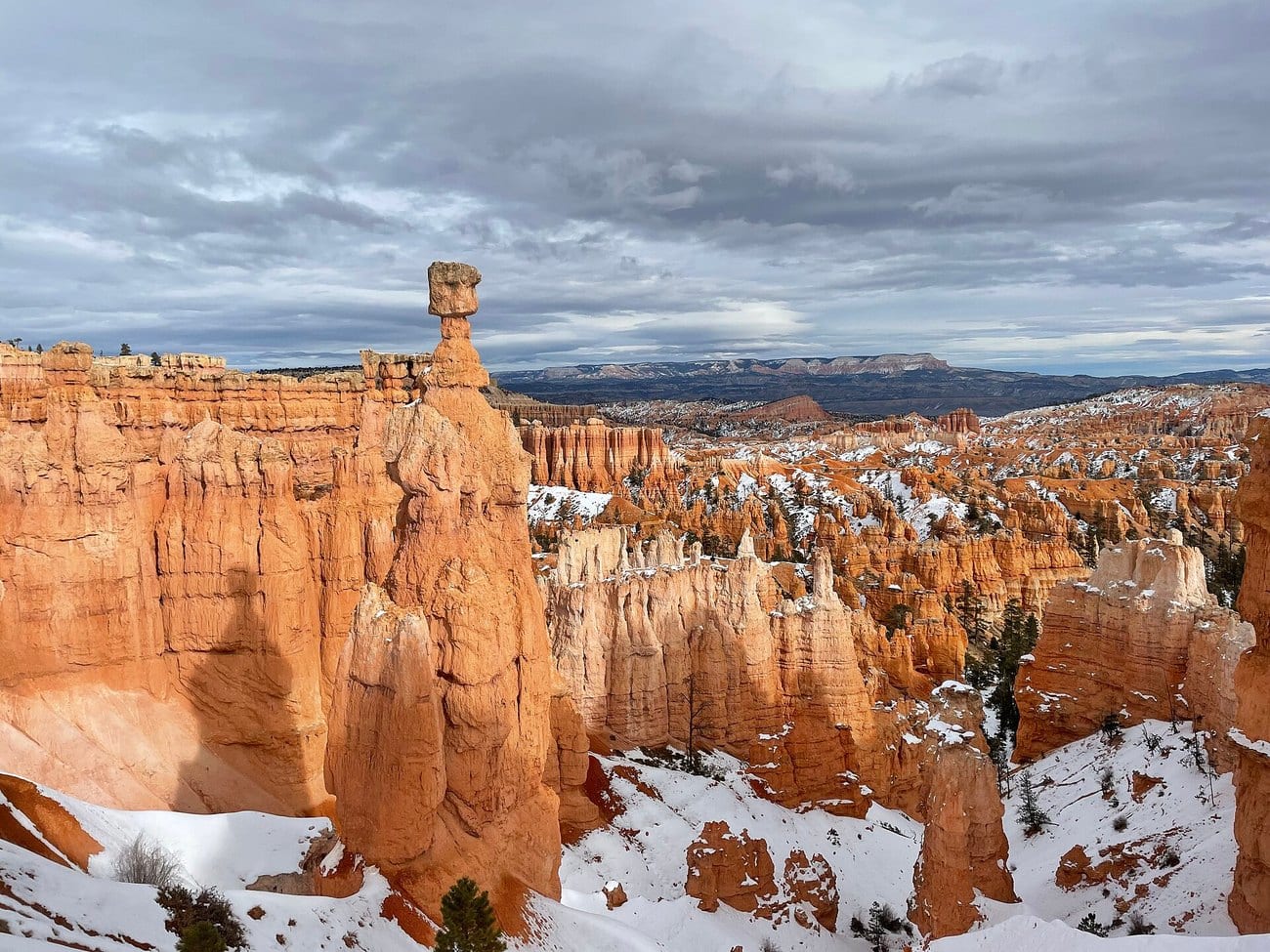
Photo: Bigwiggy · CC BY 4.0, via Wikimedia Commons
Yellowstone: Old Faithful by snowcoach, from Dec 15, 2026
Yellowstone's winter season opens Dec 15, 2026 for over-snow travel, and the NPS road page lists end dates that vary by segment. Mammoth Hot Springs to Norris runs to March 7, 2027. Norris to Madison and Norris to Canyon Village runs to March 9, and Canyon Village to Fishing Bridge to March 14.
The West, South and East entrances and all remaining groomed roads run to March 15. NPS adds that all dates are subject to change due to weather or other circumstances. At the Old Faithful station, January normals are a 28.3°F high, a 1.1°F low and 35.6 inches of snow.
Getting around is the hard part. Last winter's NPS release listed commercially guided snowmobiles and snowcoaches, plus a separate non-commercially guided snowmobile access program, as the ways to travel park roads in winter. The only roads open year-round run from the North Entrance toward the Northeast Entrance through Mammoth.
The Old Faithful Snow Lodge is listed on NPS's operating dates page for Dec 16 to Mar 6. We'd book the lodge and a guided over-snow ride together, not one at a time.
We'd pick Yellowstone for anyone who likes snow and doesn't need to drive. We'd skip it if you want a spontaneous road trip.
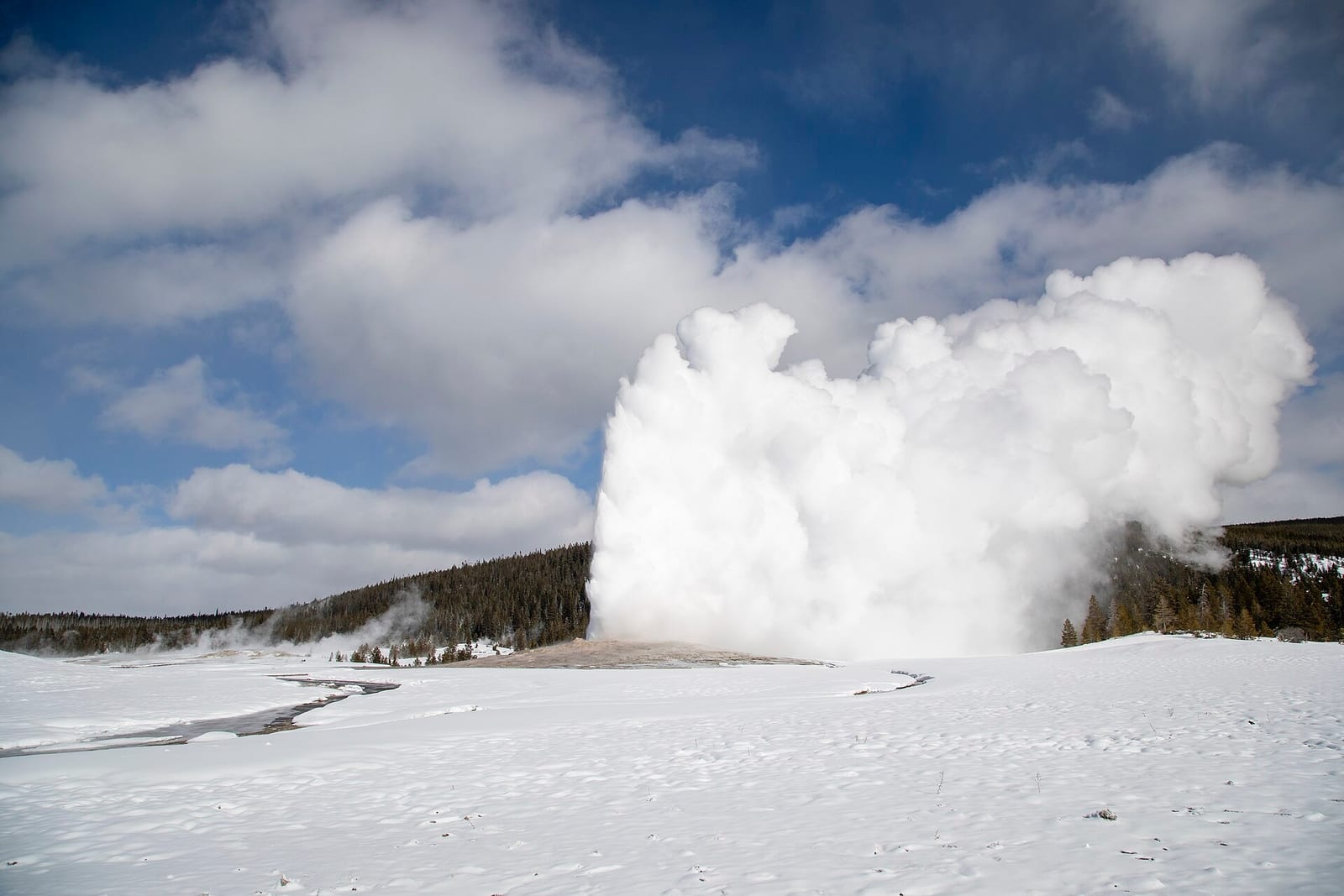
Photo: YellowstoneNPS · Public domain, via Wikimedia Commons
Fairbanks, Alaska: aurora season and a -17.2°F normal low
Fairbanks has a normal January high of 0.6°F and a low of -17.2°F, with 10.2 inches of snow in an average January. It's the coldest place on this page by a wide margin.
The sky is the draw. Explore Fairbanks, the local visitors bureau, says aurora season runs from August 21 to April 21. It says the lights are visible an average of four out of five nights when the sky is clear and dark enough.
The bureau also claims that staying at least three nights lifts your chance of seeing them above 90 percent. That's a tourism board's own number, so read it as marketing, not a forecast.
The cold is the real hazard, and we won't soften it. Dress in layers, keep your skin covered outdoors, and ask your lodging or rental company how to prepare a vehicle for nights this cold.
We'd pick Fairbanks if the aurora is the whole point of the trip. We'd skip it if that kind of cold is a dealbreaker.
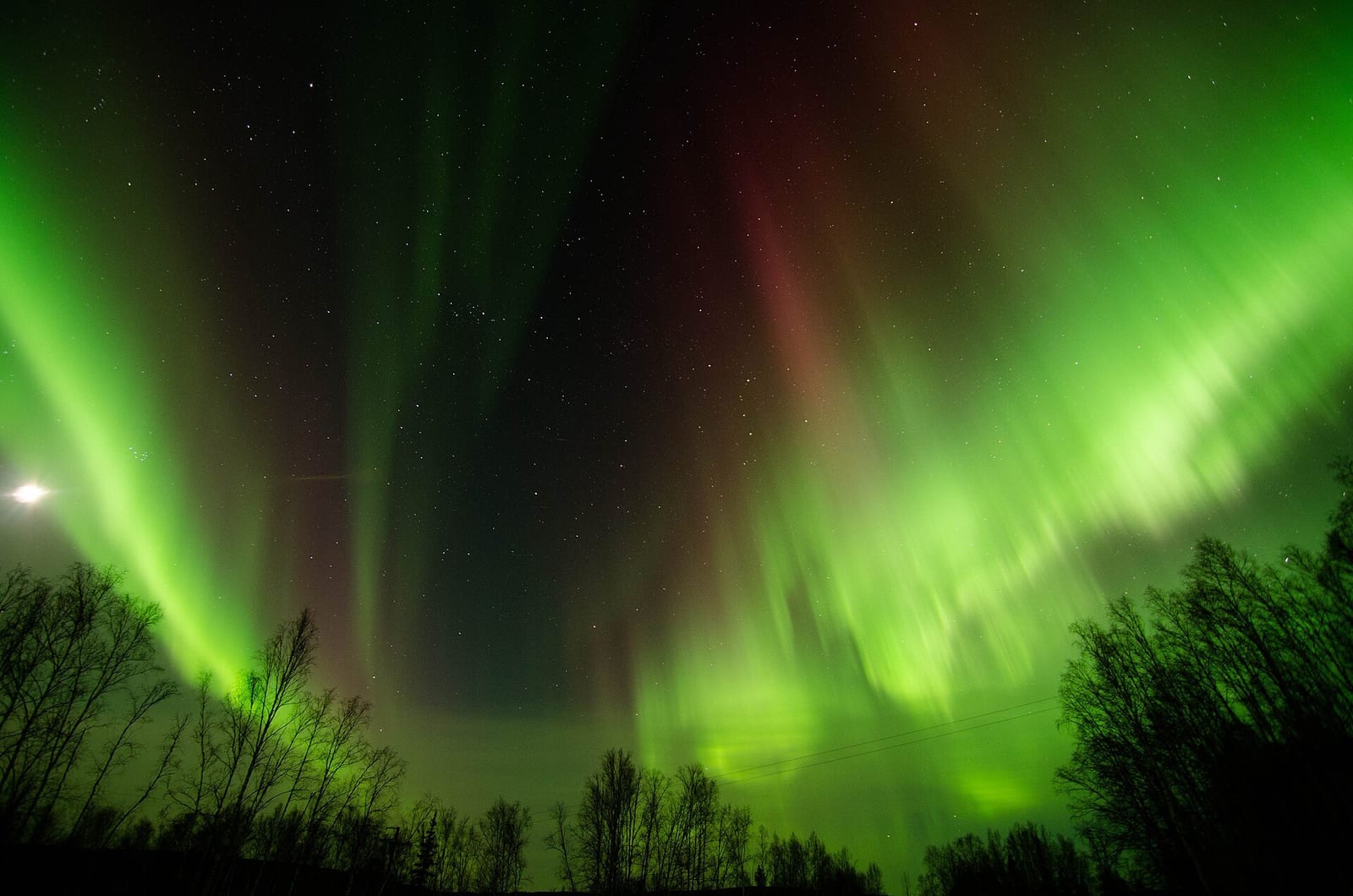
Photo: FairbanksMike · CC BY 2.0, via Wikimedia Commons
Who should skip each pick
Every pick on this list has someone it's wrong for. Here's who we'd steer away from each one.
- Guam: skip it if you only have a few days, or can't confirm a route that avoids foreign airports.
- St. Thomas: skip it if your flight has to connect through a foreign airport.
- San Juan: skip it if rain bothers you, or if a packed street party isn't your idea of a break.
- Hawaii: skip it if your budget sits well below what visitors averaged per day in January 2026.
- Florida: skip it if you want the hottest beach weather on this list.
- Bryce Canyon: skip it if you can't plan around a closed road.
- Yellowstone: skip it if you want to self-drive.
- Fairbanks: skip it if that kind of cold is a dealbreaker.
How we chose these eight
We chose these eight by starting with places a US citizen can reach without a passport, then ranked them by NOAA's normal January high. Each pick needed one extra fact from an official source, like a season date or a rule, and one downside we could back up. Florida counts as one pick with two weather stations, Miami and Key West, which is why the chart shows nine.
We left the Northern Mariana Islands and American Samoa off the ranking. USA.gov lists the first as passport-free, but we didn't pull NOAA normals for it and we won't guess a January forecast. American Samoa needs a passport or a certified birth certificate.
If you're going abroad in winter instead, our winter 2026-2027 destination list covers places with a date you can check. And if you like marking off where you've been, TripProf's free states map counts Puerto Rico, Guam, the US Virgin Islands, American Samoa and the Northern Mariana Islands as paintable units.
Frequently Asked Questions
Where should I travel in January 2027?
For warmth, we'd pick St. Thomas, San Juan or Honolulu, with normal January highs of 84.1°F, 83.2°F and 80.5°F. For cold, we'd pick Bryce Canyon under snow, Yellowstone by snowcoach or Fairbanks for the aurora. All of them are reachable without a passport for US citizens arriving from the mainland.
Which US territories don't need a passport?
USA.gov lists Guam, the Northern Mariana Islands, Puerto Rico and the US Virgin Islands as places US citizens can reach without a passport. American Samoa is the exception: it requires a passport or a certified US birth certificate to enter. For Guam and the Northern Mariana Islands, check CBP for your exact route. Guam's tourism bureau asks US citizens flying via Hawaii for a REAL ID or photo ID plus a birth certificate.
Do I need a passport for the US Virgin Islands?
You don't need a passport for the US Virgin Islands if you're a US citizen arriving from Puerto Rico or the US mainland, according to the USVI tourism department. You still need a REAL ID or another acceptable ID to fly. Book a routing that stays inside the US.
What ID do I need to fly within the US in 2027?
To fly within the US you need a REAL ID or a passport. TSA says you must be REAL ID compliant to board domestic flights, and a passport works in place of one. Since Feb 1, 2026, travelers without an acceptable ID can pay $45 to use TSA ConfirmID.
Which place on this list is warmest in January?
Guam, with a normal January high of 85.9°F. St. Thomas follows at 84.1°F, then San Juan at 83.2°F and Honolulu at 80.5°F, based on NOAA's 1991-2020 normals. Those four are close enough that we'd choose on the downside, not the thermometer. We didn't check every US location, so we don't claim a national ranking.
Can I bring fruit home from Hawaii, Puerto Rico or the US Virgin Islands?
You can bring some fruit home, but not all. Present all food and plants to a USDA inspector at the airport before you leave. For Puerto Rico and the US Virgin Islands, APHIS says all fresh fruits and vegetables are prohibited except those on its allowed lists. Check the APHIS allowed list for mangoes before you pack them. Hawaii's rules differ: fresh fruits and vegetables are off limits with exceptions such as pineapple, and some fruits need treatment. Check the APHIS list for your departure point.
Is there a health notice for Puerto Rico or the US Virgin Islands?
CDC's Level 1 Global Measles notice, last reviewed May 28, 2025, lists both. Level 1 means usual precautions. Check CDC's travel notices for the current notice before you go.
Key Takeaways
- Choose on the downside, not the thermometer. Guam, St. Thomas, San Juan and Honolulu sit within about 5.5 degrees of each other, so pick the trade-off you can live with: Guam's time gap, St. Thomas's routing, San Juan's rain or Hawaii's cost.
- Carry a REAL ID or a passport. No passport for a territory doesn't mean no ID at the TSA checkpoint.
- Know Hawaii's spending baseline, plan around San Juan. Visitors spent an average of $276 a day per person in Hawaii in January 2026, and the San Sebastian festival runs Jan 21 to 24, 2027.
- Choose cold on purpose. Bryce Canyon, Yellowstone and Fairbanks each trade comfort for something you can't get on a beach, so match the pick to the reason.
- Keep score. TripProf's free states map has a unit for Puerto Rico, the US Virgin Islands and Guam, so the trip counts on a map you can share.
Pick the trade-off first, check the ID second, and book the dates that have an official source behind them.
Sources
- USA.gov: passport rules for US territories
- CBP Carrier Information Guide (February 2019): direct travel between the US and its territories
- Guam Visitors Bureau general information sheet (c. 2013): time zone
- Guam Visitors Bureau, entry and exit formalities: current ID rule for US citizens
- TSA REAL ID page: domestic flight ID requirement
- TSA acceptable IDs: acceptable IDs and ConfirmID fee
- US Virgin Islands Department of Tourism: passport statement
- NOAA NCEI US Climate Normals 1991-2020: January temperature, precipitation and snow
- NOAA National Hurricane Center: Atlantic hurricane season dates
- NOAA Hawaiian Islands Humpback Whale National Marine Sanctuary: season, peak and approach distance
- Hawaii Ocean Safety: winter surf season
- Hawaii DBEDT: January 2026 visitor statistics
- USDA APHIS: leaving Puerto Rico and the US Virgin Islands with agricultural items
- USDA APHIS: leaving Hawaii with agricultural items
- CDC Travelers' Health: current travel health notices
- Metro Puerto Rico: San Sebastian Street Festival 2027 dates
- Explore Fairbanks: aurora season
- National Park Service, Yellowstone road dates: winter over-snow dates
- National Park Service, Yellowstone operating dates: Old Faithful Snow Lodge
- National Park Service, Yellowstone winter release: how visitors travel park roads in winter
- National Park Service, Bryce Canyon winter: snow, closures and snowshoes
Keep Reading
More travel tips and guides picked for you

Best places to visit in February: warm, snowy or a party
In February the average high is 82°F in Maui and 31°F at Alta, Utah. Here are twelve places sorted by what you want (warm, snow or a festival), with NOAA weather tables, federal lodging benchmarks and the 2027 festival dates.

Nuremberg Christmas market 2026: dates, hours and a Friday-to-Sunday plan
The Nuremberg Christkindlesmarkt runs 27 November to 24 December 2026. Here are the hours, the Christmas Eve rules, group costs and an hour-by-hour weekend plan for friends.

Strasbourg Christmas market day trip from Germany and Switzerland
Strasbourg's Christmas market runs Nov 27 to Dec 24, 2026 and closes at 6:00 pm on the last day. Here are the official hours, the quietest days, the train times from Germany and where to go on Dec 25 and 26.