How to Actually Remember Your Trips: Travel Memory Methods That Work

Key Highlights
- 1
- 2
- 3
+4 more in the takeaways below
You spent $2,261 on your last trip. You planned it for weeks, flew across an ocean, ate food you'd never heard of. Six months later, someone asks "how was Portugal?" and you say "amazing" because you can't remember a single restaurant name or what you did on day three.
The problem isn't your memory. It's that nobody taught you how to remember travel details in a way that actually sticks. Here are six methods, ranked by effort, that work with your brain instead of against it.
Your brain forgets roughly 67% of new information within 24 hours. Travel memories are especially vulnerable because they're dense and rarely reviewed. Traditional journaling fails most people. Instead, use low-effort methods: 30-second voice memos, one captioned photo, shared trip notes. Capture something small in the moment and revisit it later.
Why Your Brain Dumps Travel Memories First
Your brain treats travel memories the same way it treats everything else it encounters: as raw material to be sorted, compressed, and mostly discarded. According to a 2015 replication of Ebbinghaus's forgetting curve published in PLOS ONE, we lose approximately 67% of new information within 24 hours without any form of review. That's not a deficiency. That's the system working as designed.
But travel creates a particular problem. You're absorbing massive amounts of novel information every day: new streets, new flavors, new conversations in half-understood languages. Your hippocampus (the brain's memory-formation center) is working overtime. And then you fly home, fall back into routine, and never revisit any of it.
Here's the paradox. Empower's 2025 research found that 44% of Americans consider their vacation memories priceless, and 26% have gone into debt to fund trips. We're spending thousands to create experiences we'll mostly forget. One in five Americans prioritize travel regardless of economic conditions, and a quarter view it as an investment in themselves rather than a line item.
The Association for Psychological Science has documented how vacation memories undergo significant reconstruction over time. We remember the highs and lows, but the middle days blur. The specific details dissolve first: the name of that cafe, the conversation with the taxi driver, the side street that led to the best view of the city.
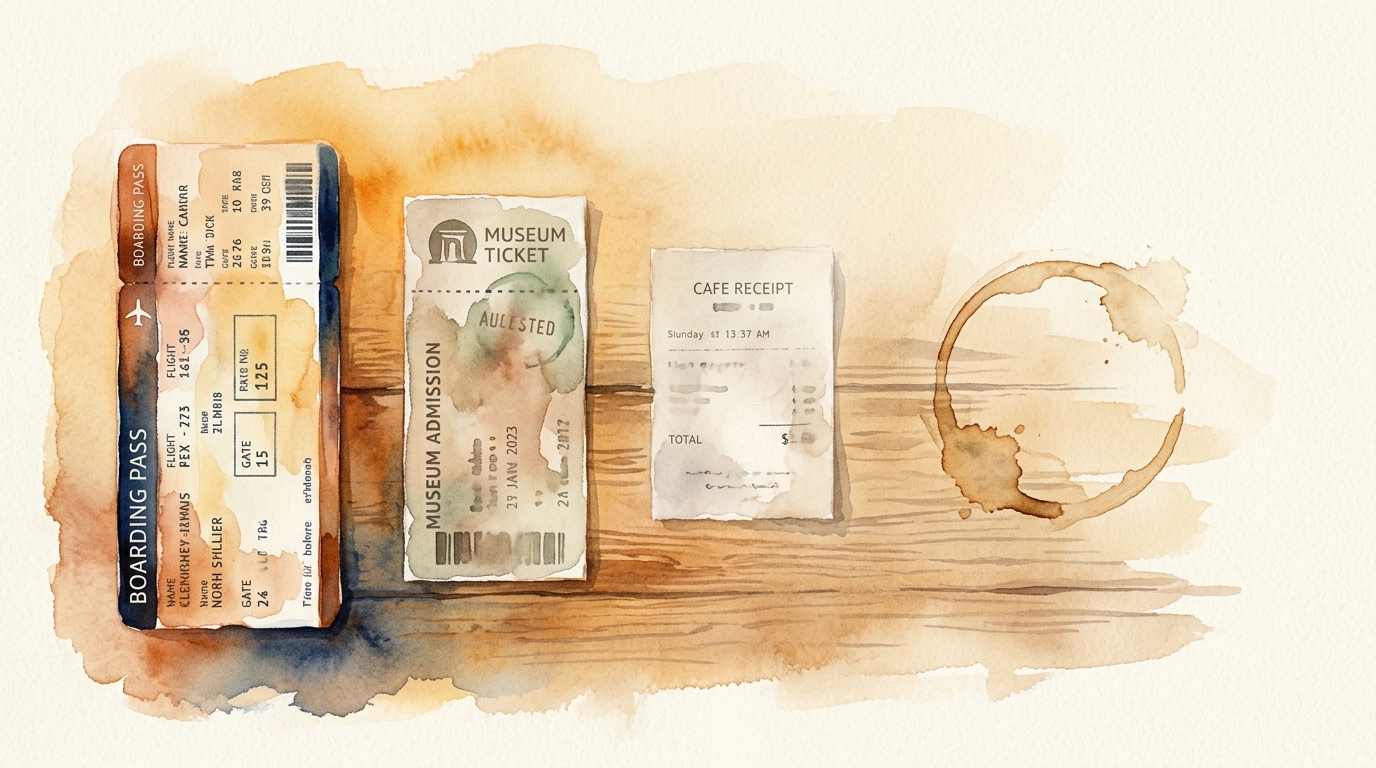
What the research tells us is straightforward: memories need reinforcement to survive.
Your brain applies the same forgetting curve to that sunset in Santorini as it does to a random Tuesday work meeting. The difference is you want to keep one of those.
The Photo Trap: Why 2,795 Phone Photos Won't Save You
Your instinctive response to "I want to remember this" is to pull out your phone and take a photo. Americans now store an average of 2,795 photos on their smartphones, and Talker Research found travelers take an average of 181 photos per trip. But here's the problem: taking photos might actually be making your memories worse.
Cognitive psychologist Linda Henkel's research at Fairfield University identified what she calls the "photo-taking-impairment effect." Participants who photographed objects in a museum had measurably worse memory for those objects compared to people who simply observed them. Even taking five photos of the same item didn't help. The mechanism: when you outsource remembering to a camera, your brain stops doing the work itself.
As National Geographic reports, psychologist Fabian Hutmacher found that passive photography reduces both enjoyment and memory retention. When you spend a 90-minute experience focused on camera angles, you're creating files, not memories.
After the trip, the problem gets worse. A Mixbook survey found that 48% of Americans have over 1,000 photos on their phones, 31% have never printed a single smartphone photo, and 21% feel overwhelmed by the accumulation. Three in five people hardly ever delete photos from their smartphones. The result is a giant unsorted archive that triggers stress instead of joy. Young adults feel this most acutely: 28% of 18-34 year-olds report feeling overwhelmed by photo clutter, compared to 16% of older adults.
This doesn't mean photos are useless. Henkel's research found one notable exception: when participants zoomed in to photograph a specific detail, their memory wasn't impaired. And Julia Soares's 2023 research found that sharing photos on social media actually improved memory of experiences. The difference is engagement. A photo you take mindfully, caption, and share does something for your memory. A photo you snap reflexively and never look at again does nothing.
Six Ways to Remember Travel Details (Ranked by Effort)
Forget the advice that says "keep a detailed travel journal." That works for travelers who genuinely enjoy writing and have the discipline to do it nightly. For everyone else, here are six methods that match different effort levels and personality types, all grounded in how memory actually works.
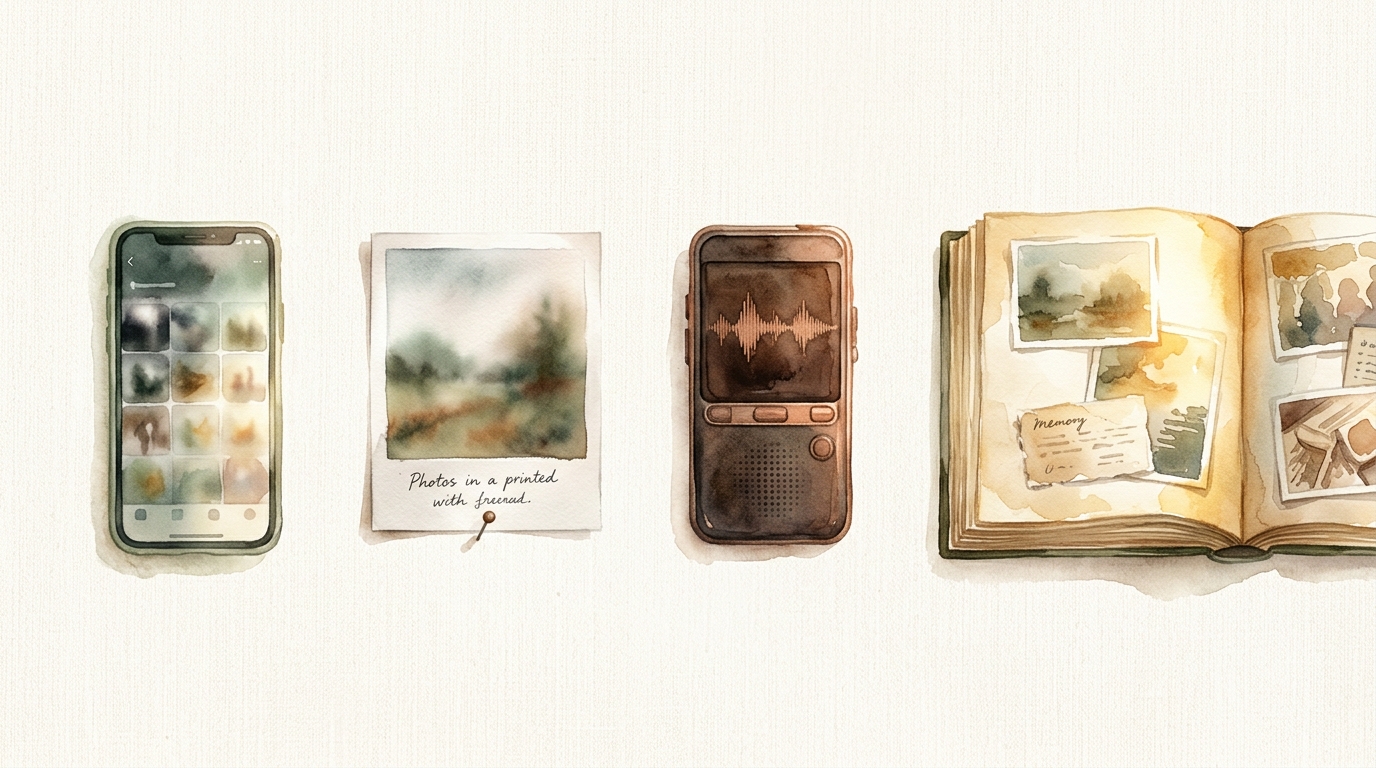
1. The 30-Second Voice Memo (Effort: Minimal)
Open your phone's voice recorder. Talk for 30 seconds about what you just did, saw, ate, or felt. That's it.
We started doing this on a trip to Kyoto and now have dozens of voice memos from that week. Listening to them a year later, you can hear the temple bell in the background of one, and it brings back the entire afternoon.
This works because of two mechanisms. First, the act of narrating an experience forces your brain to organize it into a coherent story, strengthening the memory trace. Second, you're creating a retrieval cue. When you listen back weeks or months later, your brain fills in the surrounding context: the smell of the market, the temperature, the sounds of the street.
A 2024 study from the Norwegian University of Science and Technology (NTNU) found that handwriting produced higher levels of brain connectivity than typing, but the underlying principle applies to speaking too. Any active engagement with information (narrating, writing, drawing) strengthens memory compared to passive observation. The key is moving from spectator to participant in your own experience.
Record your voice memo while the experience is still fresh: in the taxi, at the cafe, walking back to the hotel. The closer to the event, the more detail your brain retains. Morning-after recaps lose roughly half the sensory detail.
2. The One-Photo-One-Caption Method (Effort: Low)
Instead of snapping 50 photos per day, take one deliberate photo and write a single sentence in the caption or notes field. "The fish market in Porto where the vendor gave us free samples of bacalhau." "View from the bridge at sunset, Maria said this was her favorite moment."
The caption is what makes this work. Research on the photo-taking-impairment effect consistently shows that engaged photography, where you think about what you're capturing and why, doesn't impair memory the way passive point-and-shoot does. The one-sentence caption forces that engagement.
At the end of each day, you have 3-5 captioned photos instead of 50 anonymous ones. Six months later, those captions will bring back more than an entire camera roll of uncaptioned shots. It sounds counterintuitive, but fewer photos with words attached genuinely outperform hundreds of photos with nothing.
3. The Sensory Bookmark (Effort: Low)
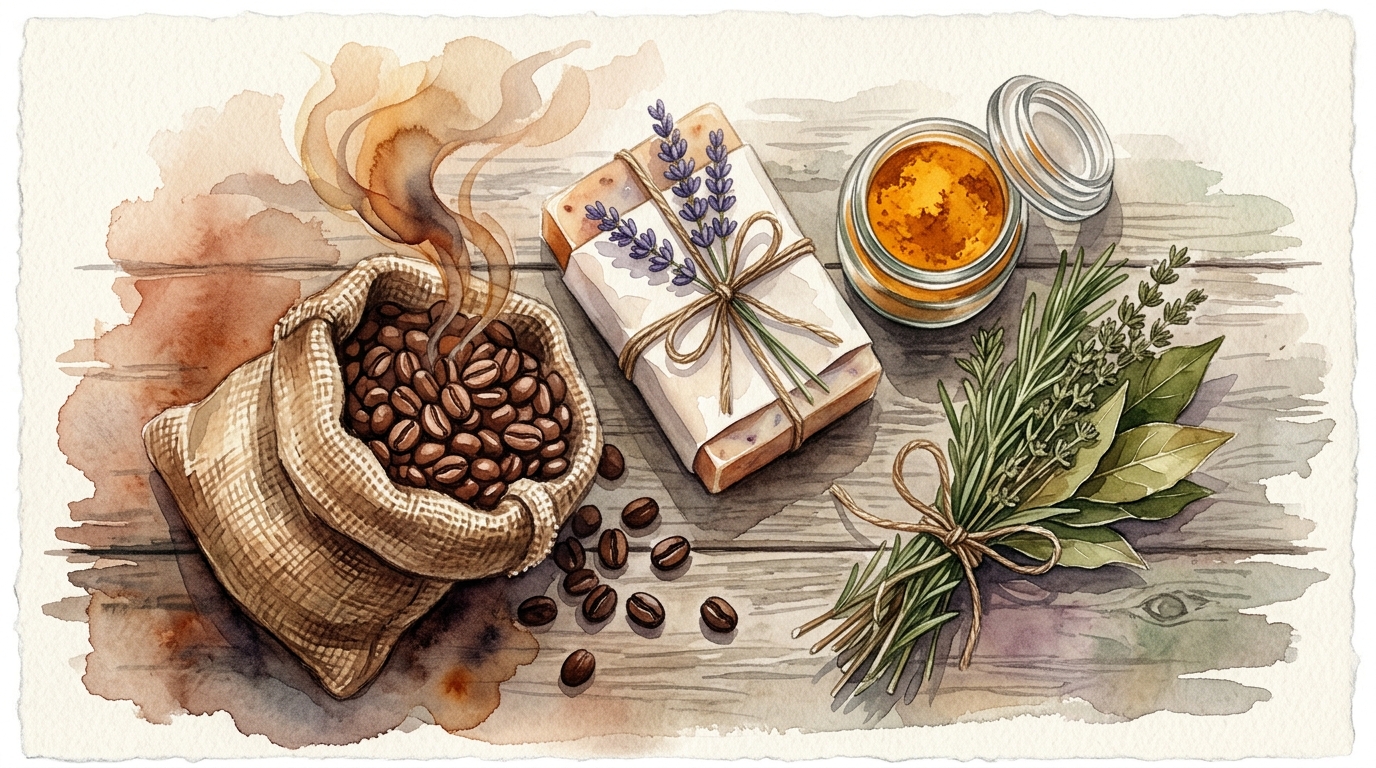
Buy a small item tied to a specific sense: a bag of the local coffee, a bar of soap from the hotel, a spice from the market. Research from Northwestern University found that the olfactory system has a direct neural pathway to the hippocampus, what researchers describe as a "superhighway" from smell to memory, making it uniquely powerful at triggering vivid recall.
When you open that bag of coffee six months later, your brain won't just remember "I went to Colombia." It'll reconstruct the morning you bought it: the market stalls, the humidity, the sound of the grinder. That's not just poetic license - it's neuroscience. Lead researcher Christina Zelano explains that smell maintained its direct hippocampal connection even as other senses were rerouted through intermediary brain regions during human evolution.
4. The Shared Trip Memory App (Effort: Low-Medium)
If you travel with other people, your best memory tool is your travel companions. Everyone notices different things. One person remembers the restaurant name, another remembers the conversation, another took the one photo that captures the vibe of the evening.
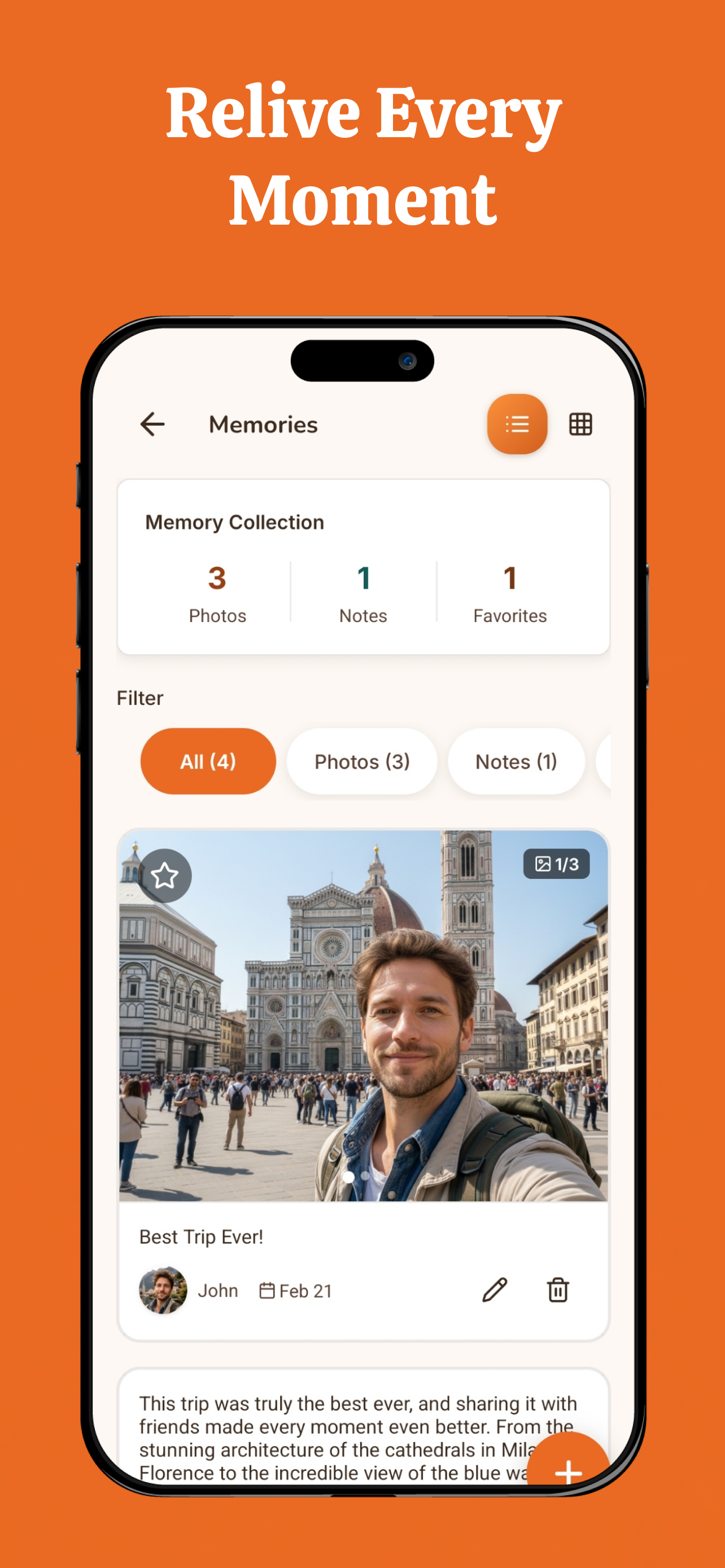
But these fragments usually live in separate phone galleries and message threads that get buried within weeks. A shared space where everyone drops photos, notes, and quick observations during the trip, and can revisit them months or years later, turns scattered individual fragments into a collaborative timeline.
TripProf's Memory Timeline is built exactly for this. Every trip participant can add photos and notes tied to the trip's timeline. No nightly journaling required, just quick captures in the moment. Come back six months later and scroll through what your whole group remembered, not just your own camera roll. It turns "remember that place?" into "oh right, that place" with the photo and the note to prove it.
Other tools serve different needs. Polarsteps auto-tracks your GPS route and plots it on a map. One Second Everyday stitches one-second video clips into a trip montage. For solo travelers who prefer writing, Day One handles long-form entries with automatic location and weather tagging. The right tool is the one you'll actually use.
| App | Best For | Key Strength | Effort Level |
|---|---|---|---|
| TripProf | Group trips | Collaborative memories tied to trip timeline | Low |
| Polarsteps | Route tracking | Automatic GPS journey mapping | Low |
| One Second Everyday | Video montages | 1-second daily clips stitched together | Low |
| Day One | Solo journaling | Long-form writing with auto location/weather | Medium |
| Google Photos | Photo organization | Auto-albums by trip, search by content | Low |
That comparison isn't exhaustive, but it covers the main approaches. The key takeaway: pick one tool and commit to it for an entire trip. Switching between three apps means none of them gets enough content to be useful later.
5. The End-of-Day Three-Sentence Recap (Effort: Medium)
Every night, write three sentences about the day. Not a journal entry. Three sentences. "We got lost looking for the ceramic workshop and ended up in a neighborhood with incredible street art. Lunch was grilled octopus at a place with no English menu. It rained hard at 4pm and we waited it out in a bookshop that sold port wine."
This works because of what cognitive scientists call the spacing effect: reviewing information shortly after learning it dramatically improves long-term retention. In a landmark 2006 study, Roediger and Karpicke found that students who practiced retrieval (actively recalling material from memory) substantially outperformed those who simply re-read the same passages on a test given one week later. The act of recalling is what strengthens the memory. Your end-of-day recap is active recall for your trip.
If you're traveling with a partner or group, take turns doing this out loud over dinner. You'll be surprised how much more the other person remembers, and saying it aloud encodes it for both of you. This is also a great dinner conversation starter when the group is tired and running out of energy for planning the next day.

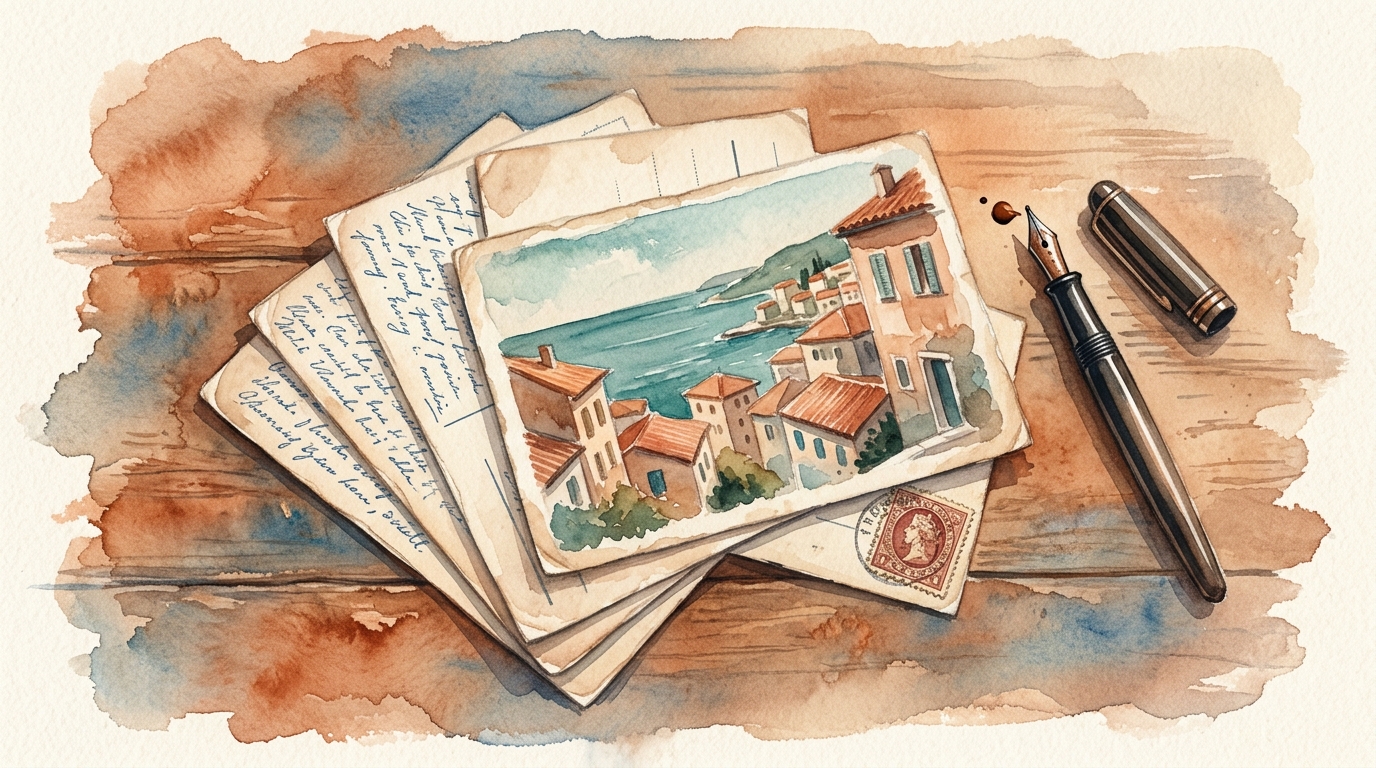
6. The Handwritten Postcard Method (Effort: Medium-High)
Buy a postcard at every destination and write yourself a short note on the back. Not "wish you were here" filler, but real details. What you did, what surprised you, what the place sounded and smelled like.
The NTNU brain connectivity study found that handwriting activates a wide network of brain regions simultaneously: visual processing, sensory integration, and the motor cortex. Typing activated minimal activity in those same areas. The researchers used a 256-electrode hairnet to measure this, and the difference was dramatic. Writing by hand literally forces your brain to process the experience more deeply.
Mail the postcards to yourself or collect them in a small stack. When you get home, you have a tangible, chronological record of your trip written in your own handwriting, each one a retrieval cue for an entire day's worth of experiences. If you enjoy packing light, postcards weigh nothing and cost almost nothing.
The Review Window: When to Revisit (and Why It Matters)
Capturing memories is only half the equation. The other half, the part almost everyone skips, is reviewing them.
Think of the forgetting curve as a slope, not a cliff - one you can flatten with strategically timed reviews. Each time you revisit a memory, you strengthen the neural pathway and slow its decay. This is the same principle behind spaced repetition, one of the most well-studied methods for long-term retention. In one landmark study, college students who reviewed material in spaced sessions retained dramatically more than those who crammed it all at once.
- During the trip Capture something daily using any method above. Even 30 seconds counts.
- First week home Sort your photos. Delete the duplicates. Add captions to your 10-15 best shots.
- One month later Review your voice memos, photos, or postcards over dinner. This single review session significantly strengthens your long-term retention.
- Six months later Revisit your trip memories one more time. By now, the ones you've reviewed twice are locked in. The ones you never reviewed are mostly gone.
The psychological benefits of nostalgia make this review process more than just memory maintenance. Research published in Current Opinion in Psychology found that nostalgic reflection increases meaning in life, self-esteem, and positive affect. Revisiting trip memories activates reward pathways in the brain and boosts social connectedness, especially when you're reviewing shared memories with the people who were there. It's not just practical. It genuinely improves your mood.
This is where collaborative trip apps have an edge over solo methods. When your travel companions add their own memories to a shared timeline, every notification becomes a mini-review. Someone uploads a photo from day four, and suddenly you're back in that market, remembering the vendor who tried to teach you three words in Greek.
What NOT to Do: Three Memory Mistakes Travelers Keep Making
Before you commit to a method, avoid these common traps that sound productive but actually work against your memory.
Mistake 1: The "I'll Journal Every Night" Promise
Traditional travel journaling fails for most people because it requires sustained effort at the exact moment you're least likely to provide it: the end of an exhausting, stimulating day. You write detailed entries for days one and two, skip day three because you're tired, feel guilty on day four, and abandon it entirely by day five.
The resurgence of travel journaling is real, particularly among Gen Z travelers - videos tagged #traveljournal have accumulated millions of views on TikTok and Instagram, showing notebooks filled with tickets, postcards, and handwritten notes. But the travelers who stick with it typically use low-friction methods (voice memos, one-line entries, photo captions) rather than full narrative journals. If you want to try journaling on your next multi-city Europe trip, set the bar embarrassingly low: one sentence beats zero sentences every time.
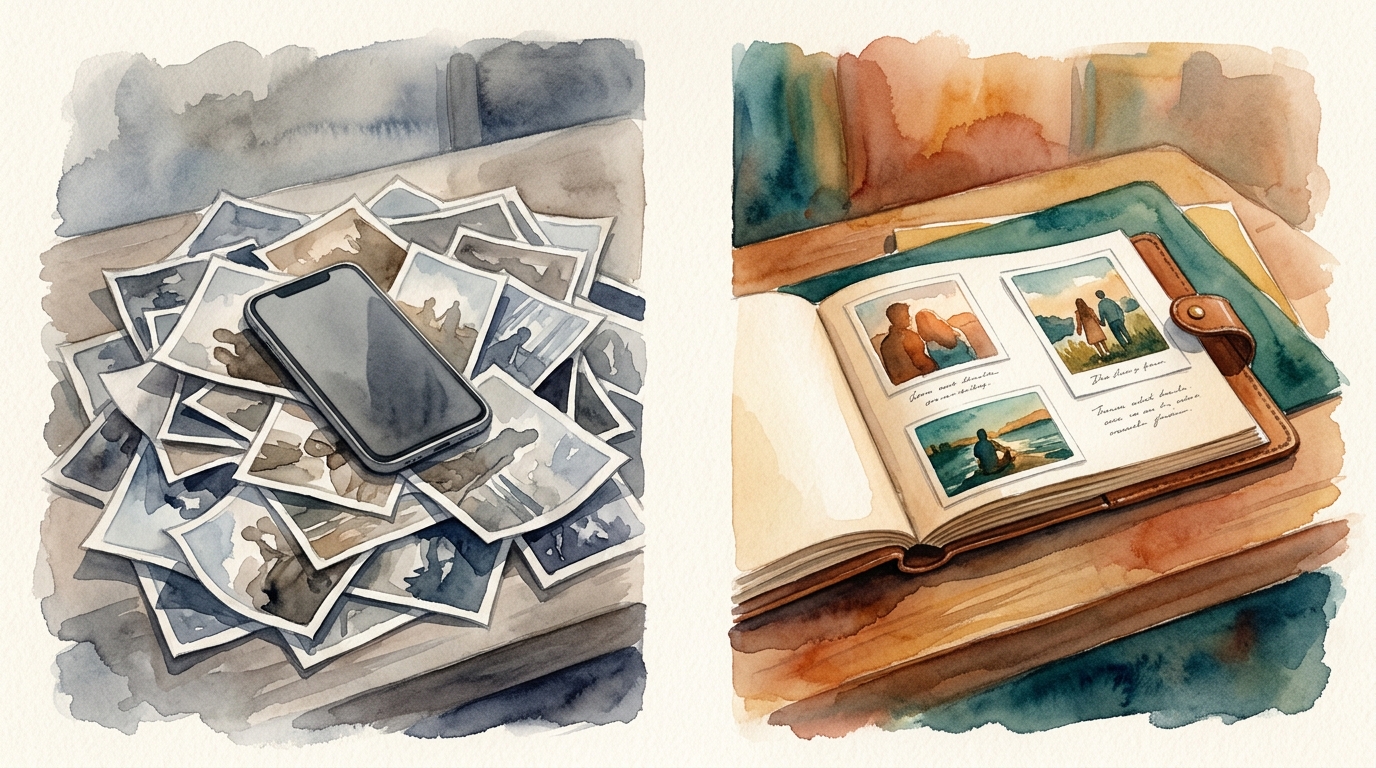
Mistake 2: The "Take Photos of Everything" Approach
We've covered the photo-taking-impairment effect, but it's worth repeating: volume doesn't equal value. A Mixbook study found that Americans are almost twice as likely to declutter their physical spaces (42%) as their digital ones (25%). Your camera roll from a two-week trip in 2024 is probably still unsorted. Those 500 photos are doing nothing for your memory.
Better approach: take fewer, more intentional photos. When you do take a photo, spend five seconds adding a caption. If you're exploring a new city, our guide to first-trip mistakes covers other habits worth building before you leave.
Mistake 3: Waiting Until You Get Home to "Organize Everything"
The intention is good. The execution rate is close to zero. Mixbook's data shows that only 18% of Americans printed a photo within the last three months, and 31% have never printed a smartphone photo. The "I'll make an album when I get back" plan has the same success rate as "I'll unpack tonight."
Capture in the moment, organize minimally, and review on a schedule. That's the realistic workflow. If you travel with friends and want to avoid the usual group trip headaches, apply the same principle to memory-keeping: distribute the effort, don't centralize it on one person.
Frequently Asked Questions
Why can't I remember details from trips I took years ago?
Your brain prioritizes memories reinforced through review or emotional intensity. Without revisiting trip details through photos, notes, or conversations, neural pathways weaken within days. The forgetting curve shows roughly 67% of details fade within 24 hours without review, and decay continues rapidly over weeks.
Does taking photos help or hurt travel memories?
Both, depending on how you do it. Mindless point-and-shoot photography has been shown to impair memory by outsourcing the work to your camera. But intentional photography (zooming into details, adding captions, sharing with others) can strengthen recall. The key distinction is engagement: a photo you think about beats a photo you just snap.
What's the easiest way to document a trip without journaling?
Voice memos. Open your phone's recorder and talk for 30 seconds about what you just experienced. It requires zero writing, captures sensory details while they're fresh, and creates a powerful retrieval cue when you listen back later. Most travelers find this sustainable even when traditional journaling falls apart by day three.
Do travel journal apps actually work?
They work if you use them, which sounds obvious but is the main differentiator. Apps that require minimal input (auto-tracking GPS routes, one-photo-per-day prompts, collaborative shared timelines) have much higher completion rates than apps that expect long-form daily entries. Choose based on your actual behavior, not your aspirational habits.
How can I remember travel details from group trips specifically?
Use collective memory. Everyone in a group notices different details: one person remembers the food, another remembers directions, another captures the mood. Use a shared space where everyone contributes photos and notes during the trip. The combined memory of four people is dramatically richer than any individual's recall.
Is handwriting really better than typing for memory?
Yes, according to neuroscience research. A 2024 NTNU study using brain activity monitoring found that handwriting activated widespread neural connectivity across visual, sensory, and motor regions, while typing produced minimal activity. Writing by hand forces deeper cognitive processing of the information. Postcards, pocket notebooks, or even scribbling on napkins all count.
When should I review my trip memories for the best retention?
Three review windows produce the best results: within the first week home (sort photos, add captions), at the one-month mark (revisit voice memos or notes), and around six months (look through your full trip record). Each review flattens the forgetting curve, and the nostalgia boost from revisiting memories has measurable psychological benefits including improved mood and self-esteem.
Key Takeaways
- 67% of new information fades within 24 hours without review, and travel memories are no exception. The forgetting curve applies to your best trip just as ruthlessly as it does to a random Tuesday.
- Taking hundreds of photos without captions or review can actually impair your memory through the photo-taking-impairment effect. Fewer intentional photos with one-line captions beat a massive unsorted camera roll.
- Voice memos are the highest-value, lowest-effort memory method. Thirty seconds of narration after an experience creates a retrieval cue your brain can use months later.
- Smell is a neural superhighway to memory. Sensory souvenirs like local coffee, soap, and spices trigger more vivid recall than photos do.
- Group travel memory works best when it's collaborative. Tools like TripProf's shared Memory Timeline let every participant contribute photos and notes, building a collective record richer than any one person's camera roll.
- Review is the secret weapon. Three strategically timed sessions (one week, one month, six months) can lock trip memories into long-term storage permanently.
- The best method is the one you'll actually do. Set the bar low: one sentence, one voice memo, one captioned photo per day is infinitely better than nothing.
Sources
- Murre, J.M.J. & Dros, J. (2015): Replication and Analysis of Ebbinghaus' Forgetting Curve. PLOS ONE
- Empower Research (2025): Travel Spending Trends. Empower
- Talker Research (2025): America's 2025 Travel Snapshot. Talker Research
- Henkel, L.A. (2014): Point-and-Shoot Memories, The Influence of Taking Photos on Memory for a Museum Tour. Psychological Science (PubMed)
- British Psychological Society (2022): Photo-Taking-Impairment Effect with Multiple Photos. BPS Research Digest
- Hutmacher, F. & Soares, J. (2023): Digital Photography and Memory. National Geographic
- Mixbook (2025): America's Photo Overload Survey. Mixbook
- Passport Photo Online (2026): Mobile Photography Statistics. Passport Photo Online
- Van der Meer, A. & Van der Weel, R. (2024): Handwriting and Brain Connectivity. Scientific American
- Van der Meer, A. & Van der Weel, R. (2023): Handwriting Leads to Widespread Brain Connectivity. Frontiers in Psychology
- Zelano, C. & Zhou, G. (2021): Hippocampal Connectivity Stronger in Olfaction Than Other Sensory Systems. Northwestern University
- Roediger, H.L. & Karpicke, J.D. (2006): Test-Enhanced Learning (PubMed): primary source for the testing effect in memory research
- Sedikides, C. et al. (2022): Nostalgia as a Pathway to Greater Well-Being. Current Opinion in Psychology
- Association for Psychological Science: Vacation Memory Reconstruction. APS Observer
- Ebbinghaus Forgetting Curve: Wikipedia
- PMC (2019): Spaced Learning Enhances Episodic Memory. PMC
Last updated: July 3, 2026
Keep Reading
More travel tips and guides picked for you
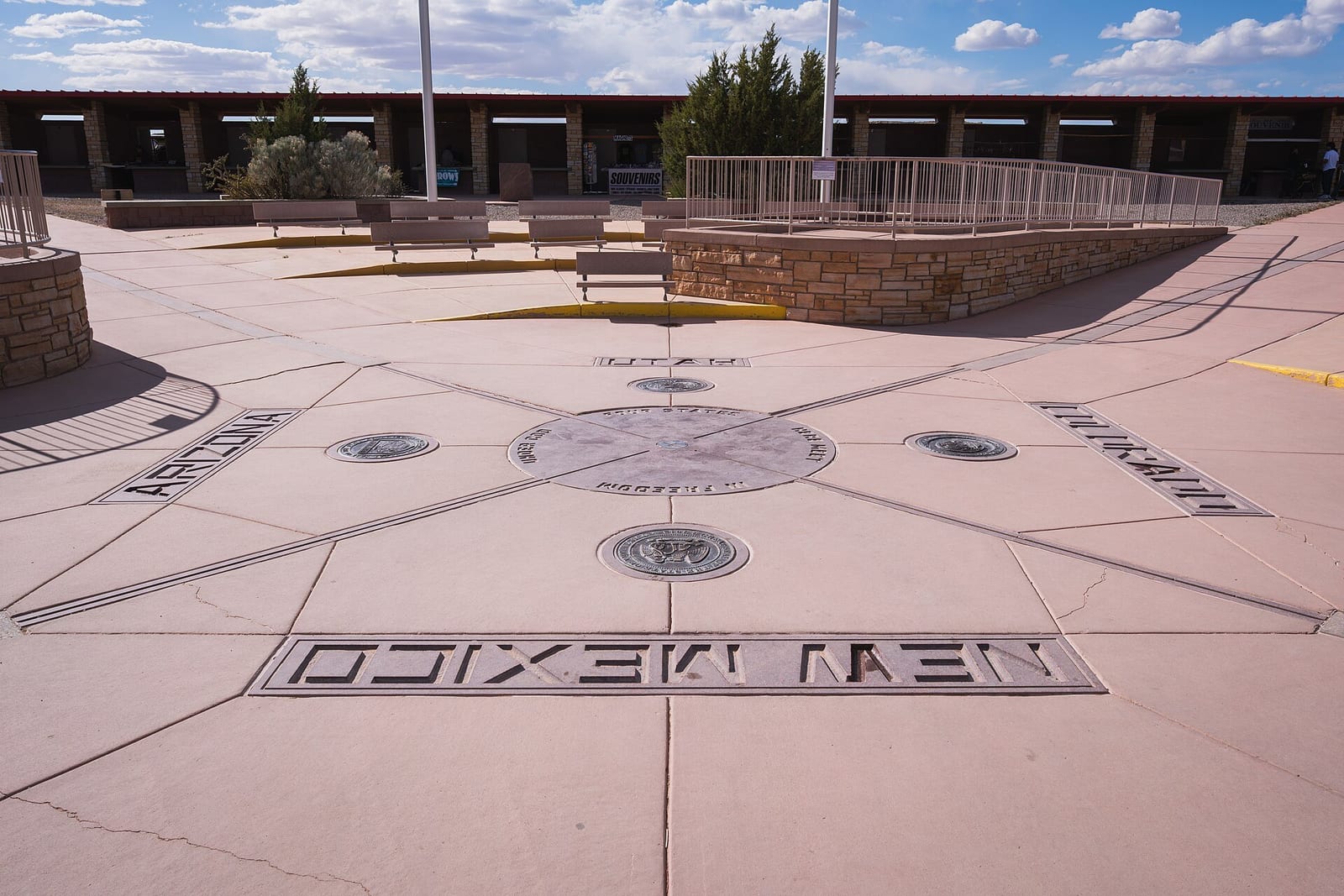
What counts as visiting a state? Layovers, drive-throughs and the rules 50-staters use
Only 2% of Americans name a plane change as the minimum that counts as visiting a state, while 27% set the bar at driving through. Here's a three-tier rubric, a lookup table for the edge cases from Four Corners to D.C., and one trip counted three ways.

The fake SBB ticket website stealing credit card and Twint data from travelers
Zurich cantonal police confirmed a fake SBB ticket website is stealing credit card and Twint payment details from travelers who find it through an ordinary Google search. Here is how to spot it and what to do if you already paid.

UK ETA scam warning: fake websites are charging Austrians up to €900
Fake UK ETA websites are charging Austrian and EU travellers hundreds of euros for a form that costs £20. Here's how the real one works, and how to spot a scam before you pay it.