Oktoberfest 2026 Without a Reservation: The First-Timer's Playbook
Key Highlights
- 1
- 2
- 3
+4 more in the takeaways below
It is a Tuesday afternoon in late September. You step off the U-Bahn at Poccistrasse, follow the smell of roast chicken and spilled beer for ten minutes, and there it is: the Theresienwiese, fourteen beer halls the size of aircraft hangars, a Ferris wheel turning against a flat Munich sky. You have no table reservation. You have no ticket. You loosen your collar and walk straight in anyway.
Going to Oktoberfest 2026 without a reservation is not just possible. It is how most of the six million people who show up actually do it. The trick is knowing the quota math, the right arrival window, and which tents and gardens will always let a walk-in sit down.
Oktoberfest 2026 runs 19 September to 4 October, and entry to the grounds and the tents is completely free. You do not need a table reservation to get in. By rule, a slice of every big tent stays unreserved: 25 percent on weekdays and 40 percent before 3 p.m. on weekends. Arrive before noon on a weekday and you will get a bench. A Mass of beer costs 14.80 to 15.90 euros in 2026. Budget roughly 100 to 150 euros a day before your bed, bring a bag no bigger than 3 litres, and stay a few U-Bahn stops out to keep lodging sane.
This is the realistic playbook for solos, couples, and small groups with zero tent booking: the seating math, the exact times to show up, the legit face-value route to a reserved table, and what a day really costs at official 2026 prices.
The 2026 Wiesn in 60 seconds
Oktoberfest 2026 runs 16 days from Saturday 19 September to Sunday 4 October on Munich's Theresienwiese, with the first keg tapped at the cry of "O'zapft is!" at 12 noon on opening Saturday. Walking onto the grounds and into any beer tent is free. There is no gate, no ticket, no entry fee. The thing people pay for, and panic about, is a table reservation, which is a different animal entirely.
A reservation is not an entry ticket. It is a held table inside a specific big tent, booked directly with that tent, that seats eight to ten people and comes with a minimum spend. There is no central booking site, no per-seat option, and the tents open their slots "by spring, at the latest in April or May" for the coming festival. If you missed that window for 2026, relax. Reservations are a convenience for big groups and prime evenings, not the price of admission.
Around 6.5 million guests came in 2025, and on the busiest Saturday about 30 percent came from abroad. That sounds like a wall of people with nowhere to sit. It is not, because the city writes the unreserved seating into the rules.
Can you go without a reservation? Yes, and here is the math
Yes. Every large tent is legally required to keep a fixed share of its benches open to walk-ins, and that share is generous. On weekdays, 25 percent of all seats stay unreserved. On weekends and public holidays it climbs to 40 percent before 3 p.m., then settles back to 25 percent after. The historic Oide Wiesn always keeps a third of its seats reservation-free. So the question is never whether seats exist. It is whether you reach them before the rush does.
Put the quota in plain numbers. A tent like the Hofbrau-Festhalle holds close to 10,000 people between hall and garden. A quarter of that is well over 2,000 open seats on a Tuesday, refreshing all day as people leave. That is the cushion working in your favour. The catch is timing: those seats are claimed fastest in the evening and on weekends, which is exactly when most first-timers try to walk in.
On a Saturday or holiday before 3 p.m., the unreserved share jumps from 25 percent to 40 percent. The single best window for a no-reservation seat on a weekend is late morning, not the afternoon.
One more rule decides everything on a busy night. When a tent fills to capacity, security closes the doors, and at that point even walk-in seats stop mattering because nobody new gets in. The muenchen.de visitor FAQ puts it plainly: you do not need a reservation to enter a tent, except when the tents are closed because of overcrowding. Beat the closure and the quota is yours. Show up at 7 p.m. on the first Saturday and you may be staring at a shut door.
Exactly when to walk in to get a seat
Arrive early and arrive on a weekday, and a seat is close to guaranteed. The doors open at 10 a.m. on weekdays and 9 a.m. on weekends, and the first two to three hours are the calmest stretch of the day. The table below is the cheat sheet: match your group to a column and pick the green window.
I was there yesterday. Got into the Hacker tent around 11:15ish. Found room for the 4 of us pretty easily. We left around 5 to walk around but could have stayed there for the whole night.
- r/Oktoberfest, October 2025
| Day / time | Solo or couple | Small group (3-6) | Verdict |
|---|---|---|---|
| Weekday, 10 a.m. to 1 p.m. | Walk in, sit anywhere | Walk in, find a part-empty table | Easiest |
| Weekday, 1 to 5 p.m. | Usually fine | Possible, split up if needed | Good |
| Weekday evening | Tight, try gardens | Hard in big halls | Risky |
| Weekend before noon | Very doable | Doable, go straight in at open | Good |
| Weekend afternoon / evening | Expect closed doors | Expect closed doors | Avoid |
The pattern is simple: before noon on a weekday is the golden window, and the first weekend plus the closing weekend are the two worst times to wing it. If your only option is a Saturday, treat the 9 a.m. opening as a hard start time, not a suggestion. Here is the move, step by step.
- Pick a weekday and a backup tent. Choose one big tent you want and one neighbour as plan B. They sit minutes apart on the Theresienwiese.
- Arrive within the first hour of opening. 10 a.m. on a weekday, 9 a.m. on a weekend. The crowd thickens fast after that.
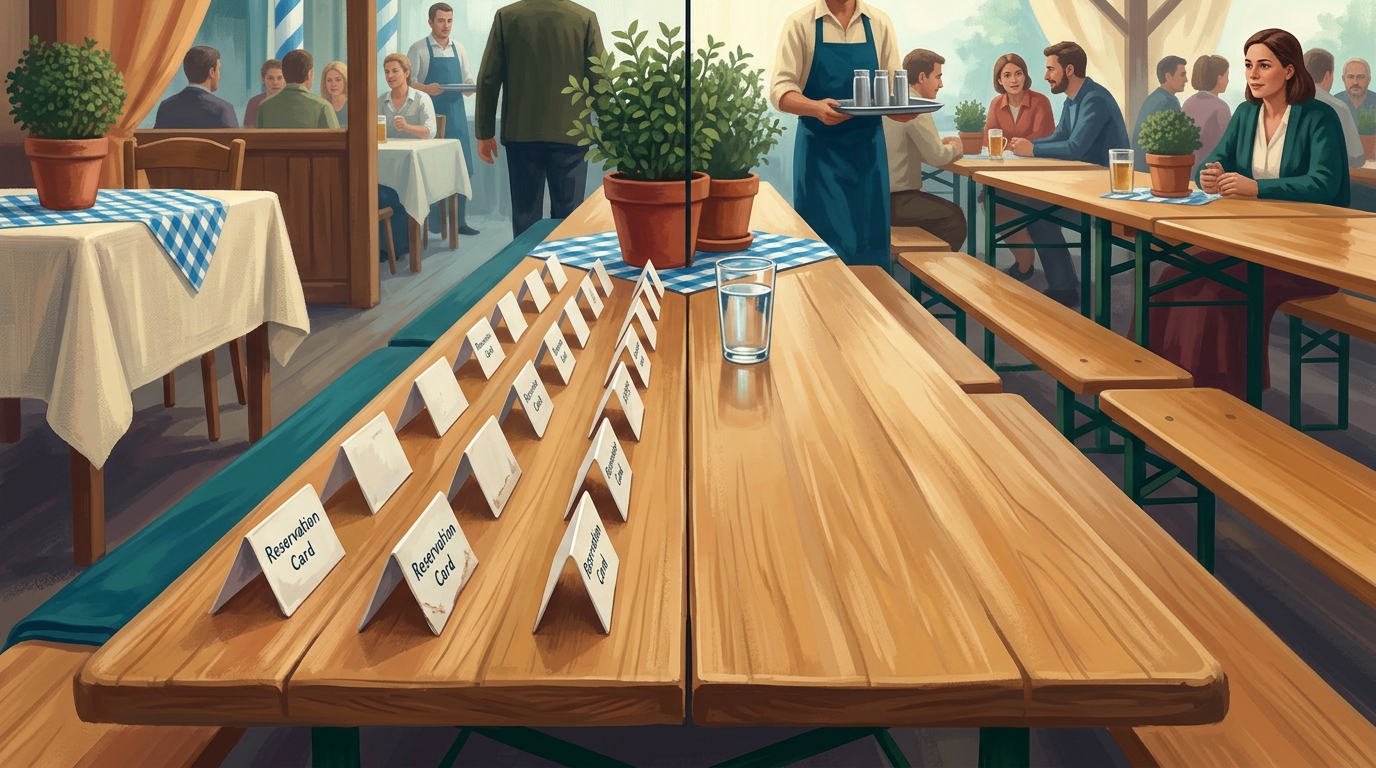
- Walk the hall, do not hover at the entrance. Unreserved benches are usually toward the sides and the back, away from the band. Reserved tables carry a paper sign.
- Ask before you sit. A polite "Ist hier frei?" (Is this seat free?) at a part-empty table works. Locals share tables. That is the whole culture.
- Order a beer to hold the spot. A seated table without drinks gets cleared. One Mass per person keeps the bench yours.
The small-tent and beer-garden move
Skip the 14 giant halls and your odds of a walk-in seat jump. Oktoberfest has more than a dozen smaller tents, plus every big tent has an outdoor beer garden, and these fill far later than the main halls. The smaller tents are where Munich locals quietly go when the famous names are slammed. Same beer, same chicken, a fraction of the queue.
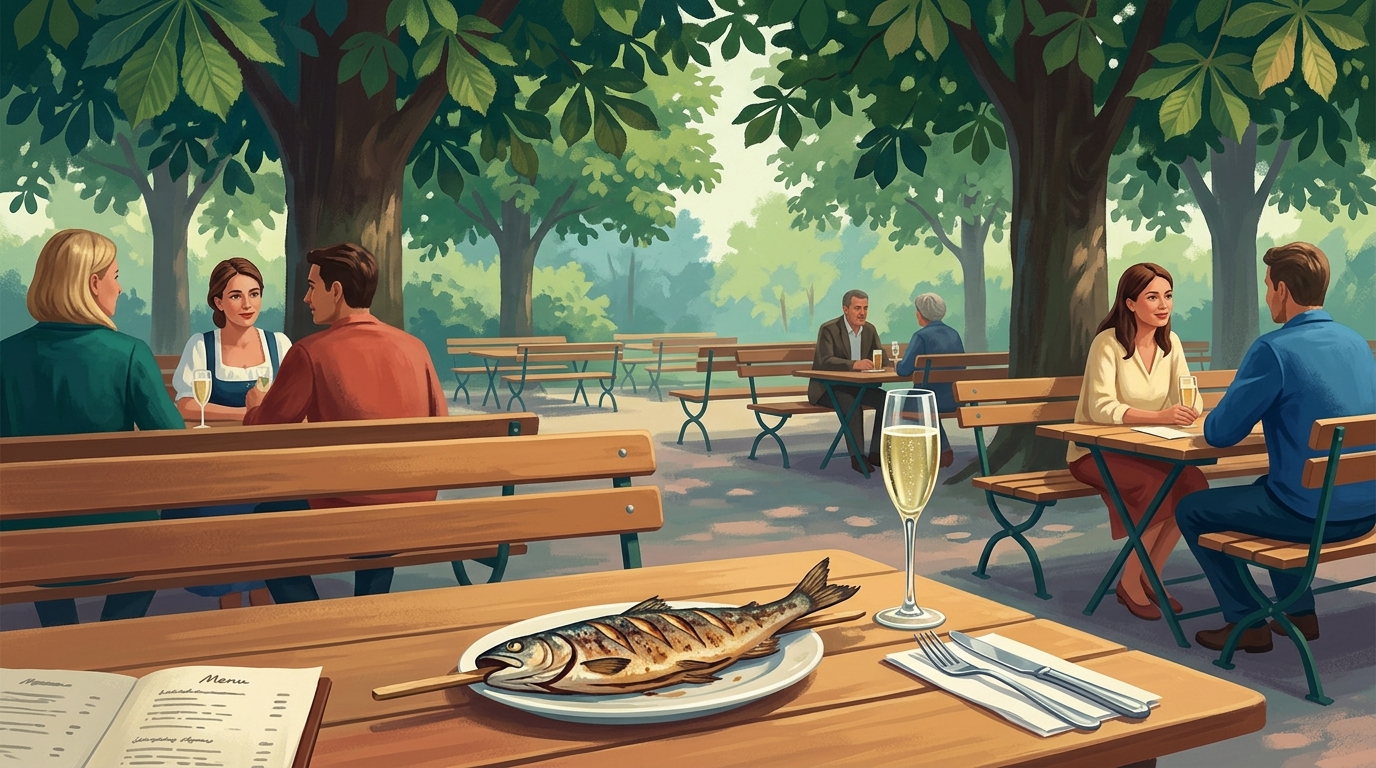
The names worth knowing: the Weinzelt for wine and bubbles, Fischer-Vroni for grilled fish on a stick, the Ableitner and the Heimer tents, and the family-friendly Familienplatzl, which by the way pours the cheapest Mass on the entire Wiesn at 14.80 euros. None of these will have the roaring brass-band energy of the Hofbrau hall, and that is the point. You came to sit down and drink a beer, not to fight for a square metre of bench.
On a warm afternoon, head for a big tent's outdoor beer garden instead of its hall. Gardens seat thousands, fill later, and many benches there are self-seating. When the hall shows a closed door, the garden gate next to it is often still open.
There is a weather catch, so plan for it. Gardens empty the moment it rains, and a cold late-September evening sends everyone indoors, which is precisely when the halls hit capacity. If the forecast is grim, flip your plan: get into a hall early and stay put, or aim for a small tent with a roof. Treat the garden as the fair-weather option, not the only one.
The legit face-value table-share route
If your small group has its heart set on a reserved table on a peak night, there is one safe path, and exactly one. Since 2023 there has been an official resale portal where people who booked a table but can no longer use it pass it on at the original price, with no markup, with around 21 major tents taking part. The portal was set up specifically to fight scalping. The reservations are verified by the tents, so you are not buying a fake. The portal closes between festivals and reopens for buying and selling in summer 2026.
Two things to understand before you go this route. First, a reservation is sold by the whole table of eight to ten, not by the seat, and it carries a minimum spend, usually two Mass of beer and half a chicken per person, paid in vouchers that average around 350 euros per table. For a couple that is poor value. For a group of eight who would buy that much anyway, it is simply pre-paying for beer and food you were going to order.
Do not buy a "reservation" from a random reseller, a classifieds post, or a stranger on social media. Black-market table sales are routinely fakes or inflated, and the tents will turn away an unverified booking at the door. Use the official face-value portal or skip the reservation and walk in.
The honest answer for most readers of this guide: a solo traveller or a couple does not need a reserved table at all. Walk in early, share a bench, and you get the identical beer and the identical band for the price of what you actually drink. Save the resale route for the night a group of six or more wants a guaranteed home base.
What a day actually costs in 2026
Plan on roughly 100 to 150 euros a day per person inside the grounds, before you count your bed. The single biggest line is beer. A one-litre Mass costs 14.80 to 15.90 euros in 2026, an average rise of 2.38 percent over 2025, with the priciest regular pours at the Armbrustschutzen, Braurosl, and Lowenbrau tents and the cheapest at the Familienplatzl. Non-alcoholic drinks are not a loophole either: bottled water runs about 11.13 euros a litre, Spezi cola about 12.84, and lemonade 12.35.
| Item | 2026 price each | Typical day |
|---|---|---|
| Mass of beer | €14.80 to €15.90 | 3 to 4 = €45 to €64 |
| Half chicken (Hendl) | €16.90 to €24.50 (2025) | 1 = ~€20 |
| Pretzel, sausages, snacks | varies | ~€15 to €25 |
| MVV day ticket (Zone M) | €10.10 | 1 = €10.10 |
| Tips and a fairground ride | varies | ~€10 to €20 |
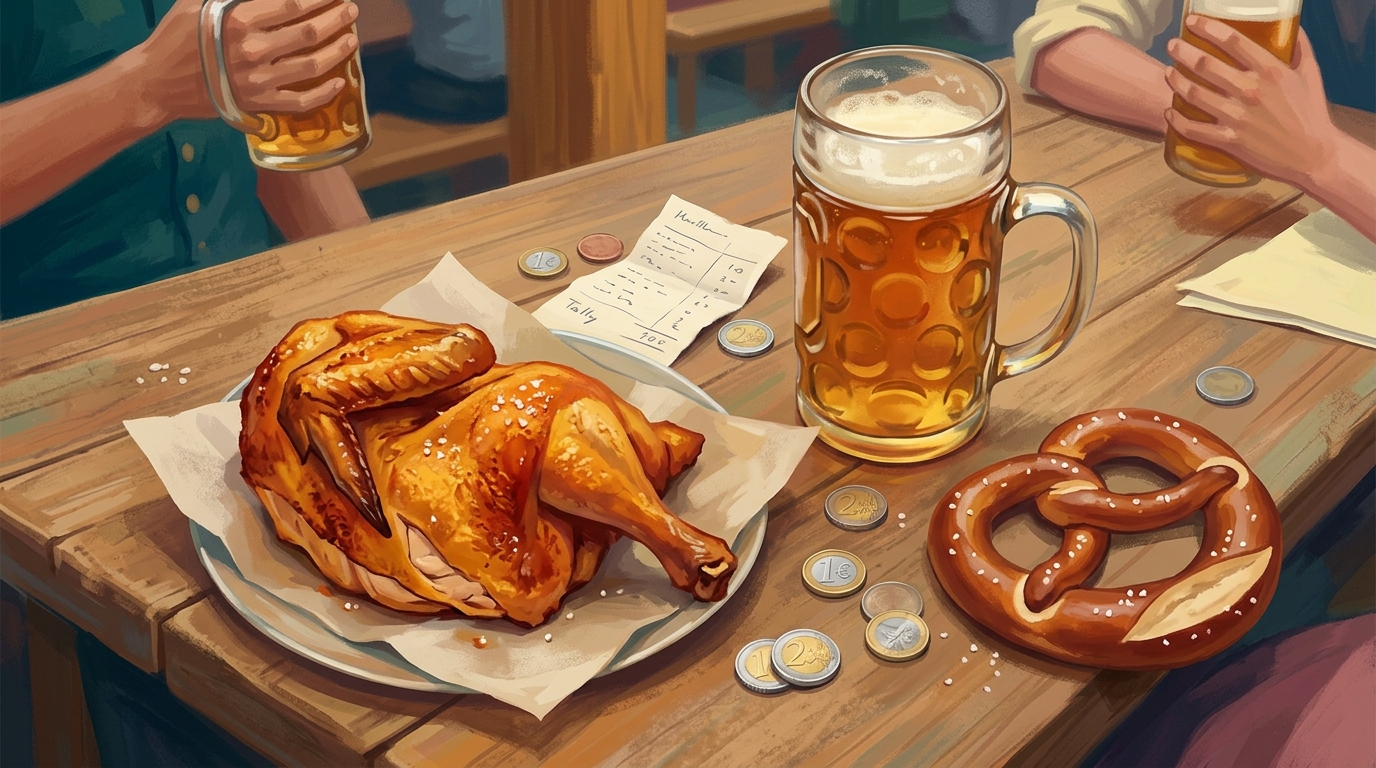
Food is the line people underestimate. A half roast chicken, the festival's signature plate, ran 16.90 to 24.50 euros across the tents in 2025, and 2026 menus will land in the same territory once they are published. Add a pretzel and a round of sausages and you are at a real meal's worth before the second beer. Bring more cash than you think, because waiter service expects cash and a tip of roughly 10 percent rounded up.
Tents take cash for table service, and a card that charges no foreign transaction fee saves real money over a few rounds. Our breakdown of Revolut vs Wise vs your bank card abroad shows which travel cards avoid the markup, and which quietly add it back.
For a group, the spend adds up fast and gets messy faster, because someone always covers a round of eight beers and then loses track. This is the kind of trip where a shared planning app earns its keep: a tool like TripProf lets you track and split the group's expenses in euros, settle a shared bar tab, and keep the running total straight, so the post-Wiesn settle-up takes a minute instead of an argument. The same shared trip keeps your hotel confirmation and your Munich plans in one place, so the whole group works from the same details.
Getting there, and where to sleep on a budget
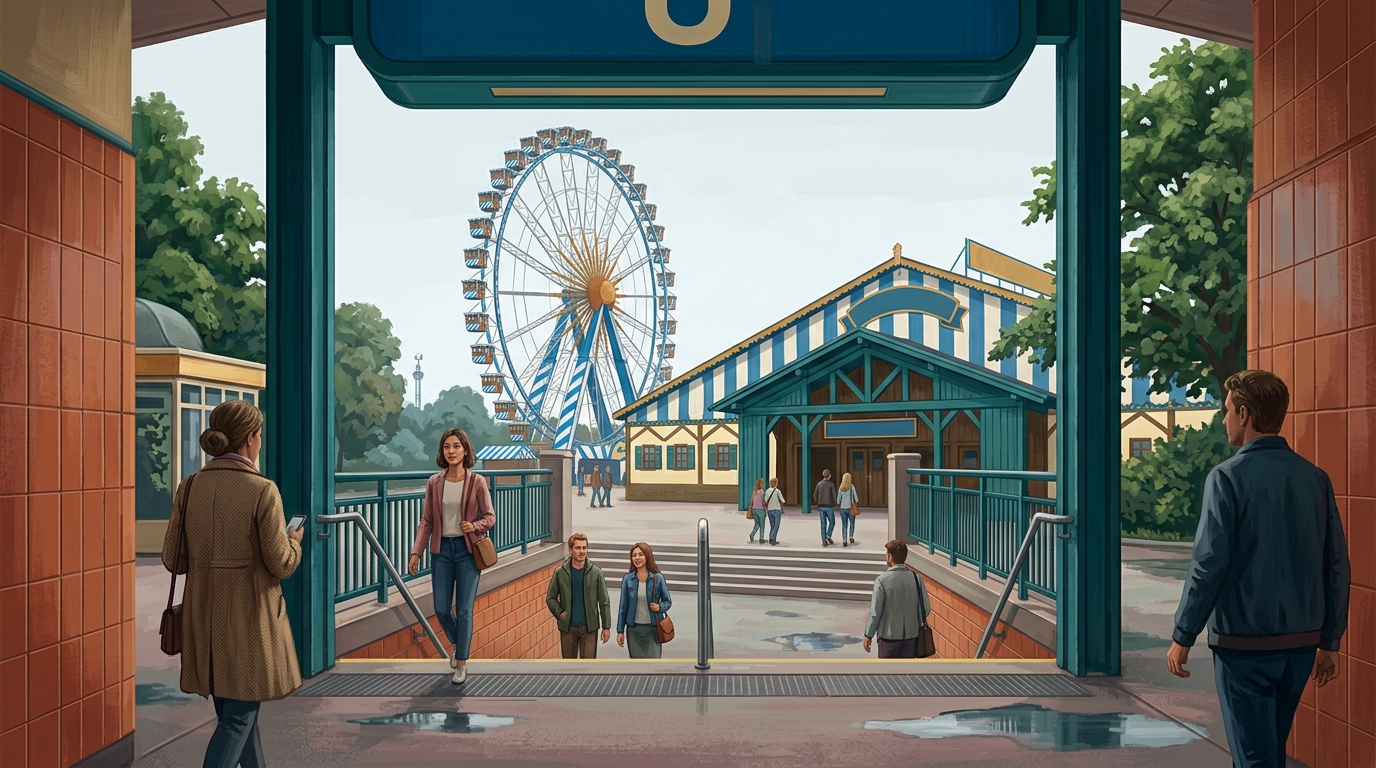
Take the U-Bahn and skip the obvious stop. The Theresienwiese station on the U4 and U5 sits right at the grounds but is a crush, especially evenings and weekends. The muenchen.de transport guide points walk-ins to the quieter alternatives instead: Poccistrasse on the U3 and U6 is "relatively quiet, about 10 minutes walking distance", and Goetheplatz on the same lines is a normal-crowd, 10-minute walk. A Zone M day ticket runs 10.10 euros, and from January 2026 children ride free on the single day ticket.
| Station | Lines | Walk | Crowd |
|---|---|---|---|
| Theresienwiese | U4, U5 | At the grounds | Heaviest |
| Poccistrasse | U3, U6 | ~10 min | Quiet |
| Goetheplatz | U3, U6 | ~10 min | Normal |
| Hackerbrucke (S-Bahn) | S-Bahn | ~10 min | Normal |
Lodging is where Oktoberfest budgets break. Rooms within walking distance of the Theresienwiese spike during the festival and sell out months ahead, so do not chase a bed beside the grounds. Munich's U-Bahn and S-Bahn run late and reach the whole city, which means a hotel or hostel four or five stops out, or near the Hauptbahnhof, costs a fraction of a Wiesn-adjacent room and adds 15 quiet minutes to your commute. Book as early as you can; the festival dates are fixed years in advance.
If Oktoberfest is one stop on a bigger autumn trip, line up the rest while you are at it. Our roundup of Europe's 2026 events and festivals is built the same way: dates, free options, and the costs that catch people out. If a city break is on the list too, our Vienna Eurovision 2026 budget guide runs the same numbers for Austria's capital.
What to wear and what to bring
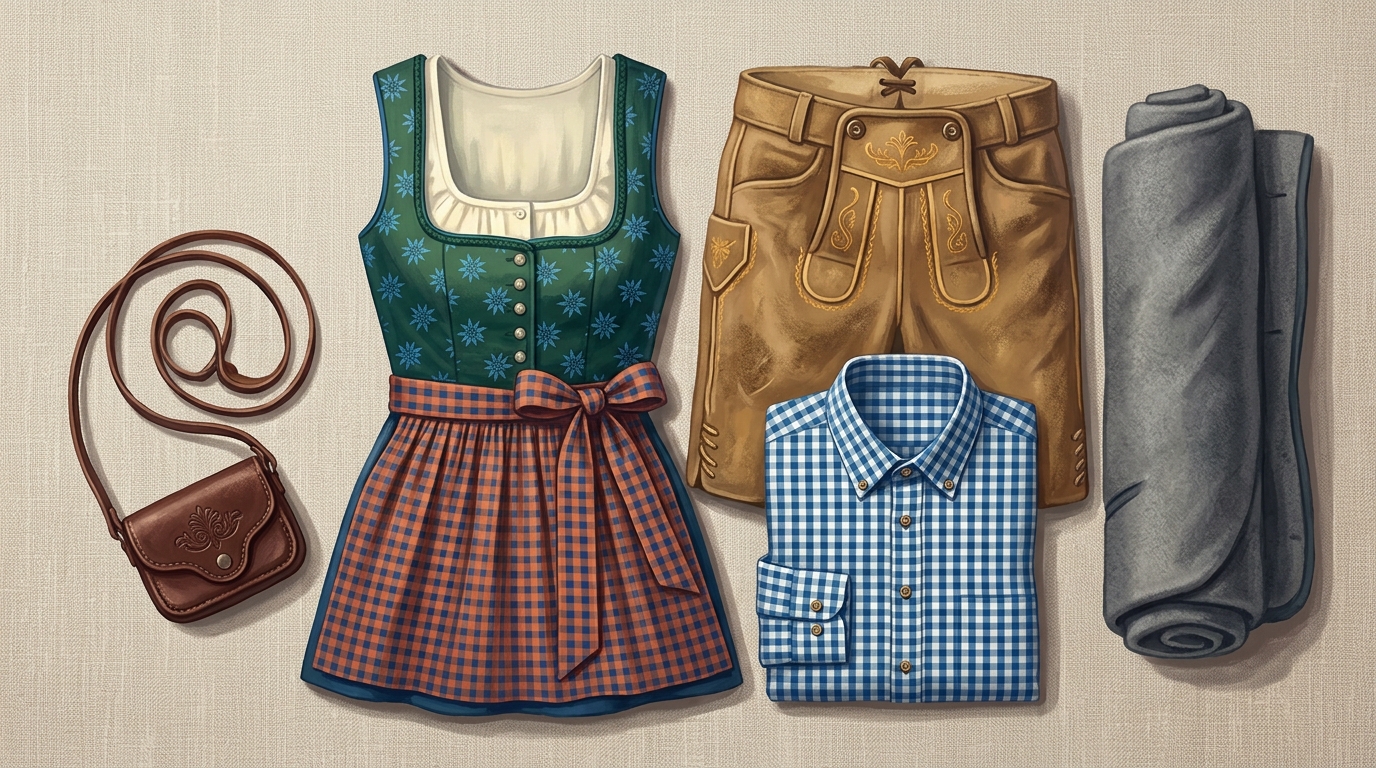
You do not need a costume, but most people wear one, and you can buy it the day you arrive. Lederhosen and dirndl shops cluster around Munich's centre and the Hauptbahnhof, with full outfits from budget to designer. A simple dirndl or a pair of lederhosen with a checked shirt is plenty. Skip the cheap polyester "party" versions if you want to blend in with locals rather than stag groups. Bring a warm layer too: late-September evenings in Munich get cold, and the gardens have no heating.
The bag rules are strict and enforced at the entrances, so pack light. The ban is the thing that trips up first-timers: backpacks and large bags are not allowed inside, and your bag can be no more than 3 litres in volume or 20 by 15 by 10 centimetres. No glass bottles, no weapons or anything that reads like one. If you turn up with a daypack, you will be sent to a paid luggage store at 5 euros and lose your spot in the queue.
- A bag under 3 litres (20 x 15 x 10 cm), or no bag at all
- Cash, more than you plan to spend, for table service and tips
- A fee-free travel card as backup
- A warm layer for the evening chill
- Comfortable, closed shoes you can stand in for hours
- Your hotel address saved offline
- Left at home: backpacks, glass bottles, anything sharp
Flying into Munich for it? Check your cabin bag against the latest limits before you pack, because they shifted again this year. Our guide to the 2026 EU hand-luggage rules covers what airlines now let you carry, so the bag drama happens at neither end of the trip.
Frequently Asked Questions
Can you go to Oktoberfest without a reservation?
Yes. Entry to the grounds and every beer tent is free and needs no ticket, and each large tent must keep a share of its seats unreserved: 25 percent on weekdays and 40 percent before 3 p.m. on weekends. A reservation only holds a table for a group on busy nights.
How do you get a seat if you did not book?
Arrive in the first hour after the tent opens, walk toward the sides and back where unreserved benches sit, and ask "Ist hier frei?" at a part-empty table. Table-sharing is normal. Order a Mass to hold your spot, since empty tables get cleared.
What time should you arrive, weekday versus weekend?
On a weekday, get in between the 10 a.m. opening and around 1 p.m. and a seat is close to guaranteed. On a weekend, treat the 9 a.m. opening as your start time, because tents can hit capacity and close their doors by mid-afternoon.
Is a reservation worth it for a couple or solo traveller?
No. Reservations are sold by the whole table of eight to ten with a minimum spend, so they only make sense for larger groups. A solo or couple gets the same beer and band by walking in early and sharing a bench, paying only for what they drink.
How much does Oktoberfest cost per day, and how much cash should I bring?
Budget roughly 100 to 150 euros per person per day inside the grounds before lodging: three to four beers, a chicken, snacks, and transport. Bring extra cash, because table service is cash-based and expects a small tip rounded up.
How much is a Mass of beer at Oktoberfest 2026?
A one-litre Mass costs 14.80 to 15.90 euros in 2026, an average of 2.38 percent more than 2025. The cheapest is at the Familienplatzl, and the priciest regular beers are at the Armbrustschutzen, Braurosl, and Lowenbrau tents.
Do you pay to get into the tents or the festival?
No. The grounds and both the large and small beer tents are free to enter with no ticket. The only paid entry is the historic Oide Wiesn at 4 euros, which is also free after 9 p.m. You pay only for food, drink, and fairground rides.
What should I wear, and what bag can I bring?
A dirndl or lederhosen is traditional but optional, and you can buy one in central Munich on arrival. Bring a warm evening layer. Your bag must be under 3 litres or 20 by 15 by 10 centimetres; backpacks and glass bottles are banned at the entrances.
Key Takeaways
- Oktoberfest 2026 runs 19 September to 4 October, and walking into the grounds and tents is free, with no ticket and no reservation required.
- By rule, 25 percent of each big tent's seats stay unreserved on weekdays and 40 percent before 3 p.m. on weekends, so seats always exist for walk-ins.
- Before noon on a weekday is the golden window; the first and last weekends after 3 p.m. are the times tents close their doors.
- Small tents and outdoor beer gardens are far easier for walk-ins than the 14 famous halls, weather permitting.
- For a reserved table on a peak night, use only the official face-value resale portal, never a random reseller.
- Plan 100 to 150 euros a day inside the grounds, with a Mass at 14.80 to 15.90 euros, and stay a few U-Bahn stops out to keep lodging affordable.
- A shared trip app like TripProf keeps a group's expenses, splits, hotel documents, and Munich plans in one place, so the money stays simple.
Sources
- Oktoberfest.de: Opening hours and 2026 dates: oktoberfest.de/en/information/oktoberfest-opening-times
- Oktoberfest.de: 2026 beer prices: oktoberfest.de/en/information/beer-price
- Oktoberfest.de: Table reservations and unreserved quota: oktoberfest.de/en/tents/reservations-oktoberfest
- Oktoberfest.de: Does it cost money to enter: oktoberfest.de/en/information/service-for-visitors/does-it-cost-money
- Oktoberfest.de: Security and bag rules: oktoberfest.de/en/information/service-for-visitors/security
- Oktoberfest.de: 2025 festival results: oktoberfest.de/en/magazin/oktoberfest-news/die-wiesn-2025
- Muenchen.de: How to get to Oktoberfest: muenchen.de/en/events/oktoberfest/how-get-oktoberfest
- Muenchen.de: Oktoberfest visitor FAQ: muenchen.de/en/events/oktoberfest/visitor-service/faq
- Oktoberfest-Booking.com: Official face-value resale portal: oktoberfest-booking.com/en
- Abendzeitung Munchen: 2025 food and beer prices: abendzeitung-muenchen.de Oktoberfest 2025 Preise
- Oktoberfest Today: Anti-scalping resale portal: oktoberfesttoday.com anti-scalping portal
- MVV Munich: Single day ticket fares: mvv-muenchen.de single day ticket
Last updated: August 28, 2026
Keep Reading
More travel tips and guides picked for you
8 best day trips from Vienna by train, ranked by travel time
No car needed. Eight real day trips from Vienna by train, ranked from a 21-minute hop to a full day at Hallstatt, with real 2026 prices, journey times, and an honest downside for each stop.
The ETIAS Canada delay: what actually changes for your Europe trip
ETIAS's 2026 launch date is gone, with no replacement confirmed. Here's exactly what changes for Canadians heading to Europe right now, and how to spot the fake ETIAS Canada sites already cashing in on the confusion.

How to Book an Alaska Cruise for the 2027 Season
Princess and Norwegian want final payment 120 days out. Carnival wants it at 91. Here's the real deadline calendar, the Seattle vs. Vancouver decision, and how a multi-generational family actually books this together.