Your First International Trip With Kids (2026 Planning Guide)

Key Highlights
- 1
- 2
- 3
+4 more in the takeaways below
Four passport applications on the kitchen table. Your toddler just scribbled on one with a crayon. You're googling whether a 9-month-old actually needs their own passport. (Yes. Every person, every age.)
Planning your first international trip with kids can feel like project-managing a space launch, except the astronauts eat crayons and need naps every three hours. what New Year's Eve 2027 actually costs But it's genuinely not as hard as the internet makes it sound. Most of the stress comes from not knowing which details matter and which ones you can skip.
We learned this firsthand traveling through Portugal with two kids under five. The color-coded spreadsheet lasted exactly one day. What actually worked was knowing the paperwork deadlines, the flight logistics, and one simple scheduling rule that kept everyone sane.
Here's everything we wish someone had told us: documents, flights, costs, gear, and that scheduling rule.
Start passports 3 months early ($135 per child, both parents must appear in person). Lap infants fly internationally for roughly 10% of the adult fare. Budget €100-200/day for a family of 4 in Western Europe. Bring your own car seat; rental availability isn't guaranteed and rules vary by country.
What Documents Do Kids Need for International Travel?
Every person crossing an international border needs their own travel documents, including newborns. The requirements aren't complicated, but the timelines catch families off guard every year.
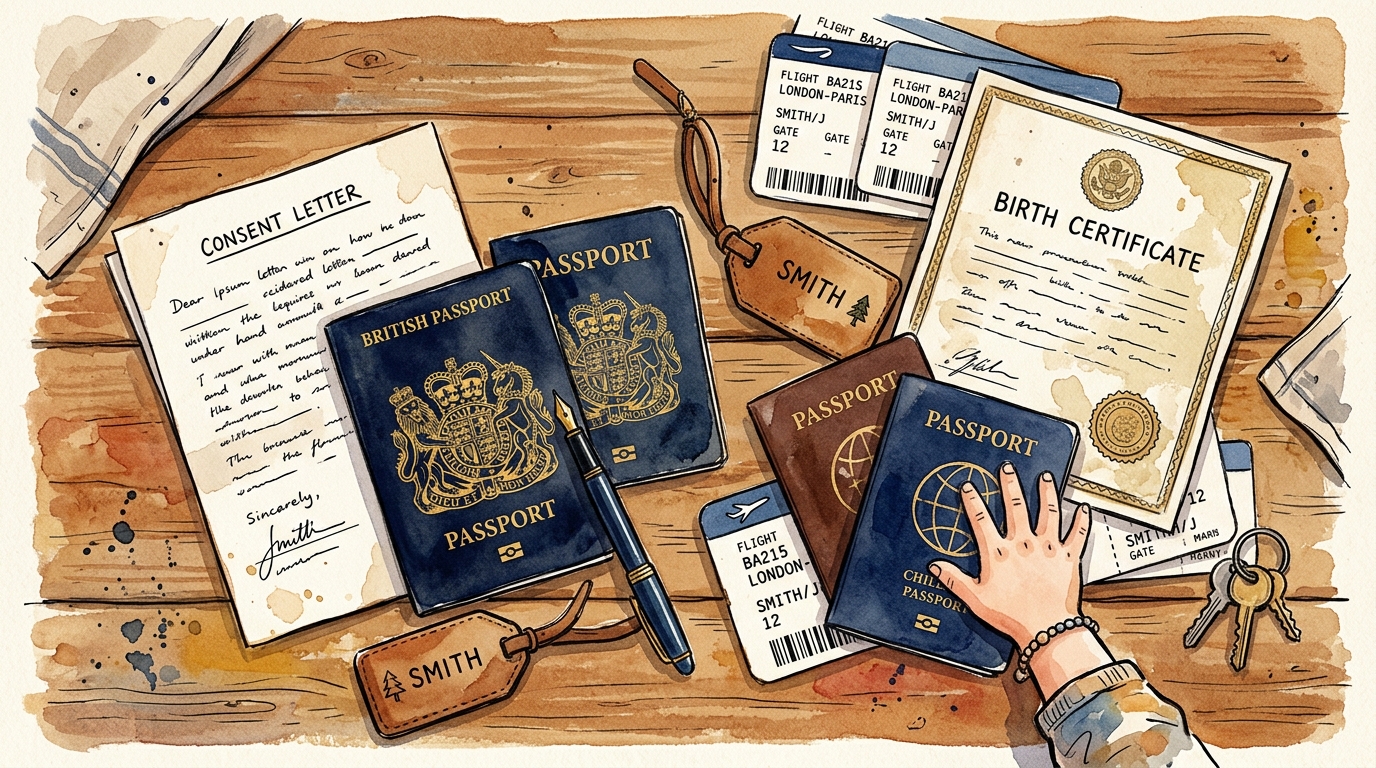
Passports for kids (US families)
A US passport for a child under 16 costs $135 as of 2026 ($100 application fee + $35 acceptance agent fee). Expedited processing adds $60. Here's the part that catches people: both parents must appear in person with the child at a passport acceptance facility. No exceptions unless the absent parent submits a notarized DS-3053 form (Statement of Consent) and a copy of their ID.
Processing takes 4-6 weeks for routine applications, as of March 2026. But that's processing time only. Add 2 weeks for mailing each way, and you're looking at 8-10 weeks door to door. Start this 3 months before your trip.
Children's passports are valid for 5 years (not 10 like adults). And Schengen countries (most of Europe) require at least 3 months of passport validity beyond your planned departure date, plus the passport must have been issued within the last 10 years. A passport expiring in October won't work for a trip ending in August. As a safety buffer, aim for 6 months of validity, since some airlines enforce stricter rules than the legal minimum.
The 3-month-beyond-departure passport rule catches families every year. Check your children's passport expiration dates before booking anything. A passport that's technically "valid" can still get you turned away at the gate.
If you're traveling from an EU country, passport rules for intra-EU travel are simpler. Check your national foreign ministry for child documentation requirements specific to your citizenship.
Traveling without the other parent?
If one parent is traveling alone with the kids, carry a consent letter signed by the non-traveling parent. It's not legally required for leaving the US, but border agents in destination countries may ask for it. Mexico and Brazil legally require a notarized version. Check the specific requirements for your destination before traveling.
The letter should include the child's full name and date of birth, both parents' names and contact information, trip dates and destinations, and a clause authorizing emergency medical decisions. Canada's government publishes a solid template you can adapt for most countries.
Our travel document checklist for 2026 covers every document families need, with specifics on REAL ID, ETIAS, and Global Entry.
ETIAS: the new EU entry requirement
The European Travel Information and Authorization System is expected to launch in late 2026, with a grace period likely pushing mandatory compliance into 2027. When it goes live, every visa-exempt traveler needs one. Infants included.
The fee is waived for children under 18. Adults pay €20 (revised upward from the original €7 in July 2025). Check the EU's official ETIAS page for the latest launch status before booking.
Don't skip the pediatrician
The CDC recommends scheduling a travel medicine appointment at least 4-6 weeks before departure for destination-specific vaccine recommendations. Infants 6-11 months may need an early MMR dose before international travel. EU families should also carry a valid GHIC (Global Health Insurance Card) for emergency medical coverage within the EU.
Flying Internationally With Kids
Children under 2 can fly on a parent's lap on most international flights for roughly 10% of the adult fare. On a $1,100 round-trip from New York to Paris, that's about $110 plus taxes. Not free, but a fraction of a full seat.
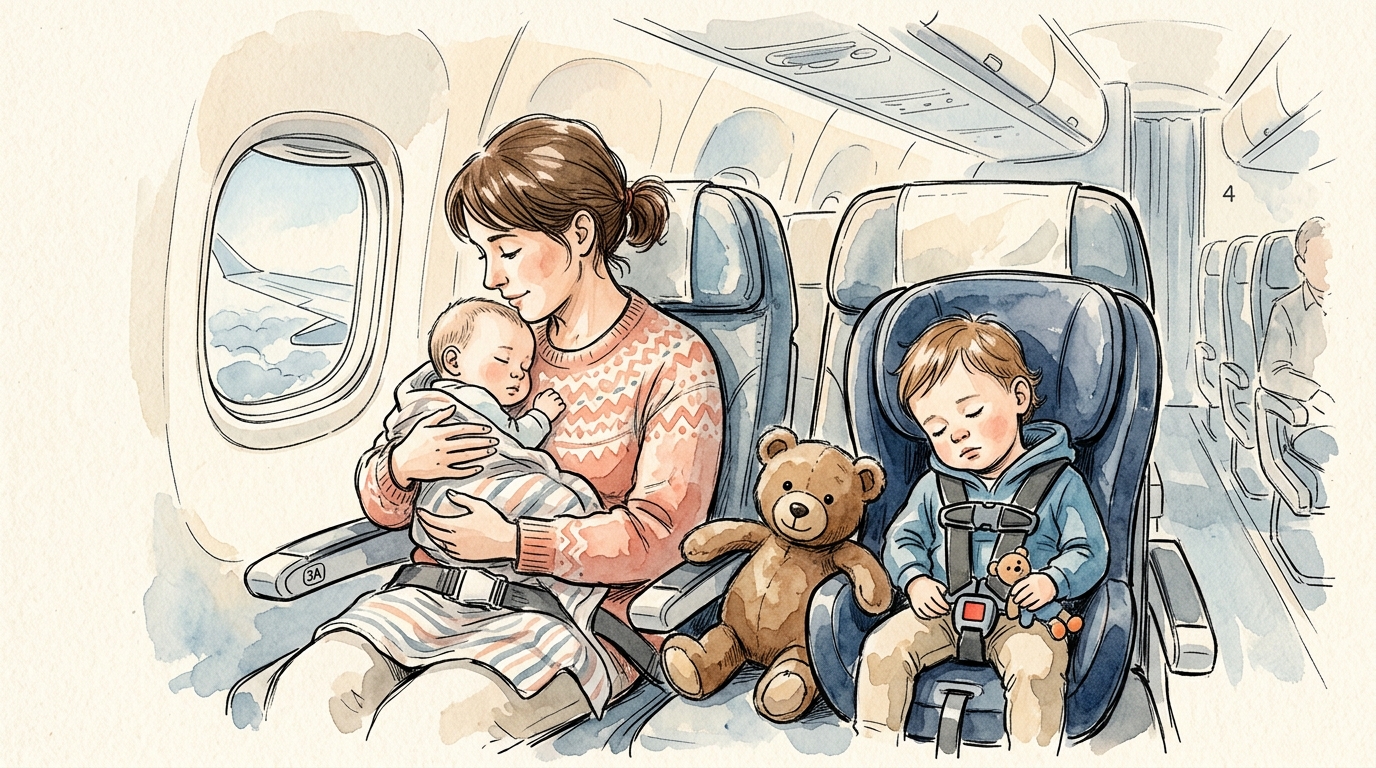
The birthday trap
Watch this one carefully. If your child turns 2 during the trip, you'll need a full-fare ticket for the return flight. Airlines enforce the age cutoff on the date of each individual flight, not the booking date. A family we know booked a round-trip to Rome with their 23-month-old as a lap infant, then got hit with a $900 surprise ticket for the flight home three weeks later.
Check your dates twice.
Lap vs. own seat
The FAA recommends children fly in an approved car seat rather than on a lap. It's safer, and toddlers sleep better in something familiar. You can check a car seat for free on most airlines. It doesn't count against your baggage allowance.
If you don't want to haul a full car seat through the airport, the CARES harness (approximately $75 as of 2026) is an FAA-approved alternative that fits in a daypack.
Seat selection by age
| Age | Best Seat Strategy |
|---|---|
| 0-12 months | Bulkhead row (request bassinet on long-haul flights), parent in window seat |
| 1-3 years | Window seat with car seat installed, parent in middle |
| 4-7 years | Window seat (entertainment + wall to lean on for sleep) |
| 8+ | Any seat works at this age |
Book seats as early as possible. Bulkhead bassinets are limited to 2-3 per flight and go fast. If you've made common first-timer flight mistakes before, at least this time you'll have the seating figured out.
What a Family Trip to Europe Actually Costs
Those flight numbers aren't a typo. A family of 4 with two full-fare children spends $800-1,200 per person on transatlantic flights alone, as of spring 2026. One family documented their 2-week trip to Italy and Greece at $13,770 for 6 people, roughly $2,295 per person including flights, accommodation, food, and activities. The FTA/NYU 2025 Family Travel Survey puts the average US family travel spend at $8,052 per year, so a Europe trip is a significant chunk of that.

Where the money actually goes
Accommodation typically eats around a third of your budget. Here's where families get smart: book apartments or apart-hotels with kitchens. Breakfast and half your dinners at "home" can save €50-80 per day compared to eating every meal out. In Lisbon during shoulder season, a decent 2-bedroom apartment runs approximately €100-150/night. A comparable hotel room (just one room) costs the same or more.
So for two weeks in Western Europe, a realistic daily budget lands around €150 beyond flights and accommodation, covering food, local transport, activities, and the inevitable gelato stops.
How to bring that number down
Fly shoulder season (May or September-October) and save 20-35% on flights and accommodation. Consider Portugal, Croatia, or Slovenia over France and Switzerland. Eastern and Southern Europe run 40-60% cheaper per day. The FTA/NYU 2025 survey found that 73% of families cite affordability as their top travel concern. Shoulder season is the single best answer to that.
Traveling with extended family or grandparents? Our guide on splitting costs fairly across households keeps the budget transparent and the relationships intact.
Getting Around Europe With Kids: Car Seats, Strollers, and Taxis
Every European country requires children to ride in appropriate car seats, but the rules differ more than you'd expect. Here's what you're dealing with, as of 2026:
| Country | Requirement | Key Detail |
|---|---|---|
| France | Under 135cm | Children under 10 must ride in the rear seat |
| Germany | Under 12 or under 150cm | One of the highest cutoffs in Europe |
| Italy | Under 150cm or under 36kg | Anti-abandonment alarm required for under 4s |
| Spain | Under 135cm | Must ride in rear seat; front seat only after age 12 or 150cm |
| Portugal | Under 12 or under 135cm | Fines of €120-600 per child for violations |
Source: EU Road Safety, Swandoo
Italy stands out: since November 2019, any car seat for a child under 4 must include an anti-abandonment alarm device. Rental companies usually provide this, but if you're bringing your own seat, you'll need a compatible sensor (approximately €40-75 on Amazon.it, though the Italian government offers a €30 rebate).
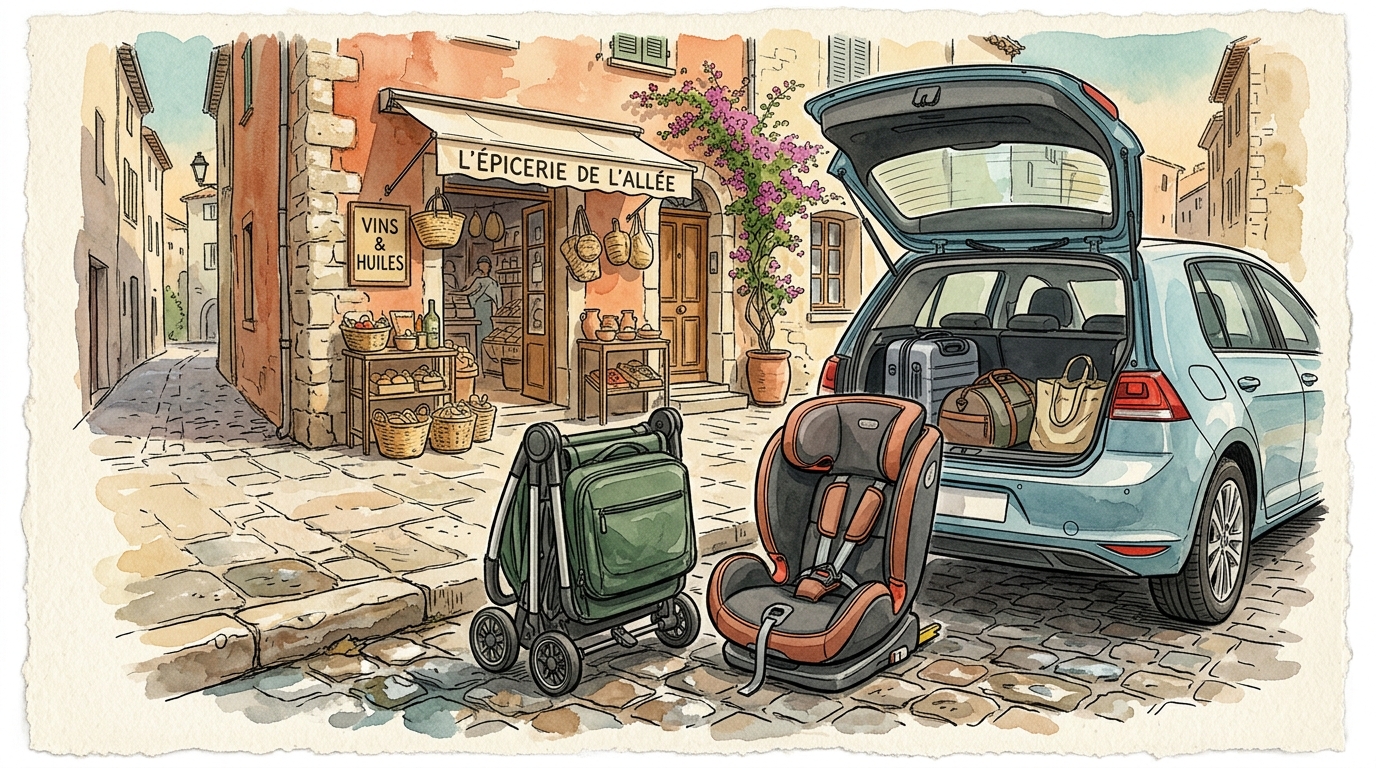
Bring your own or rent?
Bring your own. That's our position, and here's why:
- Airlines check car seats for free
- Your child knows the seat (less fussing)
- Guaranteed availability, even in peak season
- You trust the safety standard
- No hauling through airports
- €7-13/day adds up fast (€98-182 for two weeks)
- Availability isn't guaranteed in summer
- Unknown brand, fit, and condition
The trade-off is hauling it through the airport, but that beats strapping your kid into a mystery seat at midnight after an 8-hour flight.
Taxis in most EU countries are legally exempt from car seat requirements. That's both a relief for airport transfers and a reason to keep cab rides short once you have your rental car and proper seats installed.
Strollers on cobblestones
Skip the heavy jogging stroller. Cobblestone streets in Rome, Lisbon, and Prague will wreck your wrists and your wheels. A lightweight, compact travel stroller handles European streets and folds small enough for overhead bins on trains. For babies under 12 months, a structured carrier is more practical than any stroller on uneven terrain.
When you tell TripProf you're traveling with kids, it personalizes your entire planning experience. Your packing checklist adds age-appropriate items like car seats, carriers, and portable blackout blinds. Your travel guide highlights kid-friendly activities and restaurants at your destination. It's the difference between generic advice and a plan that fits your actual family.
The One Rule That Saves Every Family Trip
One big thing per day. That's it.

Every experienced family traveler says the same thing. Every first-timer ignores it. You've spent thousands getting to Rome, and you want to see everything. So you schedule the Colosseum, the Vatican, Trastevere, and the Borghese Gallery all in one day. By 2 PM someone is crying on the Spanish Steps.
It might be the toddler. It might be you.
One museum, one landmark, one neighborhood per day. Fill the rest with parks, gelato, grocery store adventures, and whatever the kids wander toward. The trip doesn't need to be a highlight reel. The best family travel memories almost always come from the unplanned hours.
Jet lag with kids is real
Plan for 2-3 adjustment days at the beginning. Get everyone outside in natural sunlight as soon as you arrive. Don't schedule anything ambitious on day one. A playground near your hotel and an early dinner is the perfect first afternoon.
Your 3-year-old will wake up at 4 AM for the first few days. Accept it. Pack snacks for those dark early hours.
Let the kids lead (a little)
Give each child one activity pick per city. A 6-year-old who chose the Natural History Museum in London is a different traveler than one who was dragged there. Buy-in matters more than you'd think.
And pack familiar snacks for the first 48 hours. Not every European restaurant is set up for kids, and trying to find food at 5:30 PM in Spain (where locals eat dinner at 9) is its own kind of adventure. For more on what to bring and what to leave behind, our breakdown of packing hacks that actually work covers the strategy side. Traveling with pets as well as kids? Our pet travel checklist for Europe handles that overlap.
The FTA/NYU 2025 Family Travel Survey found that 74% of parents now involve children ages 7-18 in choosing and planning vacations. Kids who help plan are more invested in the experience.
Frequently Asked Questions
Do babies need a passport to fly internationally?
Yes. Every US citizen needs their own passport for international travel, including newborns. Apply at least 3 months before your trip. Processing takes 8-10 weeks including mail time, and costs $135 for children under 16 (as of 2026).
Can I travel internationally with my child without the other parent?
You can leave the US without extra documentation, but carry a notarized consent letter from the other parent. Some countries (Mexico, Brazil) legally require it. Border agents in Europe may ask, especially if you have different last names than your child.
Do children need their own seat on international flights?
Children under 2 can fly as lap infants for about 10% of the adult fare on international routes. The FAA recommends a car seat in their own purchased seat for safety. Children 2 and older must have a full-fare ticket with their own seat.
What is ETIAS and does my child need one?
ETIAS is the EU's upcoming travel authorization for visa-exempt travelers, expected in late 2026. Children need their own authorization, but the fee is waived for those under 18. Adults pay €20.
Do I need a car seat in Europe?
Yes. All EU countries require child restraints, but height and age cutoffs vary (as of 2026). Germany's rule extends to under 12 or 150cm. Bring your own car seat. Airlines check them for free, and rental availability is unreliable in peak season.
Is travel insurance worth it for families?
A 14-day family policy for Europe costs approximately €120-190. It covers trip cancellation, medical emergencies, and evacuation. A single ER visit in Europe without insurance can run €500 or more. With kids, unexpected illnesses are a matter of when, not if.
What age is best for a child's first international trip?
There's no perfect age. Babies are portable but need frequent stops. Toddlers (2-4) are the toughest age for travel logistics. Kids 5 and up start genuinely enjoying and remembering destinations. Don't wait for the "right" age. It doesn't exist.
Key Takeaways
- Start passports at least 3 months early. Both parents must appear in person with the child. Cost: $135 per child, with 8-10 weeks total processing (as of 2026).
- Lap infants fly internationally for ~10% of the adult fare, but if your child turns 2 during the trip, you'll owe a full ticket for the return flight. Check your dates.
- Budget €100-200/day for a family of 4 in Western Europe, plus $3,200-4,800 for round-trip flights. Shoulder season and kitchen-equipped accommodation are your best cost levers.
- Bring your own car seat. Rules vary by country (Germany requires one up to age 12 or 150cm), rentals aren't guaranteed in summer, and airlines check car seats for free.
- Follow the "one big thing per day" rule. Over-scheduling is the single most common mistake on first family trips abroad.
- Pack a consent letter if traveling without the other parent, snacks for the first 48 hours, and a change of clothes for everyone in your carry-on. Schedule a pediatrician visit 4-6 weeks before departure.
- TripProf personalizes your travel guide when you add kids to your trip - from age-appropriate packing lists and kid-friendly activity suggestions to document checklists and day-by-day itineraries built around your family's pace.
Your kids won't remember the passport office or the car seat logistics. They'll remember the gelato, the park with the pigeons, and the morning you all had croissants on a balcony overlooking terracotta rooftops.
Sources
- FTA/NYU 2025 Family Travel Survey - family travel spending, affordability statistics
- US Department of State - passport fees, processing times, child requirements
- EU ETIAS Official FAQ - authorization requirements, fees, and launch timeline
- EU Road Safety - child passenger safety regulations
- Squaremouth - travel insurance cost benchmarks for Europe
- A Mom Explores - real family trip cost breakdown (Italy and Greece)
- CDC Yellow Book - travel health recommendations for children
Last updated: July 3, 2026
Keep Reading
More travel tips and guides picked for you

What counts as visiting a state? Layovers, drive-throughs and the rules 50-staters use
Only 2% of Americans name a plane change as the minimum that counts as visiting a state, while 27% set the bar at driving through. Here's a three-tier rubric, a lookup table for the edge cases from Four Corners to D.C., and one trip counted three ways.

The fake SBB ticket website stealing credit card and Twint data from travelers
Zurich cantonal police confirmed a fake SBB ticket website is stealing credit card and Twint payment details from travelers who find it through an ordinary Google search. Here is how to spot it and what to do if you already paid.

UK ETA scam warning: fake websites are charging Austrians up to €900
Fake UK ETA websites are charging Austrian and EU travellers hundreds of euros for a form that costs £20. Here's how the real one works, and how to spot a scam before you pay it.