The Pet Travel Checklist for Europe You Actually Need (2026)
Key Highlights
- 1
- 2
- 3
+5 more in the takeaways below
Your vet says everything's in order. The airline confirmed the carrier fits under the seat. You're at Schiphol with your terrier, boarding pass in hand, feeling prepared.
Then the border vet asks about the tapeworm treatment.
You didn't know the Netherlands doesn't require one. But your connecting flight to Helsinki does. Finland is one of five European countries with a mandatory Echinococcus treatment, and the window closed two days ago. Your dog isn't getting on that plane.
That's how pet travel in Europe falls apart. Not because the rules are hard, but because every country layers its own requirements on top of the EU baseline. This pet travel checklist for Europe puts them all in one place. So you don't learn the hard way.
Rules change. Always verify requirements with your vet and your destination's official veterinary authority before booking.
Start prep 3-4 months before travel, not 21 days. EU residents need a Pet Passport (€15-50, reusable). Non-EU travelers need an Animal Health Certificate (€80-300 per trip, single-use). Microchip MUST come before the rabies vaccine. Reverse it and the 21-day clock resets. Five countries require tapeworm treatment 1-5 days before arrival. Ryanair, EasyJet, and British Airways don't allow pets at all.
The Timeline Nobody Warns You About
The "21-day rule" for pet travel to Europe is real. It's also wildly incomplete. Twenty-one days is just the rabies vaccine waiting period, one step in a process that realistically takes 3-4 months from start to departure. And you're not alone in underestimating it: over 25% of pet owners who flew with their pet in 2025 were doing it for the first time.
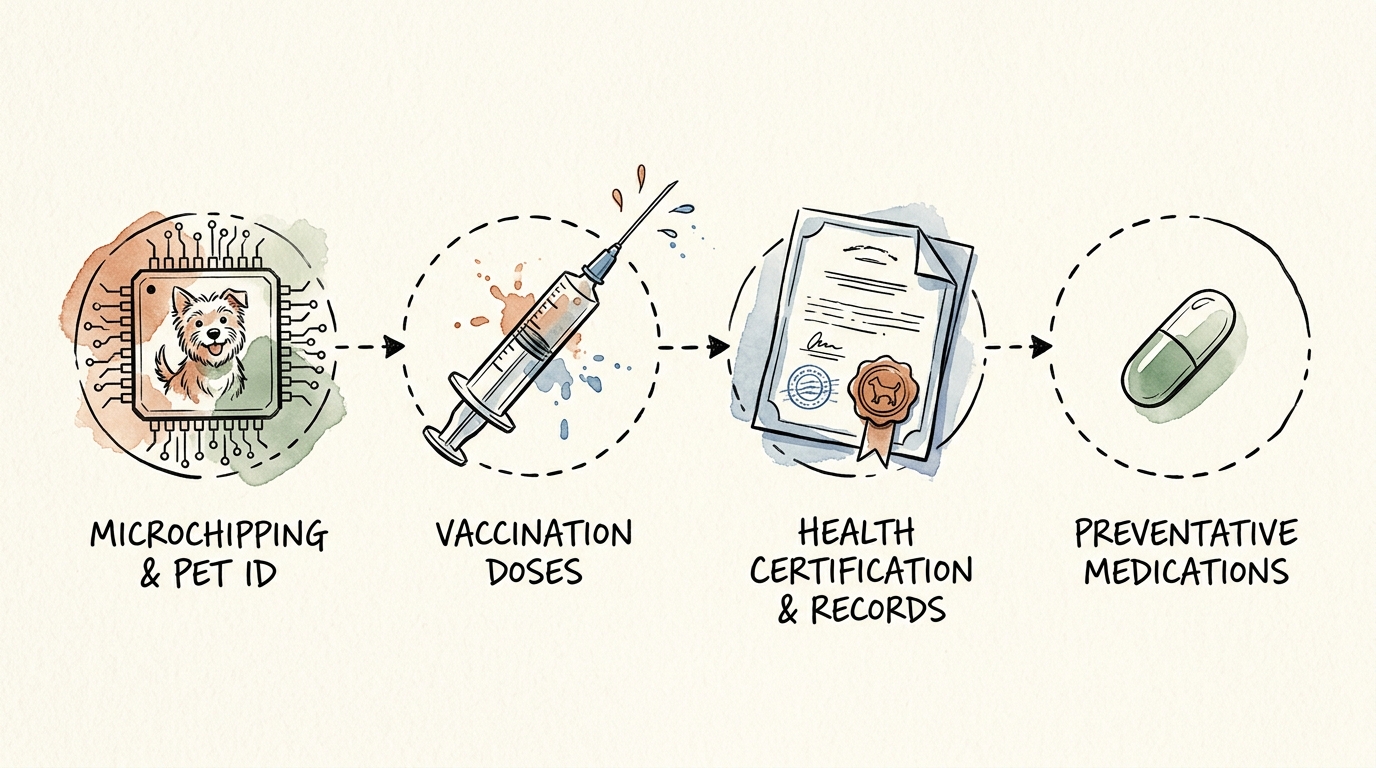
4 months before: Microchip. Get an ISO 11784/11785 chip (the 15-digit kind operating at 134.2 kHz). Based in the US? Check whether your pet already has an AVID chip (125 kHz, 9 or 10 digits). European border scanners can't read those. You can have both implanted side by side. They don't interfere.
3 months before: Rabies vaccination. Your pet must be at least 12 weeks old. And here's the fact that derails more pet travel plans than any border regulation: the microchip must be implanted BEFORE the rabies vaccine. Reverse the order and that vaccination doesn't count. Full stop. Re-vaccinate, restart the 21-day wait. Your vet can confirm the exact sequence and timing for your pet's breed and age.
10 days before departure: Official health documentation. EU residents update their Pet Passport with a vet visit. Non-EU travelers get an Animal Health Certificate from an official state vet. In the US, that means a USDA APHIS endorsement at $38 per certificate on top of the vet's fee.
1-5 days before arrival: Tapeworm treatment, if heading to Finland, Ireland, Malta, Norway, or Northern Ireland. More on the exact timing window later. It's tighter than you'd think.
As of April 21, 2026, the new EU regulation (2016/429, replacing 576/2013) didn't add new requirements. It removed forgiveness. Paperwork errors that used to slide through informal border checks now trigger actual delays. And non-EU travelers can no longer use a Pet Passport for initial entry. AHC only.
Pet Passport vs Animal Health Certificate
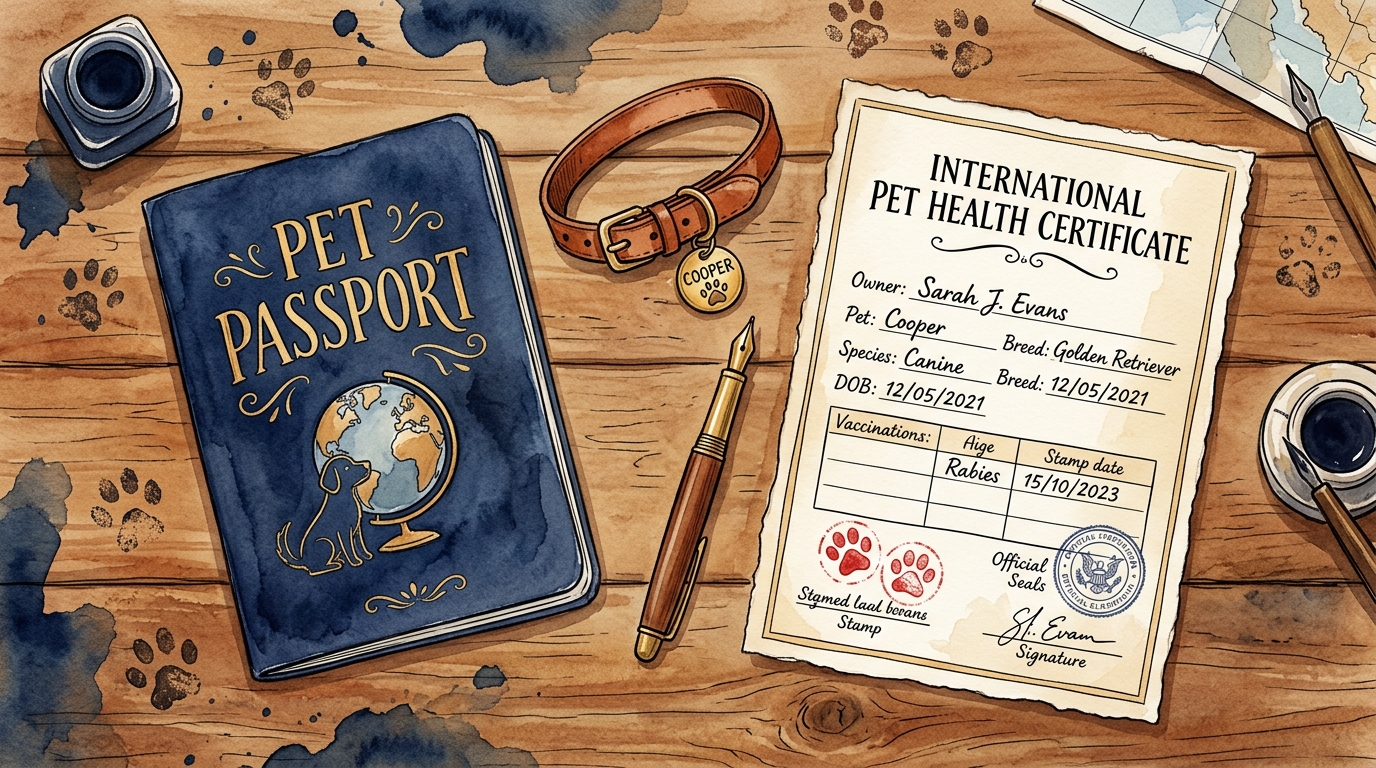
If your pet lives in the EU, you need an EU Pet Passport, a reusable booklet that costs €15-50 and lasts your pet's lifetime. Coming from outside the EU? You need an Animal Health Certificate. It costs more, it's single-use, and the timing is unforgiving.
| EU Pet Passport | Animal Health Certificate (AHC) | |
|---|---|---|
| Who needs it | EU/EEA residents | Non-EU travelers (UK, US, Canada, etc.) |
| Validity | Reusable, lifetime | 10 days for EU entry, then 4 months intra-EU |
| Cost | €15-50 (one-time) | €80-300 per trip |
| Issued by | Any authorized EU vet | Official state vet in departure country |
| Contents | Microchip, rabies record, owner ID | Same + health declaration, non-commercial statement |
Coming from the UK? Budget ~£220-250 (~€260-295) per AHC. From the US? It's $510-1,100 (~€470-1,010) including the mandatory USDA endorsement. The price gap between "EU resident with a €30 passport" and "American with a $800 health certificate" is the kind of thing that makes you seriously consider pet-sitting.
Here's what trips people up: the AHC is single-use. Fly from New York to Paris, spend two weeks in Europe, fine. But leave the EU for a side trip to the UK and come back? You need a fresh AHC for re-entry.
And there's a rule buried in the fine print. Under "non-commercial" pet travel, you or an authorized person must travel within 5 days before or after your pet. Miss that window and your pet legally becomes a commercial shipment. Different forms, different fees, much more headache.
The Country-by-Country Gotchas
Europe isn't one set of pet rules. It's 30+ countries layering their own requirements on top of the EU baseline. The microchip-rabies-health-cert trio gets you into the EU. What happens inside each country is where plans unravel.
Tapeworm Treatment - The 5-Country Gotcha
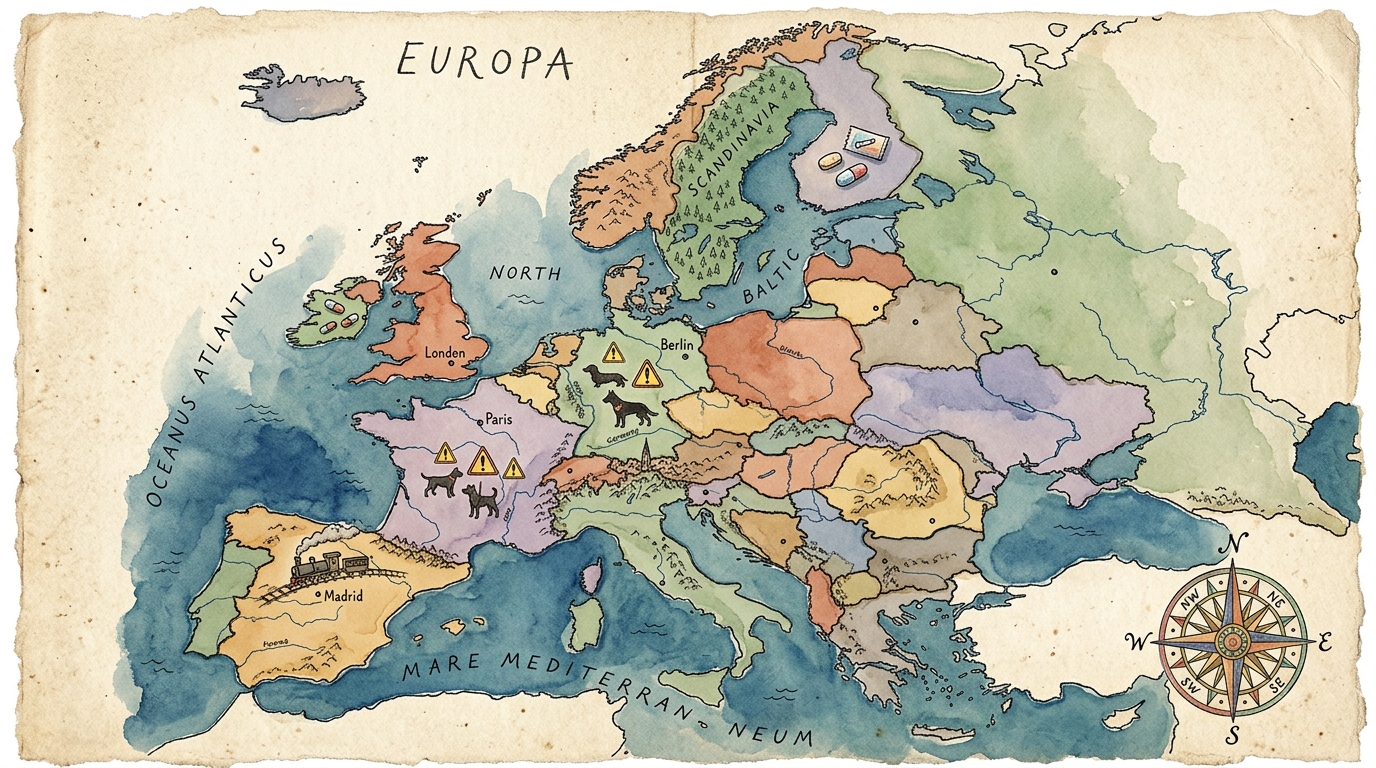
Five countries require Echinococcus treatment for dogs: Finland, Ireland, Malta, Norway, and Northern Ireland. Cats and ferrets? Exempt.
The timing is exact. Treatment must happen between 24 and 120 hours before arrival. Not "a few days before." Not "roughly this week." Your vet needs to record the exact date and time, and the border vet will check both numbers.
Schedule the treatment 72 hours (3 days) before your arrival date. That gives you buffer in both directions: enough time for the drug to take effect, safely within the 120-hour maximum. If travel plans shift by a day, you're still in range.
Breed Restrictions by Country
| Country | What to know |
|---|---|
| Germany | Pit Bull, Am. Staff, Staff. Bull Terrier, Bull Terrier banned federally. Additional breeds vary by state. |
| France | Category 1 (banned): Pit Bull types without pedigree. Category 2 (restricted): Rottweiler, pedigreed Staffordshire (muzzle + permit required). |
| Denmark | Several breeds restricted (check Denmark's official breed list before traveling). All dog owners must carry liability insurance. |
| Norway | Certain breeds require a police permit for import. |
| Spain | No outright bans, but "potentially dangerous" breeds need a license + insurance. |
| Italy | No national breed bans since 2009. Venice restricts Rottweilers and Dobermans in some areas. |
And one transport quirk catches people off guard: most Renfe trains in Spain still cap pets at 10 kg. The exception? Select AVE high-speed routes (Madrid-Barcelona, Madrid-Malaga, and five others) now allow dogs up to 40 kg for €35, but your dog needs an adjacent seat booking, and only ~100 weekly trains qualify. If your Lab's route isn't on the AVE list, you're renting a car.
Sorting your own travel documents at the same time? Our travel document checklist for 2026 covers passports, ETIAS, and everything humans need alongside their pets.
Getting There - Airlines, Trains, and Ferries
Your transport choice decides everything: cost, stress level, and whether your pet can even come along. Three of Europe's biggest budget carriers (Ryanair, EasyJet, and Wizz Air) don't allow pets at all. Not in cabin, not in the hold. Guide dogs only. Here's who does (as of March 2026). Fees are approximate and subject to change:
| Airline | Cabin? | Limit | Fee | Hold? |
|---|---|---|---|---|
| Air France | Yes | 8 kg | ~€125 | Yes |
| Lufthansa | Yes | 8 kg | ~€70 | Yes |
| Eurowings | Yes | 8 kg | €40-75 | Yes |
| Vueling | Yes | 8 kg | €50-60 | No |
| ITA Airways | Yes | 10 kg (30 kg on select domestic!) | ~€73 | Yes |
| KLM | No | - | - | Cargo only |
| British Airways | No | - | - | Cargo only |
| Ryanair | No | - | - | No |
| EasyJet | No | - | - | No |
Worth watching: ITA Airways is testing 30 kg cabin limits on designated domestic Italian flights starting summer 2026. No other European carrier offers this. If you're flying within Italy with a medium-sized dog, book early. Capacity is limited to about 6 large pets per flight.
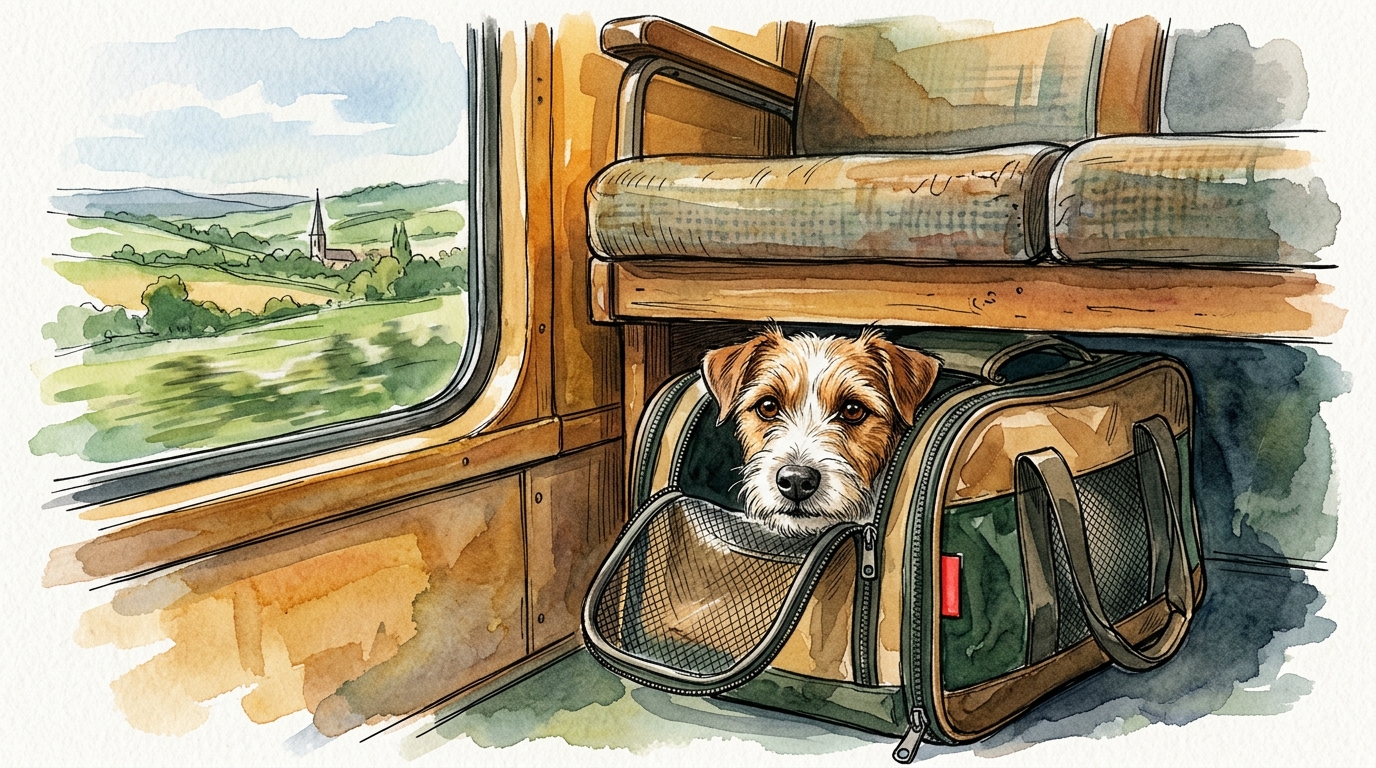
Trains are the cheapest option in most countries. On SNCF in France, small pets under 6 kg ride free in a carrier on TGV and Intercités trains. Larger dogs on a lead pay €10. TER regional trains charge €7 for any pet. Deutsche Bahn lets small dogs ride free and charges large dogs half an adult ticket. Trenitalia is similarly affordable.
Spain's Renfe is more complicated than most guides let on. Most train types cap pets at 10 kg, but select AVE high-speed routes now accept dogs up to 40 kg for €35 (adjacent seat required). Check the specific route before assuming your dog can't go.
Eurostar has a split personality. Continental routes (Paris-Amsterdam, France-Germany, France-Belgium) allow pets: €30 for large dogs, free for small ones in carriers. But UK routes, the Brussels-Lille connection, and "Sun and Snow" ski services? Blanket ban on all pets except guide dogs. No change in 2026 despite years of petitions.
Ferries work best for drivers. Le Shuttle through the Channel Tunnel takes 35 minutes. Pets stay in the car, no fuss. DFDS and Stena Line offer pet-friendly cabins on overnight UK-to-Netherlands routes. Greek island ferries expanded pet cabin capacity by 30% for the 2026 season (Go-Ferry).
And if budget isn't the constraint? BARK Air launched four new European routes in 2026 (Dublin, Stockholm, Athens, Berlin) but at $7,850+ (~€7,200) per ticket covering one dog and one human, that's a different conversation entirely.
Planning your first international trip? Our guide to the 15 mistakes that catch first-timers covers what goes wrong for humans, too.
Five Mistakes That Catch Everyone
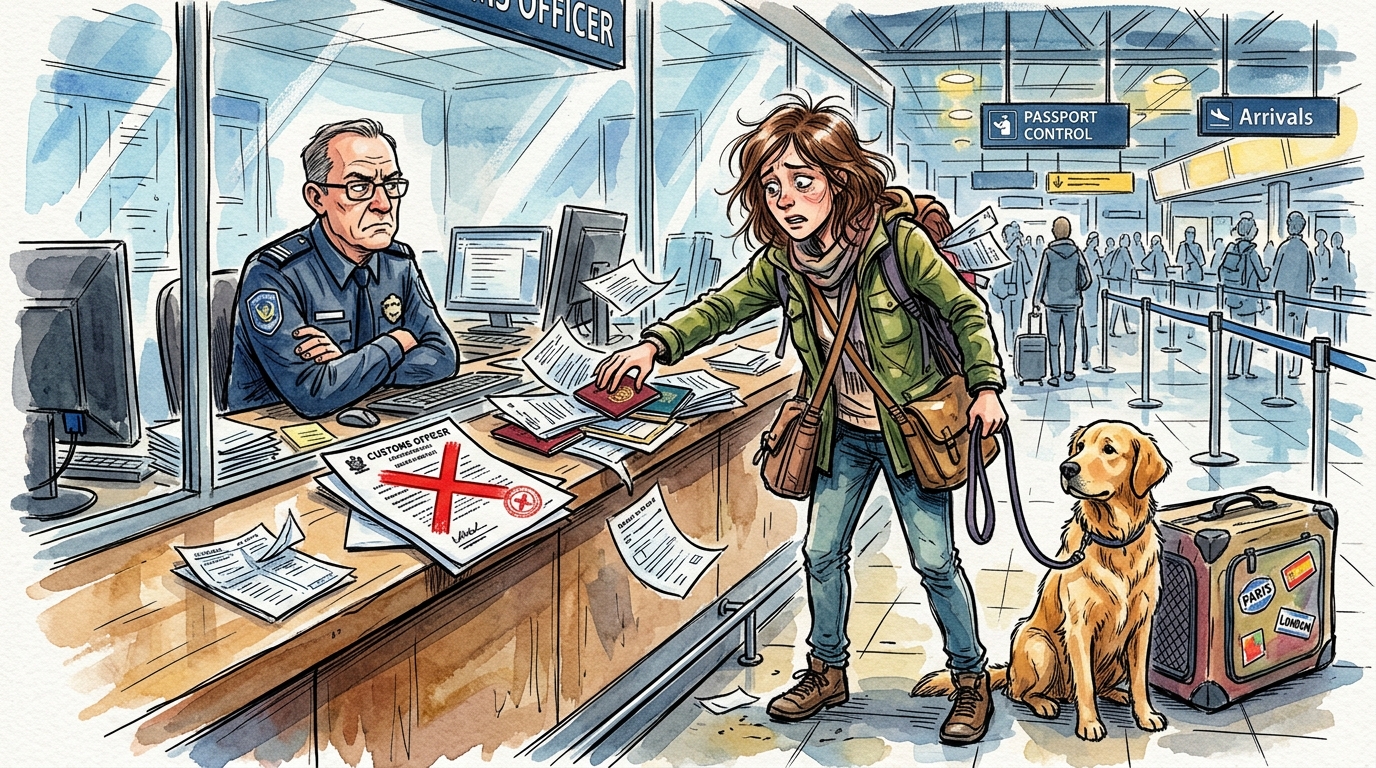
We added pet travel sections to TripProf after a friend's corgi got held at Frankfurt airport for three hours over a microchip-vaccine sequencing error. Most pet travel disasters aren't exotic. They're scheduling errors and wrong assumptions. Here are the five that come up again and again.
1. The Microchip-Vaccine Flip
Your vet vaccinates first, chips second. Two procedures in the same visit. Seems harmless. It's not. The EU requires the chip to be in place before the vaccine. Reverse the order and that vaccination record isn't linked to any identification. Re-vaccinate, restart the 21-day wait. This single mistake has probably delayed more pet travel timelines than any actual border regulation.
2. The 10-Day Crunch
The AHC must be issued no more than 10 days before EU arrival. Schedule the vet too early and a flight delay pushes you past the window. Too late and your vet's booked. Aim for 5-7 days before departure. Enough margin for rebooking, tight enough to stay valid.
3. The Tapeworm Clock
24 to 120 hours. That's the window. Schedule the treatment six days out? Invalid. Twelve hours before? Also invalid. Your vet needs to record the exact date AND time of administration. Border officials check both.
4. The Wrong Chip
Does your pet's chip read 10 digits at 125 kHz? European scanners need 15 digits at 134.2 kHz. You're arriving with an effectively unidentified animal. Get an ISO chip implanted alongside the existing one. They coexist without issues.
5. The Breed Surprise
Your dog is "mostly Lab" but the mixed-breed paperwork lists Staffordshire Terrier. At the German border, that word matters. Different countries define "dangerous breeds" differently, and some officers have discretion. Check your destination's breed list before booking anything.
Some trip planning apps generate per-destination pet travel guides: entry requirements, nearby vet clinics, pet-friendly parks, even local boarding options tailored to your specific city. TripProf covers this, which can save hours of country-specific research before you go.
And while you're prepping, our packing guide might free up some bag space for your pet's travel kit.
Frequently Asked Questions
Do I need a pet passport or animal health certificate?
EU residents use a reusable Pet Passport (€15-50). Non-EU travelers need a single-use Animal Health Certificate (€80-300 per trip), issued no more than 10 days before arrival. Since April 2026, non-EU travelers can no longer use a Pet Passport for initial EU entry.
Which airlines allow pets in the cabin in Europe?
Air France, Lufthansa, Eurowings, Vueling, ITA Airways, Iberia, and Transavia allow cabin pets under 8 kg with carrier (as of March 2026). Ryanair, EasyJet, British Airways, KLM, and Wizz Air don't allow cabin pets at all. ITA Airways is testing 30 kg cabin limits on select domestic Italian flights in summer 2026.
Can my dog travel on trains in Europe?
In most countries, yes. SNCF (France) lets small pets ride free and charges €10 for larger dogs. Deutsche Bahn (Germany) lets small dogs ride free. Spain's Renfe caps most trains at 10 kg but allows dogs up to 40 kg (€35) on select AVE high-speed routes. Eurostar allows pets on continental routes but bans them on UK, Brussels-Lille, and ski routes.
What is the 21-day rule for pet travel?
After your pet's first rabies vaccination, you must wait 21 days before travel. The microchip must be implanted before the vaccine. Reverse the order and the vaccination doesn't count, restarting the 21-day clock from the new vaccination date.
Which European countries ban certain dog breeds?
Germany bans Pit Bulls, Am. Staffs, Staffordshire Bull Terriers, and Bull Terriers federally, with additional restrictions by state. France has a two-category system. Denmark, Norway, and Spain have varying restrictions. Italy has had no national breed bans since 2009.
Do cats need tapeworm treatment for European travel?
No. The Echinococcus treatment is required for dogs only. Cats and ferrets are exempt across all five countries that enforce it: Finland, Ireland, Malta, Norway, and Northern Ireland.
Is pet travel insurance required in Europe?
No European country requires it, but it's worth considering. A vet visit abroad can run €200-500+ without coverage, and standard travel insurance policies rarely cover pets. Look for a pet-specific add-on or standalone policy if your pet has health conditions or you're crossing multiple borders.
Key Takeaways
- Start preparing 3-4 months before travel, not 21 days. The vaccine wait is just one step in a much longer process.
- Microchip MUST be implanted before the rabies vaccine. Wrong order = restart the entire timeline.
- EU residents use a reusable Pet Passport (€15-50). Everyone else needs a single-use Animal Health Certificate (€80-300 per trip).
- Five countries require tapeworm treatment 1-5 days before arrival: Finland, Ireland, Malta, Norway, Northern Ireland. Dogs only. Cats and ferrets are exempt.
- Check breed restrictions before booking. Germany, France, and Denmark have lists that might include your dog.
- Budget airlines (Ryanair, EasyJet, Wizz Air) don't accept pets at all. Plan flights around pet-friendly carriers.
- Trains are the cheapest way to travel with pets in Europe (free to €10 in most countries). Spain's Renfe is limited but expanding AVE routes for larger dogs.
- Trip planning tools with built-in pet travel sections, like TripProf, can pull up destination-specific entry requirements, local vets, and pet-friendly parks before you go.
Your dog's already packed. Now make sure the paperwork is, too.
Sources
- Paws Abroad - EU pet travel rules April 2026, airline policies, AHC guide
- Your Europe (europa.eu) - Official EU pet travel regulations
- Pet Abroad - EU Pet Passport, airline cabin policies, country requirements
- Travelnuity - European airlines and trains pet policies
- Go-Ferry / Amadeus - Pawprint Economy statistics 2026
- Seat61 - Dogs on European trains, country-by-country policies
- Paws Abroad Cost Guide - Health certificate costs by country, including USDA endorsement fees
- Finnish Food Authority - Echinococcus tapeworm treatment requirements
- Amadeus Travel Trends 2026 - First-time pet flyer statistics, Pawprint Economy report
- Renfe - Official pet policy for Spanish trains, AVE large-dog routes
- Market Report Analytics - Pet travel services market size and forecast
Last updated: July 3, 2026
Keep Reading
More travel tips and guides picked for you

What counts as visiting a state? Layovers, drive-throughs and the rules 50-staters use
Only 2% of Americans name a plane change as the minimum that counts as visiting a state, while 27% set the bar at driving through. Here's a three-tier rubric, a lookup table for the edge cases from Four Corners to D.C., and one trip counted three ways.

The fake SBB ticket website stealing credit card and Twint data from travelers
Zurich cantonal police confirmed a fake SBB ticket website is stealing credit card and Twint payment details from travelers who find it through an ordinary Google search. Here is how to spot it and what to do if you already paid.

UK ETA scam warning: fake websites are charging Austrians up to €900
Fake UK ETA websites are charging Austrian and EU travellers hundreds of euros for a form that costs £20. Here's how the real one works, and how to spot a scam before you pay it.